Why a Vacation Rental Business Directory Beats Google
A vacation rental business directory is a curated, niche-specific listing platform that organizes short-term rental service providers, cleaners, property managers, photographers, revenue managers, by market and category, so operators can find vetted vendors without wading through generic search results built for every industry at once. That distinction matters more in 2026 than it did five years ago, because the STR service stack has gotten more specialized, not less.
At the regiSTR, we built our directory because we watched too many hosts burn hours on Google Maps trying to figure out which "professional cleaning company" three miles from their property had ever actually handled a same-day Airbnb turnover. Google doesn't know the difference. A dedicated STR directory does.
- A vacation rental business directory filters providers by STR-specific category (cleaning, co-hosting, photography, revenue management) rather than generic "home services" tags Google uses for every local business.
- Professional vacation rental managers now control roughly 42% of global short-term rental listings as of early 2026, a sign that operators are increasingly turning to specialized management rather than piecing together vendors ad hoc.
- The global vacation rental market is projected to reach USD 109.4 billion in 2026, growing to an estimated USD 136.78 billion by 2031, according to Mordor Intelligence, meaning more hosts and more vendors are entering a space Google was never built to organize.
- Directories built for one vertical maintain provider accuracy through referral and vetting mechanisms, while Google search results and Maps listings rely on self-reported business categories that rarely distinguish an STR-experienced vendor from a general contractor.
- Service providers relying solely on general directories or pay-per-lead platforms compete against every home service business in their zip code, not just other STR specialists.
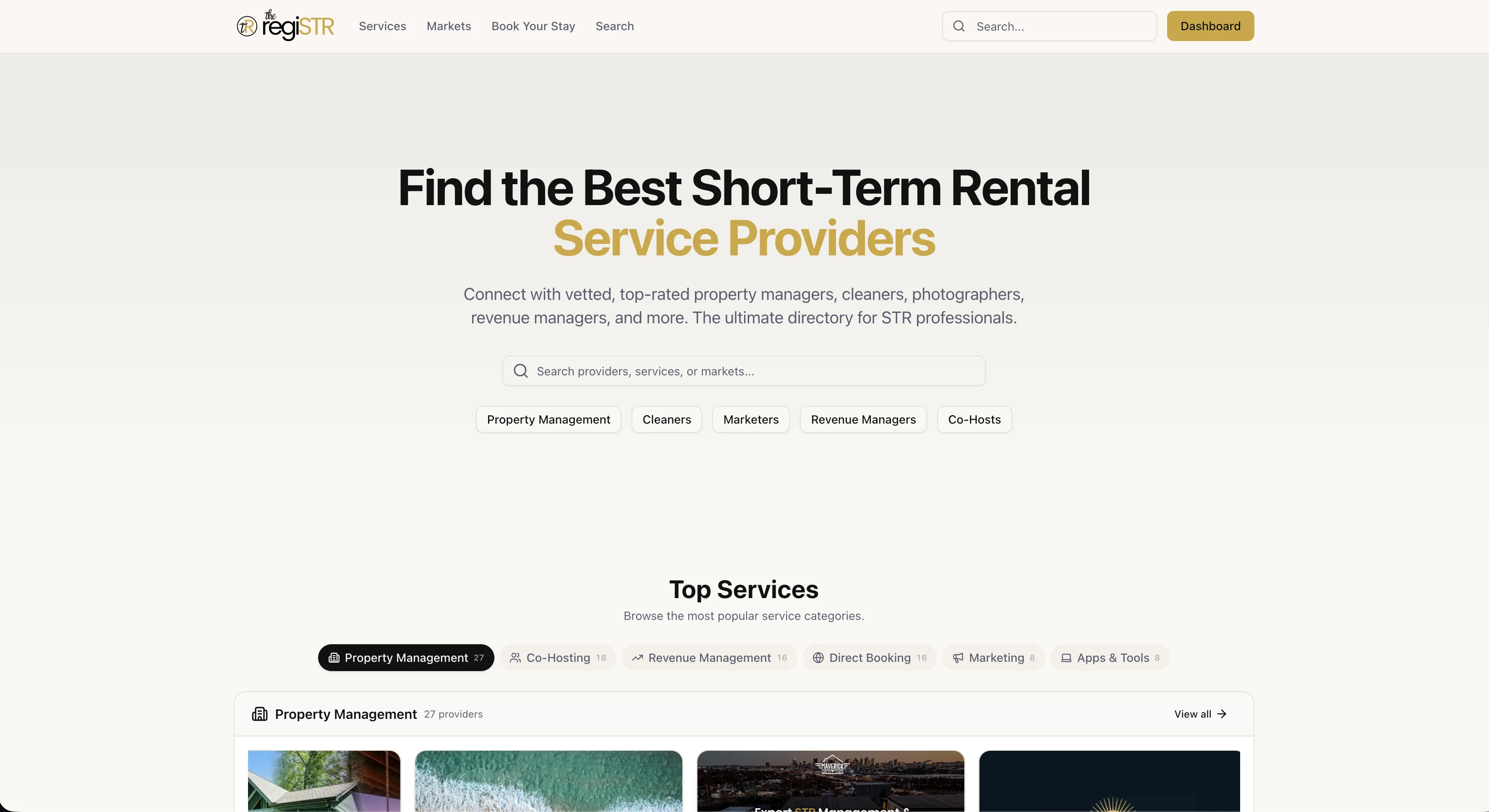
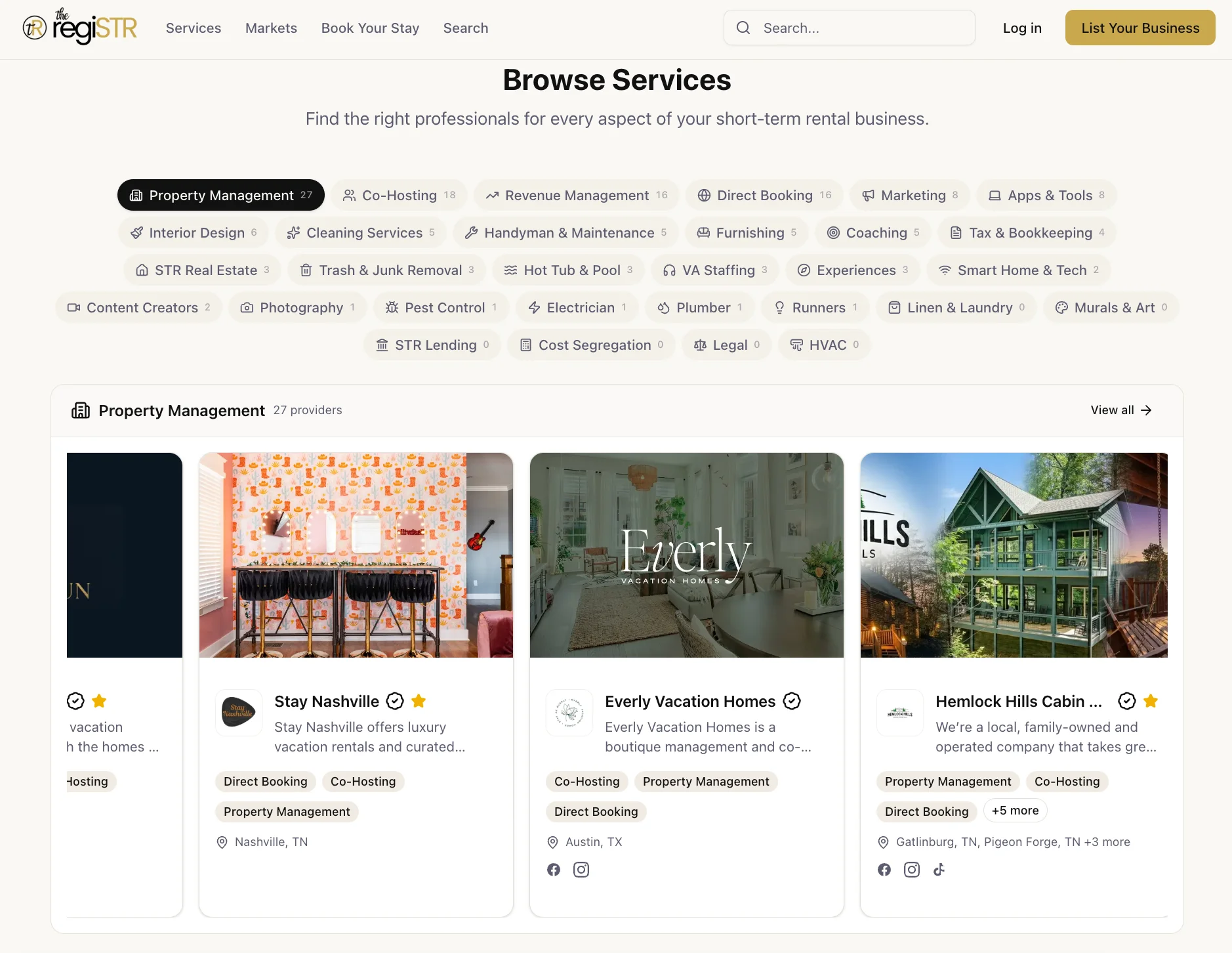
- The regiSTR solves this by organizing providers into Popular Markets and Top Services categories, so hosts search by exact need and providers get discovered by an audience already looking to hire STR vendors specifically.
If you've ever typed "vacation rental cleaner near me" into Google and scrolled past ten residential maid services before finding one that mentions Airbnb turnovers, you already understand the problem this article is solving. Generic search engines are built to answer every query type from every industry. They were never designed to distinguish a photographer who shoots weddings from one who understands OTA listing photography, or a property manager who handles long-term leases from one who runs same-day turnovers across a portfolio of short-term rentals.
This gap is exactly why a dedicated vacation rental business directory exists, and why it functions differently than a Google search or a Yelp listing. In the sections below, we'll walk through what a purpose-built STR directory actually does that general search cannot, how hosts and providers should evaluate one, and where the regiSTR fits into the broader marketing stack most operators are already using in 2026.
What Is a Vacation Rental Business Directory and How Does It Differ From Google?
A vacation rental business directory is a searchable database of service providers who work specifically within the short-term rental industry, organized by service category and geographic market rather than by general business type. Unlike Google, which indexes any business with a website or Google Business Profile, a niche directory requires providers to demonstrate STR-specific experience before being listed.
Google Maps and general search results treat a cleaning company the same whether it services hotels, offices, or Airbnb turnovers. A vacation rental directory, by contrast, organizes providers under categories like Cleaning and Turnover Services, Co-Hosting and Co-Management, or Photography and Virtual Tours, so the filtering happens before you ever start reading reviews.
Notably, the pattern we consistently see across the regiSTR network is that providers who join a specialized directory already understand terms like turnover window, comp set, and channel manager without explanation. That's not something a Google search result can filter for. Browse all STR services to see the category structure in action.

What Is the Best Vacation Rental Company for Owners?
There is no single "best" vacation rental company for every owner, because the right fit depends on portfolio size, market, and how hands-on you want to be. What matters more than any single company name is whether the provider has been vetted specifically for short-term rental operations, not general property management.
A first-time host with one property in a seasonal market has different needs than a scaling investor managing eight units across three states. For the first-time host, a co-host or boutique property manager who can be reached directly usually beats a large national franchise. For the scaling investor, a company with proven multi-property reporting and channel manager integration matters more.
What we look for when evaluating a management company listing on the regiSTR includes response time commitments, fee transparency, and whether the provider has been vouched for by other real operators, not just star ratings that can be manipulated. Full-service property management fees typically run on the higher end of the range in competitive, high-demand markets, and that cost only makes sense if the time and stress you're saving justifies it.
Hosts weighing this decision can compare STR property managers filtered by market directly, rather than relying on a Google search that mixes long-term rental management firms into the same results.
How Do Directories Maintain Data Accuracy Compared to Scraping Google Maps?
Directory data accuracy depends on how providers get listed in the first place. A directory built by scraping Google Maps or public business listings inherits every inaccuracy in those sources, including outdated phone numbers, closed businesses, and providers who never actually worked in short-term rentals.
A referral-gated model works differently. On the regiSTR, providers join by invitation from an existing network member, which means every new listing has already been touched by someone with real STR operating experience. That's a meaningfully different verification process than an algorithm crawling business category tags.
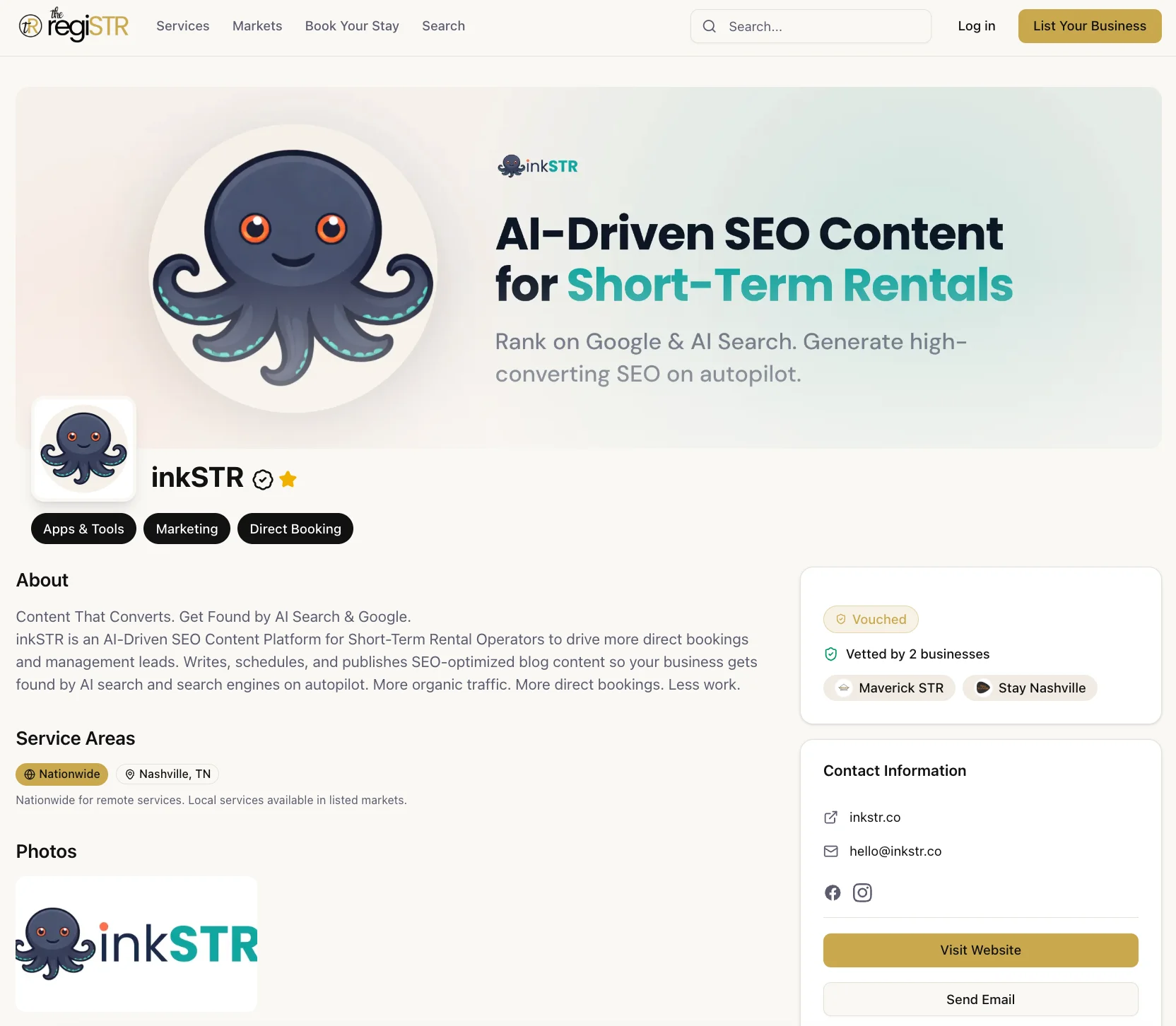
Additionally, the Vouch system lets STR operators publicly endorse a provider they've actually hired, attaching their name and context to the endorsement. This creates an accountability layer that anonymous star ratings, the kind you'd find scraping a general search results page, simply cannot replicate. A five-star rating from an anonymous account tells you nothing about whether that reviewer even managed a vacation rental.
As of 2026, the regiSTR also refreshes its Recently Added section continuously, surfacing new providers as they're invited into the network rather than relying on a static export that goes stale within months.
How Does a Directory Fit Into a Broader Vacation Rental Marketing Stack?
A vacation rental business directory functions as one layer in a larger operational stack that also includes channel managers, dynamic pricing tools, and direct booking websites. It is not a replacement for those tools; it is the discovery layer that connects you to the humans who build, run, and maintain them.
For example, a channel manager like Hospitable or Hostaway syncs your calendar across Airbnb and Vrbo, but it does not tell you who to call when your dynamic pricing needs an audit or your listing photos are underperforming. That's a vendor discovery problem, not a software problem, and it's the specific gap a directory closes.
Specifically, the regiSTR organizes this stack by service category: Revenue Management and Dynamic Pricing, SEO and Content Marketing, Website Design and Development, and Social Media Management all sit alongside operational categories like cleaning and maintenance. As a result, an operator building a direct booking strategy in 2026 can find both the STR-specific web developer and the STR-specific photographer in the same search, rather than piecing together a stack across five different tools and referral sources.
If OTA fees are eating into your margins, our guide to what an STR marketplace actually does breaks down how this fits into a direct booking strategy in more depth.
What Is the 75-55 Rule for Airbnb?
The 75-55 rule is a pricing and occupancy heuristic some STR operators use to evaluate whether their nightly rate strategy is balanced: targeting roughly 75% occupancy at a rate that still nets around 55% of gross revenue after major operating costs. It's a rough framework, not a universal standard, and different revenue managers apply variations of it.
The point of the rule isn't the exact numbers; it's the discipline of checking both occupancy and margin together instead of optimizing for one at the expense of the other. A property booked at 90% occupancy with rock-bottom nightly rates can still underperform a property at 65% occupancy priced correctly.
This is exactly the kind of strategic question a revenue management specialist earns their fee answering, and it's why we categorize Revenue Management and Dynamic Pricing separately from general property management on the regiSTR. Not every STR needs a dedicated revenue manager on day one, but once you're running multiple units or a seasonal market with sharp demand swings, the math usually justifies it.
What Is the 80 20 Rule for Airbnb?
The 80 20 rule, applied to short-term rentals, generally refers to the idea that roughly 80% of your booking revenue or guest satisfaction outcomes come from about 20% of your operational effort, typically concentrated in a handful of high-leverage decisions: pricing, listing photos, and turnover reliability.
In practice, this means a host who nails professional listing photography and a dependable cleaning schedule has already covered the majority of what drives repeat bookings and strong reviews, before ever touching guest communication scripts or amenity upgrades.
We see this pattern repeat across the provider categories in our network. Hosts who invest first in a vetted cleaner and a specialized photographer, rather than spreading a small budget across ten minor upgrades, tend to see the bigger jump in booking conversion. If your photos are underperforming, our guide to hiring a vacation rental photographer covers exactly what separates an STR specialist from a generalist shooter, and you can browse STR photographers directly by market.
What Is the Most Used Vacation Rental Website?
Airbnb and Vrbo remain the two most used vacation rental booking platforms among travelers, and most STR operators list on both to maximize visibility across OTA channels. But "most used" for booking is a different question than "most useful" for finding the vendors who keep those listings running.
Airbnb and Vrbo are guest-facing booking platforms, not vendor discovery tools. Neither platform helps you find a cleaner, a co-host, or a photographer, that's a gap general marketplaces were never built to fill, and it's a different problem than the one a vacation rental business directory solves.
Notably, as of 2026 the regiSTR functions as the vendor-side counterpart to those booking platforms: hosts already know where guests book, but they still need a dedicated resource for where to hire. That's the specific niche a service directory fills in the broader STR marketing stack, and it's one general search engines and even the booking platforms themselves don't address.
Directory Structure vs Google Search: A Side-by-Side Look
The table below compares how a dedicated vacation rental business directory differs structurally from a general Google search or Maps listing, across the criteria that matter most to STR operators and service providers.
| Criteria | General Google Search / Maps | Vacation Rental Business Directory |
|---|---|---|
| Provider vetting | Self-reported business category, no STR-specific screening | Referral-gated onboarding; providers invited by existing network members |
| Search filtering | Broad "home services" or "cleaning services" categories | STR-specific categories: cleaning, co-hosting, revenue management, photography |
| Social proof | Anonymous star ratings, easily gamed | Named peer endorsements (Vouch system) from real operators |
| Geographic organization | Proximity-based, mixes residential and commercial services | Popular Markets pages segmented by STR-active metros |
| Data freshness | Listings can go stale for years without correction | Recently Added section refreshed as providers join the network |
| Audience intent | Mixed: homeowners, businesses, travelers, all query types | Exclusively STR operators actively seeking service providers |
What Should Hosts Look for When Vetting Providers in a Directory?
Vetting a service provider found through a vacation rental business directory still requires due diligence, the directory narrows the field, it doesn't eliminate the need to ask good questions. Start with STR-specific experience: has this provider handled a same-day turnover, or only standard residential cleans?
Next, check for peer endorsements over star counts. A provider vouched for by name by another operator carries more weight than an anonymous five-star average, since you can see exactly who is vouching and often what market they operate in.
- Confirm the provider serves your specific market, not just a broad regional area.
- Ask about guaranteed turnaround windows for cleaning and maintenance categories.
- Request references from other STR operators, not general residential clients.
- Review fee structures upfront; management fees vary significantly by market and service tier.
- Check whether the provider understands channel manager syncing if the role touches booking calendars.
This is exactly the vetting criteria the regiSTR applies before a provider profile goes live, and it's the same checklist we'd recommend running yourself even after finding a promising listing.
How Should Service Providers Use a Directory to Find STR Clients?
For STR service providers, a vacation rental business directory functions as a lead generation channel where every visitor is already searching for a service like yours, not a homeowner comparing quotes for a one-off repair. That audience match is the core structural advantage over general directories and pay-per-lead platforms.
Providers on general home services directories compete against every business in their category regardless of niche fit. A cleaning company on a general platform is stacked against every residential maid service in the zip code. On an STR-specific directory, that same company only competes against other providers who understand turnover timelines and same-day scheduling.
That's exactly why providers list on the regiSTR: direct visibility to hosts in your market who are actively looking to hire, plus a public profile that builds credibility through Vouch endorsements rather than anonymous reviews. Providers exploring this path can review our short-term rental directory guide for a deeper walkthrough of the listing process, and can sign up free to claim a profile at theregistr.co.
What Content Gaps Do Most Vacation Rental Directories Leave Unaddressed?
Most vacation rental directories function as little more than searchable lists, businesses and categories, with almost no explanation of why that structure actually outperforms a general search engine. This leaves operators without a clear framework for evaluating whether a directory listing is trustworthy in the first place.
A directory that scrapes Google Maps for listings inherits every flaw of that data source: outdated contact information, closed businesses, and zero verification that a "cleaning company" has ever touched an Airbnb turnover. A referral-gated directory avoids this by requiring an existing network member to vouch for or invite a new provider before they're listed at all.
Additionally, most directory pages treat marketing and outreach as an afterthought, focusing entirely on the browse-and-search experience. But for service providers, the real value is in how a directory positions their profile for discovery: category placement, market tagging, and peer endorsement all function as ranking signals within the directory itself, not just external SEO factors.
Practical Guidance: How to Choose the Right Directory for Your STR Operation
Choosing a vacation rental business directory comes down to matching the platform's structure to your specific need, whether that's finding a vendor, listing your services, or scaling a multi-market portfolio. Prioritize directories organized by service category and market over generic aggregator sites.
- Common mistake: Assuming any directory with "vacation rental" in the name is STR-specific. Check whether providers are actually vetted for short-term rental experience, not just tagged as "property management."
- Trade-off to understand: Referral-gated directories have smaller initial provider pools than open directories, but the quality floor is significantly higher.
- Step-by-step for hosts: Identify your service category need, filter by your specific market, check for named peer endorsements, then contact two to three providers directly before committing.
- Step-by-step for providers: Confirm the directory serves your exact market and category, complete a profile with real portfolio details, and ask an existing client or peer to vouch for your work.
British and international operators researching alliance-level resources can also look at organizations like the British Columbia Short-Term Rental Association or the European Holiday Home Association for regional advocacy context, though these function as industry bodies rather than vendor directories.
Frequently Asked Questions
What is the regiSTR and how does it differ from general home services directories?
The regiSTR is an invite-only, STR-specific service directory that connects vacation rental hosts with vetted cleaners, property managers, photographers, and other providers. Unlike general home services directories, every visitor and every listed provider is specifically tied to short-term rental operations.
How do I find a vetted vacation rental cleaner in a market I don't live in?
Browse the regiSTR's Cleaning and Turnover Services category filtered by your specific market, and prioritize providers with named Vouch endorsements from other operators. Confirm the cleaner has handled same-day turnovers before, not just standard residential cleaning.
What should I look for when hiring a property manager for a short-term rental?
Look for response time commitments, transparent fee structures, and references from other STR operators rather than general landlords. Full-service property management fees typically run on the higher end in competitive markets, so weigh that cost against the time and stress it saves you.
How does the regiSTR's Vouch system work?
The Vouch system lets real STR operators publicly endorse a provider they've personally hired, attaching their name and operator context to the recommendation. This creates accountable, peer-verified social proof that anonymous star ratings cannot replicate.
What service categories are available in a vacation rental business directory like the regiSTR?
Categories typically include Full-Service Property Management, Cleaning and Turnover Services, Co-Hosting and Co-Management, Photography and Virtual Tours, Revenue Management and Dynamic Pricing, Interior Design and Staging, Maintenance and Repairs, and Regulatory and Compliance.
How can I list my STR service business on the regiSTR?
Sign up free at theregistr.co and complete the onboarding flow, which includes profile details, service categories, and markets served. Providers can also ask satisfied clients to vouch for their work to build credibility on their profile.
Is a vacation rental business directory available in every market?
The regiSTR organizes providers by Popular Markets across active short-term rental metros nationwide, with location-independent services like SEO, revenue management, and website design available to operators anywhere in the country.
Conclusion: Finding the Right Vendor Starts With the Right Directory
A vacation rental business directory beats a Google search because it filters for the one thing general search cannot: STR-specific experience, verified through referral and peer endorsement rather than self-reported categories. With professional managers now controlling roughly 42% of global STR listings and the market projected to top USD 109 billion in 2026, the vendor discovery problem is only getting bigger, not smaller.
Whether you're a first-time host looking for a reliable cleaner or a service provider trying to get found by operators who actually need what you offer, the fastest path runs through a directory built specifically for this industry, not a search engine built for every industry at once. Get started with the regiSTR and browse by market and category in under two minutes.

If you're tired of guessing which providers actually understand short-term rental operations, browse vetted STR service providers by market and category at theregistr.co/services. Sign up free and see why the regiSTR was built to be the vendor discovery layer Google was never designed to be.
Content powered by inkSTR.co