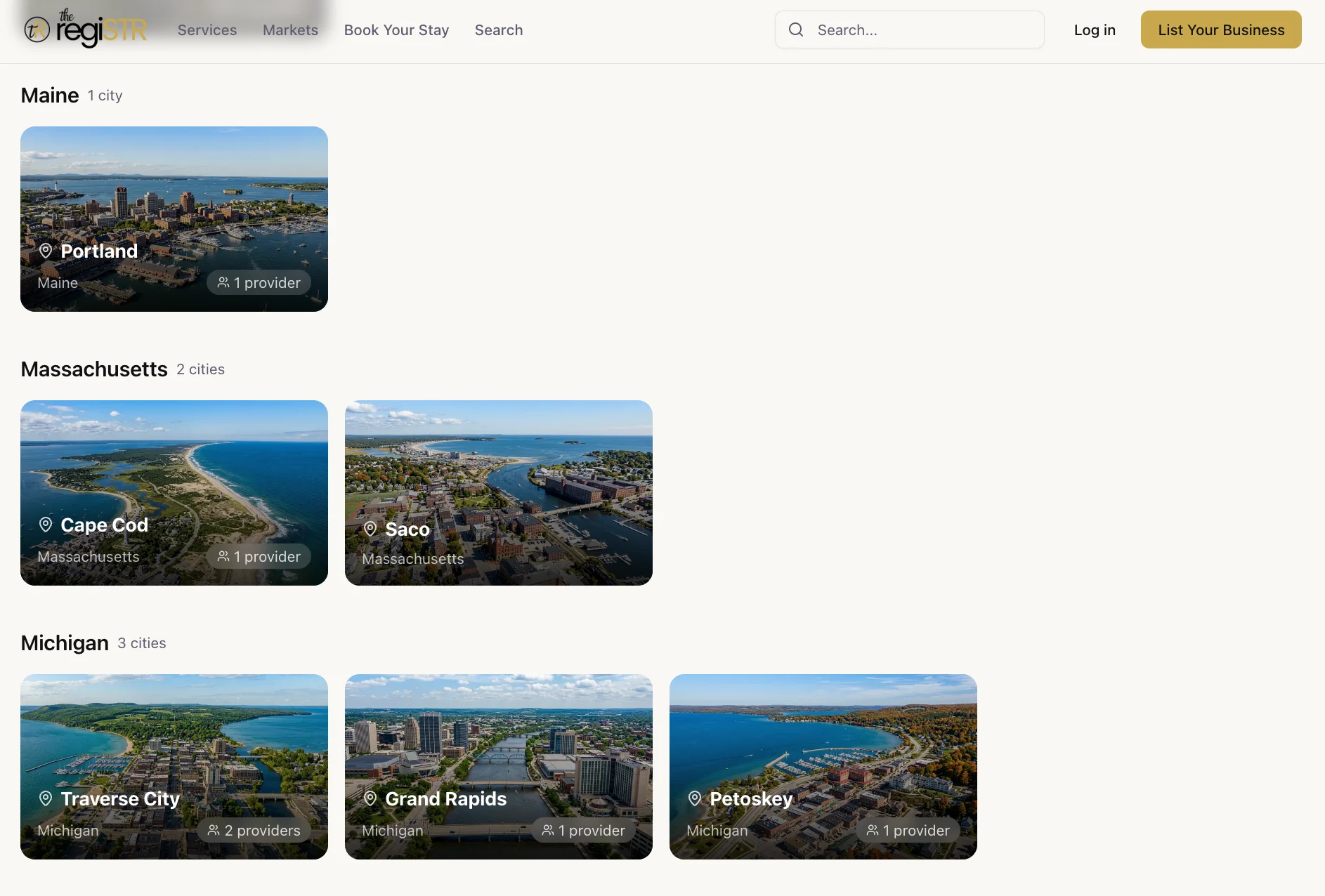
What Is an STR Marketplace and Why Hosts Need One
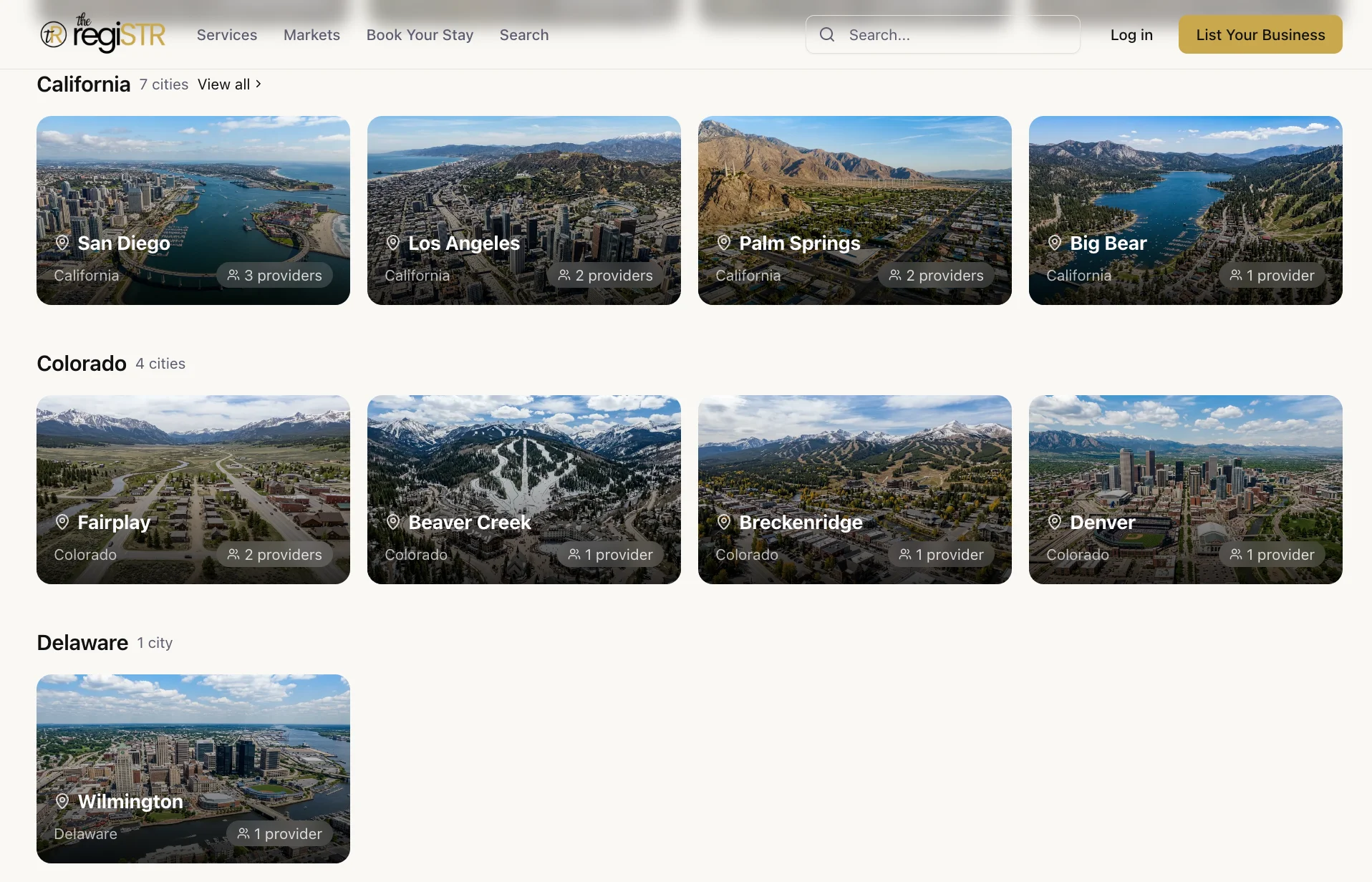
An STR marketplace is a purpose-built platform that connects short-term rental operators with the vetted service providers they need to run a guest-ready operation: cleaners, co-hosts, revenue managers, photographers, interior designers, and maintenance crews. Unlike a general business directory, an STR marketplace organizes providers specifically around vacation rental workflows, so every listing you browse already understands turnover windows, OTA compliance, and the operational tempo of a professional short-term rental.
- An STR marketplace is a specialized directory that connects vacation rental hosts with niche service providers: not a general contractor listing or booking platform for guests.
- General directories surface residential service providers who have never dealt with a same-day turnover; an STR-specific marketplace pre-filters for vacation rental experience by design.
- The global vacation rental market is projected to reach USD 109.4 billion in 2026, according to Mordor Intelligence, making professional vendor networks more valuable than ever for scaling operators.
- The most useful STR marketplaces organize providers by service category (cleaning, photography, co-hosting, revenue management) AND by geographic market, so you can find local experts in your specific city.
- Hosts who build their vendor network through a curated STR marketplace typically spend less time chasing down unreliable contractors and more time focused on revenue strategy.
- the regiSTR is the only short-term rental service directory organized by both market and category, with every provider referred in by a network member, making it the fastest path from "I need a cleaner in Scottsdale" to a hired professional.
What Exactly Is an STR Marketplace?
An STR marketplace is a two-sided platform built exclusively for the short-term rental industry, where operators on one side and specialized service providers on the other can connect, vet each other, and do business. The term covers a wide range of platform types, but the defining characteristic is industry specificity: every provider listed has demonstrated experience with vacation rental operations, not just general home services.
This distinction matters more than it sounds. A cleaner who excels at weekly residential housekeeping may have no framework for a 90-minute turnaround between a 10am checkout and an 11:30am check-in. A photographer who shoots commercial interiors beautifully may not understand how to stage a living room for an Airbnb hero shot that converts browsers into bookers. An STR marketplace screens for that experience before you ever pick up the phone.
The service categories a well-built STR marketplace covers typically include: full-service property management, co-hosting and co-management, cleaning and turnover services, revenue management and dynamic pricing, photography and virtual tours, interior design and staging, maintenance and repairs, regulatory and compliance consulting, and direct booking tools. That breadth matters because running a professional short-term rental requires a stack of specialists, not just one vendor.

How Does an STR Marketplace Differ from Yelp or Google Maps?
An STR marketplace differs from a general directory like Yelp or Google Maps in one fundamental way: every provider on the platform was selected because they work specifically with short-term rental operators, not because they showed up in a location search. General directories index every cleaning company in a zip code regardless of whether that company has ever handled a vacation rental turnover. The result is a time-consuming filter problem that a purpose-built STR marketplace solves by design.
Consider what happens when you search a general directory for a cleaner in Nashville. You get dozens of residential housekeeping companies, a handful of commercial janitorial services, and maybe two or three that mention "Airbnb" anywhere in their profile. You then have to call each one, explain what an STR turnover actually involves, and find out which ones can commit to same-day service windows. That process takes hours and still leaves you guessing.
In an STR marketplace, every provider in the cleaning category already understands turnover logistics. They know what "11am checkout, 3pm check-in" means operationally. They have linen protocols. They have backup coverage plans. You're not educating them from zero; you're evaluating which qualified option is the best fit for your specific market and property type.
General directories also rely on anonymous star ratings that any business can accumulate regardless of whether their reviewers are STR operators or residential homeowners. A cleaning company with 400 five-star reviews from residential clients tells you nothing about their ability to handle a six-unit portfolio with staggered checkout times. An STR-specific marketplace, by contrast, can surface endorsements from actual vacation rental operators who have hired that provider for exactly the same workflow you need covered.

What Services Can You Find on an STR Marketplace?
A well-organized STR marketplace covers every operational layer of a vacation rental business, from pre-launch setup to ongoing revenue optimization. The core service categories map directly to the stages of building a professional STR operation, and knowing which category to prioritize depends on where you are in that journey.
Operational Services
Cleaning and turnover services are typically the first hire any host makes. Co-hosting and co-management come next for operators who want to stay involved but need local support for guest communication and key handoffs. Maintenance and repairs round out the operational tier, covering everything from HVAC calls to furniture assembly after a guest incident.
Strategic Services
Revenue management and dynamic pricing consultants help operators stop leaving money on the table with flat nightly rates. These specialists use tools like PriceLabs and market-level comp set analysis to optimize rates across seasons, weekends, and local events. Regulatory and compliance consultants handle the increasingly complex landscape of STR permits, local ordinances, and platform registration requirements.
Creative and Marketing Services
Photography and virtual tours directly affect your listing's click-through rate on Airbnb and VRBO. Interior design and staging services help hosts configure and furnish properties for both guest experience and listing photography performance. SEO, content marketing, and website design providers help operators build direct booking infrastructure that reduces dependence on OTA commission fees.
The value of finding all of these categories in a single STR marketplace is that you build your vendor network in one place, organized by market, rather than piecing it together through Facebook groups and cold Google searches over months. The regiSTR's directory covers all of these categories with market-specific filtering, so operators can browse by their city and service need simultaneously. Browse all STR services by category and market to see which provider types are currently listed in your area.
Why Do STR Hosts Struggle to Find Vetted Providers Without a Marketplace?
STR hosts struggle to find vetted providers outside of a dedicated marketplace because the search tools available to them were built for residential consumers, not vacation rental operators. General directories, social media groups, and word-of-mouth referrals each introduce friction and quality uncertainty that compounds as your portfolio grows.
The Facebook group approach is illustrative. You post asking for cleaner recommendations in a Nashville STR host group. You get 15 responses in 24 hours. Six are from providers who have never cleaned a short-term rental and are guessing at what the job involves. Four are from cleaners who service only one or two properties and cannot take on new clients. Three are genuine recommendations from other hosts, but two of those hosts have properties that differ significantly from yours in size and guest volume. You are left with one useful lead after an afternoon of back-and-forth.
Multiply that experience across every service category you need, across every market where you own a property, and you understand why building a reliable vendor network without a curated STR marketplace is genuinely exhausting. It is not that good providers do not exist. It is that the discovery mechanism is broken.
The pattern we consistently observe at the regiSTR is that operators who have been hosting for two or more years spend a disproportionate share of their mental energy managing vendor relationships rather than optimizing revenue. They have accumulated a patchwork of contractors through trial and error, and they are still not confident in most of them. A purpose-built STR marketplace compresses that discovery timeline significantly by doing the category-specific filtering before the host ever shows up.
How Do You Use an STR Marketplace to Build Your Vendor Network?
Using an STR marketplace to build your vendor network is a straightforward process, but the sequence matters. Start with the service categories where unreliability creates the most immediate guest-facing risk, then work outward to strategic and creative services once your operational foundation is stable.
- Identify your market first. A good STR marketplace organizes providers by geography. Filter to your specific city or metro before browsing categories, so every result you review serves properties in your area. A co-host listed for Phoenix is irrelevant if your property is in Gulf Shores.
- Prioritize cleaning and turnover. This is the service category that directly affects your review score on every single booking. A cleaning provider who can't commit to a guaranteed turnaround window is not the right fit for STR, regardless of their residential reputation. Browse vetted STR cleaning providers by market to see who is currently operating in your city.
- Add photography before you launch or relaunch. Listing photos affect click-through rate, which affects occupancy, which affects everything downstream. STR-specialized photographers understand how to shoot for OTA listing performance. Finding one through a general marketplace wastes time on providers who have never considered thumbnail optimization.
- Bring in revenue management after your first 60-90 days. Once you have baseline occupancy data and understand your property's seasonal patterns, a revenue manager can identify where your pricing is leaving money on the table. This is not a day-one hire for most new operators, but it becomes increasingly valuable as your portfolio scales.
- Add co-hosting or property management as your workload grows. The decision between co-hosting and full-service management depends on how much operational involvement you want to retain. Browse STR property management companies in your market to compare what each model actually includes before committing.
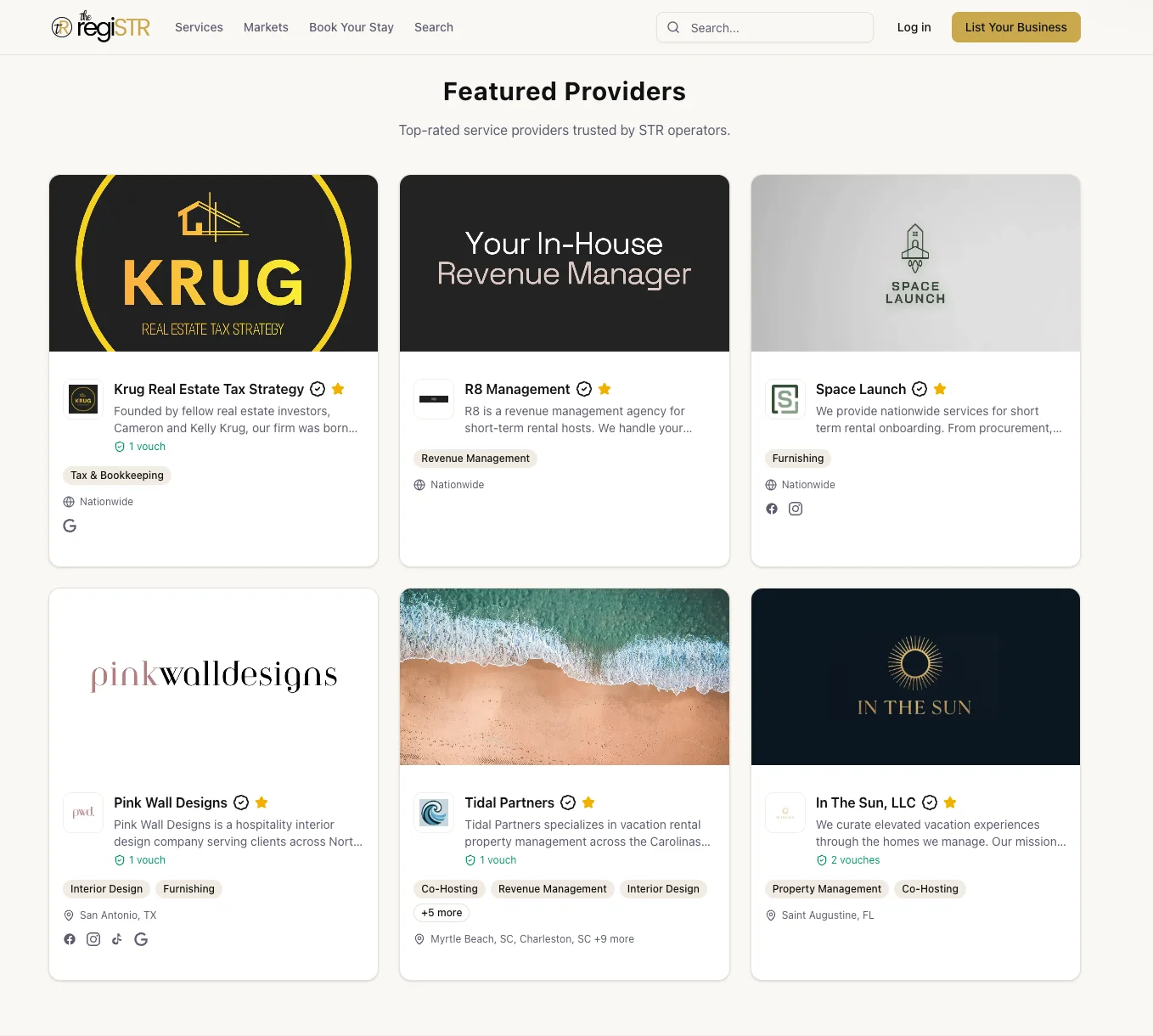

What Should You Look for in an STR Marketplace?
Not every platform that calls itself an STR marketplace applies the same quality controls to its provider listings. The difference between a curated marketplace and an open directory is the quality floor: in an open directory, any provider can list; in a curated marketplace, providers earn their listing through a vetting or referral process. That distinction determines the reliability of every search result you browse.
Provider Vetting Mechanism
Ask specifically how providers get listed. Referral-gated onboarding, where existing network members nominate new providers, creates accountability that self-serve sign-up cannot replicate. When a provider's listing exists because another STR professional vouched for them publicly, you have a fundamentally different quality signal than a five-star review from an anonymous residential client.
Market-Specific Filtering
A useful STR marketplace lets you filter by both service category and geographic market simultaneously. A directory that only organizes by service type forces you to manually screen out providers who don't serve your area. A directory that only organizes by location buries relevant providers under a mix of unrelated service categories. You need both filters working together.
Service Category Depth
Evaluate how many of your vendor needs the marketplace covers. A platform that lists only cleaners and property managers leaves you searching elsewhere for photographers, revenue managers, interior designers, and maintenance crews. The more categories a marketplace covers, the less time you spend maintaining separate discovery processes for each service type.
Social Proof from STR Operators Specifically
Look for endorsements that come from identifiable STR hosts and investors, not anonymous reviewers. A named operator saying "I've used this cleaner across three of my Nashville properties for eight months" is actionable information. An anonymous four-star review is not.
How Does an STR Marketplace Help Remote Vacation Rental Owners?
An STR marketplace is particularly valuable for remote vacation rental owners because it solves the market knowledge gap that makes out-of-state ownership so operationally difficult. Managing a property in a market you have never lived in means you have no existing contractor relationships, no local professional network, and no reliable way to distinguish between providers who understand vacation rental workflows and those who do not.
The traditional alternative is cold outreach: searching Google for cleaners in Gatlinburg, calling three or four, explaining what an STR turnover involves, hoping one of them has availability, and finding out two weeks later whether they meet your standards. That process repeats for every service category, in every market where you own a property. It is genuinely one of the most frustrating parts of scaling a remote STR portfolio.
An STR marketplace with market-based filtering compresses this process dramatically. You navigate to your specific market, filter by the service category you need, and browse providers who have already been established as STR-experienced in that area. The discovery step that used to take weeks of cold outreach takes minutes. You still need to vet the shortlist you generate, but you are starting from a pool of qualified candidates rather than the general population of local contractors.
For operators managing multiple properties across different markets, this compounds in value. Rather than maintaining separate discovery processes for Nashville, Scottsdale, and Gulf Shores, you have one resource organized by market that surfaces relevant providers wherever your portfolio expands. The regiSTR's Popular Markets section is built specifically for this use case: operators can filter providers by city and service category from a single directory. If you're building a remote vendor network, browse STR maintenance and repair providers by market as a starting point for the hardest-to-find local vendor category.
What Is the Difference Between an STR Marketplace and a Property Management Platform?
An STR marketplace and a property management platform serve fundamentally different functions, and confusing them leads hosts to use the wrong tool for their actual problem. A property management platform is software: it handles calendar sync, channel management, automated messaging, pricing updates, and financial reporting for properties you are already operating. An STR marketplace is a directory: it connects you with the human professionals who perform the work that software cannot automate.
Channel managers like Hospitable, Hostaway, and Lodgify handle the calendar sync and pricing automation side of STR operations effectively. But they do not tell you who to call when your HVAC breaks at 11pm on a Saturday in Sedona. They do not help you find a co-host who understands the difference between a guest communication response time of 4 hours and one of 40 minutes. They do not surface a revenue manager who specializes in your specific market's seasonal patterns.
The two tool types are complementary, not competing. You run your operation through a property management platform; you build the team behind that operation through an STR marketplace. Most professional operators use both, and the gap between hosts who have figured this out and those who haven't is visible in their review scores and occupancy rates.
| Feature | STR Marketplace | Property Management Platform |
|---|---|---|
| Primary function | Find and hire human service providers | Automate operational workflows |
| Who uses it | Hosts discovering and vetting vendors | Operators managing bookings and channels |
| Key output | A shortlist of vetted professionals to hire | Automated messaging, pricing, and reporting |
| Provider quality signal | Referral vetting, peer endorsements | Not applicable (no provider directory) |
| Geographic relevance | Filtered by your specific market | Works regardless of property location |
| Examples of use | Finding a cleaner, hiring a co-host | Syncing calendars, sending check-in messages |
How Is the Vacation Rental Service Industry Growing in 2026?
The vacation rental service industry is growing significantly in 2026, driven by both the expansion of the overall market and the increasing professionalization of individual operators. According to Mordor Intelligence, the global vacation rental market is projected to reach USD 109.4 billion in 2026. The Business Research Company estimates year-over-year growth of 6.6% from 2026 to 2026 alone. That scale creates real demand for specialized service providers across every category an STR marketplace covers.
The professional management shift is particularly notable. Dataintelo reports that professional management companies now control approximately 42% of the more than 7 million active STR listings globally as of early 2026. That means the market for co-hosting, property management, and supporting services like revenue management and photography is expanding at the same rate as the underlying rental market.
For hosts, this growth has a practical implication: the competition for bookings is increasing in every major STR market. Guests in 2026 have more professionally managed options than at any previous point, which raises the baseline expectation for listing quality, photo presentation, and guest communication response times. Operators who have not yet built a professional vendor stack are competing against those who have, and the gap shows in booking conversion rates.
The demand for bundled, end-to-end STR management services is also accelerating, according to market trend data. Hosts are increasingly looking for integrated solutions rather than managing five separate vendor relationships manually. A well-organized STR marketplace that covers all service categories in one place aligns directly with that trend, reducing the coordination overhead that makes self-managing a growing portfolio unsustainable.
We built the regiSTR specifically to address this market moment: as the industry professionalized, the gap between what hosts needed and what general directories offered grew wider. Operators needed a resource that kept pace with the industry's expansion, surfaced new providers as markets matured, and maintained a quality floor that general directories structurally cannot enforce.
Frequently Asked Questions About STR Marketplaces
What is an STR marketplace and how does it work?
An STR marketplace is a specialized platform that connects short-term rental operators with vetted service providers across categories like cleaning, property management, photography, revenue management, and co-hosting. It works by organizing providers by both service type and geographic market, so hosts can find professionals who already have vacation rental experience in their specific city. Unlike general directories, a purpose-built STR marketplace applies industry-specific vetting criteria before listing any provider.
How is an STR marketplace different from general directories?
General directories like Yelp or Google Maps index providers based on location and category without filtering for vacation rental experience. An STR marketplace pre-selects providers who understand STR-specific workflows, including same-day turnovers, OTA compliance, and guest communication standards. This means every provider you browse has already passed an industry relevance filter, dramatically reducing the time you spend on outreach to providers who are not the right fit.
What service categories should a good STR marketplace cover?
A well-organized STR marketplace should cover the full operational stack: cleaning and turnover services, property management, co-hosting, revenue management and dynamic pricing, photography and virtual tours, interior design and staging, maintenance and repairs, regulatory and compliance consulting, and direct booking tools. The broader the category coverage, the fewer separate discovery processes you need to maintain as your portfolio grows.
How does peer vetting work in an STR marketplace?
Peer vetting in an STR marketplace means providers earn their listing through referrals or endorsements from existing network members, rather than self-serving into an open directory. In the regiSTR's model, providers are invited in by other STR professionals and can receive Vouch endorsements from operators who have hired them directly. This creates a quality floor that anonymous star rating systems cannot replicate, because every endorsement is attached to an identifiable STR operator with real context.
Do I need an STR marketplace if I already use a property management platform?
Yes, because a property management platform handles software automation (calendar sync, pricing, messaging) while an STR marketplace connects you with the human professionals who perform the work. These tools solve different problems and are complementary. A channel manager won't find you a trusted cleaner in Gatlinburg; an STR marketplace won't automate your pricing or guest messages. Experienced operators typically use both.
How do I find an STR marketplace that covers my specific market?
Look for an STR marketplace with geographic filtering by city or metro area, not just national-level provider listings. The regiSTR's Popular Markets section organizes providers by specific US cities so operators can filter results to their exact market. If a directory does not let you filter by location alongside service category, you will spend time contacting providers who do not serve your area.
Is an STR marketplace useful for remote vacation rental owners?
An STR marketplace is especially valuable for remote owners, because it solves the market knowledge gap that makes out-of-state property management so difficult. Instead of cold-searching Google for contractors in a city you have never lived in, you can browse an STR marketplace filtered to your specific market and find providers who are already established as vacation rental specialists in that area. This compresses a weeks-long vendor discovery process into a much shorter, more reliable search.
Can STR service providers also benefit from joining an STR marketplace?
Absolutely. For cleaning companies, photographers, co-hosts, revenue managers, and other STR service providers, listing on a purpose-built STR marketplace means every visitor to the platform is already an STR operator looking to hire. That audience specificity is the core advantage over general directories, where visitors are a mix of residential homeowners, businesses, and the occasional vacation rental host. Providers listed on the regiSTR gain visibility with exactly the client base they need, without paying per lead on an open marketplace model.
How Do You Know If an STR Marketplace Is Reputable?
A reputable STR marketplace demonstrates its credibility through three observable characteristics: a transparent vetting process, market-specific depth, and a track record of providers who are genuinely active in the STR industry. If a marketplace cannot explain clearly how providers earn their listing, treat that as a meaningful red flag.
Check whether the directory surfaces providers with verifiable STR-specific experience rather than general service company descriptions. A cleaning company profile that says "we offer residential and commercial cleaning" with no mention of vacation rental turnovers tells you nothing about their fit for your operation. A profile that lists specific STR markets served, turnover protocols, and endorsements from named STR operators tells you exactly what you need to know.
Also evaluate freshness. A reputable STR marketplace actively adds new providers as markets grow and removes providers who leave the network. A static directory that hasn't updated its listings in 18 months is not serving the current state of your local market. The regiSTR's Recently Added section exists specifically to surface new entrants to the network and signal to operators that the directory reflects the current provider landscape, not a snapshot from years ago.
For a broader look at how to find and evaluate STR service providers beyond any single category, the short-term rental directory overview on the regiSTR blog walks through what to look for when evaluating any STR service resource. And if you are building out your operational tool stack alongside your vendor network, the STR apps hosts actually keep on their phone is a useful companion read for understanding which software tools complement a strong service provider team.
Conclusion: The Right STR Marketplace Pays for Itself in the First Hire
Running a short-term rental profitably in 2026 means competing against operators who have already built professional vendor stacks across every service category. The hosts who are winning on occupancy and review scores are not necessarily smarter or more experienced than you; they found the right providers faster. A purpose-built STR marketplace is the most direct path to that outcome.
General directories were not built for this problem, and they show it. The friction of cold-searching for STR-experienced cleaners, co-hosts, and revenue managers through platforms designed for residential consumers costs operators real time and real money. An STR marketplace built around vacation rental workflows eliminates that friction by doing the category-specific vetting before you arrive.
Whether you are launching your first Airbnb or managing a portfolio across multiple markets, the vendor discovery problem is the same. The regiSTR was built to solve it: a curated, invite-only directory organized by service category and geographic market, where every provider has been referred in by a network member and every listing reflects genuine STR industry experience. The right cleaner, co-host, or revenue manager for your specific market and property type is already in the directory. Your next step is finding them.
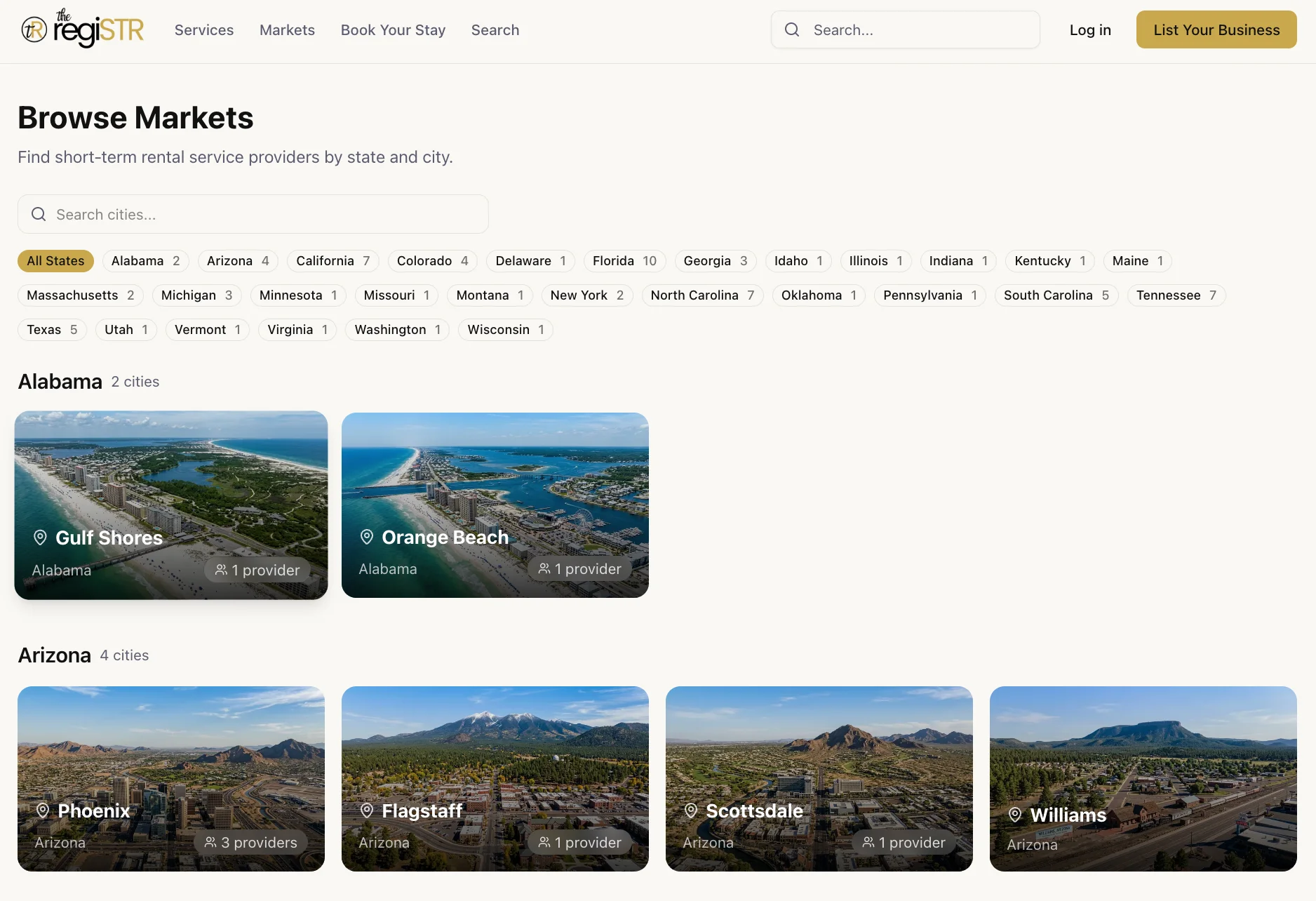
Browse vetted STR service providers by market and category at the regiSTR. Sign up free and filter by your city in under two minutes.
Content powered by inkSTR.co