How to Build an STR Vendor Network That Actually Holds
Building an STR vendor network means recruiting at least two vetted, insured providers per service category (cleaning, maintenance, landscaping, emergency repair) in every market you operate, then tracking their credentials, response times, and performance on a recurring schedule. A network that only works when nothing goes wrong is not a network. It is a single point of failure with a nice spreadsheet.
- Redundancy is non-negotiable: Property managers are consistently advised to keep a minimum of two vendors per trade category to avoid single-vendor dependency that can shut down a turnover overnight.
- Verification beats referral trust alone: Insurance certificates, licenses, and references should be confirmed directly with the carrier or issuing board, not just accepted from a copy the vendor hands you.
- Tiered management scales better than a flat list: Tier 1 vendors handling high-volume, critical systems need quarterly reviews; Tier 2 preferred vendors need semi-annual check-ins; Tier 3 backups just need to stay current.
- Professional management now controls roughly 69% of the U.S. short-term rental market according to aggregated 2026 industry data, a shift that is pushing even self-managing hosts toward networked vendor systems instead of solo relationships.
- Quarterly audits catch what monthly chaos hides: unresponsive vendors, expired certificates of insurance, and stale rate sheets are supposed to get flagged and removed on a set schedule, not whenever someone remembers.
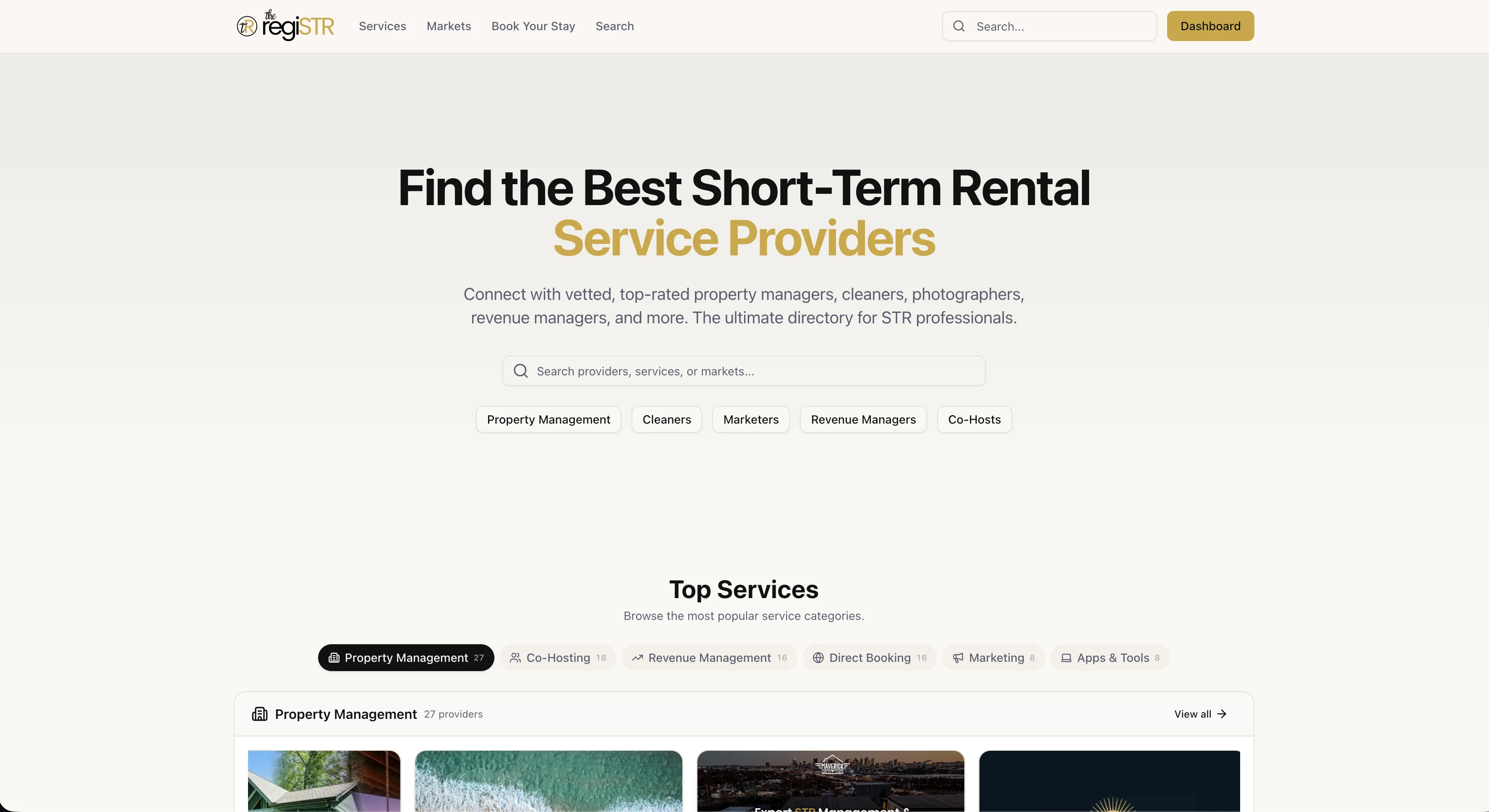
- the regiSTR shortens the sourcing phase of this entire process by surfacing pre-vetted, STR-specific providers by market and category, so you're not building your vendor bench from a cold Google search or a Facebook group post.
In 2026, the short-term rental industry looks nothing like it did five years ago, and the professionalization is not slowing down. The global vacation rental market is projected to reach somewhere between $101 billion and $109 billion this year depending on the forecasting model, and property management software adoption alone is growing at close to a 9% compound annual rate. That growth is not abstract. It means more competition for good vendors, tighter turnover windows, and less patience from guests when something breaks.
At the regiSTR, we've indexed hundreds of STR service providers across active vacation rental markets, and the pattern we see repeatedly is this: hosts don't fail because they can't find a cleaner. They fail because they only have one cleaner, one handyman, one photographer, and the moment that person goes dark, guests notice. This guide walks through how to build an STR vendor network that survives a no-show, a cancelled contract, or a 6am plumbing emergency, not just one that looks good on paper.
You'll get a full framework here: how to map your vendor needs by trade and geography, what a vetting process should actually check, how to structure contracts for 24/7 on-call coverage, and the tracking systems that keep a network from quietly rotting six months after you build it.
What Do I Need to Set Up a Vendor Network for My STR?
Setting up an STR vendor network requires four foundational elements: a mapped list of trade categories your property needs covered, at least two qualified providers per category, a verification process for licenses and insurance, and a tracking system that flags gaps before they become emergencies. Skipping any one of these turns your "network" into a list of phone numbers.
Start by listing every trade your property realistically needs: turnover cleaning, general maintenance and handyman work, HVAC, plumbing, electrical, pest control, landscaping, pool or hot tub service if applicable, linen supply, and photography for periodic listing refreshes. For a Gatlinburg cabin with a hot tub, that list looks different than a Scottsdale condo with none. Notably, many first-time hosts forget emergency-specific categories entirely, things like after-hours animal control if the property backs up to a wooded lot, or a bulk linen supplier who can overnight replacement sets during peak holiday turnover crunches.
Once your category list exists, you need contact fields for each vendor: company name, primary contact, phone, email, service area boundaries, hours of operation, insurance expiration date, license number, rate schedule, payment terms, and average response time. This is the spreadsheet skeleton that industry-standard property management practice recommends, and it works whether you're running one cabin or a fifteen-property portfolio.
Here's where most self-managing hosts get stuck: sourcing enough qualified candidates to actually fill that spreadsheet. Cold-calling contractors off Google Maps in a market you've never lived in is slow, and you have no way to know if that plumber has ever worked on a same-day STR turnover before. This is exactly why we built the regiSTR's market pages, so you can filter STR maintenance providers by the exact city or metro your property sits in, instead of guessing from a general contractor directory.

How Do I Vet an STR Vendor Before I Hire Them?
Vetting an STR vendor means confirming three things before anyone touches your property: they carry current, verifiable insurance, they hold any required trade license, and they have actual experience with rental properties, not just homeowner work. Skipping direct verification is the single most common mistake we see hosts make.
Start with a basic screen before you go deep. Ask five questions on the first call: does the vendor service your exact area consistently, can they handle your volume (a one-person cleaner might manage 20 turnovers a month but not 200), are they responsive within a defined window, do they have rental property experience specifically, and are they willing to work within your existing software and communication process.
If they clear that first screen, move to full verification. Insurance certificates should be confirmed with the carrier directly, not just accepted as a PDF from the vendor. Licenses should be checked against the state licensing board's searchable database for that trade, not taken on faith. For contractors specifically, local plumbing or HVAC supply houses can often tell you who pays their bills on time, who buys quality materials, and who's been in business longer than 18 months, information a resume never shows you.
Standardized vendor questionnaires help here too: ask about staff training procedures, emergency response protocols, and how they handle a callback if the work fails inspection. Rental-property experience matters more than most hosts realize. A residential cleaner who does biweekly homeowner visits has completely different expectations than an STR turnover cleaner working a 90-minute window between an 11am checkout and a 1pm check-in. That mismatch is exactly what causes missed check-ins and bad reviews.
This is the layer where a general directory like a broad home services marketplace falls short: it doesn't filter for STR experience, and it can't tell you whether the plumber on the other end has ever dealt with a burst pipe during a booked holiday week. Every provider listed on the regiSTR was referred in by an existing network member, and hosts can see which other STR operators have publicly vouched for that provider before making first contact.
What Order Should I Build Out My Vendor Categories In?
The order for building your STR vendor network should prioritize the trades that touch every single guest stay first, then move to periodic and seasonal needs. Cleaning and turnover always come first. Maintenance and emergency repair come second. Photography and revenue optimization come third, since those affect bookings rather than day-to-day operations.
For a first-time host, this looks like: (1) turnover cleaning, because every stay depends on it, (2) a general handyman or maintenance contact for the inevitable clogged drain or dead smoke detector, (3) HVAC and plumbing specialists for anything beyond basic repair, (4) pest control, especially in markets with seasonal insect pressure, (5) landscaping if the property has any yard, and (6) photography, which matters for booking conversion but won't shut down a stay if it's delayed a month.
For a scaling investor with three or more properties, the order flips slightly. Revenue management and a reliable property manager or co-host often need to be locked in first, since they coordinate everything downstream. Then cleaning, then maintenance, then the creative categories like interior design and photography that support long-term listing performance rather than day-to-day function.
One thing we consistently see across the providers in our network: hosts who build categories in the wrong order end up with a beautifully photographed listing and no reliable way to clean it between guests. Prioritize function over polish every time. A gorgeous listing with a late checkout cleaner still gets a one-star review.
Once you know your order, sourcing gets faster if you work market by market instead of trade by trade. Browse vetted STR cleaners for your city first, lock that category, then move to the next trade on your list. Trying to build every category simultaneously across every market you own property in is how vendor networks stay half-finished for a year.

How Do I Develop Vendor Relationships That Actually Last?
Developing lasting STR vendor relationships means moving beyond a one-time hire into a tiered management system with scheduled reviews, clear payment terms, and documented performance tracking. Vendors who feel like an afterthought behave like one. Vendors who are managed like a real business relationship perform like one.
Industry-standard practice recommends a tiered structure. Tier 1 covers your highest-volume, most critical vendors, typically your primary cleaner and your go-to maintenance contact. These get quarterly performance reviews and annual contract renegotiation. Tier 2 covers preferred backup vendors who get semi-annual reviews. Tier 3 is your approved-but-rarely-used bench, checked periodically just to confirm licenses and insurance haven't lapsed.
Track performance with real metrics, not gut feeling: on-time arrival rate, work quality measured by callback frequency, invoice accuracy, average response time, and guest impact when something goes sideways. Review Tier 1 vendors quarterly and Tier 2 semi-annually. This is also when you catch the vendor who's been slowly raising rates or slipping on response time before it becomes a five-star-review problem.
Contracts matter more than most hosts think, especially for anyone offering 24/7 on-call coverage. A written agreement should specify response time expectations (for example, a two-hour window for an emergency plumbing call), any penalty or credit structure if that SLA gets missed, payment terms, and a clear scope of what counts as an emergency versus routine work. Verbal handshake deals are fine for a backup landscaper. They are not fine for the vendor who's supposed to show up at midnight when a water heater fails during a booked week.
Quarterly network audits are the maintenance habit almost every self-managing host skips, and it's the one that prevents the network from quietly decaying. Every quarter: remove unresponsive vendors, verify insurance renewal dates, update rate sheets, and confirm every trade category still has coverage. A network you built two years ago and never revisited is not a network anymore. It's a list of people who may or may not still answer the phone.
Out-of-state owners feel this pain acutely, since building trust with a vendor you've never met in person, in a market you don't live in, is genuinely hard. That's exactly the gap the regiSTR was built to close: our market pages let you browse STR property managers and every supporting trade by city, with peer vouches from other operators standing in for the in-person relationship you can't build remotely.
Vendor Network Structure: Data and Comparison
Understanding how a professional-grade vendor network is structured requires comparing tier levels side by side against review frequency, redundancy requirements, and typical use case. The table below reflects the tiered management approach used across professional property management operations as of 2026.
| Tier Level | Vendor Type | Review Frequency | Minimum Redundancy | Contract Type |
|---|---|---|---|---|
| Tier 1 | Primary cleaner, main maintenance contact | Quarterly | 2 vendors minimum | Master Service Agreement with SLA |
| Tier 2 | Preferred backups (HVAC, plumbing, landscaping) | Semi-annual | 1-2 vendors | Standard service agreement |
| Tier 3 | Approved bench (pest control, rare specialists) | Annual or as-needed | 1 vendor acceptable | Basic terms, W-9 on file |
The redundancy column matters most. Skipping it is how a single missed cleaner call turns into a same-day cancellation and a refund. According to aggregated 2026 industry data, professional managers now control roughly 69% of the U.S. short-term rental market, a share that keeps climbing as guest expectations for consistent, hotel-like reliability rise. Operators who still run on a single-vendor-per-trade model are competing against portfolios that were built with redundancy from day one.
Notably, the global property management software market itself reached $6.53 billion in 2026 and is projected to grow to $9.93 billion by 2031, an 8.74% compound annual growth rate that reflects exactly how much operators are investing in systems to track vendor performance rather than relying on memory or a paper folder. If you're still managing vendor relationships from a phone contacts list, you're behind where the market's headed.
What Happens When an STR Vendor Fails Mid-Stay?
When an STR vendor fails mid-stay, whether a cleaner no-shows before check-in or a plumber cancels during an active booking, your response protocol should activate your Tier 2 backup immediately while a scripted guest communication goes out simultaneously. This is the scenario most vendor-network guides skip entirely, and it's the one that determines whether you get a one-star review or a five-star save.
Build a standing script before you need it, not during the crisis. A guest communication template might read: "We've been notified of a delay with today's preparation team. We are actively working to resolve this and will update you within the hour. As a gesture of goodwill, we're applying [specific accommodation] to your stay." Having this drafted in advance means you're not composing an apology at 12:47pm while a guest is standing outside.
Your backup vendor activation should be automatic, not improvised. This is exactly why the minimum-two-vendors-per-category rule exists. The moment your primary cleaner texts that she's running 45 minutes late with a 2pm check-in looming, you need Tier 2 on speed dial, not a fresh Google search. If you don't have that backup relationship already established with verified insurance and a known rate, you're negotiating terms with a stranger during an emergency, which is the worst possible time to vet anyone.
Document every failure. A vendor who no-shows once might have had a legitimate emergency. A vendor who no-shows twice in a quarter gets moved to Tier 3 or removed entirely at your next scheduled audit. This is where the performance tracking fields (on-time arrival rate, response time) earn their keep. Without documentation, you're relying on memory to decide who stays in your network and who doesn't.
For multi-market portfolios, this failure scenario multiplies. A vendor failure in a market you've never physically visited is significantly harder to manage remotely. Browsing STR service providers by market ahead of time, before you're in crisis mode, means your Tier 2 backup is already vetted and reachable the moment you need them.
How Do I Map Vendor Coverage Across Multiple Markets and Seasons?
Mapping vendor coverage across multiple markets means building a separate vendor roster per property location, adjusted for that market's seasonal demand pattern, rather than assuming one vendor list works everywhere. A beach market and a mountain market have fundamentally different peak seasons, and your vendor availability needs to reflect that.
A Gulf Coast beach property typically sees peak turnover volume in summer, meaning your cleaning and landscaping vendors need maximum bandwidth from May through August. A Smoky Mountains cabin market often peaks around fall foliage season and again from Thanksgiving through New Year's, meaning your HVAC vendor needs to be on standby specifically for winter heating failures during your highest-occupancy weeks. Building one generic vendor map and applying it to both markets ignores exactly when each vendor category actually gets stress-tested.
For multi-property investors, this means a separate spreadsheet tab, or ideally a separate vendor roster entirely, for each metro. A vendor who covers your Scottsdale desert-modern condo has no relevance to your Gatlinburg cabin's vendor needs, and treating them as interchangeable is a common mistake among owners scaling into a second or third market for the first time.
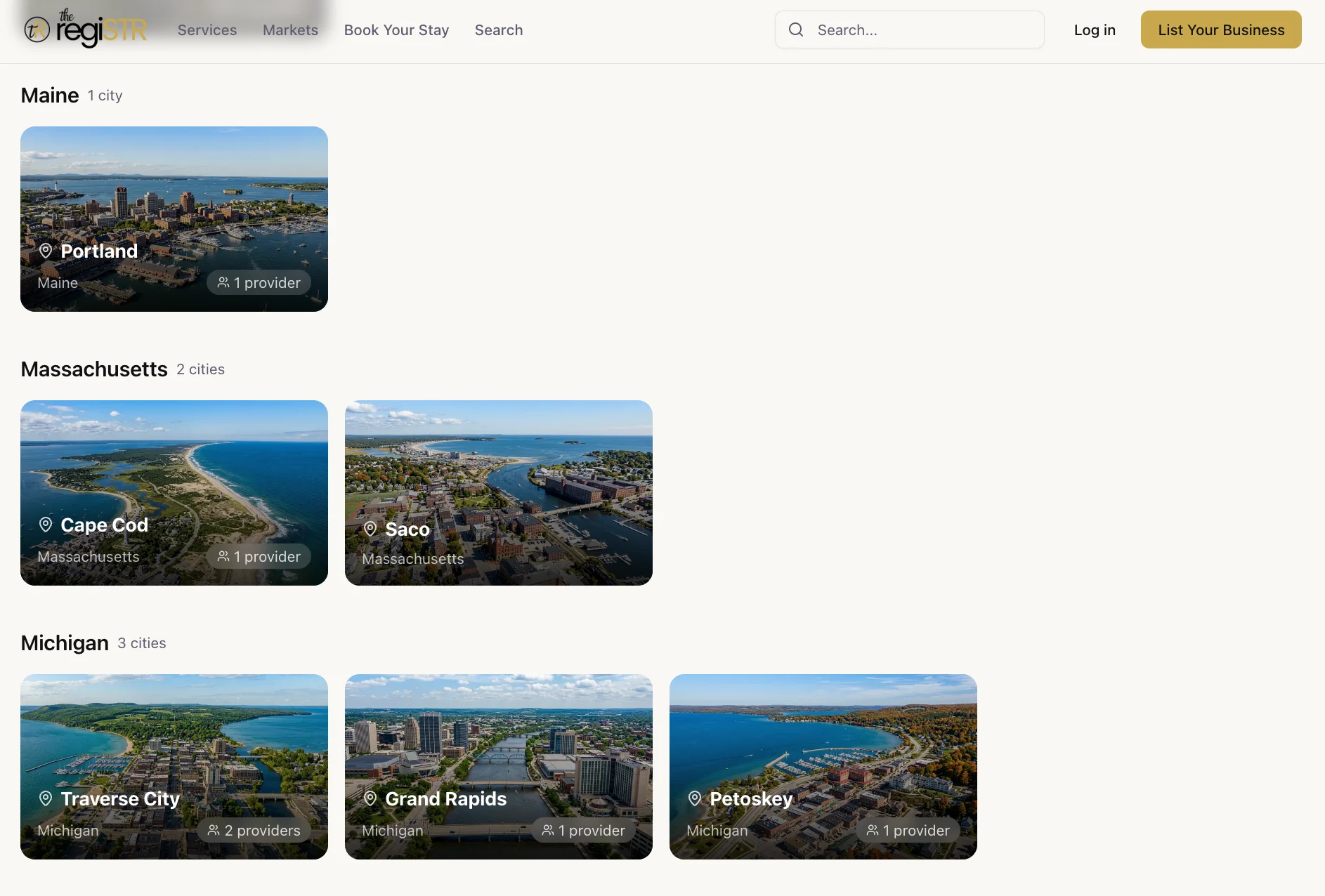
This is precisely the discovery problem that geography-agnostic sourcing (cold calls, general contractor directories, Facebook groups) fails to solve efficiently. The regiSTR's market pages are organized specifically so an owner in Colorado can pull up vendor categories filtered to their Gulf Coast property without wading through providers who don't even service that region. Every listing includes the specific markets that provider actually serves, which prevents the frustrating dead-end of calling someone who covers a neighboring county but not yours.
If you're actively expanding into a new market this year, building the vendor map before you close on the property, not after, saves you weeks of reactive scrambling during your first guest stay.
Practical Guidance: Building Your Network Step by Step
Follow these numbered steps in order. Skipping ahead, especially to hiring before vetting, is the most common reason vendor networks fail within the first year.
- Map your trade categories. List every service your specific property type requires: cleaning, maintenance, HVAC, plumbing, pest control, landscaping, and photography at minimum.
- Set your minimum redundancy target. Commit to at least two vendors per Tier 1 category before you consider that category "covered."
- Source candidates by market. Use a directory built specifically for STR providers rather than a general contractor search, so you're starting with vendors who already understand turnover timelines.
- Screen with the five basic questions. Area coverage, volume capacity, responsiveness, rental experience, and software compatibility.
- Verify credentials directly. Confirm insurance with the carrier and licenses with the state board, not just from the vendor's paperwork.
- Draft a Master Service Agreement. Include response time SLAs, payment terms, and a defined emergency scope for any 24/7 vendor.
- Onboard with a checklist. W-9, certificate of insurance, license numbers with renewal dates, and emergency contact confirmation, all stored in one place.
- Assign tier levels. Tier 1 for critical high-volume vendors, Tier 2 for preferred backups, Tier 3 for the approved bench.
- Schedule your review cadence. Quarterly for Tier 1, semi-annual for Tier 2, annual for Tier 3.
- Audit and prune quarterly. Remove unresponsive vendors, verify expiring credentials, and update rates every single quarter without fail.
Common mistakes to avoid: hiring based on price alone instead of rental-property experience, skipping direct insurance verification because the vendor "seems trustworthy," and building a network for your primary property but forgetting to replicate it for a second market when you expand. The trade-off to understand upfront is time. A properly vetted network takes real hours to build. But the alternative, scrambling for a same-day replacement cleaner during a booked week, costs far more in refunded nights and damaged reviews than the upfront vetting time ever will.
Frequently Asked Questions
How many vendors do I actually need per service category?
Property management best practice recommends a minimum of two vendors per critical trade category, such as cleaning and general maintenance. Anything less creates a single point of failure that shuts down operations the moment one vendor becomes unavailable.
How do I verify a vendor's insurance is actually current?
Contact the insurance carrier directly using the information on the certificate of insurance rather than trusting a PDF copy alone. Track the expiration date in your vendor spreadsheet and flag it for review at least 30 days before it lapses.
Should I use different vendors for different properties in different markets?
Yes. Vendor coverage should be mapped separately for each market since availability, seasonal demand, and service areas vary significantly between a beach market and a mountain market. A single vendor roster rarely translates across regions.
What should be in an STR vendor contract?
A solid vendor contract, ideally structured as a Master Service Agreement, should include response time expectations, defined emergency scope, payment terms, and any penalty structure for missed service level agreements. This matters most for 24/7 on-call vendors.
How often should I review my vendor network?
Review your highest-priority Tier 1 vendors quarterly and your Tier 2 preferred backups semi-annually. A full network audit every quarter, removing unresponsive vendors and confirming credential renewals, keeps the entire system from quietly decaying.
What's the difference between the regiSTR and a general contractor directory?
A general home services directory does not filter for short-term rental experience, meaning listed vendors may have never handled a same-day turnover window or understood STR-specific pressure points. The regiSTR is organized specifically around STR service categories and markets, with providers referred in by existing network members and vouched for by real operators.
How do I find vendors in a market I don't live in?
Browse a directory that filters providers by exact metro or city rather than relying on cold calls or general search results. The regiSTR's market pages let out-of-state owners find STR-specific vendors, from cleaners to maintenance crews, already organized by the geographic area their property sits in.
What happens if my only vendor in a category cancels last minute?
Without a documented backup, you're forced to vet a stranger during an active emergency, which is the worst possible time. This is why the two-vendor minimum per category exists: your Tier 2 backup should already have verified insurance, a known rate, and an existing relationship before you ever need them.
Conclusion: Building an STR Vendor Network That Holds Up in 2026
Building an STR vendor network is not a one-time project you finish and forget. It is a system: redundant coverage per trade, verified credentials, tiered review cadences, and a documented plan for the moment a vendor fails mid-stay. Hosts who treat vendor sourcing as an ongoing discipline rather than a single hiring event are the ones whose properties stay guest-ready through a no-show, a burst pipe, or a slow season staffing gap. As professional management continues absorbing a growing share of the U.S. short-term rental market in 2026, the operators still running on a single point of contact per trade are increasingly the exception, not the norm.
The categories, the vetting steps, and the tiered review system in this guide give you the framework. What's historically been missing is a fast way to actually source qualified, STR-experienced candidates in your specific market instead of starting from a cold search. Get started with the regiSTR to browse vetted providers by city and service category, sign up free, and start filling out your network with vendors who already understand what a same-day STR turnover actually requires.

If you're still piecing together your vendor roster one cold call at a time, browse vetted STR service providers organized by market and category, and stop rebuilding your network from scratch every time you expand into a new city.
Content powered by inkSTR.co