How to Find STR Service Providers Who Get It Right

The fastest way to find STR service providers is through a niche directory built specifically for short-term rentals, supplemented by referrals from other operators in your market. General business listing sites don't filter for vacation rental experience, which means you waste hours vetting cleaners and managers who have never handled a same-day turnover.
- Niche directories beat general listing sites because every provider is pre-filtered for short-term rental experience, not general residential or commercial work.
- Professional STR managers control an estimated 42% of active listings globally as of early 2026, reflecting a shift toward vetted, tech-enabled operators rather than word-of-mouth hires.
- Full-service STR management typically runs 15-25% of gross revenue, though industry data shows some firms charge as much as 50%, so comparing multiple providers side by side matters more than ever.
- Referrals and owner groups remain useful, but they don't scale once you own property in a market you've never visited.
- Local vendor gaps, meaning cleaners, handymen, and photographers who actually understand STR turnover timelines, are the hardest category to fill without a market-specific resource.
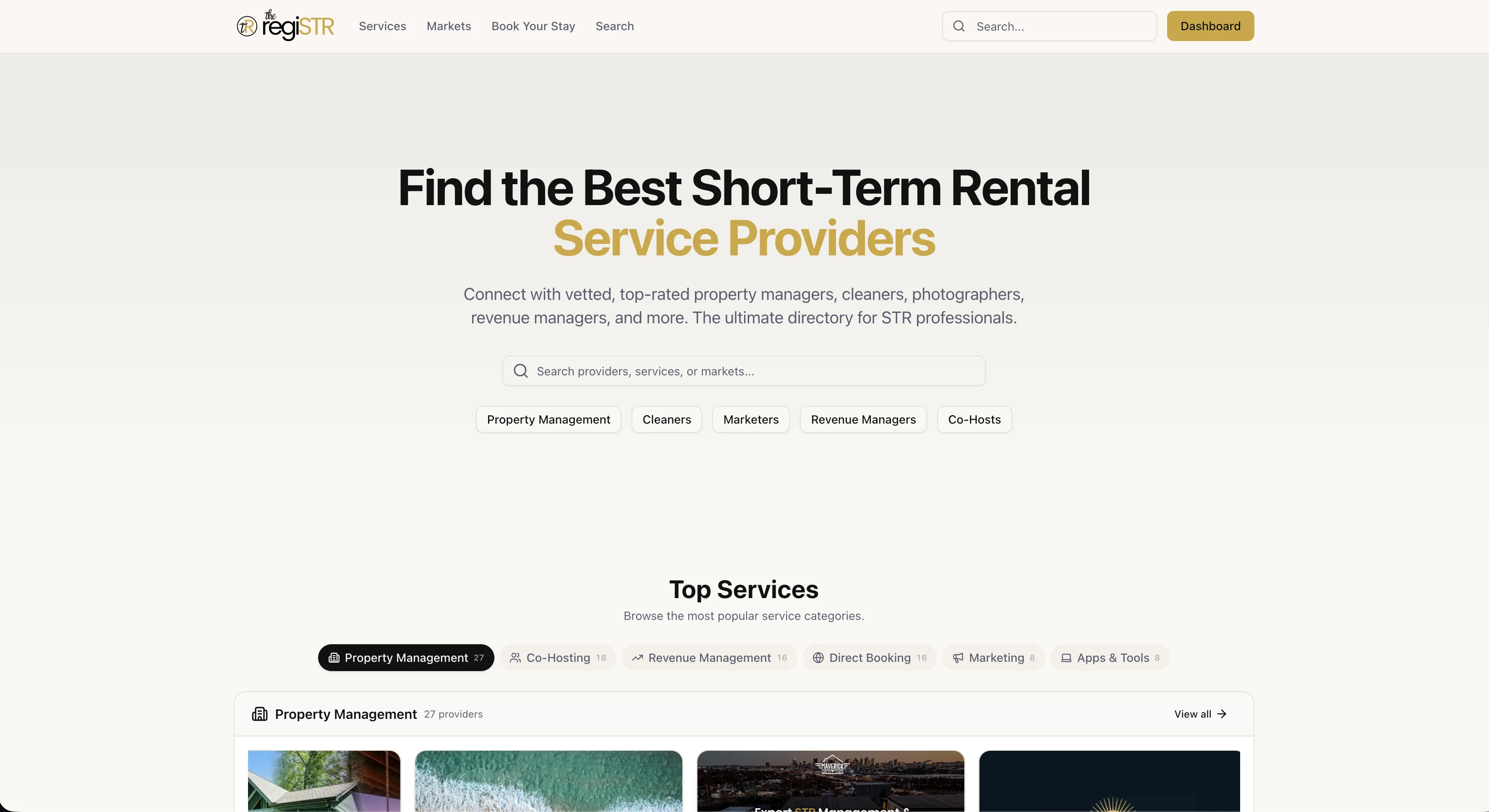
- the regiSTR solves this discovery problem by organizing vetted STR service providers by market and category, so you can filter by city instead of cold-calling contractors who've never touched a vacation rental.
If you've ever typed "vacation rental cleaner near me" into Google and gotten a list of residential maid services with no idea which ones have handled a three-hour turnover window, you already know the problem. Most business directories were never built for short-term rentals. They don't ask about checkout timelines, they don't verify STR-specific insurance, and they definitely don't tell you whether a "property manager" has ever managed anything other than a duplex.
At the regiSTR, we built our directory around this exact gap. Hosts searching for cleaners, photographers, co-hosts, and property managers need a resource that filters for STR experience from the start, not a general contractor site where you're guessing based on a five-star rating with no context. This guide walks through where to actually find these providers in 2026, what separates a reliable one from a risky hire, and how to build a vendor network that holds up whether you're managing one cabin or a twelve-property portfolio.
What Is the 75/55 Rule for Airbnb?
The 75/55 rule is an informal pricing benchmark some hosts use to decide when to accept a shorter minimum-stay booking: if a reservation covers at least 75% of your target nightly rate and fills a gap of 55% or more of your available calendar window, it's generally worth accepting rather than holding out for a longer stay. It's not an official Airbnb policy, it's an operator heuristic.
You'll see this rule referenced most often by hosts using dynamic pricing tools who are trying to avoid long vacancy gaps between bookings. In practice, the logic matters less than the discipline behind it: know your floor price and your acceptable gap tolerance before a booking request comes in, not after.
This is where the line between self-managing and hiring a revenue specialist starts to blur. Pricing rules like this are useful shortcuts, but they don't replace a person actively watching your comp set and adjusting for local events. If you're spending more time debating pricing heuristics than running your property, that's usually the signal it's time to look at a revenue management provider. the regiSTR's Revenue Management and Dynamic Pricing category lists providers who build these decisions into an actual pricing system instead of a rule of thumb you have to remember to apply.
What Is the 80/20 Rule for Airbnb?
The 80/20 rule applied to short-term rentals generally refers to the idea that 80% of your booking revenue, guest issues, or operational headaches come from 20% of your properties, guests, or vendor relationships. For STR operators specifically, it's most often used to identify which service providers or property segments deserve the most attention.
In our experience working with operators across multiple markets, this plays out predictably: one unreliable cleaner or one poorly maintained property tends to generate the majority of a host's support tickets, bad reviews, and rebooking headaches. Identifying that 20% early, and fixing it with a better vendor, is usually more valuable than optimizing the properties or providers that already run smoothly.
Applying this to vendor management means auditing your current provider roster honestly. Which cleaner causes the most late-checkout scrambles? Which maintenance contact takes three days to return a call during a plumbing emergency? Those are your 20%. the regiSTR's market pages exist precisely so you can replace that underperforming slice of your vendor network without starting the search from zero every time a relationship breaks down.
Where Should You Actually Search for STR Service Providers?
The best places to search for STR service providers in 2026 are niche STR directories, local owner groups, and direct market visits, in that order of efficiency. General search engines and broad service marketplaces rank lower because they don't filter for vacation rental specialization, which means more time spent disqualifying unqualified vendors.
Industry guidance from property management resources consistently recommends starting with referrals: ask fellow investors, local real estate contacts, or drive through your market and observe well-kept STR properties to identify who manages them. That advice still holds, but it doesn't scale once you own property in a market you've never lived in or plan to expand into a third or fourth metro.
Local Owner Groups and Facebook Communities
Joining local STR owner groups on Facebook or Reddit remains one of the most commonly recommended tactics for finding vendor referrals, and for good reason: real operators sharing direct experience carries more weight than an anonymous star rating. The limitation is consistency. Group recommendations are scattered across old threads, outdated contact info, and providers who may no longer be taking new clients.
Niche STR Directories
A dedicated short-term rental directory organizes providers by service category and market, which is the structural advantage a general directory can't replicate. On the regiSTR, every listed provider was invited in by an existing network member, so you're not sorting through residential-only vendors who've never handled a same-day Airbnb turnover. You can browse vetted STR cleaners by city, filter property managers by market, or find STR photographers who already understand OTA listing requirements, all from one search.
Driving the Market and Direct Property Visits
Physically visiting properties that a management company or cleaning crew maintains is still one of the most reliable vetting steps available, especially for out-of-state buyers evaluating a new market before closing on a property. Notice landscaping upkeep, exterior condition, and whether the listing photos match what you see in person.
How to Find an Airbnb Co-Host?
Finding an Airbnb co-host starts by defining exactly which tasks you want off your plate, guest messaging, check-in coordination, cleaner scheduling, or all three, before you start interviewing candidates. A co-host is not the same as a full-service property manager; the arrangement is typically more limited in scope and often less expensive, but the quality gap between a great co-host and a mediocre one is just as wide.
Most first-time hosts default to asking a neighbor or a former guest, which can work but comes with no accountability structure if the relationship sours. A better approach is treating the co-host search the same way you'd vet a contractor: ask for STR-specific references, confirm their response time commitments in writing, and clarify who handles emergency maintenance calls after hours.
Notably, co-hosting arrangements vary widely in fee structure, some charge a flat monthly rate, others take a percentage of booking revenue similar to hybrid property management models running 8-15% for limited services. Ask upfront which model applies and what specifically triggers additional charges, like same-day guest issues or holiday coverage.
This is exactly the kind of vetting the regiSTR was built to shortcut. Our Co-Hosting and Co-Management category lists providers by market with their service scope clearly defined, so you're not guessing whether "co-host" means full guest communication or just a key exchange service. Sign up free and compare co-hosts in your specific market before committing to anyone.
What Is the Best Short-Term Rental Website for Finding Service Providers?
The best short-term rental website for finding vetted service providers is one built specifically around STR vendor discovery, organized by market and service category, rather than a general home services marketplace. A purpose-built STR directory filters for vacation rental experience from the point of onboarding, which a general contractor site simply doesn't do.
General service marketplaces work on a pay-per-lead or open-bid model, where any registered contractor can respond to your request regardless of whether they've ever managed a vacation rental turnover. That structure means the quality floor is set by whoever's willing to bid lowest, not by STR-specific competence.
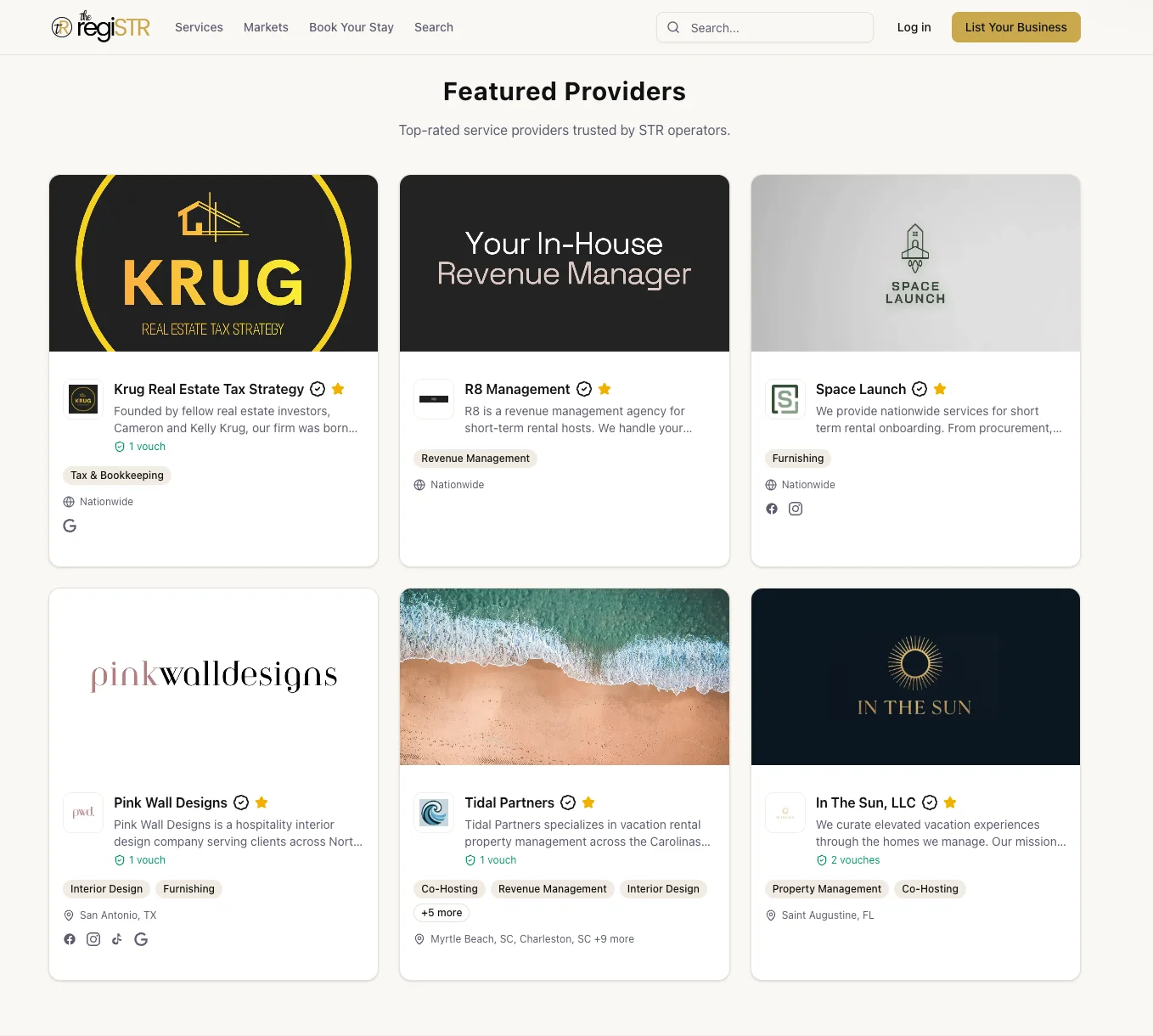
the regiSTR takes a different approach: providers join by invitation from an existing network member, and hosts can see which other STR operators have publicly vouched for a provider they've actually hired. That's a materially different trust signal than an anonymous five-star review with no context about whether the reviewer even runs a short-term rental. Our market pages cover popular STR regions nationwide, and every provider profile lists the specific markets they serve, so you're not contacting a photographer who doesn't actually work in your city.
For operators comparing options, the practical difference shows up fastest in Cleaning and Turnover Services and Full-Service Property Management, the two categories where STR-specific experience matters most and where a mismatch causes the most guest-facing damage.

How Do You Vet an STR Service Provider Before You Hire?
Vetting an STR service provider means confirming their vacation rental experience specifically, not just their general trade competence, and reviewing insurance, contract terms, and references from other STR operators before signing anything. A cleaning company that's excellent at standard residential work can still be a poor fit if they've never worked within a same-day turnover window.
Industry guidance consistently points to a short list of questions worth asking every provider before hiring: How long have they worked specifically with short-term rentals? Do they carry insurance that covers STR-specific liability? How do they handle same-day cancellations or last-minute maintenance emergencies? What does their contract actually include, and what triggers additional fees?
Ask for STR-Specific References, Not General Ones
A property manager who's only handled long-term rentals will answer confidently about lease renewals and tenant screening, but that experience doesn't transfer to guest communication during a two-hour turnover crunch. Ask specifically for references from other short-term rental owners, and follow up with those references directly rather than trusting a testimonial on a website.
Review Their Existing Portfolio
Check how a prospective property manager markets the properties they already manage. Are the listing photos professional? Is availability easy to find? Does the copy read like it understands what STR guests actually search for? A provider's own marketing quality is a strong proxy for how they'll market yours.
Confirm Insurance and Contract Terms in Writing
Insurance coverage is not optional for STR vendors, particularly cleaners and maintenance contractors who have keyed access to your property. Get proof of coverage before the first service date, not after an incident. On the contract side, most full-service management agreements require a 30 to 60 day notice period for termination, so understand your exit terms before you sign, not when you're already frustrated three months in.
This is precisely the vetting criteria we apply when reviewing providers for inclusion on the regiSTR. Every listing reflects a provider who was referred in by an existing network member and, in many cases, publicly vouched for by an operator who's actually worked with them. It's a meaningfully different starting point than an open marketplace where anyone can create a profile.
How Do You Build a Vendor Network Across Multiple STR Markets?
Building a vendor network across multiple STR markets means treating each city as its own procurement project, cleaning, maintenance, photography, and management sourced locally, rather than assuming one provider or platform can service properties in different states. What works in one market rarely transfers cleanly to another.
This is the single biggest operational gap for scaling investors and out-of-state owners. You might have a reliable cleaner in your home market, but that relationship means nothing once you close on a second property three states away. Most operators solve this the hard way: cold calls, Facebook group posts in unfamiliar communities, and a lot of trial and error before finding someone dependable.
Standardize Your Vetting Process, Not Your Vendors
Instead of trying to find one national provider for each service category, standardize the questions and criteria you use to vet local providers in every new market. Same insurance requirements, same reference checks, same contract review, applied consistently whether you're sourcing a handyman in a mountain market or a photographer on the coast.
Use Market-Specific Directory Pages
the regiSTR's directory is organized by market specifically to solve this problem. Instead of starting from zero in every new city, you can pull up a metro's page and see every service category, cleaning, maintenance, co-hosting, property management, filtered to providers who actually serve that market. That geographic filtering prevents the frustrating experience of contacting a provider whose service area doesn't even cover your zip code.
Bundle Categories Where It Makes Sense
Some providers offer overlapping services, a cleaning company that also handles light maintenance, or a co-host that also manages guest communication and pricing. Bundling can simplify your vendor count, but only if the provider is genuinely strong in both categories. Don't accept a mediocre bundled service just to reduce the number of contacts in your phone.
What Data Should You Compare Before Choosing a Service Provider?
Comparing STR service providers effectively requires evaluating fee structure, contract terms, insurance coverage, and STR-specific experience side by side, not just price. The global vacation rental market reached an estimated USD 101.7 billion in 2026 and is projected to hit USD 106.5 billion in 2026 according to Grand View Research, and that growth has brought more providers into the space, which makes disciplined comparison more important, not less.
| Comparison Factor | What to Ask | Why It Matters |
|---|---|---|
| Fee structure | Percentage of revenue or flat rate? What triggers add-on fees? | Full-service management commonly runs 15-25% of gross revenue, though rates as high as 50% appear in the market, so comparison prevents overpaying |
| STR-specific experience | How many years managing short-term versus long-term rentals? | Long-term rental experience doesn't transfer to turnover timelines or guest communication demands |
| Contract notice period | What's the termination clause? | Most full-service contracts require 30-60 days notice, so know your exit before you commit |
| Insurance coverage | Do they carry liability coverage specific to STR access? | Keyed access without documented insurance is a real exposure risk |
| Portfolio similarity | Do they manage properties similar in size and type to yours? | A firm handling only small units may not scale well to a larger property, or vice versa |
| Occupancy performance | What occupancy range do their managed properties typically see? | Professionally managed STRs often land in the mid-60% to high-70% occupancy range in strong markets, versus 40-50% for self-managed units in the same area |
Notably, professional management companies now control an estimated 42% of active STR listings globally as of early 2026, a meaningful shift toward tech-enabled, vetted operators rather than informal management arrangements. That consolidation trend is exactly why side-by-side comparison on a directory built for this purpose, rather than scattered outreach, saves real time.
What Are the Biggest Gaps Hosts Run Into When Searching for STR Providers?
The biggest gaps hosts run into are finding niche specialists beyond generalist property managers, structuring multi-vendor contracts efficiently, and building a support ecosystem in a new market before operations even begin. Most guidance online stops at "hire a property manager," which ignores everything else a functioning STR operation actually requires.
Niche Specialists Beyond the Property Manager
Smart home installers, STR-specific insurance brokers, and regulatory consultants rarely show up in general vendor searches, yet they're increasingly essential. As of 2026, jurisdictions from Los Angeles to New York have tightened registration requirements, including New York's Department of State mandate that booking services file quarterly compliance reports beginning December 22, 2026, with a $25 non-refundable filing fee per report. Finding a consultant who tracks these changes matters as much as finding a good cleaner.
Structuring Multi-Vendor Contracts
Few resources explain how to negotiate bundled service agreements across cleaning, maintenance, and co-hosting to reduce administrative overhead. If you're managing three or more properties, ask providers directly whether they offer multi-property discounts or consolidated invoicing, most won't advertise this unless asked.
Building a Local Ecosystem Before You Launch
Before closing on a property in a new market, map out your full vendor stack, cleaner, handyman, photographer, and compliance contact, rather than scrambling after your first booking. This is precisely the workflow the regiSTR's market pages are designed to support: a single search surface covering every category you'll need before your listing even goes live.
What Services Do You Actually Need to Run a Successful Short-Term Rental?
Running a successful short-term rental requires, at minimum, a reliable turnover cleaner, a maintenance contact, professional listing photography, and either a co-host or full-service property manager, depending on how hands-on you want to be. Revenue management and compliance consulting become necessary as you scale beyond one or two properties.
Not every operator needs every category from day one. A single-property host managing locally might handle guest communication personally while outsourcing only cleaning and maintenance. A twelve-property portfolio spread across three states needs the full stack, revenue management, compliance monitoring, and consistent cleaning standards across every market.
The mistake we see most often is sequencing this backwards: hosts invest heavily in photography and marketing before locking down a dependable cleaner, then lose bookings to bad reviews about a late checkout or a dirty unit. Fix operational reliability first. Marketing polish matters far less if your five-star listing photos are attached to inconsistent turnover service.
You can browse the full service stack, from STR maintenance providers to interior designers who specialize in vacation rental staging, across the regiSTR's category pages, filtered by the exact market you operate in.
Frequently Asked Questions
What is the regiSTR and how does it differ from general home services directories?
the regiSTR is a short-term rental service directory that organizes vetted cleaners, property managers, photographers, and other vendors by market and service category. Unlike general home services sites, every provider joins through referral from an existing network member, and hosts can see peer vouches from operators who've actually hired them.
How do I find a vetted STR cleaner in a market I don't live in?
Start with a directory organized by geographic market rather than a general search engine, since it filters for STR-specific turnover experience upfront. Confirm the cleaner's same-day availability and communication workflow before hiring, and ask for references from other short-term rental owners specifically, not general residential clients.
What should I look for when hiring a property manager for a short-term rental?
Look for direct short-term rental management experience rather than long-term landlord experience, documented insurance coverage, and a clear fee structure in writing. Ask how long they've operated in your specific market and request references from current STR clients, then follow up with those references directly.
What's the difference between a co-host and a full-service property manager?
A co-host typically handles a defined slice of operations, guest messaging or check-in coordination, often for a flat fee or a smaller percentage of revenue. A full-service property manager typically handles the entire operation, cleaning coordination, pricing, maintenance, and guest communication, usually for 15-25% of gross revenue, though rates vary by market and service tier.
How much does STR property management typically cost?
Full-service short-term rental management commonly ranges from 15% to 25% of gross monthly revenue, though industry data shows fees as high as 50% at some firms depending on service scope and market. Hybrid models covering only pricing or guest communication often run 8-15% instead.
Is it better to search local Facebook groups or a dedicated STR directory?
Local owner groups are useful for informal referrals but lack consistency and are hard to search once threads age out. A dedicated STR directory organizes providers by market and category with structured vetting, making it more efficient once you're managing property in more than one location.
How can I list my STR service business to get more clients?
Service providers can join the regiSTR by invitation from an existing network member and build a public profile listing their markets served, services offered, and client vouches. This puts your business in front of an audience already searching specifically for STR vendors, rather than competing in a general contractor pool.
What documentation should STR service providers have ready before onboarding to a directory?
Providers should have proof of insurance, a portfolio of prior STR-specific work, and at least a few operator references ready before applying. A clear description of markets served and service scope also speeds up profile approval and helps hosts filter accurately.
Conclusion: Where to Find STR Service Providers in 2026
Finding STR service providers in 2026 means going beyond general search engines and open marketplaces toward directories built specifically for vacation rental operations. With professional managers now controlling an estimated 42% of active global listings and the U.S. vacation rental market alone generating roughly USD 19.6 billion in 2026, the pool of providers is growing, but so is the need for real vetting.
The framework is straightforward: define what you actually need, vet for STR-specific experience and documented insurance, compare fee structures honestly, and build your vendor stack market by market rather than assuming one relationship transfers everywhere. Whether you're hiring your first cleaner or your fifth property manager, the regiSTR exists to make that search a filtered, market-specific process instead of a guessing game.

If you're ready to stop cold-calling contractors who've never handled an Airbnb turnover, browse vetted STR service providers by market and category at the regiSTR. Sign up free and start comparing cleaners, managers, photographers, and more in your exact city today.
Content powered by inkSTR.co