What Is an STR Directory and Why General Listings Fall Short
A short-term rental (STR) directory is a specialized platform that organizes and lists service providers specifically for the vacation rental industry, connecting Airbnb hosts, vacation rental owners, and property investors with vetted cleaners, property managers, photographers, revenue managers, and other STR-specific professionals in one centralized place. Unlike a general business directory, an STR directory filters every listing through the lens of short-term rental operations, so every provider you find already understands turnover timelines, OTA listing requirements, and the guest experience standard your property needs to compete.
- An STR directory is purpose-built for vacation rental operators, not general homeowners searching for house cleaners or real estate photographers who serve anyone.
- General business listings fail STR hosts because they mix residential service providers with STR specialists, offer no way to filter by STR experience, and rely on anonymous reviews from clients with entirely different needs.
- The U.S. short-term vacation rental market is projected to reach $76.46 billion in 2026 (DataIntelo), creating a large and growing operator base that needs a dedicated vendor discovery resource.
- Professional management companies control an estimated 42% of over 7 million active STR listings globally as of early 2026, which means a significant portion of the market is already relying on specialized vendor relationships rather than ad-hoc hiring.
- The most common failure point for new STR operators is not pricing or marketing. It is building a reliable local vendor network before the first guest checks in.
- As a specialized short-term rental directory, the regiSTR was built specifically to solve this problem, organizing vetted STR service providers by market and category so operators can find exactly who they need without sifting through irrelevant results.
Most hosts discover the vendor problem the hard way. They post in a Facebook group asking for a reliable cleaner, get six responses from people who have never heard the term "turnover," and spend the next three weeks cycling through candidates. The same story plays out for photographers, maintenance contacts, co-hosts, and revenue managers. The underlying problem is always the same: there is no organized, STR-specific place to find these people.
General business directories were not built for this. They were designed to help homeowners find plumbers and dog groomers. Searching for "vacation rental cleaner" on a general platform surfaces results that include residential housekeeping services, commercial janitorial companies, and the occasional actual STR turnover specialist, with no way to tell the difference at a glance. The audience is wrong, the filtering is wrong, and the social proof is wrong. A five-star rating from a happy homeowner does not tell you anything about whether that cleaner can flip a three-bedroom cabin in 90 minutes between a 2 PM checkout and a 4 PM check-in.
In 2026, the STR industry is mature enough to demand purpose-built infrastructure for vendor discovery. This article breaks down exactly what an STR directory is, what it should do, why general listings consistently fall short, and what to look for when you evaluate one.

What Is an STR Directory, Exactly?
An STR directory is a curated online platform that lists short-term rental service providers, organized by service category and geographic market, so vacation rental operators can find, evaluate, and hire the right vendor for their specific property and location. The defining characteristic is audience specificity: every provider in the directory serves STR operators, and every operator searching the directory is looking for STR-specific help.
This is a meaningful distinction. The same word "cleaner" means something completely different in a general home services context versus an STR context. A residential housekeeper follows a weekly maintenance schedule and spends 2-3 hours on a leisurely clean with no time pressure. An STR turnover specialist coordinates a same-day flip between checkout and check-in, restocks consumables to a standardized inventory checklist, identifies and documents damage, and resets the property to a guest-ready condition that photographs well. These are different jobs. A directory that conflates them is useless to a host.
A well-built short-term rental directory organizes providers into meaningful service categories: cleaning and turnover services, full-service property management, co-hosting, photography and virtual tours, revenue management and dynamic pricing, interior design and staging, maintenance and repairs, SEO and marketing, and regulatory compliance. Each category maps directly to a real operational need in the STR business, not a generic home services bucket.
Geographic organization matters just as much. A cleaner in Nashville does not help you if you own a cabin in Gatlinburg. A strong STR service provider platform organizes listings by market, so you can filter to your specific city or region and see only providers who actually operate there. At the regiSTR, the Popular Markets section exists precisely for this reason: operators can navigate directly to the markets where they own property and see every vetted provider available in that geography.
Why Do General Business Listings Fall Dangerously Short for STR Operators?
General business listing platforms fail STR operators because they were designed for a different audience with different needs, and the mismatch is fundamental rather than fixable by search filters. When you search a general directory for a vacation rental photographer, you are competing for attention with real estate agents, newlyweds, and commercial clients. The photographer you find may be technically skilled but completely unfamiliar with OTA listing composition, twilight staging, or the hero-shot sequencing that drives click-through rate on Airbnb.
The review problem is just as serious. Star ratings on general platforms aggregate feedback from clients with entirely different requirements. A cleaning company might have 200 five-star reviews from residential clients who value a thorough biweekly deep clean, and still be completely incapable of executing a 90-minute STR turnover under time pressure. Those 200 reviews tell you nothing useful. Worse, they actively mislead you by creating false confidence.
Here are the five specific ways general business listings fall short for STR operators:
1. No STR-Specific Filtering
General directories let you filter by location and service category, but they cannot filter for STR experience, STR market knowledge, or STR-specific credentials. Searching "cleaner in Scottsdale" on a general platform returns hundreds of results with no way to identify which providers have ever worked in a vacation rental context. You are back to cold-calling and hoping for the best.
2. Audience Mismatch Creates Low-Quality Results
The most capable STR service providers in any market tend to build their client base through referrals within the STR operator community, not through general listing platforms where most of the incoming inquiries are irrelevant. As a result, the providers who show up prominently on general directories are often the ones who need the volume, not the ones who have already earned a strong enough reputation to be selective about clients.
3. Trust Signals Are Not Calibrated to STR Standards
A five-star rating means something different depending on who gave it. Reviews from Airbnb hosts who have experienced a provider's STR-grade work are far more valuable than anonymous ratings from residential clients. General directories cannot make this distinction. They aggregate all reviews equally, which dilutes the signal and makes vetting genuinely difficult.
4. No Market-Specific Organization
STR operators frequently own properties in markets they do not live in. A general directory's location-based search is not granular enough to help a Texas-based investor find a vetted cleaner specifically for their Gulf Shores, Alabama property. An STR-specific directory organized around popular vacation rental markets solves this by surfacing only providers who are established and active in exactly the geography that matters.
5. Pay-Per-Lead Models Create Incentive Misalignment
Many general home service platforms charge providers per lead rather than per relationship. This incentivizes quantity over quality. Providers who pay per lead are motivated to respond to everything and close fast, not to vet whether they are actually the right fit for your specific STR situation. An invite-only STR directory with peer-endorsed profiles aligns incentives differently: the provider's reputation within the community is the asset, not their lead volume.
What Should a Strong Short-Term Rental Directory Actually Include?
A strong short-term rental directory includes, at minimum: comprehensive service category coverage, geographic market organization, STR-verified provider profiles, a trust and social proof mechanism calibrated to STR standards, and a clear intake process that distinguishes STR specialists from general service providers. If any of these elements are missing, the directory is not genuinely useful for operators who need to build a functional vendor team.
Let's break down what each of these looks like in practice.
Comprehensive Service Category Coverage
A useful STR directory covers every category of vendor you will need to run a competitive vacation rental: not just cleaning, but also property management, photography, revenue optimization, co-hosting, interior design, maintenance, and compliance consulting. Operators at different stages of their business have different needs. A first-time host in the Smoky Mountains needs a cleaner and a photographer. A scaling investor with properties in Nashville, Myrtle Beach, and Scottsdale needs a revenue manager, a co-host network, and possibly an STR compliance consultant for each market. The directory should serve both.
The regiSTR's service categories cover this full spectrum: Cleaning and Turnover Services, Full-Service Property Management, Photography and Virtual Tours, Revenue Management and Dynamic Pricing, Co-Hosting and Co-Management, Interior Design and Staging, Maintenance and Repairs, Website Design and Development, SEO and Content Marketing, Social Media Management, STR Consulting and Advisory, and Regulatory and Compliance. Each category has its own dedicated page with market-filtered provider listings. You can browse all STR services by city and category to see the full scope.
Geographic Market Organization
Provider listings should be navigable by specific STR market, not just by broad location. "Florida" is not useful when you need a cleaner specifically in Destin or a property manager in St. Pete Beach. The best STR directories maintain individual market pages for the cities and regions where vacation rental demand is concentrated: Gatlinburg, Nashville, Scottsdale, Gulf Shores, Joshua Tree, the Texas Hill Country, Colorado mountain towns, and comparable high-volume markets. Providers on those pages should have demonstrated, active operations in the relevant geography, not just a checkbox claiming nationwide availability.
STR-Verified Profiles with Peer Endorsements
The trust mechanism is the most critical element. An STR directory that allows open self-registration and anonymous star ratings solves the filtering problem but not the trust problem. What hosts actually need is social proof from other STR operators who have worked with a provider and can speak to their performance under real STR conditions. The regiSTR's Vouch system is built on this principle: peer endorsements from named STR operators who have actually hired the provider replace anonymous star ratings with accountable, contextual recommendations.
An Intake Process That Screens for STR Specialization
The directory's intake process determines the quality of everything inside it. An open-enrollment model lets anyone self-list, which means the directory quickly fills with providers who serve the residential market and have added "Airbnb cleaning" as a keyword. An invite-only or referral-based model means providers enter through an existing network member's endorsement, which pre-screens for STR credibility before the profile ever goes live. That difference in intake quality is the single largest determinant of whether the directory is actually useful to operators who need vetted help.
How Does an STR Directory Differ From a Government STR Registry?
An STR directory, in the context of this discussion, refers to a service provider discovery platform for vacation rental operators. This is a completely different concept from a government STR registry, which is a compliance database maintained by a city or state where operators must register their properties to operate legally. The two exist for different purposes, and confusing them is a genuine operational risk for new hosts.
Government STR registries are mandatory compliance systems. Cities like Honolulu, for example, maintain official registration and permitting databases that hosts must file with before accepting guests. Portland, Oregon maintains a publicly accessible short-term rental permit registry going back to 2003, allowing the public to verify which properties hold valid operating permits. Rhode Island operates a statewide mandatory STR registration system, with registration applications and renewals processed through the state's official eLicensing portal. These are not vendor directories. They are compliance databases that operators must interact with to avoid fines, permit revocations, or listing removal from OTA platforms.
A service provider STR directory, by contrast, is a voluntary marketplace. Operators use it to find the vendors they need to run their property. Providers use it to get found by qualified STR clients. There is no regulatory component. The distinction matters because operators sometimes encounter the term "STR directory" in a compliance context, which triggers a different set of obligations and concerns entirely.
Both types matter to serious operators. You need to be registered with the right government bodies in your market, and you need a reliable vendor network to actually run the property. The compliance side is handled by your local municipality; the vendor side is where a purpose-built short-term rental service directory like the regiSTR comes in.
Who Actually Benefits From an STR Service Provider Directory?
An STR service provider directory benefits two distinct groups: vacation rental operators who need to find and hire reliable specialized vendors, and STR service providers who need to get found by qualified clients without paying per-lead fees to general home services platforms. The directory works because both sides have an audience-matching problem that general platforms cannot solve.
For STR Operators: From First-Time Hosts to Portfolio Investors
The operator side of the audience spans a wide range. A first-time Airbnb host in the Smoky Mountains needs to find a turnover cleaner and a listing photographer before their first booking confirms. An out-of-state investor who owns a property in Gulf Shores and lives in Atlanta cannot afford to rely on casual word-of-mouth for vendor discovery; a bad cleaner who no-shows before a peak weekend can translate directly into a cancellation, a one-star review, and weeks of listing suppression. A scaling multi-property operator needs a centralized resource that works in every new market they enter.
For all of these operators, the core need is identical: find a provider who already understands STR requirements, has been endorsed by other hosts with real experience working with them, and operates in the specific market where the property is located. An STR directory built around these three criteria eliminates weeks of searching and reduces the risk of expensive bad hires. If you are managing properties across multiple markets and want a vetted team without starting from scratch each time, you can find STR property managers organized by city directly through the regiSTR.
For STR Service Providers: Getting Found by the Right Clients
Service providers benefit from the audience quality that a specialized STR directory delivers. When a cleaner, photographer, or revenue manager lists on a general home services platform, the vast majority of incoming inquiries come from residential clients with no STR needs. These leads require heavy qualification, rarely convert, and waste significant time.
On an STR-specific directory, every visitor is already a qualified prospect. The host or investor searching the directory has identified that they need STR-grade service. They are not browsing out of curiosity; they are actively trying to hire. That audience quality is the core value proposition for providers, and it is why boutique STR cleaning companies, STR-focused photographers, and specialized co-hosts are better served by a platform like the regiSTR than by general marketplace alternatives.
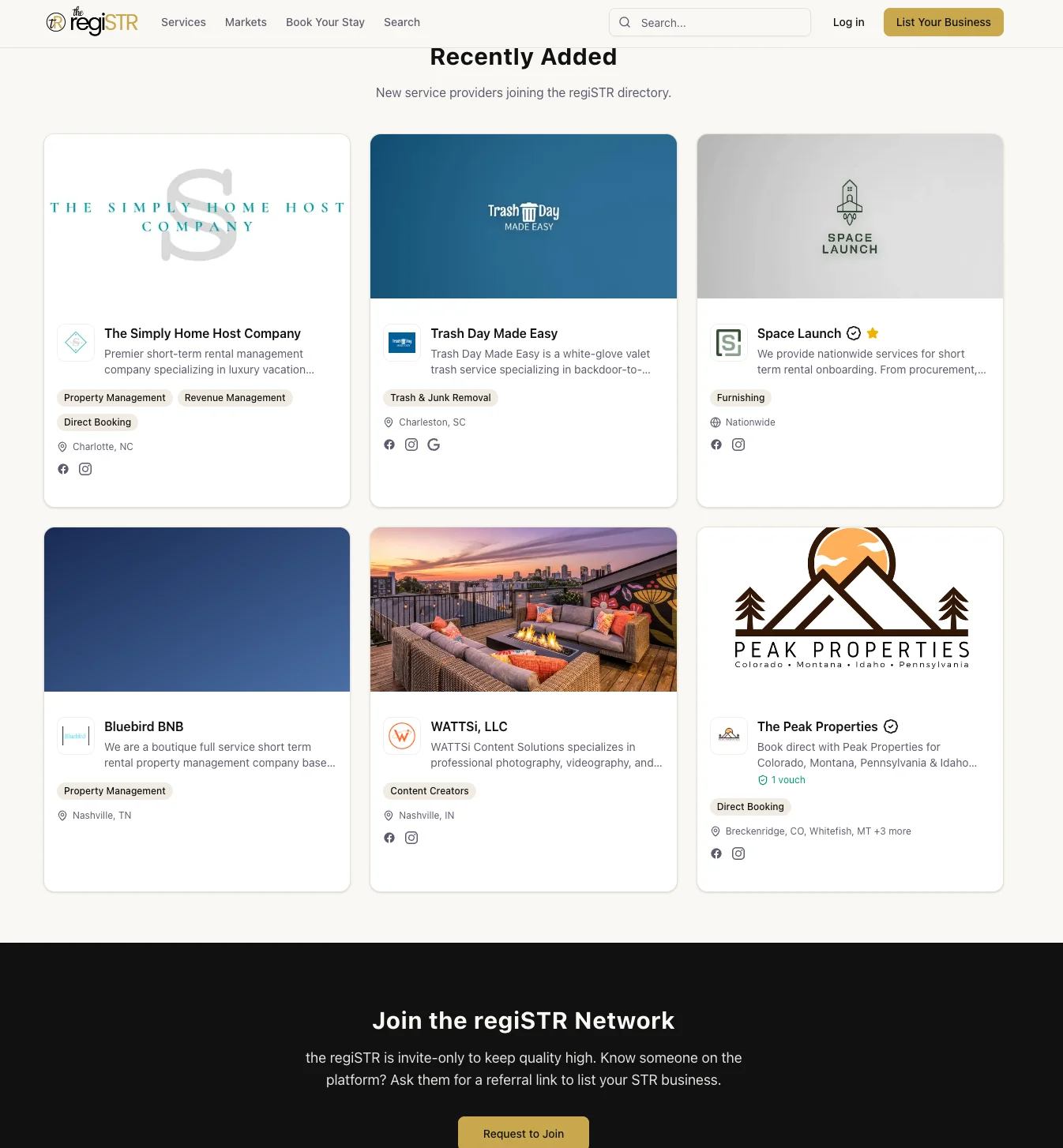
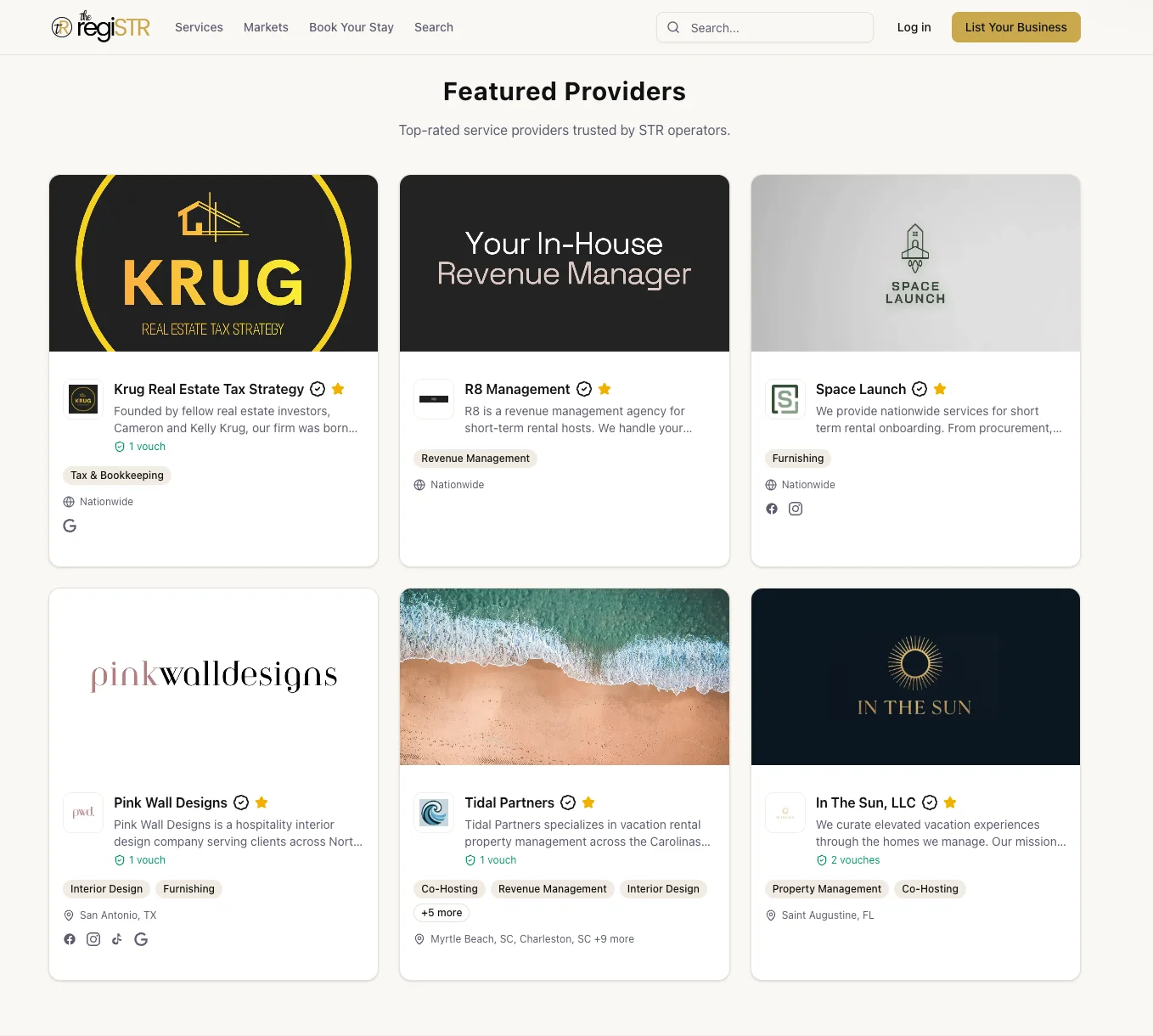
Providers listed on the regiSTR include specialists like Revive Rental Solutions, Cribs Consulting, and Pink Wall Designs, each serving STR operators in specific markets with services tailored to vacation rental operations rather than general home services.
How Do You Evaluate an STR Directory Before Using It?
Evaluating an STR directory before you rely on it for vendor hiring comes down to four questions: How do providers get in? How is trust established? How are listings organized? And is the audience actually STR operators, or is it a mixed residential and STR crowd? The answers to these questions determine whether the directory will save you time and reduce hiring risk, or simply add another layer of noise to your search.
| Evaluation Criterion | What to Look For | Red Flag |
|---|---|---|
| Provider intake process | Invite-only, referral-based, or application with STR verification | Open self-registration with no vetting step |
| Trust mechanism | Peer endorsements from named STR operators who have hired the provider | Anonymous star ratings or self-reported testimonials only |
| Geographic organization | Market-specific pages for individual STR cities and regions | Broad location filters only (state or country level) |
| Service category depth | Covers all major STR service types including revenue management, co-hosting, compliance | Limited to cleaning and property management only |
| Audience specificity | Platform is exclusively for STR operators and STR service providers | Mixed residential and STR audience with no segmentation |
| Profile transparency | Markets served, services offered, and client endorsements are publicly visible | Profiles consist of self-written descriptions with no third-party verification |
Apply these criteria before you hire through any platform. A directory that fails on intake process or trust mechanism will have an uneven quality floor, and you will not know which providers clear the floor until after you have hired them. The goal of a well-designed STR service directory is to front-load that vetting so the work is done before you start browsing, not after.
What Types of Providers Should Be Listed in an STR Directory?
A complete STR directory should list every category of service provider that vacation rental operators need to run a competitive, guest-ready property. The categories below represent the full scope of vendor relationships a serious STR operator needs to manage, from operational day-to-day functions to strategic growth and compliance.
Operational Providers (Day-to-Day)
Cleaning and turnover specialists form the backbone of any STR operation. A reliable STR cleaning and turnover team is the single most critical vendor relationship for maintaining guest satisfaction and review scores. Co-hosts and full-service property managers handle guest communications, check-in coordination, and on-the-ground response for hosts who manage remotely or prefer a hands-off approach. Maintenance and repair providers cover the inevitable issues that arise between guests, from a broken appliance to a plumbing call that cannot wait until Monday.
Creative and Marketing Providers
Professional photographers who specialize in STR listings understand OTA composition requirements, know how to stage for perceived space, and deliver hero shots that drive click-through rate against competing listings. Interior designers who work in the STR space understand the intersection of guest experience, durability, and visual performance in listing photos. These are not the same as residential interior designers; an STR-focused designer makes decisions based on how a space photographs as much as how it feels to live in. You can browse STR-specialized photographers and STR interior designers organized by market on the regiSTR.
Strategic and Revenue Providers
Revenue managers and dynamic pricing specialists optimize nightly rates based on market demand, competitor pricing, and seasonal patterns. In markets like Gatlinburg or Scottsdale, where demand spikes are sharp and predictable, a revenue manager can meaningfully improve annual income compared to static or manually adjusted pricing. SEO and content marketing providers help operators build direct booking channels that reduce dependence on OTA fees over time. STR consulting and advisory services cover everything from portfolio acquisition strategy to regulatory navigation for operators entering new markets.
Compliance Providers
Regulatory and compliance specialists understand the permit requirements, lodging tax obligations, and municipal ordinances that apply to STR operators in specific markets. As STR regulation has tightened across major markets in recent years, from New York City's strict guest limits to city-level permit databases in Portland and Honolulu, the compliance layer has become a meaningful operational category in its own right. An STR directory that omits compliance specialists is leaving out a service that many operators urgently need.
Is the STR Service Provider Market Large Enough to Justify a Specialized Directory?
The STR service provider market is large enough, and growing fast enough, to not only justify a specialized directory but to make one genuinely necessary. As of early 2026, there are over 7 million active short-term rental listings globally across major OTA platforms, according to industry data. Professional management companies control an estimated 42% of those listings. The U.S. short-term vacation rental market alone is projected to reach $76.46 billion in 2026 and grow to $125.14 billion by 2033 at a 7.3% CAGR (DataIntelo).
These numbers translate directly into vendor demand. Every one of those 7 million listings needs, at minimum, a cleaning service. A substantial portion needs photography, property management, and maintenance support. The operators behind those listings span every segment from first-time hosts launching a spare bedroom to professional investors managing 20-property portfolios. General business directories were not designed to serve this audience, and the gap between what those platforms offer and what STR operators actually need has grown as the industry has matured.
The regiSTR was built in direct response to this gap. Almost 60% of short-term rental operators cite additional income generation as the primary driver for running an STR (Statista). Those operators are running a business, not a hobby. They need business-grade vendor infrastructure, not a residential home services directory with "Airbnb" added as a search keyword.
How Do STR Operators Use a Service Directory in Practice?
In practice, STR operators use a service directory the way any business owner uses a vetted vendor network: as the first stop when a need arises, rather than starting a cold search from scratch each time. The operator who has already identified their key vendors through a trusted STR directory is not scrambling to find a cleaner the night before a same-day turnover. They have a name, a contact, and a relationship built on at least one previous successful hire.
The workflow looks like this for a typical operator. Before launching a new property, they navigate to the directory's market page for the relevant city. They browse the cleaning and turnover category, filter by location, read peer endorsements from other hosts who have worked with each provider, and contact two or three candidates. They run a trial turnover, evaluate the results against their property's checklist, and lock in a primary cleaner. They repeat this process for photography, maintenance, and revenue management before the first guest ever books.
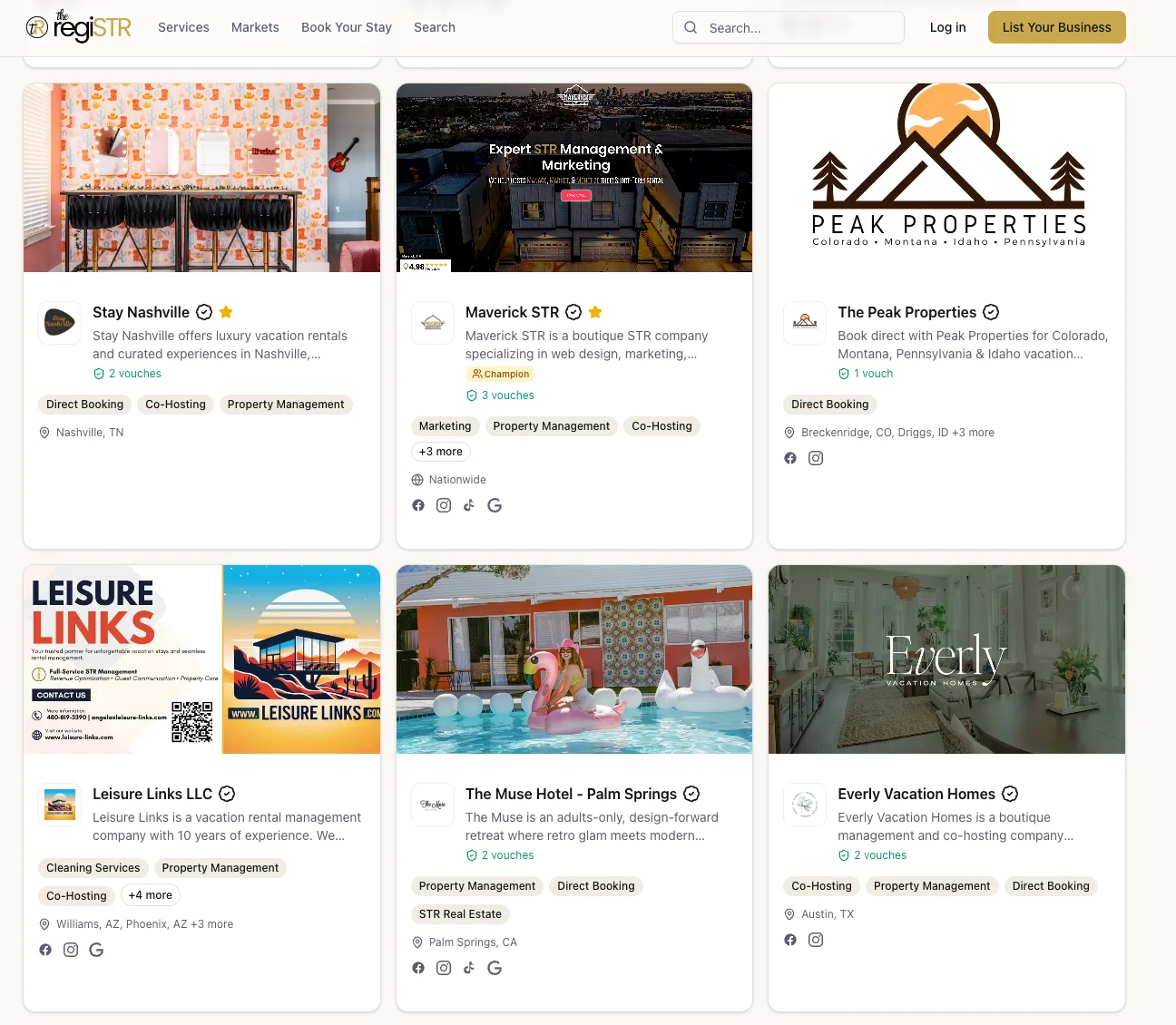
For operators entering a new market, the workflow is even more valuable. Building a vendor network in a city you do not live in through cold Google searches and Facebook groups is genuinely difficult. A directory organized by market shortens that process from weeks to hours. The regiSTR's market pages function as a ready-made vendor map for every major STR geography, letting operators like Hideaway Retreats and others navigate new markets without starting from zero.
Ready to stop cycling through cold searches? Browse vetted STR service providers by market and category at the regiSTR. Sign Up Free at theregistr.co.
Frequently Asked Questions About STR Directories
What is an STR directory and how is it different from a general business listing?
An STR directory is a specialized platform that lists service providers specifically for the short-term rental industry, organized by service category and geographic market. Unlike a general business listing, an STR directory filters every provider through the lens of vacation rental operations, so hosts are not sorting through residential cleaners or general real estate photographers to find someone who understands STR turnover timelines, OTA listing requirements, and the operational standards that affect guest reviews and revenue.
Why do general business directories fail vacation rental operators?
General business directories fail STR operators for several interconnected reasons: they do not filter for STR-specific experience, they aggregate reviews from residential clients whose standards differ fundamentally from STR standards, they lack market-specific organization relevant to vacation rental geographies, and their pay-per-lead models incentivize providers to respond to any inquiry rather than only the ones they are genuinely qualified to serve. The result is that operators spend significant time filtering out irrelevant results rather than evaluating genuinely qualified candidates.
What service categories should a short-term rental directory cover?
A complete short-term rental directory should cover all major STR service categories: cleaning and turnover services, full-service property management, co-hosting and co-management, photography and virtual tours, interior design and staging, maintenance and repairs, revenue management and dynamic pricing, SEO and content marketing, website design, social media management, STR consulting and advisory, and regulatory and compliance support. Directories that cover only cleaning and property management leave significant gaps for operators who need a full vendor team.
How do I know if a provider listed in an STR directory is actually vetted?
Vetting quality depends entirely on the directory's intake process and trust mechanism. Look for directories that use an invite-only or referral-based admission system, where existing trusted members endorse new providers before they go live. The trust signal on provider profiles should come from named STR operators who have worked with the provider, not anonymous star ratings or self-written testimonials. The regiSTR uses a Vouch system where real, named STR operators publicly endorse providers, making the social proof accountable and contextually relevant rather than generic.
Is there a difference between an STR service directory and a government STR registry?
Yes, these are completely different systems. A government STR registry is a mandatory compliance database maintained by a city or state where operators must register their properties to operate legally. Examples include permit registries in Portland, Oregon, and mandatory registration systems in states like Rhode Island. An STR service directory is a voluntary marketplace where operators find and hire vendors for their property. Both matter to serious operators, but they serve entirely different functions: compliance versus vendor discovery.
Can STR service providers benefit from listing in a specialized directory?
STR service providers benefit significantly from a specialized directory because the audience quality is far higher than on general home services platforms. Every visitor to an STR-specific directory is a potential client with a genuine vacation rental need, compared to general platforms where the majority of incoming inquiries come from residential clients with no STR requirements. For cleaners, photographers, co-hosts, and property managers who specialize in short-term rentals, an STR directory delivers qualified leads without the audience mismatch problem of general marketplace platforms.
How should I use an STR directory when entering a new vacation rental market?
When entering a new STR market, use the directory's market-specific pages to identify vetted providers in the relevant city or region before your first guest books. Start with cleaning and turnover services, then identify a maintenance contact and a photographer if you need new listing photos. Read peer endorsements from other operators who have hired in that market, contact two or three providers for each category, and run a trial engagement before committing to a long-term relationship. This process is significantly faster and lower-risk than cold searching through general directories or social media groups.
What makes the regiSTR different from other STR directories?
The regiSTR is an invite-only, curated STR service directory organized by market and service category, with a Vouch system that replaces anonymous ratings with peer endorsements from named STR operators. Every provider has been referred into the network by an existing trusted member, which pre-screens for STR specialization before the profile goes live. The directory covers all major STR service categories and maintains dedicated market pages for popular vacation rental cities and regions across the United States, making it a centralized resource for operators who need a vetted vendor team in any market they enter.
What Does the STR Directory Landscape Look Like in 2026?
In 2026, the STR directory landscape reflects both the maturity of the vacation rental industry and the growing recognition that operators need purpose-built infrastructure for vendor discovery. The global vacation rental market is valued at over $100 billion (Mordor Intelligence), and the professionalization of the operator base has accelerated demand for credible, organized vendor networks.
Government-level STR directories have expanded in scope and enforcement. Cities and states across the U.S. maintain mandatory registration databases, permit lookup tools, and public-facing compliance registries. Rhode Island, for example, operates a public STR license lookup tool where anyone can verify whether a property is legally registered. These regulatory systems have become standard infrastructure in active STR markets, and operators who fail to register face fines and potential platform removal.
Internationally, STR advocacy organizations and directories have become a meaningful part of the industry's institutional infrastructure. Bodies like the Association of Scotland's Self Caterers, the Spanish Federation of Holiday Rentals Associations, and the Australia and New Zealand Short-Term Rental Association maintain their own operator directories and resources that parallel what the regiSTR does for the U.S. market. The existence of these organizations across multiple continents signals that the STR industry consistently develops specialized directory infrastructure as it matures, because general business resources cannot meet the operational needs of vacation rental operators.
On the service provider side, the pattern we consistently observe is that the most capable vendors in any market eventually migrate toward STR-specific platforms. The audience quality is better, the client fit is tighter, and the peer endorsement dynamic builds the kind of reputation that compounds over time. In 2026, that migration is accelerating as the STR operator base grows more sophisticated and less willing to accept the noise of general home services search results.
The Verdict: Why an STR Directory Is Not Optional for Serious Operators
For hosts who want to run a consistently profitable, guest-ready vacation rental, a purpose-built STR directory is not a nice-to-have. It is the foundation of a functional vendor network. The operators who consistently outperform their competitors in markets like Nashville, Gatlinburg, the Smoky Mountains, and Scottsdale are not doing anything magical with pricing or marketing. They have reliable cleaners who never miss a turnover, photographers who made their listings look better than the competition, and maintenance contacts who pick up the phone. The infrastructure for that team starts with knowing where to find the right people.
General business listings, government compliance registries, and social media groups each serve a different function. None of them replaces a dedicated STR service directory where every provider has been vetted through peer endorsement, organized by market, and categorized by the specific operational need they serve.
If you are building that vendor team now, whether for your first property or your tenth market, the regiSTR's directory is the most direct path to vetted, STR-specialized providers. Browse by service category, filter by market, read Vouch endorsements from other hosts, and contact providers who already understand what your operation requires.
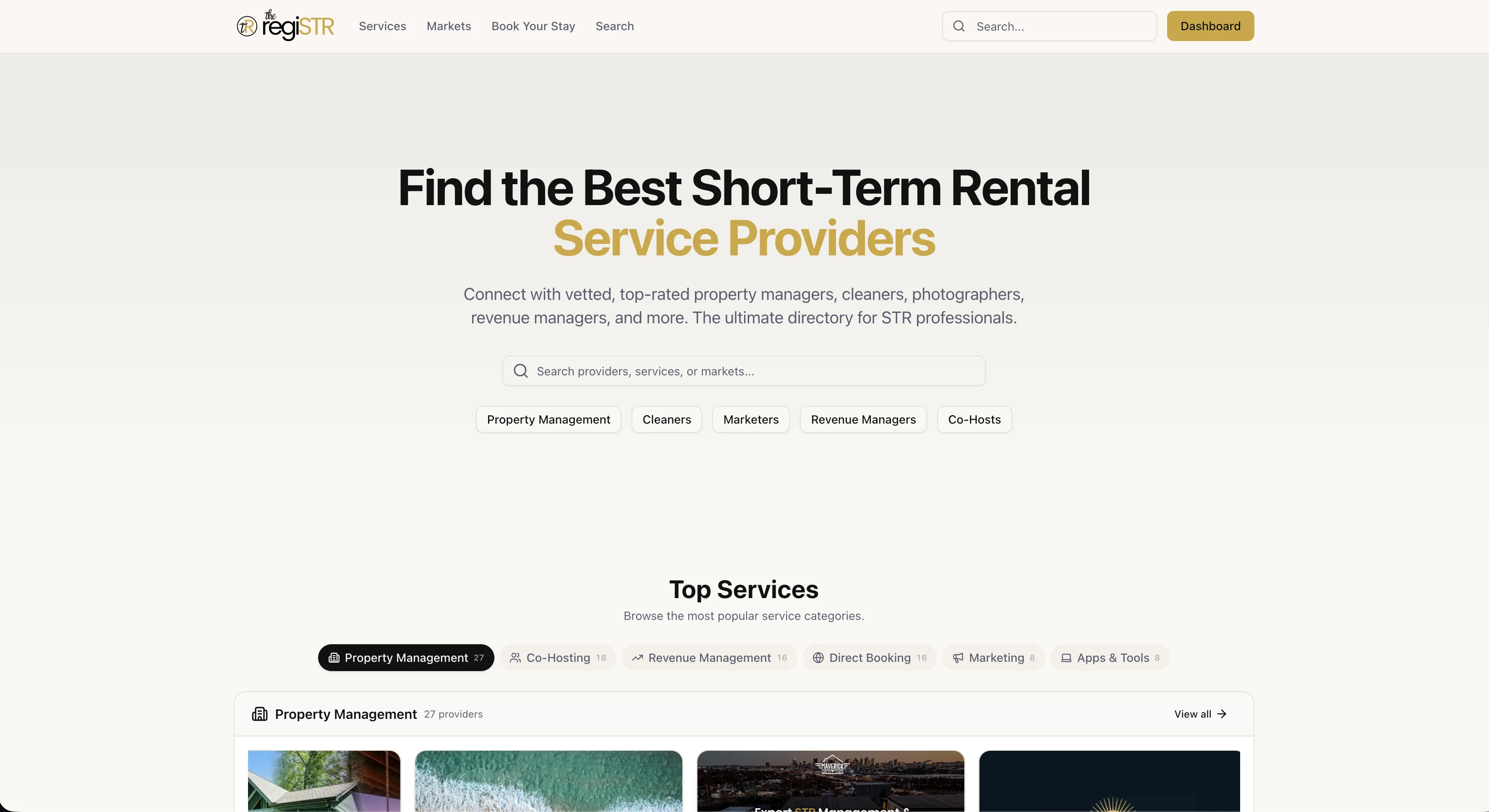
Find vetted STR service providers organized by market and category at the regiSTR. Sign Up Free and build your vendor network without the guesswork.
Content powered by inkSTR.co