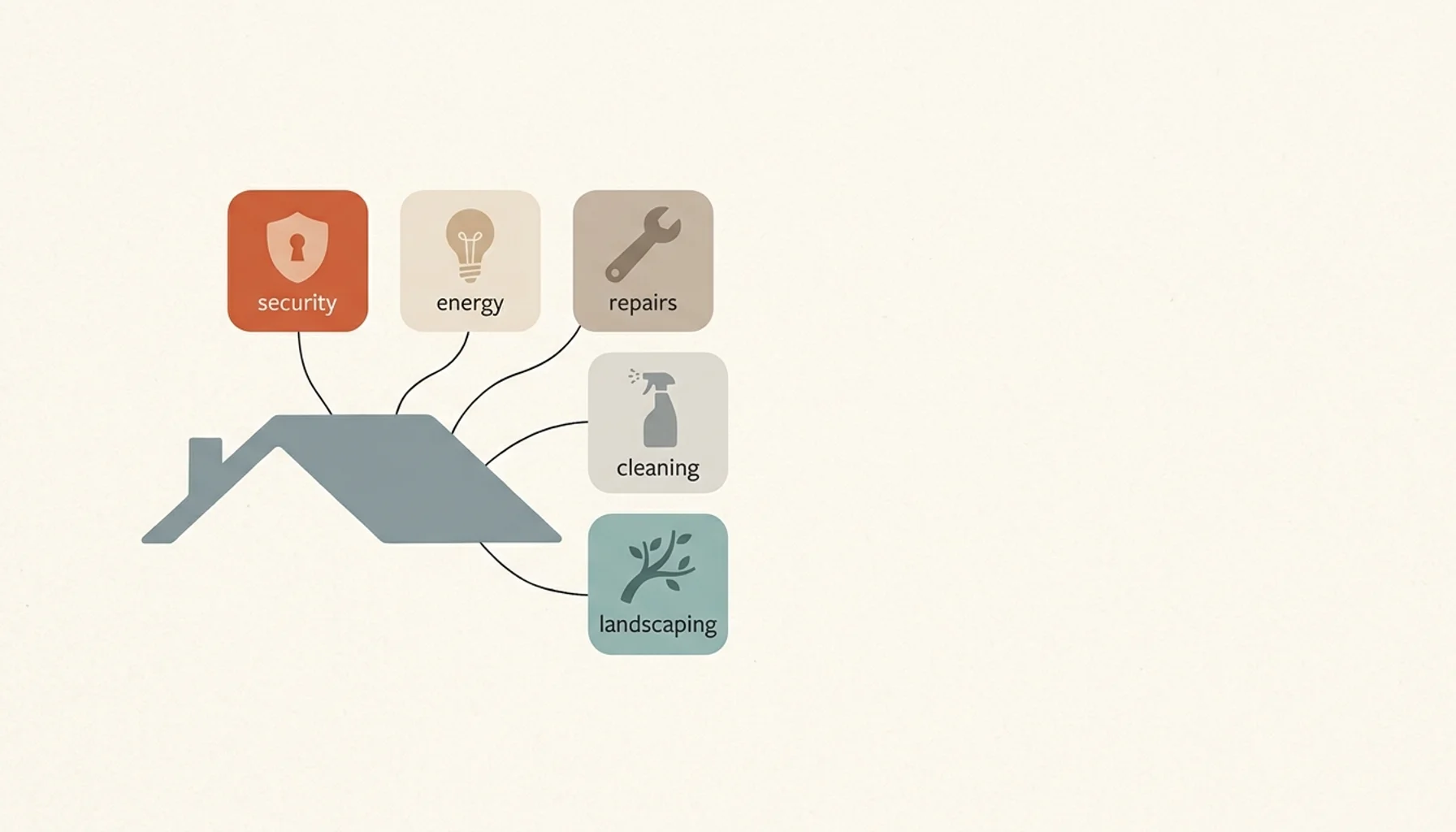
How to Scale Your STR Portfolio With Vendors Who Deliver

Scaling an STR portfolio with vendors means building a repeatable, documented vendor network, cleaners, maintenance techs, co-hosts, and revenue managers, before you acquire each new property, not after you're already overwhelmed. The vendor bottleneck, not capital, is what actually stalls most STR operators between their first and third unit.
- Vendor capacity, not cash, is the real ceiling on scaling. A cleaner who can't add a second property without slipping on the first will cap your growth long before financing does.
- Professional STR property managers typically charge 15 to 25% of gross rental revenue, depending on service scope and market, according to industry benchmarks, so vendor economics need to be built into your acquisition math from day one.
- Most efficient management companies run 5 to 15 units per manager before service quality starts to erode, a useful reference point when deciding how many properties one vendor relationship can realistically support.
- Roughly 42% of the estimated 7 million active short-term rental listings globally are already under professional management as of early 2026, according to DataIntelO, meaning the operators who scale successfully are outsourcing systematically, not doing everything themselves.
- Standardizing your amenity sets, cleaning protocols, and vendor contracts across properties before market two is the single biggest predictor of whether scaling goes smoothly or turns into a full-time crisis job.
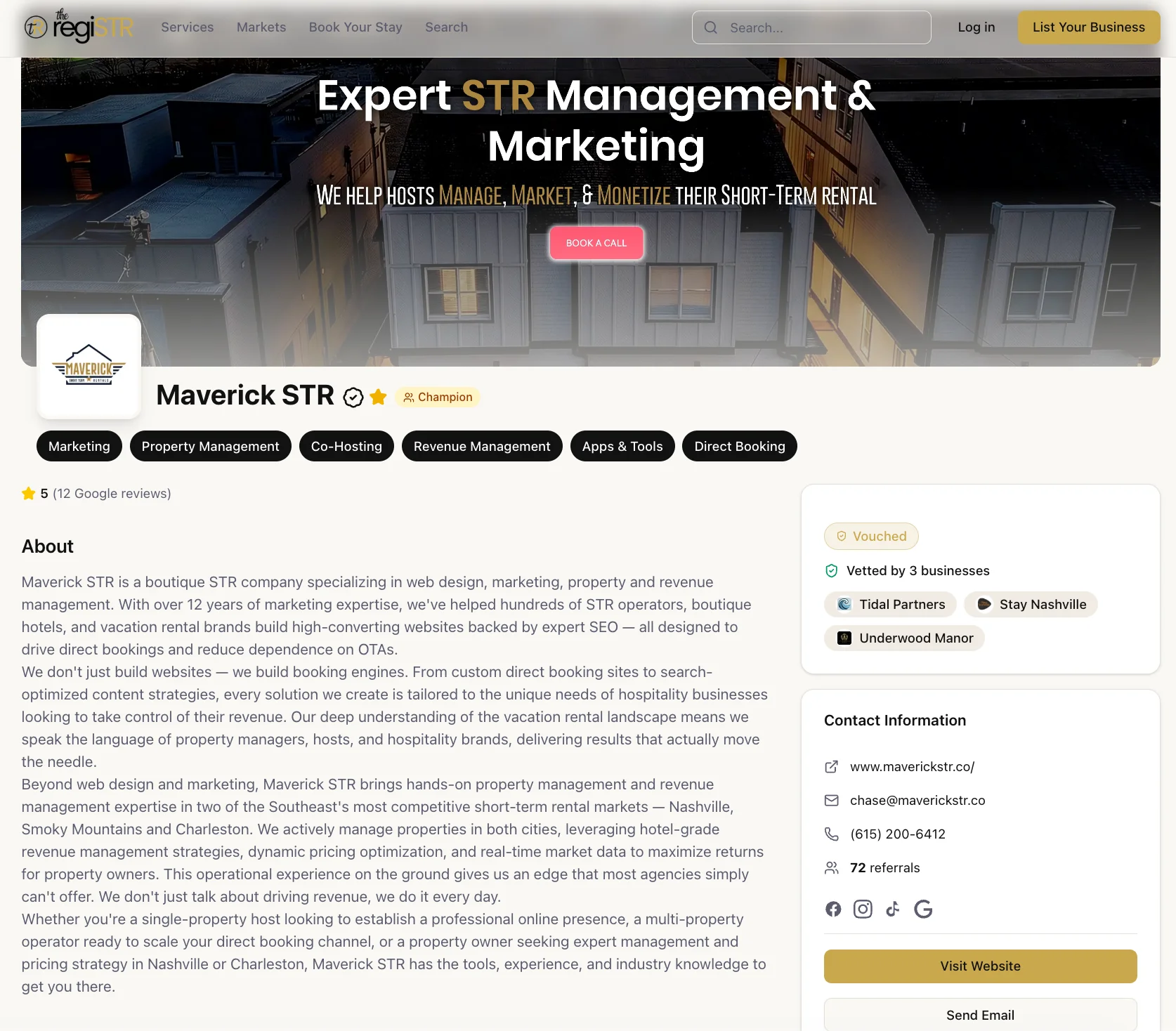
- the regiSTR solves the vendor discovery problem directly: it's a vetted, market-organized directory where you can build your next city's vendor bench before you close on the property, instead of scrambling after keys are in hand.
If you're reading this because your one property runs smoothly and you're eyeing a second, or because you already own three and the cracks are showing, you're in the right place. This is a how-to for operators, not investors chasing a spreadsheet fantasy. It assumes you already know what a turnover window is and what RevPAR means. What follows is the operational playbook for the part nobody talks about at STR meetups: how you actually find, vet, and retain the vendors who let your portfolio grow without your quality of life collapsing.
Based on what we see across the providers listed on the regiSTR, the operators who scale past three properties without burning out share one habit: they treat vendor sourcing as a pre-acquisition task, not a post-closing scramble. This guide walks through that framework step by step, using the real questions hosts ask when they hit the wall between "comfortable with one" and "drowning in three."
Step 1: Master Your First Property Before You Buy a Second
Mastering your first STR property means using it as a training ground for the systems, vendor relationships, and standards you'll replicate everywhere else. Skipping this step is the number one reason second properties underperform their first.
Your first unit teaches you five things you cannot learn from a spreadsheet: your actual turnover cleaning window, your guest communication rhythm, your realistic pricing ceiling, your local vendor bench, and what specific amenities actually move your occupancy needle. Document all five before you start looking at property two. Specifically, write down your cleaner's average turnaround time, your maintenance response time on emergencies, and which listing photos or amenities generated the most inquiries. This becomes your operations manual, the reference document your future co-host or property manager will use instead of reinventing your process from scratch.
A common mistake: buying property two because property one is profitable, without confirming your existing cleaner has capacity for a second unit without sacrificing quality on the first. If your cleaner is already stretched, that's your signal to recruit a backup, not your signal to expand. This is exactly the vetting gap we designed the regiSTR's Cleaning and Turnover directory to close, filtering for STR-specific cleaners by market so you're not relying on a single point of failure.
What Is the 3-3-3 Rule in Real Estate?
The 3-3-3 rule in real estate is a scaling guideline that suggests operators focus on reaching three properties in their first market before expanding into a second, then repeating that pattern of three to five units per market before adding a third. For STR operators specifically, this translates into a vendor strategy: build a complete local bench, cleaning, maintenance, and co-hosting, in one metro before you split your attention across two. The logic holds up operationally. A vendor network takes real time to establish: you need to test a cleaner's reliability across multiple turnovers, confirm a handyman's response time on an actual emergency, and build enough trust with a co-host that they'll flag issues before they become reviews. Trying to build that trust in two markets simultaneously usually means neither gets built well. In practice, this means resisting the urge to buy your second property in a brand-new state just because the cap rate looks better on paper. The vendor relationships you'd need to rebuild from zero often outweigh a marginal yield improvement. Once you hit three to five properties in one market with a documented, reliable vendor bench, that's your signal to evaluate a second market, not before. Browsing the regiSTR's property management directory for your target metro before you buy gives you a read on vendor density in that market well ahead of closing.
How to Scale a Real Estate Portfolio?
Scaling a real estate portfolio for short-term rentals requires four parallel systems working at once: standardized operations, a documented vendor bench per market, automation for repetitive tasks, and quarterly performance tracking across every property. Missing any one of these four turns growth from a plan into chaos. First, standardize what can be standardized. Consistent bedding suppliers, a repeatable kitchen inventory list, preselected décor vendors, and a standard outdoor amenity kit, think fire pits, deck seating, game areas, reduce decision fatigue every time you onboard a new unit. You're not reinventing the wheel per property; you're deploying a known formula. Second, build your vendor bench market by market rather than nationally. Electricians, plumbers, HVAC technicians, landscapers, pest control companies, and handymen are the six vendor categories that repeatedly show up as critical across scaling portfolios, and every one of them needs to be locally sourced. A remote owner in Denver can't call their Nashville handyman when a Smoky Mountains cabin's water heater fails at 11pm. Third, automate the repetitive. Calendar sync, automated guest check-in instructions, cleaning notifications triggered by checkout, review prompts, dynamic pricing updates, and maintenance reminders all need to run without your daily intervention once you're past two properties. This is also where browsing the full regiSTR services directory by category becomes useful: revenue managers, co-hosts, and consultants who specialize in setting up these automated systems are listed by market, so you're not building this stack from scratch alone. Fourth, review quarterly. Track occupancy trends, ADR movement, guest issues, review patterns, and amenity ROI on a fixed schedule rather than reacting property by property as problems surface.
What Is the 60/20/20 Rule for Portfolios?
The 60/20/20 rule for STR portfolios is a resource allocation framework suggesting operators dedicate roughly 60% of operational focus to properties currently performing at or above target occupancy, 20% to properties underperforming and needing intervention, and 20% to forward planning, new market research, vendor recruitment, and system upgrades. It's less a hard financial ratio and more a discipline for where your attention goes as your portfolio grows. The temptation as you scale is to spend nearly all your time firefighting the underperforming property, the one with the inconsistent cleaner or the maintenance backlog. But that pulls focus away from the properties quietly running well, which is exactly when small issues, a slipping review score, a cleaner cutting corners, go unnoticed until they compound. Applying this to vendor management specifically: your best-performing properties still need periodic vendor check-ins, not just crisis properties. A quarterly call with your top cleaner or co-host, even when nothing's wrong, catches capacity issues before they surface as a missed turnover. Meanwhile, the 20% dedicated to forward planning is where you're researching your next market's vendor landscape, so when you do buy property four or five, you're not starting vendor discovery from zero. That's the exact gap the regiSTR's market pages are built to close: pre-browsing vetted providers in a market you haven't entered yet, from cleaning to co-hosting, so your forward-planning hours produce a real vendor shortlist instead of a Google search history.
What Is the 7% Rule in Real Estate?
The 7% rule in real estate is a rough investment benchmark suggesting a property should generate roughly 7% of its purchase price in annual net operating income to be considered a strong acquisition. For STR operators, vendor costs are one of the biggest variables that determine whether a property actually clears that bar once it's operational, not just on paper. Here's why this matters for vendor planning specifically: a property that looks like it clears 7% based on projected ADR and occupancy can fall short fast if your management fee, cleaning costs, and maintenance reserve weren't modeled realistically. Professional property management alone typically runs 15 to 25% of gross revenue depending on service scope, according to industry benchmarks, and that's before turnover cleaning, routine maintenance, and emergency repairs are factored in separately. A mistake we see often: operators run their 7% math using self-management labor costs of zero, then get surprised when hiring a manager or co-host to make the numbers work on paper actually drags net income below the underwriting they used to justify the purchase. Build your vendor costs into the acquisition model before you make an offer, not after your first quarter of actual invoices. Comparing quotes side by side across vetted property managers and revenue management providers before you close gives you real numbers to underwrite with, instead of assumptions.

Step 2: Recruit Your Vendor Bench Before You Need It
Recruiting your vendor bench before you need it means identifying and vetting cleaners, maintenance technicians, and support staff in your target market before your new property closes, not after guests are already booked. Waiting until move-in day to start vendor outreach is the single most common operational mistake among first-time multi-property owners. The recommended recruiting order is housekeepers first, then maintenance technicians, followed by guest support staff, inspectors, and laundry services if your properties use linen rental. Each category has a different vetting bar. A cleaner needs demonstrated STR turnover experience, not just residential cleaning history; a maintenance tech needs a realistic response-time commitment, ideally under a few hours for urgent issues; an inspector needs to understand what "guest-ready" actually looks like beyond a generic checklist. For remote owners specifically, this recruiting phase is where things typically break down. Cold-calling contractors found through generic search results wastes weeks and often produces vendors who've never handled a same-day, guest-facing turnover. This is precisely the friction the regiSTR's Maintenance and Repairs category was built to remove: every listed vendor serves specific named markets, so a Colorado-based owner buying in the Smokies can filter directly to providers who already work that geography, rather than guessing from a map search. Pro tip: recruit two vendors per category from the start, a primary and a backup, even for your first property in a new market. Single points of failure in cleaning or maintenance are what turn one bad week into a review-damaging streak.
Step 3: Standardize Contracts and Documentation Across Properties
Standardizing vendor contracts across properties means using consistent scope-of-work language, payment terms, and performance expectations for every cleaner, manager, or maintenance provider you hire, regardless of which property they service. This prevents the patchwork of informal handshake deals that quietly erodes accountability as portfolios grow. Your management contract, whether with a full-service property manager or an individual co-host, should specify response time commitments, reporting cadence, fee structure tied to gross revenue, and what happens during vacancy or off-season periods. If a contract doesn't specify a guaranteed turnaround window for turnover cleaning, that's a red flag, not a minor omission. A documented operations manual, the one you built during Step 1, becomes the attachment every new vendor contract references. Instead of explaining your standards verbally to every new hire, you hand them the manual. This is what separates operators who scale smoothly from those who re-explain the same expectations to every new vendor in every new market.
Step 4: Track Performance With Portfolio-Level KPIs
Tracking portfolio-level KPIs means monitoring occupancy rate, ADR, RevPAR, guest review scores, cleaning costs, maintenance expenses, and profit margin across every property on a fixed schedule, not just glancing at individual booking calendars when something feels off. One useful metric as you add properties is the Market Penetration Index, calculated as your property's occupancy divided by market occupancy, multiplied by 100. Many operators set an alert when a property drops below 85% MPI, signaling it's underperforming its comp set and needs a pricing or vendor review before the quarter ends. Pacing benchmarks also vary meaningfully by property type. Industry data suggests 1 to 2 bedroom condos should sit around 40% booked at the 90-day mark, 70% at 60 days, and 90% at 30 days out. Larger 3 to 4 bedroom homes typically pace slower, around 30% at 90 days and 85% at 30 days, while 5-plus bedroom luxury properties often pace at just 20% booked at 90 days but climb to 75% by the 30-day mark. If a property in your portfolio is falling meaningfully behind its type's pacing benchmark, that's often a vendor or pricing issue, not a market issue. Quarterly reviews should specifically cross-reference these KPIs against vendor performance: is a specific property's declining review score tracing back to a cleaner who's overextended? Is a maintenance backlog on one unit dragging down its occupancy relative to comparable properties in the same market? Portfolio-level tracking makes these patterns visible instead of buried in five separate booking dashboards.
| Property Type | 90 Days Out | 60 Days Out | 30 Days Out |
|---|---|---|---|
| 1 to 2 bedroom condo | 40% booked | 70% booked | 90% booked |
| 3 to 4 bedroom home | 30% booked | 60% booked | 85% booked |
| 5+ bedroom luxury | 20% booked | 45% booked | 75% booked |
Why Does Vendor Consolidation Save Money as You Scale?
Vendor consolidation saves money as an STR portfolio scales because fixed costs like technology subscriptions, marketing spend, and vendor negotiation leverage get spread across more properties, reducing the effective cost per unit. A portfolio of five properties negotiating cleaning rates carries meaningfully more leverage than a single-property owner calling around individually. Larger portfolios can typically negotiate better terms with cleaning services, maintenance providers, and software subscriptions simply because vendors value the volume and consistency of repeat business across multiple units under one relationship. A cleaning company servicing four of your properties on a predictable schedule has less incentive to prioritize a competitor's single, irregular booking over yours. This is also where the vendor discovery layer matters most. If you're sourcing vendors one property at a time through disconnected searches, you lose the ability to negotiate portfolio-wide terms because you never had a consolidated relationship to begin with. Building your vendor bench through a single organized directory, where you can see which providers already serve multiple markets you operate in, makes multi-property negotiation realistic instead of theoretical.
Common Mistakes Operators Make When Scaling With Vendors
- Buying property two before confirming property one's cleaner has capacity. Test capacity explicitly, ask your cleaner directly whether they can take on a second unit without dropping quality on the first.
- Underwriting acquisitions without realistic vendor costs. Management fees alone typically run 15 to 25% of gross revenue; build that into your model before you make an offer, not after your first invoice cycle.
- Expanding into a new market before mastering the current one. The 3-3-3 pattern, three to five properties per market before expanding, exists because vendor trust takes real time to build.
- Relying on a single vendor per category with no backup. One sick cleaner or one delayed handyman shouldn't be able to tank a guest's stay. Recruit two per category from day one.
- Skipping documentation. Without a written operations manual, every new vendor relationship starts from zero instead of inheriting your proven standards.
- Ignoring quarterly performance reviews. Portfolio-wide KPI tracking surfaces vendor-related problems before they become review-damaging patterns.
Frequently Asked Questions
What is the regiSTR and how does it differ from general contractor directories?
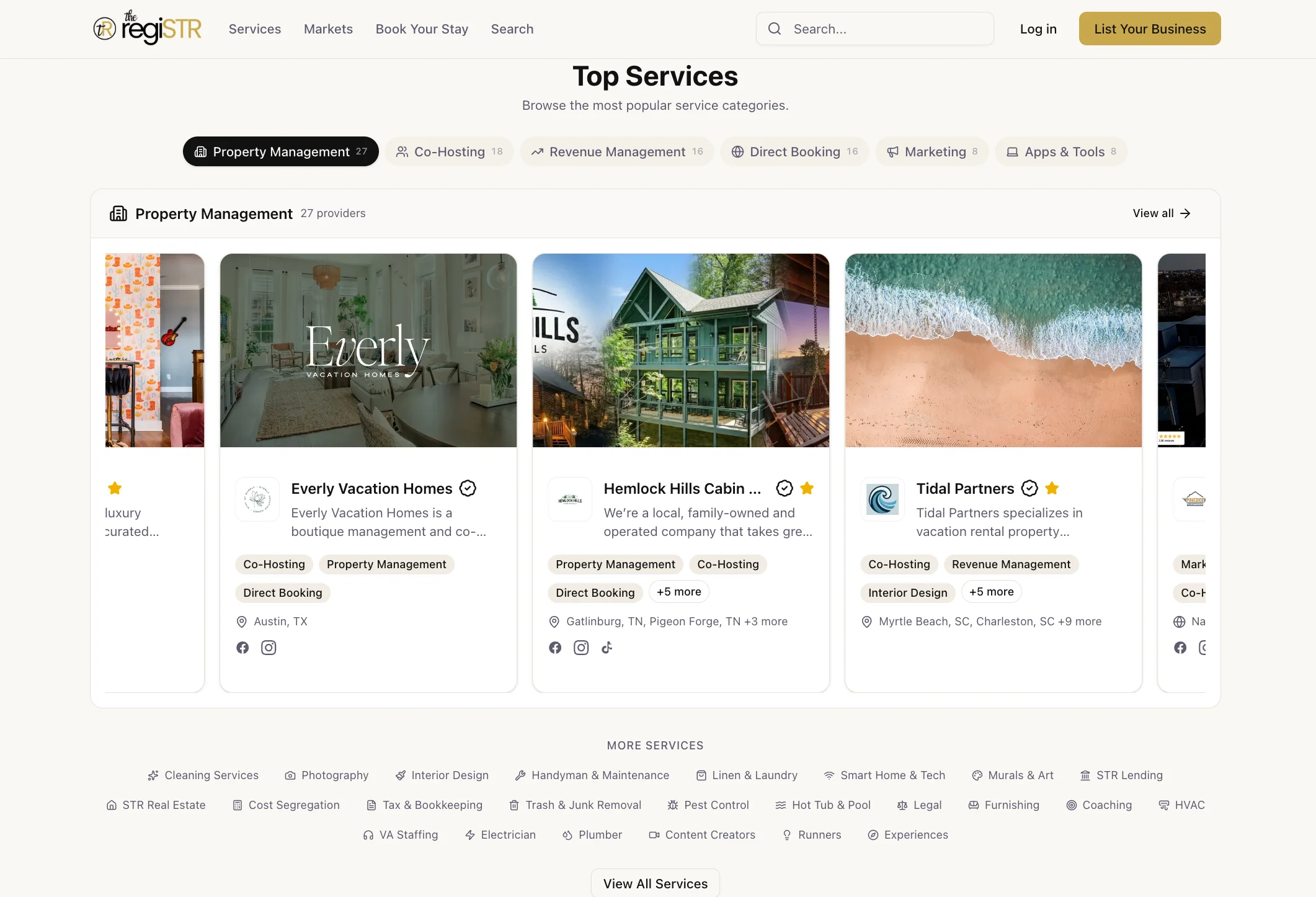
The regiSTR is a short-term rental service directory organized specifically by market and service category, connecting STR operators with cleaners, property managers, maintenance techs, and other vendors who have actual vacation rental experience. Unlike general directories, every visitor is already an STR operator searching for STR-specific services, and providers are referred in by existing network members rather than appearing through anonymous sign-up.
How many properties should I have before hiring a property manager?
There's no fixed number, but many operators find the workload becomes unsustainable somewhere between two and four self-managed properties, particularly if any are in a market they don't live in. If you're spending more time coordinating vendors than growing your business, that's a stronger signal than a specific property count.
How do I find reliable maintenance vendors in a new STR market?
Start by identifying the six core vendor categories, electricians, plumbers, HVAC technicians, landscapers, pest control, and handymen, and vet each for STR-specific response time commitments before you close on the property. Browsing a market-organized directory like the regiSTR's maintenance category lets you shortlist providers who already serve your exact metro before you need them urgently.
What's the difference between a co-host and a full-service property manager?
A co-host typically handles guest communication, pricing, and vendor coordination for a percentage fee while you retain more direct oversight, whereas a full-service property manager takes on the complete operational stack including cleaning oversight, maintenance dispatch, and guest services under one contract. Full-service management fees typically run 15 to 25% of gross revenue depending on scope.
How often should I review my vendor performance across a portfolio?
Quarterly reviews are the standard cadence for cross-referencing vendor performance against occupancy, review scores, and maintenance costs across every property in a portfolio. This catches capacity problems, like an overextended cleaner or slow-responding maintenance tech, before they show up as a pattern of negative guest reviews.
Do I need different vendors for every market I operate in?
Yes, for location-dependent services like cleaning, maintenance, and property management, you need vendors physically present in each specific market since these are hands-on services. Location-independent services like revenue management, SEO, and website development can be handled by the same provider across all your properties regardless of geography.
What's the biggest vendor-related mistake operators make when scaling fast?
The most common mistake is expanding into a second or third property without confirming existing vendors have real capacity, then discovering mid-crisis that one overextended cleaner or maintenance tech is now responsible for double the workload. Recruiting a backup vendor per category before you scale prevents this from becoming a guest-facing problem.
Can vendor consolidation actually reduce my per-property costs?
Yes, larger portfolios typically gain negotiating leverage with cleaning services, maintenance providers, and software subscriptions because vendors value predictable, repeat business across multiple units. Spreading fixed costs like marketing and technology across a bigger portfolio also lowers the effective cost per property.
Quick-Reference Summary: Scaling Your STR Portfolio With Vendors
- Master your first property fully before buying a second; document your cleaner's turnaround time, maintenance response times, and top-performing amenities.
- Follow the 3-3-3 pattern: build a complete vendor bench of three to five properties in one market before expanding into a new one.
- Recruit your vendor bench, housekeepers, maintenance techs, support staff, before your new property closes, not after.
- Standardize contracts and reference a documented operations manual for every new vendor relationship.
- Track portfolio-level KPIs quarterly: occupancy, ADR, RevPAR, review scores, and vendor-linked cost trends.
- Underwrite vendor costs realistically against the 7% rule before you make an offer on your next property.
- Consolidate vendor relationships across properties to unlock negotiating leverage on cleaning, maintenance, and software costs.
Conclusion
Scaling an STR portfolio with vendors comes down to sequencing: master one property, document your standards, recruit a vendor bench before you need it, and track performance on a fixed schedule instead of reacting property by property. The operators who stall at two or three units almost always hit a vendor capacity wall, not a capital wall. As of 2026, with professional management already covering roughly 42% of active global STR listings, the direction of the industry is clear: growth increasingly depends on systematized vendor relationships, not solo hustle. Building that vendor bench market by market, with documented standards and realistic contract terms, is what turns a side hustle into a durable portfolio. That's exactly the gap the regiSTR was built to close: a vetted, market-organized directory where you can shortlist cleaners, property managers, maintenance providers, and revenue managers in your next city before you ever close on the property.
If you're planning your next acquisition and want your vendor bench built before closing day instead of scrambling after, browse vetted property managers, cleaners, and maintenance providers by market at theregistr.co/services. Sign up free and filter by city and category in under a minute.
Content powered by inkSTR.co