The Short Term Rental Directory Built for STR Operators

A short term rental directory is a curated platform that organizes STR operators, service providers, or rental properties by category and location so that hosts can find the vendors they need, and vendors can find the clients actively looking to hire them. That definition sounds simple. The reality of finding the right version of one is considerably more complicated, and most operators waste weeks searching in the wrong places before they figure out the distinction that actually matters.
TL;DR
- A short term rental directory built specifically for STR operators solves a problem that general home service platforms cannot: every listing is a vendor who understands turnovers, OTAs, and guest experience standards.
- According to the 2026 State of Digital Government report, the global STR market is now 20 times larger than it was in 2011, and over 75% of surveyed jurisdictions have reported significant STR market growth, meaning the demand for specialized vendor networks has never been higher.
- There are four distinct types of STR directories: guest-facing booking platforms, government registration registries, operator advocacy networks, and vendor service directories. Knowing which type you need determines where to look.
- For STR operators, the most practical directory type is the vendor service directory: a curated, market-organized platform where you can find cleaners, property managers, photographers, co-hosts, and revenue managers in your specific market.
- The invite-only, peer-vouched model outperforms open marketplaces on trust because every provider was referred in by a working operator, not self-listed after paying a fee.
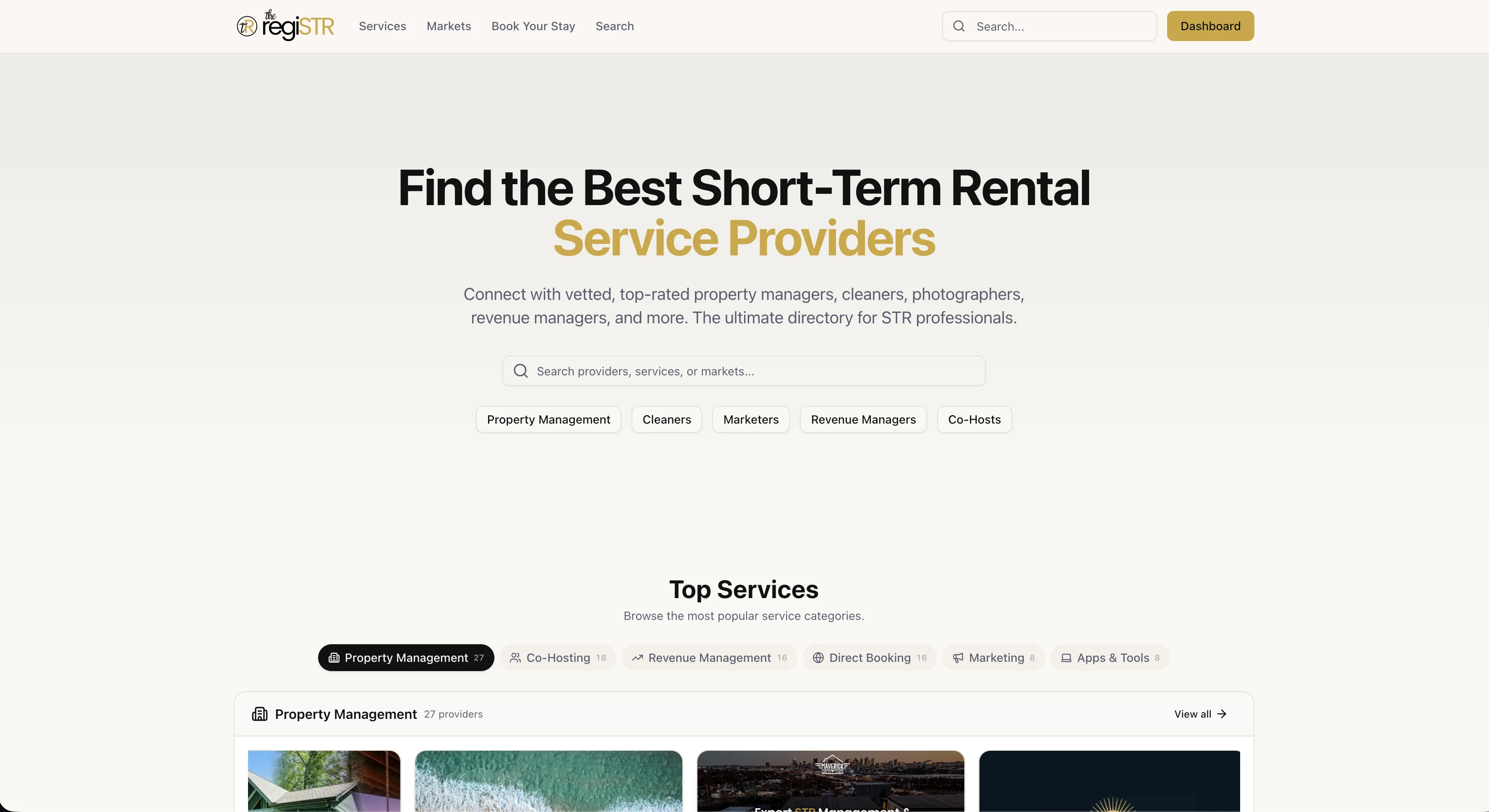
- the regiSTR is a short term rental directory built exclusively for the STR industry, organizing vetted service providers by market and category so hosts can build a complete vendor stack in minutes rather than weeks.
Table of Contents
- What Is a Short Term Rental Directory and Why Does It Matter in 2026?
- The Four Types of STR Directories (And Which One You Actually Need)
- Which Website Is Best for Short-Term Rentals?
- How to Find a Short-Term Tenant: What Operators Often Get Wrong
- What Is the 2% Rule for Rentals and Does It Apply to STRs?
- What Is the 75-55 Rule for Airbnb?
- What Services Should Every STR Operator Have in Their Vendor Stack?
- How Does an Invite-Only STR Directory Differ From an Open Marketplace?
- How to Get Listed in an STR Service Directory as a Provider
- How to Use a Short Term Rental Directory to Build Your Vendor Network Fast
- Frequently Asked Questions About STR Directories
At the regiSTR, we built this platform after watching operators across markets like Nashville, the Smoky Mountains, Scottsdale, and Gulf Shores go through the same painful cycle: post in a Facebook group, get ten responses, vet them manually with no reliable signal of quality, hire someone, get burned, and repeat. That is not a vendor discovery process. It is a tax on your time and your guest reviews.
The STR industry in 2026 is enormous and still growing. What it lacks is the infrastructure layer that makes finding the right vendors fast. This guide covers what a real STR service directory looks like, how to use one to build your vendor stack, and how to evaluate whether what you are looking at is actually built for operators like you or just a general business listing site with an "Airbnb" tag bolted on.

What Is a Short Term Rental Directory and Why Does It Matter in 2026?
A short term rental directory is a structured, searchable platform that organizes STR-relevant businesses, operators, or properties so that users can filter by location, service type, or specialty to find exactly what they need. The key word is "structured." A Facebook group is not a directory. Google Maps is not a directory. A directory has categories, search filters, verified profiles, and some form of quality signal.
Why does this matter specifically in 2026? Because the STR market has scaled far beyond what informal discovery methods can support. The 2026 State of Digital Government report confirms the global short-term rental market is now 20 times larger than it was in 2011. More than 75% of surveyed jurisdictions reported significant STR growth. That scale creates an enormous supply of operators, and an equally enormous supply of vendors trying to reach them. Without a curated directory, the signal-to-noise ratio is brutal.
The operators who build reliable vendor networks the fastest share one trait: they use targeted, STR-specific resources rather than general platforms. A general home service marketplace serves plumbers, wedding caterers, house cleaners, and hundreds of other categories. The person searching for a cleaner there might need a post-construction cleanup or a weekly residential service. Finding someone who knows what a same-day STR turnover requires means filtering through irrelevant results that dominate general directories.
That is the gap the regiSTR fills. Every provider in our network works specifically in the short-term rental space. Every profile is organized by the markets they serve and the services they provide. The distinction is not cosmetic. It changes who shows up in your search results.
The Four Types of STR Directories (And Which One You Actually Need)
Most guides treat "STR directory" as a single concept. It is not. There are four meaningfully different types, and confusing them wastes time. Here is the taxonomy operators actually need to understand.
Guest-Facing Booking Platforms
Airbnb, VRBO, and Booking.com are directories of rental properties organized for travelers. They are optimized for guest discovery, not operator workflows. These platforms are essential for filling your calendar, but they provide zero infrastructure for finding the vendors who keep your property operational. Treating a booking platform as an operator resource is like looking for a mechanic in a car rental app.
Government Registration Registries
Several jurisdictions maintain public STR registries that list permitted properties, permit numbers, and compliance statuses. Rhode Island's Department of Business Regulation, for example, requires mandatory Short-Term Rental Registration under R.I. Gen. Laws § 42-63.1-14, with registration handled through the Rhode Island eLicensing portal. Portland, Oregon maintains a public permit registry with Type A and Type B ASTR classifications. These registries are compliance tools, not vendor discovery tools. You need to know they exist, but they will not help you find a turnover cleaner.
Operator Advocacy Networks
Organizations like the Right to Rent Collaborative and international bodies such as the European Holiday Home Association maintain alliance directories that connect STR operators with advocacy groups organized by region. These networks are valuable for regulatory awareness, community building, and policy advocacy. If you want to connect with other operators in your market, these are useful. If you need a cleaner for your Gatlinburg cabin by Friday, they will not help.
Vendor Service Directories
This is the category built for operational STR management. A vendor service directory organizes cleaners, property managers, photographers, co-hosts, revenue managers, interior designers, and maintenance providers by location and specialty. This is what most operators actually need and have the hardest time finding. The regiSTR's short term rental directory sits in this category, and it is the one we focus on for the rest of this guide.

Which Website Is Best for Short-Term Rentals?
"Best website for short-term rentals" means different things depending on what you are trying to accomplish. This question actually has two separate answers, and conflating them leads operators to use the wrong tool for the wrong job.
For guest acquisition, Airbnb remains the dominant booking platform in North America as of 2026 in terms of search volume and brand recognition. VRBO performs particularly well for whole-home rentals aimed at families and groups. Booking.com has strong international reach. Most operators running a multi-unit portfolio list on at least two of these platforms simultaneously, using a channel manager to prevent double-booking. The tradeoff is the commission structure: combined host and guest fees on the major OTAs add up significantly over a full year, which is why direct booking strategies have become a priority for scaling operators.
For vendor and service provider discovery, booking platforms are useless. You need a dedicated STR service directory organized by market and category. This is where the regiSTR's platform is specifically designed to help: filtering by city, selecting a service category (cleaning, photography, property management, co-hosting, revenue management), and reviewing providers who have been vetted and vouched for by other operators. The two tool types serve completely different functions. Use booking platforms to fill your calendar; use a service directory to build the team that keeps your property operational.
A note on the direct booking question: for operators who want to reduce OTA dependence, the regiSTR also lists providers across all STR services including website design and SEO specialists who build direct booking funnels for vacation rental operators. These are location-independent services available to operators nationwide, whether you own in Destin, Joshua Tree, or Lake Tahoe.
How to Find a Short-Term Tenant: What Operators Often Get Wrong
Finding short-term guests for your rental involves a different strategy than filling a long-term rental, and operators who come from traditional real estate backgrounds often underestimate how different the mechanics are.
On booking platforms like Airbnb and VRBO, "finding tenants" means optimizing your listing so the platform's algorithm surfaces your property to the right travelers. That optimization involves professional photography, competitive pricing set by a dynamic pricing tool, a well-structured listing description, and a strong review history. None of these are about searching for guests manually; they are about making the platform do the work for you.
Where operators lose significant revenue is by treating this as a passive process. Your listing photos are either earning you clicks or costing you them, every single day. The properties that consistently outperform in markets like Scottsdale or the Smoky Mountains are not always the nicest properties; they are the best-presented ones with the fastest response times and the most reliable guest experiences. All three of those things require a vendor stack operating well behind the scenes.
If you are managing your own listing and struggling with occupancy, the issue is rarely the guests. It is almost always the inputs: under-optimized photos, inconsistent cleanliness standards, or pricing set by intuition instead of data. The regiSTR's vendor directory addresses the operational side of this directly. You can find STR photographers who specialize in OTA listing optimization, and revenue management consultants who set pricing floors and ceilings appropriate for your specific market's seasonal demand patterns.
What Is the 2% Rule for Rentals and Does It Apply to STRs?
The 2% rule is a traditional real estate investment benchmark suggesting that a property's monthly rent should equal at least 2% of its purchase price to indicate positive cash flow potential. A property purchased for $200,000 should generate at least $4,000 per month in rent to pass the test.
For short-term rentals, this metric requires significant recalibration. STRs generate revenue per night rather than per month. They carry variable occupancy rates across seasons. And their operating costs are substantially higher than long-term rentals: cleaning fees, consumable restocking, platform commissions, maintenance between high-turnover stays, and professional management fees all reduce net operating income in ways that the 2% rule does not account for.

Most STR investors use gross revenue potential and net operating income models to underwrite vacation rental properties rather than the 2% rule. A mountain cabin in the Smokies might generate strong revenue during peak fall foliage and Christmas week while sitting largely quiet in February, requiring a seasonal cash flow model to evaluate accurately. Real estate investors entering STRs for the first time often benefit from working with an STR consulting specialist who understands how to underwrite properties in specific markets rather than applying residential investment rules that were not designed for the vacation rental model.
The practical takeaway: the 2% rule is a starting screen for traditional rentals, not a reliable STR investment metric. Use it as a rough ceiling check, not a floor qualification.
What Is the 75-55 Rule for Airbnb?
The 75-55 rule for Airbnb refers to Airbnb's long-term pricing guidance suggesting that hosts price their listings at roughly 75% of comparable hotel rates during peak periods and around 55% during off-peak periods to remain competitive on the platform while maintaining occupancy.
This rule is a useful mental model for new hosts calibrating pricing intuition, but experienced operators do not rely on it as an operational pricing strategy. Dynamic pricing tools analyze real-time market data across competing listings, local events calendars, historical booking patterns, and forward-looking demand signals to set rates far more precisely than any static percentage rule can. In markets like Gulf Shores during peak summer weeks or Nashville during major events, rates can and should exceed any fixed percentage of hotel comparables.
The more important discipline is understanding your property's floor rate: the minimum nightly price at which you cover operating costs without eroding your review quality by attracting guests who are not the right fit for your property type. Setting that floor requires knowing your cleaning costs, supply costs, platform fee structure, and your market's true comparable set. That is where a revenue management specialist in your specific market earns their fee back many times over.
At the regiSTR, the revenue management category lists specialists who work specifically in the STR space and understand how to model pricing strategy for markets with seasonal demand swings. Generic pricing advice applies broadly; market-specific revenue management applies to your property.
What Services Should Every STR Operator Have in Their Vendor Stack?
Building a complete STR vendor stack means identifying which service categories your operation requires and then sourcing a reliable provider for each one before you need them urgently. Operators who assemble this infrastructure proactively rather than reactively spend far less time managing crises.
The core vendor categories every operational STR needs are: cleaning and turnover (your most frequent vendor relationship and the one with the highest failure cost on guest satisfaction), photography (a one-time investment that pays back continuously in click-through rate), and maintenance (the category most operators underinvest in until something breaks between checkouts).
Beyond the core three, the services that differentiate profitable operations from average ones include revenue management and dynamic pricing, co-hosting or property management for operators who need to delegate communications and logistics, and interior design and staging for properties in competitive visual markets like Scottsdale, Palm Springs, or coastal Florida where listing aesthetics directly affect occupancy.
For operators scaling to multiple properties, regulatory and compliance consulting becomes critical. Permit requirements vary significantly by municipality. In 2026, more than 82.5% of government jurisdictions use permitting and licensing fees as a mechanism for generating STR revenue, according to the 2026 State of Digital Government report. Staying compliant across multiple markets without a specialist is a meaningful operational risk.
The regiSTR organizes all twelve of these service categories in one place. You can find vetted STR cleaners in your specific market, then move directly to property managers, photographers, and maintenance providers without switching platforms. That consolidation is the point. Building your vendor stack should take hours, not weeks.
How Does an Invite-Only STR Directory Differ From an Open Marketplace?
An open marketplace allows any vendor to self-list after completing a profile and, typically, paying a listing fee. The barrier to entry is low by design, which means the volume of listings is high and the signal quality is low. You end up filtering through hundreds of profiles, many of which are either not actively working in the STR space or have no verifiable track record with vacation rental operators.
An invite-only directory uses a referral gate. Providers enter the network because an existing, trusted member referred them. That referral process is the first quality filter. It does not guarantee perfection, but it does mean every provider in the directory was known well enough by a real operator to be vouched for by name. That is a meaningfully higher bar than a self-completed profile and a credit card number.
The regiSTR's model is invite-only with an additional trust layer: the Vouch system. Each provider profile carries public endorsements from named STR operators who have hired that provider and are willing to attach their identity to the recommendation. This is different from anonymous star ratings, which can be manipulated, purchased, or written by people who have never hired the provider in question. A vouch from a real, identifiable host who managed a 10-unit portfolio in Nashville and hired a specific cleaner for 18 months is a qualitatively different signal than a 4.8-star average from anonymous reviewers.
For operators in markets where bad vendor hires have real costs (a cleaner who misses a turnover the day of a check-in, a property manager who ghosts during peak season), the distinction between open marketplace and invite-only is not academic. It is the difference between a directory that saves you time and one that creates more work than searching on your own.

How to Get Listed in an STR Service Directory as a Provider
STR service providers searching for a way into the regiSTR's network should understand how the process works and what makes a strong listing profile. Getting listed is not the end goal; getting found and hired is. Those are different things, and most providers underinvest in the latter.
The regiSTR uses an invite-only referral model. New providers enter through a referral from an existing network member. Once admitted, they complete a six-step onboarding wizard. The platform's AI-assisted onboarding can auto-fill a provider profile from an existing business website, which substantially reduces the time required to set up a complete listing. Providers who complete their profiles thoroughly, including service areas, specialties, and prior client vouches, receive significantly more profile views than those with minimal entries.
The three listing tiers (Free, Pro, and Premium) determine placement visibility and profile depth. Higher tiers unlock better positioning within search results, expanded market coverage, and additional profile features. Importantly, providers at every tier keep 100% of their bookings. The regiSTR charges a flat optional subscription, not a per-lead or per-booking commission. That model is a deliberate departure from pay-per-lead platforms where providers pay for traffic regardless of whether the lead converts.
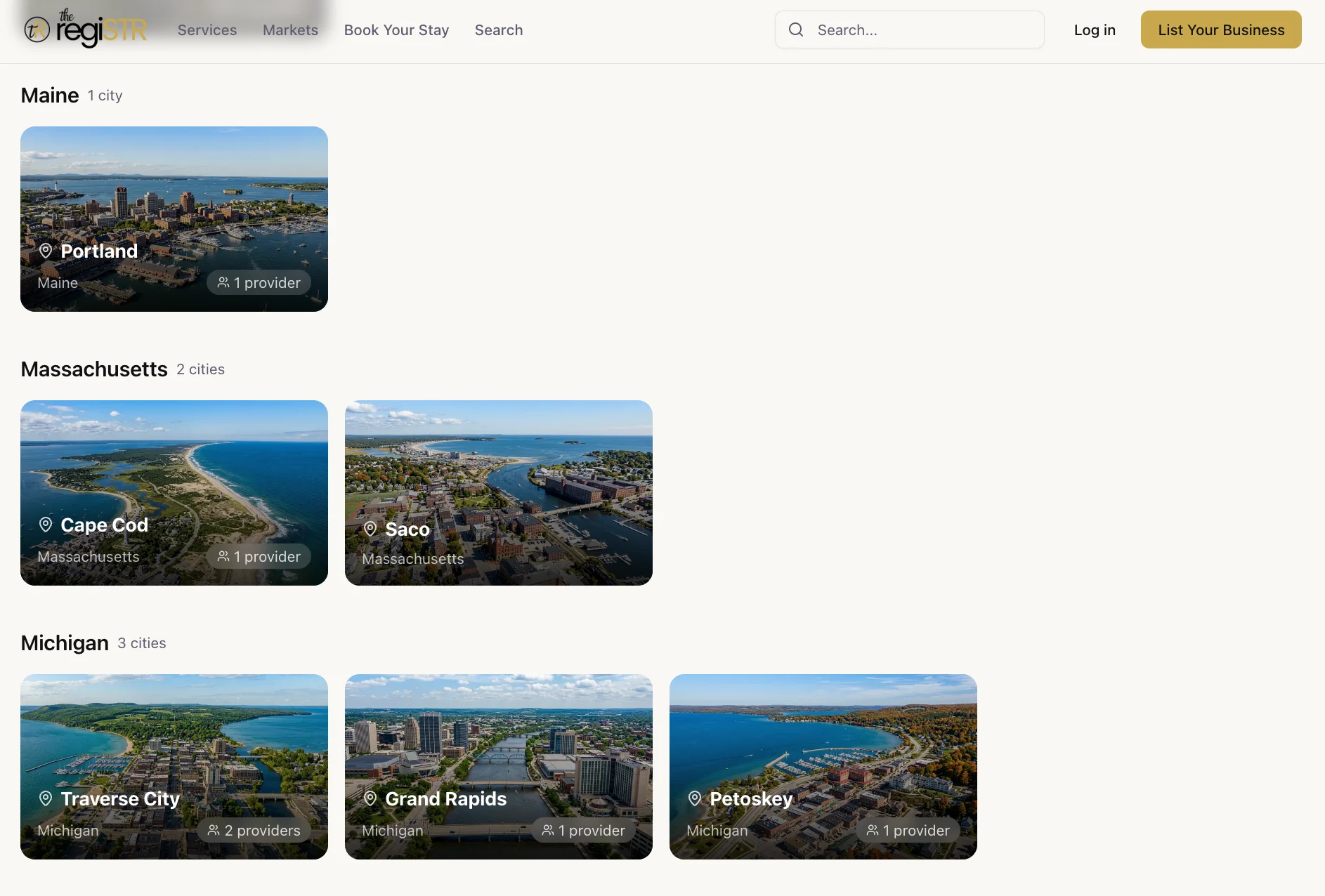
For providers who specialize in a specific market, like a co-hosting operation focused on the Texas Hill Country, or a photography business serving the Florida Panhandle, the regiSTR's market-specific landing pages provide targeted visibility to operators searching for providers in exactly those areas. A listing on a general platform puts you in front of a mixed audience. A listing in a dedicated STR service directory puts you in front of operators who are already looking for what you offer.
Providers like Maverick STR, Revive Rental Solutions, and Hideaway Retreats are examples of the kinds of specialized STR operators already listed in the network, giving prospective providers a sense of the quality bar and positioning style the directory rewards.
How to Use a Short Term Rental Directory to Build Your Vendor Network Fast
Building a vendor network from scratch in a new market is one of the most time-intensive tasks an STR operator faces. Here is the process we recommend, based on what works across the markets the regiSTR covers.
Start with your highest-risk category. For most operators, that is cleaning. A missed turnover or a substandard clean directly affects guest reviews, which directly affects future bookings. Hire your cleaner before you need anyone else. Vet them specifically on their STR experience: Do they work within your checkout-to-check-in window? Do they restock consumables or just clean? Do they communicate proactively if they find a maintenance issue?
You can find vetted STR cleaners organized by market directly on the regiSTR, with Vouch endorsements from operators who have hired them. Read those vouches carefully. A vouch that mentions specific situations ("showed up during a same-day emergency turnover without being asked") tells you far more than a general five-star rating.
Build your maintenance contact second. You will need someone who can respond quickly between checkouts for minor repairs and who understands that a guest's perception of a maintenance issue is as important as the fix itself. For local on-the-ground coverage, the regiSTR's maintenance category lists STR maintenance providers who understand the urgency of a same-day repair between checkouts. Providers like Valor Pro Assist represent the type of STR-focused operational support that general handyman listings rarely offer.
Address photography in your first 30 days. If your listing is already live with amateur photos, this is costing you occupancy right now. Every day you delay is a day of potential bookings at a lower click-through rate. Photography is the one vendor relationship that has a one-time, high-impact ROI. The regiSTR's photography category lets you find STR photographers in your market who understand OTA listing requirements, not just interior composition. Providers who specialize in vacation rental photography know how to shoot for perceived space, natural light, and the hero shots that drive first-click conversions on Airbnb search results.
Add property management or co-hosting based on your bandwidth. If you are managing remotely, a co-host or full-service property manager is not optional; it is the infrastructure that makes remote ownership viable. You can browse STR property managers by city on the regiSTR and review peer vouches before reaching out. The regiSTR also lists STR interior designers for operators who want to refresh a property before the next peak season. Providers like Pink Wall Designs and Custom Coastal LLC represent the kind of STR-focused design specialists the directory surfaces.
Layer in strategic services as you scale. Revenue management, SEO, and direct booking website development become increasingly valuable as your portfolio grows and OTA commission costs accumulate. These are location-independent services, available to operators anywhere in the country. Whether you own in Colorado mountain towns or the South Carolina coast, the regiSTR's service categories cover the full vendor stack a scaling operator needs.
The complete picture of every service category in the network is available when you browse all STR services on the regiSTR, organized by category and searchable by market.
Frequently Asked Questions About STR Directories
What is a short term rental directory?
A short term rental directory is a curated platform that organizes STR service providers, operators, or properties by category and location so that hosts can find vendors and vendors can find clients. Unlike general home service platforms, an STR-specific directory is built around the operational reality of vacation rentals: turnover timelines, OTA compliance, guest experience standards, and market-specific licensing requirements.
How does the regiSTR differ from general home service directories?
The regiSTR is an invite-only, peer-vouched directory built exclusively for the short-term rental industry. Every provider was referred in by an existing network member, and each profile carries endorsements from named STR operators who have actually hired that provider. General home service platforms accept any business that pays to list, regardless of STR experience, which means hosts waste time filtering out vendors who have never managed a same-day turnover window.
What types of service providers are listed in the regiSTR?
The regiSTR organizes providers across twelve service categories: Full-Service Property Management, Cleaning and Turnover Services, Photography and Virtual Tours, Revenue Management and Dynamic Pricing, Co-Hosting and Co-Management, Interior Design and Staging, Maintenance and Repairs, Website Design and Development, SEO and Content Marketing, Social Media Management, STR Consulting and Advisory, and Regulatory and Compliance. Each category is searchable by market.
Which website is best for short-term rentals?
The answer depends on your goal. For reaching guests, Airbnb and VRBO are the dominant booking platforms in 2026. For finding vetted service providers to operate your rental professionally, a specialized STR service directory like the regiSTR is the most targeted resource because it is organized by vendor type and market rather than by guest destination. These are two separate tools with different purposes.
What is the 2% rule for rentals and does it apply to short-term rentals?
The 2% rule is a traditional real estate benchmark suggesting monthly rent should equal at least 2% of a property's purchase price. For short-term rentals, this metric requires significant adjustment: STRs generate per-night revenue with variable occupancy, and carry higher operating costs including cleaning, platform fees, and consumable restocking. Most STR investors use gross revenue potential and net operating income models when underwriting vacation rental properties rather than the 2% rule.
How do STR service providers get listed on the regiSTR?
STR service providers join the regiSTR through an invite-only referral process. Once admitted, providers complete a six-step onboarding wizard that can auto-fill a profile from an existing business website. Providers can list on Free, Pro, or Premium tiers, with higher tiers unlocking better placement, richer profiles, and expanded market visibility. Providers keep 100% of their bookings and pay only a flat, optional subscription rather than per-lead fees.
What is the Vouch system on the regiSTR?
The Vouch system replaces anonymous star ratings with public endorsements from named, identifiable STR operators who have hired the provider. Each vouch is tied to a real operator profile, making the social proof accountable and verifiable. This is the core trust mechanism that separates the regiSTR from open marketplaces where reviews can be anonymous, purchased, or left by people with no direct experience hiring that vendor.
Ready to Build Your STR Vendor Network?
Running a short-term rental profitably in 2026 is fundamentally a vendor management operation. The hosts consistently outperforming their competition have not found a secret pricing strategy; they have built reliable teams around their properties. That starts with finding the right people in the right markets before you need them urgently.
The short term rental directory landscape has more options than most operators realize, but most of those options were not built for you. Government registries serve compliance purposes. Booking platforms serve travelers. General home service marketplaces serve everyone, which practically means they serve no one particularly well. A purpose-built STR vendor service directory, organized by market and service category with real operator vouches as the trust signal, is the infrastructure layer that makes building your vendor stack fast and reliable.
Whether you are launching your first property in the Smoky Mountains, scaling a portfolio across multiple markets, or a service provider looking to connect with STR operators who are actively hiring, the regiSTR is built for exactly this moment in the industry's growth.

Browse vetted STR service providers by market and category, read real operator vouches, and connect directly with the vendors your operation needs. Sign up free at the regiSTR and build the vendor network your properties deserve.
Content powered by inkSTR.co