The STR Apps Hosts Actually Keep on Their Phone
The STR apps that hosts actually keep on their phone after the first month are the ones that solve a single operational problem so completely that removing them would break something. Most hosts download six to ten tools at launch. Sixty days later, they are running three to five. The survivors share one trait: they work on mobile, they trigger on events (a booking, a checkout, a guest message), and they connect to the humans who actually do the work.
- Core app categories that survive: channel management, dynamic pricing, guest messaging automation, maintenance coordination, and cleaning workflow.
- The global vacation rental market is valued at roughly $101 billion in 2026, yet most experienced hosts rely on a focused stack of three to five apps rather than one bloated all-in-one platform.
- Single-property hosts and portfolio operators keep different apps: simplicity wins at one unit, automation and vendor coordination win at five or more.
- The apps dropped fastest are those with desktop-only functionality, opaque pricing tiers, or no mobile-native triage workflow.
- STR apps automate repeatable tasks well but cannot replace the humans who physically show up. The tool stack and the service provider network solve different halves of the problem.
- the regiSTR directory complements any app stack by connecting hosts with vetted cleaners, co-hosts, maintenance crews, and property managers that no software can replace.
What STR Apps Do Hosts Actually Keep After Month One?
The STR apps hosts keep after the first month are the ones embedded in their daily operational trigger points: a guest books, a checkout happens, a maintenance request arrives. Apps that require hosts to log in intentionally and manually update information get opened less and less until they disappear from the home screen entirely. The pattern we consistently observe across operators in the markets we cover is that survival correlates with event-driven automation, not feature count.
In 2026, the short-term rental management software market is growing at roughly 11 to 14 percent annually, which means hosts face an expanding menu of options with very little signal on which ones are genuinely worth keeping. The noise is real. A tool might win a Product Hunt upvote and still be useless to a host trying to coordinate a same-day turnover between a 10am checkout and a 1pm check-in.
The framework here is simple: build your STR app stack in order of operational urgency. Start with the tools that prevent disasters. Add tools that improve revenue. Finish with tools that improve the guest experience. In that order, not the reverse.
Step 1: Lock In a Channel Manager Before Everything Else
A channel manager is the foundational STR app that synchronizes your calendar and rates across every platform where your property is listed, preventing double bookings and eliminating the need to manually update availability on each OTA. For any host listing on more than one platform, a channel manager is not optional. It is the infrastructure every other app sits on top of.
Without calendar synchronization, a single booking on Airbnb that is not reflected on Vrbo within minutes creates the possibility of a double booking. Resolving a double booking means canceling one reservation, which triggers platform penalties, damages your Superhost or Premier Host status, and occasionally requires you to find alternative accommodation for a stranded guest. That is an expensive, reputation-damaging problem that a channel manager costs less to prevent than a single double-booking costs to fix.
Choose a channel manager with a genuinely functional mobile app, not just a responsive website. You need to be able to block a date, update a minimum stay, or push a rate change from your phone in under 90 seconds. If the tool requires a laptop and a stable internet connection to make basic changes, it will fail you during the moments you actually need it most.
What Happens When You Skip the Channel Manager?
Hosts who delay adding a channel manager typically do so because they are only listed on one platform. The problem surfaces the moment they add a second channel, which most do within the first six months. At that point they face a retroactive migration of all their existing settings, pricing rules, and calendar blocks into a new tool. Do it once, at the start, and build everything else on top of it.
The regiSTR team regularly advises hosts on the operational sequencing of their tool stack, and the single most common mistake we see from new operators is building their guest experience technology before they have locked down their inventory management. Guest experience apps matter. But a beautifully automated welcome message sent to a guest who just got double-booked is a complaint waiting to happen.
Step 2: Add Dynamic Pricing as Your Second App
Dynamic pricing refers to the practice of adjusting your nightly rate in real time based on demand signals including local events, seasonality, booking lead time, and competitor availability. STR properties running flat annual rates consistently underperform against comparable properties using algorithmic pricing, particularly during high-demand weekends and shoulder-season windows where demand fluctuates sharply.
The global short-term rental management software market, valued at approximately $0.92 billion in 2026, reflects strong operator demand for tools in exactly this category. Pricing tools represent one of the fastest-growing segments within that market because the revenue impact is immediate and measurable. A host who adds a dynamic pricing tool mid-season typically recovers the tool's subscription cost within the first month on peak-weekend uplift alone.
The key feature to evaluate is not the algorithm itself, every major pricing app claims its algorithm is superior. What matters more is the minimum stay integration (can the tool automatically enforce a two-night minimum on peak Saturdays?), the calendar override experience on mobile, and whether the tool connects directly to your channel manager without requiring manual exports.
Do not wait until you feel like your pricing is "good enough" to add this app. Flat-rate pricing is never good enough in a market with meaningful seasonality. The operators in the Smoky Mountains who run the same nightly rate in October as in February are donating revenue to their competitors every single peak weekend.
Step 3: Automate Guest Messaging Before Your First Booking
Guest messaging automation refers to the practice of pre-scheduling communications at booking triggers, pre-check-in milestones, check-in day, mid-stay, and post-checkout moments, so that every guest receives timely, consistent information without requiring the host to manually send each message. As of 2026, multi-channel distribution and automated communication are, as leading industry platforms put it, practically necessities for competitive STR operation rather than optional enhancements.
The specific messages that matter most are the pre-arrival sequence (check-in instructions, door code, parking details, WiFi password, house rules reminder) and the post-checkout review request. These two sequences alone cover the majority of what guests contact hosts about and what drives your public rating up or down. Get them right, and your review volume increases without any additional effort.
Choose a messaging app that allows conditional logic: if a guest books more than seven days out, send a specific pre-arrival message three days before check-in. If a guest books within 48 hours, send the same information immediately. Guests who book last-minute need information faster. Hosts who do not account for this end up with panicked same-day check-in messages that consume time and create anxiety on both ends.
Many channel managers include basic messaging automation as part of their platform. Evaluate whether the native feature is sufficient for your operation before paying for a dedicated messaging tool on top. For single-property hosts, the built-in messaging features of a quality channel manager are often more than adequate.
Which STR Apps Get Dropped the Fastest?
The STR apps that get uninstalled fastest are the ones that work beautifully on a desktop and fall apart on a phone screen. Hosts do not manage their properties from a desk. They manage them from a parking lot, a grocery store, and occasionally from a guest's check-in queue when something breaks. If a tool requires a full keyboard and a wide monitor to navigate, it will not survive the realities of active hosting.
Why Desktop-Only Tools Fail Mobile-First Hosts
The specific failure pattern is predictable. A host downloads a tool with impressive desktop functionality: beautiful dashboards, detailed reporting, clean revenue charts. They set it up on a Saturday afternoon. Then Monday arrives, a guest messages at 7am about a malfunctioning lock, and the host opens the app on their phone to find a cramped, nearly unusable mobile interface. They respond via Airbnb's native app instead. The new tool gets used less. Within four weeks, the subscription is a line item they are planning to cancel.
The second-fastest category of dropped apps is the all-in-one platform that does everything adequately but nothing exceptionally well. Hosts who try a single platform to handle channel management, pricing, messaging, maintenance, and accounting simultaneously often find that each individual feature is weaker than the standalone competitor in that category. The appeal of one login is real. The operational cost of using five mediocre tools instead of five excellent ones is realer.
Tools with confusing subscription tiers are the third exit trigger. If the feature you actually need, say, API connections to more than two OTAs, sits behind a plan that costs three times your current subscription, that creates a moment of frustration that often ends the relationship entirely. Evaluate pricing tiers at signup, not after you have built your operation on top of the tool.
Step 4: Add Maintenance Coordination Once You Have Occupancy
Maintenance coordination apps for STRs refer to platforms that allow hosts or property managers to create, assign, track, and close maintenance tasks from a mobile device, connecting guest-reported issues to a vetted vendor network that can respond within a defined SLA. For hosts managing more than two properties, or any host managing remotely, maintenance coordination is the category where dropped balls cost the most in guest satisfaction and physical property damage.
The workflow these tools solve is specific: a guest reports a broken dishwasher at 9pm on a Thursday. Without a coordination system, the host receives the message, texts a handyman who may or may not respond, and the repair either gets handled or it does not. With a coordination app, the ticket is created with photos attached, assigned to a vendor who has confirmed availability for STR-priority work, and tracked to resolution with a timestamp the host can review later.
Maintenance apps are most valuable when they connect to real, available, STR-experienced vendors in your specific market. A coordination app that routes tickets into a void because you have no vetted vendors assigned to it is just a more organized version of the same problem. This is where the human network matters as much as the software.
Finding vetted STR maintenance providers is exactly the kind of problem the regiSTR directory was built to solve. Find STR Maintenance providers by market on the regiSTR and assign them in your coordination app before you need them, not after a guest reports an emergency.
Step 5: Use a Cleaning Workflow App to Protect Your Reviews
A cleaning workflow app for STRs is a tool that triggers a cleaning task automatically at checkout, assigns it to a designated cleaner, provides a digital checklist with property-specific items, and allows the cleaner to mark completion with timestamped photos before the next guest checks in. Reviews for cleanliness are the most-read review category on every major OTA. A single one-star cleanliness review can drop a listing's overall rating by a measurable amount and suppress its position in Airbnb search results for weeks.
The key workflow detail most hosts overlook is the gap between when a cleaning task is marked complete by the cleaner and when the host or co-host confirms the property is genuinely guest-ready. The best cleaning workflow apps include a verification step: the cleaner finishes and uploads photos, the host or a property manager reviews the photos and approves before unlocking the digital key. That 90-second verification step prevents the "cleaner said they finished but the bathroom was not touched" scenario that produces the worst guest arrival experiences.
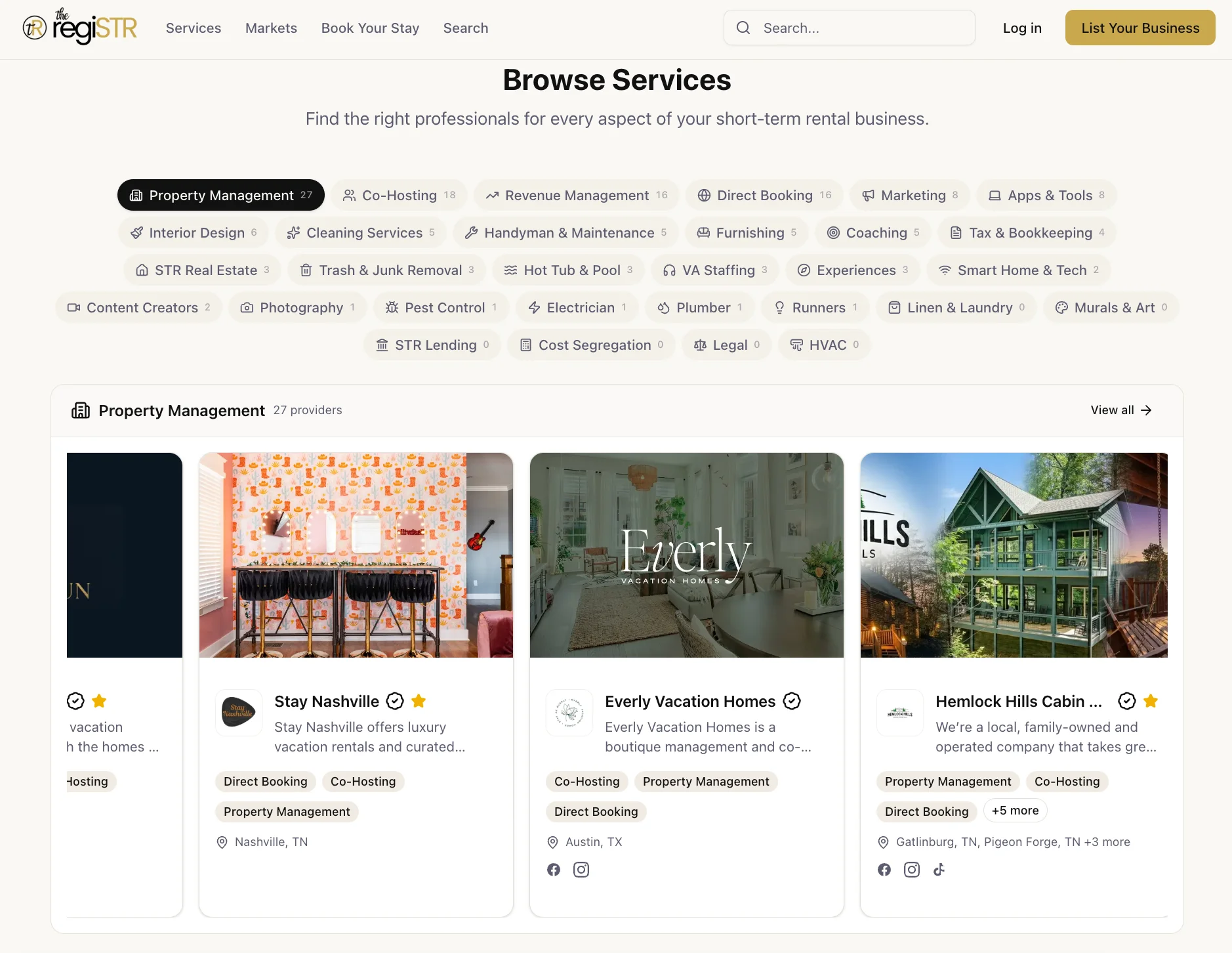
A cleaning app tells your cleaner where to start, what to check, and how to document completion. It cannot find you a cleaner who understands a three-hour STR turnover window, stocks linens at hotel-fold standard, or knows the difference between a residential clean and a guest-ready turnover. Find STR Cleaners who specialize in vacation rental turnovers through the regiSTR directory, and then put them in your workflow app once you have confirmed they are the right fit.
How Do Power Hosts Combine STR Apps Into a Working Stack?
The most effective STR app stacks are combinations of three to five purpose-built tools that integrate with each other rather than a single all-in-one platform. Power hosts, defined here as operators running three or more active listings with strong occupancy and review scores, consistently use a layered approach: channel management as the foundation, pricing on top of that, messaging triggered by the channel manager, and cleaning or maintenance apps connected through automation rules.
The integration piece is what separates a working stack from a collection of disconnected subscriptions. Specifically, your channel manager should trigger your cleaning task automatically at every checkout. Your pricing tool should sync rates back to your channel manager without manual exports. Your messaging app should pull reservation details from the channel manager so guest names, check-in dates, and door codes populate automatically. If any of these connections require manual intervention, that is a friction point that will eventually produce an error at the worst possible moment.
Single-Property Host Stack vs. Portfolio Operator Stack
| App Category | Single-Property Host (1-2 units) | Portfolio Operator (5+ units) |
|---|---|---|
| Channel Management | Lightweight tool with built-in messaging | Full PMS with API connections to all major OTAs |
| Dynamic Pricing | Standalone pricing app, manual override capability | Pricing tool with portfolio-wide rule management |
| Guest Messaging | Built into channel manager | Dedicated messaging platform with conditional logic |
| Cleaning Coordination | Basic task trigger from channel manager | Dedicated cleaning app with photo verification and multi-cleaner scheduling |
| Maintenance | Direct text to one trusted handyman | Maintenance coordination platform with vendor SLAs |
| Analytics | OTA native reporting, optional pricing app dashboard | Dedicated STR analytics platform for occupancy, RevPAR, and comp set tracking |
The table above reflects a pattern we consistently observe among hosts in the regiSTR network: single-property operators over-invest in complexity early and then simplify, while portfolio operators who start lean eventually add dedicated tools as their operational volume makes manual coordination impossible.
If you are scaling from three to five units, the inflection point where a full property management system becomes worth the higher monthly cost is typically when manual coordination between your existing tools is consuming more than two hours per week. Before that threshold, the simpler stack usually wins on both cost and reliability.
What Tools Do I Actually Need to Run a Short-Term Rental?
The minimum viable STR tool stack for a new host in 2026 is three apps: a channel manager, a dynamic pricing tool, and an automated messaging platform. Everything else, including maintenance coordination, cleaning workflow apps, and analytics dashboards, should be added based on demonstrated operational need rather than anticipated future complexity.
The pattern of over-tooling is as common as under-tooling, and it is more expensive. Hosts who subscribe to eight STR apps in month one typically spend more time managing their tools than managing their property for the first 60 days. That is time not spent on the guest experience, the listing quality, or the vendor relationships that actually drive reviews.
Two categories are consistently underweighted by new hosts relative to their operational impact. First, compliance tracking: as of 2026 and 2026, local regulatory requirements for STR permits, transient occupancy tax remittance, and annual rental day caps have tightened in dozens of major US markets. Some property management systems now include rule-based calendar blocking for day-cap markets, which matters significantly if your property is in a city with a strict annual limit. Second, direct booking infrastructure: reducing dependence on OTA commission structures (which typically represent a meaningful percentage of each booking's gross revenue) requires a separate website, SEO strategy, and booking engine that most app stacks do not include by default.
For hosts navigating compliance complexity or building a direct booking channel, the regiSTR's short-term rental directory includes vetted STR consulting and advisory professionals as well as website development and SEO specialists who work specifically within the vacation rental ecosystem. These are not generalist agencies; they are STR-focused professionals who understand OTA dependency and the local regulatory environment in specific markets.
Understanding the full landscape of STR service providers alongside your app stack is the fastest path to a sustainable operation. Browse All STR Services on the regiSTR directory to find vetted providers in your market across every category your operation needs.
Frequently Asked Questions About STR Apps
What are the most essential STR apps for new Airbnb hosts in 2026?
New hosts should start with three core STR apps: a channel manager to sync calendars across Airbnb and Vrbo, a dynamic pricing tool to avoid flat-rate underpricing, and an automated guest messaging platform to handle check-in instructions and mid-stay communication. Adding a cleaning coordination app before your first booking prevents the most common early review problems. Build from these four before adding anything else.
How many STR apps do experienced hosts actually use?
Most experienced hosts running one to three properties settle on three to five apps that each solve one specific problem well. Portfolio operators managing five or more units tend to run a slightly larger stack but prioritize tools with strong mobile apps and integrations between them. The pattern we consistently observe is that hosts who try to do everything in one platform often switch back to a focused multi-app approach within six months of going all-in on an all-in-one solution.
Which STR apps do hosts drop the fastest after the first month?
The apps most commonly dropped are those that work well on desktop but have no functional mobile experience, tools with confusing subscription tiers that lock core features behind premium plans, and all-in-one platforms that do many things adequately but nothing exceptionally well. Hosts on the go need apps that let them respond to a maintenance emergency, update a listing, or message a guest from their phone in under 60 seconds. If the mobile experience does not meet that bar, the app will not survive month two.
Do I need a channel manager if I only list on Airbnb?
If you list exclusively on Airbnb and have no plans to expand to Vrbo or a direct booking channel, a full channel manager is optional in the short term. However, even single-channel hosts benefit from the automated messaging, task scheduling, and cleaning triggers that channel managers provide beyond calendar sync. Most hosts who start single-channel add a second OTA within six months, at which point a channel manager becomes essential immediately and retroactive migration of all settings adds unnecessary friction.
Can STR apps replace a property manager or co-host?
STR apps automate repeatable tasks extremely well: calendar sync, pricing updates, scheduled messages, and cleaning triggers. But they cannot physically inspect a property, handle a guest who locks themselves out at midnight, coordinate an emergency plumbing repair, or make judgment calls about a difficult guest situation. Apps and human service providers solve different halves of the operational problem. The most profitable STR operators use both, with software handling the predictable and humans handling the unpredictable.
How do I find vetted cleaners and maintenance providers to pair with my STR apps?
The regiSTR directory organizes vetted STR-specific service providers by market and service category, covering cleaners, co-hosts, maintenance crews, and property managers. Unlike general home services directories, every provider on the regiSTR has been referred in by a network member and brings direct experience with STR turnover timelines and OTA workflows. Browse providers for your specific market at theregistr.co.
What STR apps help with compliance and licensing tracking?
Several property management systems now include rule-based calendar blocking for markets that cap annual rental days, and some integrate tax calculation for transient occupancy taxes. For hosts in heavily regulated markets, a dedicated STR compliance consultant is often more valuable than any single app, particularly as local ordinance changes in 2026 and 2026 have accelerated across major US markets. The regiSTR's Regulatory and Compliance category lists vetted STR consulting professionals who specialize in permit and licensing guidance for specific markets.
What is the difference between a channel manager and a property management system for STRs?
A channel manager primarily handles calendar synchronization and rate distribution across multiple OTA platforms like Airbnb, Vrbo, and Booking.com, preventing double bookings. A property management system (PMS) is a broader platform that may include channel management alongside accounting, owner reporting, guest CRM, and work order management. For hosts with one to five properties, a standalone channel manager paired with separate pricing and messaging tools often outperforms a heavier PMS on both cost and mobile usability.
The App Stack Is Only Half the Answer
The STR apps that survive on a host's phone after month one all share the same underlying logic: they solve a real operational problem, they work on mobile, and they connect to the humans who execute the physical work. Channel managers prevent disasters. Pricing tools protect revenue. Messaging apps protect reviews. Cleaning and maintenance tools protect your relationship with both guests and vendors.
But no app has ever folded a set of linens, fixed a leaking faucet, or made a judgment call about a guest arriving four hours early. The software stack and the service provider network are not competing solutions. They are complementary halves of a sustainable operation. Hosts who invest heavily in one while neglecting the other eventually feel the gap.
In 2026, the vacation rental market is more competitive and more regulated than it has ever been. The operators pulling consistent revenue and maintaining strong review scores are the ones who have built both sides: the right tools and the right people in every service category their property needs.
If your app stack is solid but your vendor network is not, the regiSTR is the fastest way to close that gap. Whether you need a cleaner who understands a three-hour turnover, a co-host who can handle a late-night emergency, or a vetted property manager to take the whole operation off your plate, the regiSTR directory is organized by market and service category so you find the right person for your specific location, not just the closest available result on a general directory. Sign up free and browse vetted STR service providers at theregistr.co.
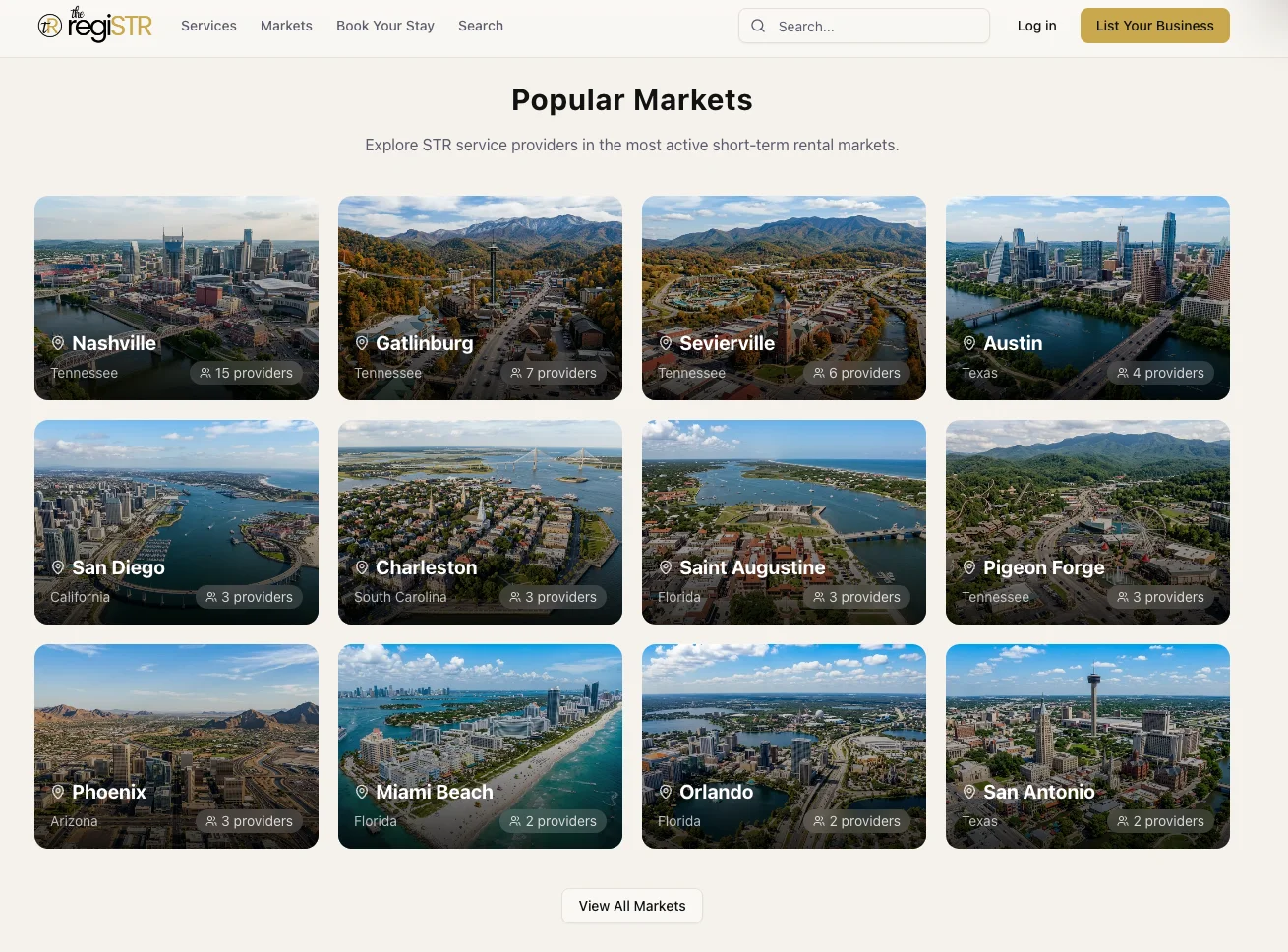
Browse the regiSTR's vetted STR service providers across Nashville, Gatlinburg, Austin, Charleston, Miami Beach, and a dozen other active short-term rental markets. Your app stack handles the automation. The regiSTR handles the human side. Sign up free at theregistr.co and find the providers your operation is missing.
Content powered by inkSTR.co