How to Vet Vacation Rental Vendors Before You Hand Over a Key

To vet vacation rental vendors properly, you need to go well beyond a quick Google search or a recommendation from a Facebook group. The process means verifying STR-specific experience, confirming insurance and license status directly with issuing authorities, testing communication responsiveness, and getting peer references from other operators in your market: before you hand over a key, a door code, or a management agreement.
- Vetting vacation rental vendors requires STR-specific criteria, not just general contractor checklists: a residential cleaner and an STR turnover specialist are not the same thing.
- Property managers typically charge 15-25% of gross revenue, making a bad hire one of the most expensive mistakes in STR operations.
- The most overlooked vetting step is independently verifying vendor insurance and license status with the issuing authority, not just accepting a certificate at face value.
- Red flags specific to STR vendors include inability to guarantee turnaround windows, vague emergency protocols, and no documented same-day transition experience.
- As of 2026, the U.S. short-term rental market is projected to reach USD 76.46 billion (Grand View Research), which means competition for reliable vendors is intensifying across every major market.
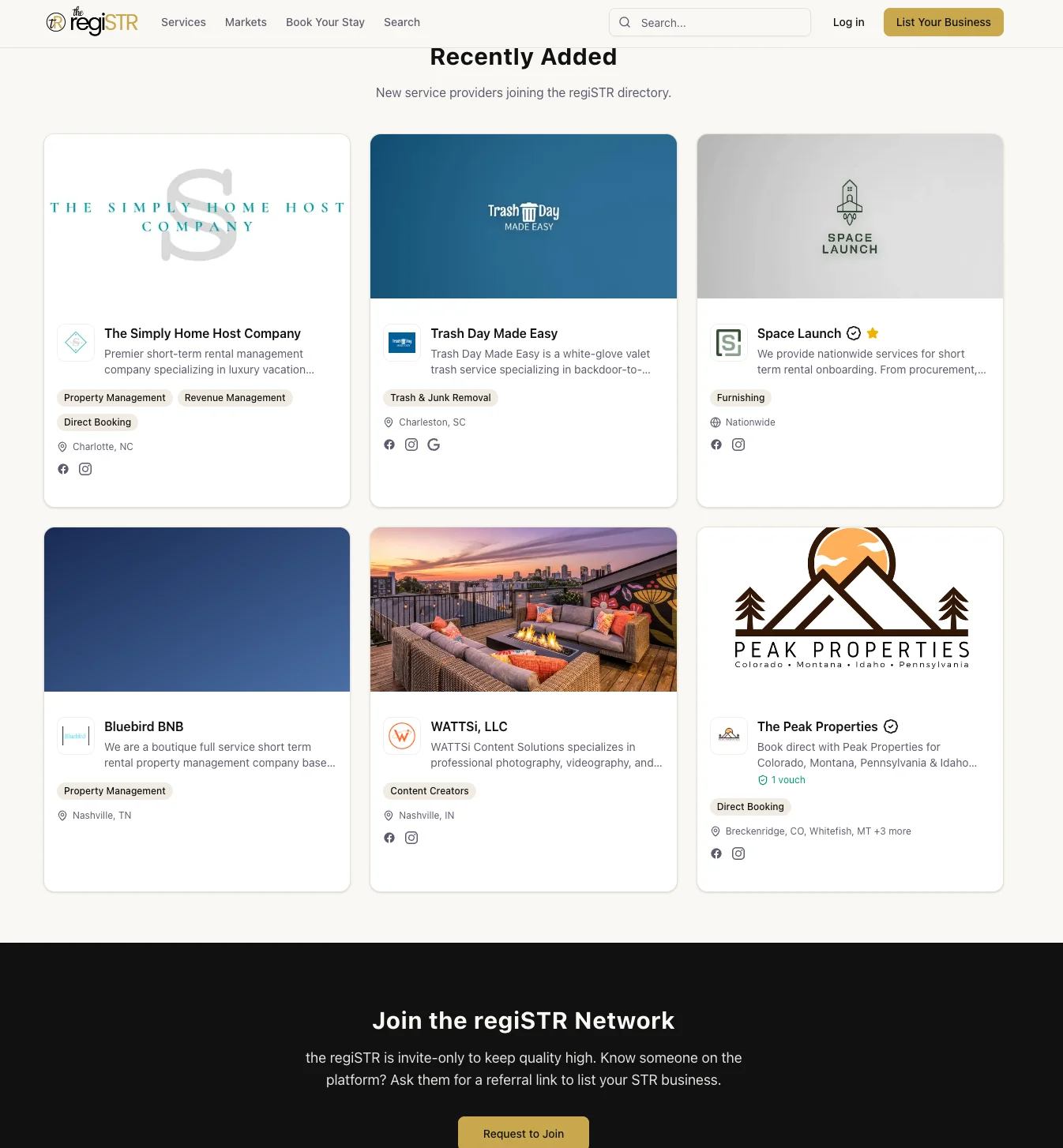
- the regiSTR is an invite-only STR service directory where every provider has been referred in by a network member, cutting the discovery risk that makes vendor vetting so exhausting for remote owners.
Your STR operation runs on its vendors. Not on the platform algorithm, not on your listing description, not even on your nightly rate. The cleaner who misses a checkout. The property manager who stops returning calls after month two. The handyman who shows up two days late to fix a hot water heater. Each of those failures lands directly in your guest reviews, and guest reviews are the only durable currency in this business.
At the regiSTR, we've connected hundreds of STR operators with vetted service providers across the country's most active vacation rental markets. The single most consistent mistake we see operators make is skipping structured vetting in favor of speed. They need someone fast, so they hire the first cleaner who answers. They want to go hands-off, so they sign the first management contract they receive. This guide gives you the framework to slow down enough to get it right: and then find providers who already clear the bar.

What Does It Actually Mean to Vet a Vacation Rental Vendor?
Vetting a vacation rental vendor means systematically confirming that a service provider has the experience, credentials, insurance, and operational capacity to handle STR-specific work before you give them access to your property. It is not the same as vetting a general contractor or a residential service company, because STR operations have requirements those categories simply do not face: same-day turnovers, guest-facing cleanliness standards, after-hours emergency response, and consistent communication with a remote owner who cannot walk through the front door to check the work.
Most operators treat vendor vetting as a gut-check process. They read a review, have a phone call, and decide. That approach works well enough for low-stakes hires in industries with long lead times and recoverable mistakes. It does not work for a business where a missed cleaning window means a bad review from guests who drove six hours to find an unmade bed.
Structured vetting has three layers. First, credential verification: does this vendor have the licenses, insurance, and business registration required to operate legally in your market? Second, performance verification: do other STR operators in your market vouch for this vendor by name? Third, operational fit: can this vendor meet the specific demands of your property, your turnover schedule, and your guest communication standards? A vendor who passes layers one and two but fails layer three is still the wrong hire.
This is the framework the regiSTR applies before any provider appears in our directory. Every listing is referral-gated, meaning a vendor must be introduced by an existing network member before they can build a profile. That single requirement filters out most of the risk that comes from cold discovery on general platforms.

What Is the 80/20 Rule for Airbnb, and How Does It Shape Who You Hire?
The 80/20 rule in Airbnb operations refers to the principle that roughly 20% of your operational decisions drive 80% of your guest experience outcomes. Specifically, your cleaner and your pricing strategy together account for the overwhelming majority of review quality and revenue performance. Every other vendor category matters, but those two categories are where vetting failures hurt the most and vetting excellence pays the most.
This is not abstract. A guest who checks into a property that is spotless and accurately priced for the season will almost always leave a positive review, regardless of minor imperfections elsewhere. A guest who finds a hair on the bathroom counter or a checkout process that felt rushed will mention it, and they will mention it publicly. Your cleaner is your frontline quality control, which is why hiring a cleaner who has never managed a same-day STR turnover is a structural risk, not just an inconvenience.
The 80/20 framing also tells you where to allocate your vetting time. Spend the most rigorous effort on your cleaner and your revenue or pricing strategy first. Get those two right, and the rest of your vendor stack operates on a more forgiving margin. Get them wrong, and no amount of excellent photography or smart channel management will compensate for the damage to your review profile.
If you're actively looking to find STR cleaners who specialize in vacation rental turnovers rather than general residential cleaning, browsing by market is the fastest path to providers who already understand the timeline and quality expectations that matter for Airbnb and VRBO performance.
How Do You Verify a Vendor's STR-Specific Experience Before Signing Anything?
Verifying a vendor's STR-specific experience means asking for concrete, demonstrable proof of short-term rental work: not general service history. A cleaner might have fifteen years of residential experience and still have never managed a same-day turnover between an 11am checkout and a 1pm check-in. A property manager might have a decade of long-term residential management and no understanding of OTA fee structures, dynamic pricing, or guest communication protocols on Airbnb and VRBO.
Ask for references specifically from STR operators, not homeowners or residential clients. Contact those references directly and ask two questions: Would you hire this vendor again? And have they ever missed a deadline that affected a guest experience? The second question matters more than the first. Anyone can give you a glowing reference. A reference who describes how a vendor handled a crisis , and how they communicated through it , tells you everything about operational reliability.
For property managers, request a sample owner statement from a current client (with identifying details redacted). A manager who cannot produce owner reporting on short notice is either not generating it or not willing to share it. Neither is a good sign. Also ask what channel manager and dynamic pricing tools they use. A manager who is still manually adjusting rates or copy-pasting between platforms is not equipped to compete in a market where pricing decisions update daily.
For maintenance vendors, ask whether they have worked on short-term rental properties specifically. STR maintenance calls differ from residential ones in timing: your handyman needs to be available for same-day response, because a broken HVAC unit or a non-functioning dishwasher cannot wait three days when you have guests checking in tonight. You can find STR maintenance providers on the regiSTR who list their markets served and their response time expectations as part of their profile.
What Red Flags Should You Watch for When Evaluating STR Service Providers?
Red flags when vetting STR service providers are distinct from the warning signs you'd apply to general contractors. The STR context creates a specific set of failure modes, and most of them show up clearly in the first conversation if you know what to listen for.
The first and most important red flag for any turnover vendor is the inability to guarantee a specific turnaround window. If a cleaner tells you they'll "get there as soon as they can" after checkout, that is not a usable answer for an STR operation. Your next guest has a confirmed check-in time. The cleaner needs to be able to commit to a specific start time and a completion time that leaves a buffer before check-in. A cleaner who cannot make that commitment is serving too many properties simultaneously or does not understand STR operational requirements.
For property managers, the red flag to watch for most carefully is vague owner communication. Ask how often you receive reports, through what channel, and who you contact when something goes wrong after hours. A manager who says "we handle everything, you don't need to worry" without specifying the reporting mechanism is describing a black box, not a managed service. You should always know what is happening with your property.
Additional red flags across all vendor categories include: no business insurance or an unwillingness to provide proof; no verifiable references from STR operators specifically; a contract that places all liability on the property owner; inconsistent response time during the inquiry process itself (if they take three days to answer your pre-hire email, imagine the response time during an emergency); and reluctance to describe their process in operational detail. A professional vendor who knows their work should be able to walk you through a typical service call or turnover in concrete steps.
One pattern we consistently observe across provider categories at the regiSTR is that the best vendors are eager to share their process because they're proud of it. Vendors who are vague about how they work usually have something to hide, or they simply have not thought through their systems carefully enough to describe them.
How Do You Check a Vendor's Insurance and License Status the Right Way?
Checking a vendor's insurance and license status the right way means verifying directly with the issuing authority, not just accepting a certificate or a verbal confirmation. This is the step most operators skip, and it is the one that creates the most serious liability exposure when something goes wrong at the property.
For insurance, ask the vendor for a current certificate of insurance that names your property as an additional insured for the duration of the service relationship. Then contact the insurance carrier listed on that certificate and confirm the policy is active, current, and covers commercial work on short-term rental properties. Some general liability policies explicitly exclude commercial rental properties. You need to know whether the cleaner working in your home has coverage that applies to the specific type of work they are performing in the specific type of property they are entering.
For license verification, the process varies by state and vendor type. Contractors in most states are required to hold a state-issued contractor license. You can verify license status directly through the relevant state contractor licensing board by searching the license number or business name. Most states maintain publicly accessible license lookup tools online. Do not assume a business card or a certificate makes the license real.
Property managers operating in most U.S. states are required to hold a real estate broker license or a property management license, depending on the jurisdiction. Verify this requirement for your specific market and check the manager's license status through the state real estate commission database. A manager who is operating without a required license is not just unqualified: they may be operating illegally, which creates liability for you as the property owner.
This level of diligence sounds like a lot of work because it is. It is also the reason the regiSTR's referral-gated model adds genuine value: providers who enter the network through an existing member's referral have already cleared a credibility layer before you encounter them. Browsing a curated directory does not eliminate your due diligence responsibility, but it significantly reduces the population of risky vendors you need to evaluate.
What Is the 75/55 Rule for Airbnb, and Why Does It Matter for Turnover Vendors?
The 75/55 rule refers to Airbnb's checkout task guidance: checkout processes for guests should take no more than 75 seconds, and any cleaning tasks asked of guests should require no more than 55 minutes of effort. For hosts, the operational implication is direct: your turnover vendor must be able to complete their work within a tight post-checkout window, because a checkout process that burdens the departing guest with extensive cleaning tasks will be reflected in your reviews.
Where this rule connects to vendor vetting is in the turnaround window calculation. If your checkout is at 10am and your next check-in is at 3pm, your cleaner has five hours. That sounds generous until you factor in a property with multiple bathrooms, a full kitchen, laundry for linens, and a hot tub that needs to be checked and reset. A cleaner managing five other properties that same morning may not arrive until noon. Your window just became three hours, and your quality standard did not change.
When you vet a turnover vendor, ask this question directly: "If I have a 10am checkout and a 3pm check-in on the same day, how do you structure your schedule to guarantee my property is ready by 2:30pm?" The answer tells you everything. A vendor with a real process will describe their arrival window, their workflow, and their quality-check step. A vendor without one will tell you it depends on the day.
Platforms like Airbnb also have tools that allow hosts to block same-day turnovers entirely. That is a valid operational choice for some hosts. But if you want to maximize occupancy in high-demand periods, same-day turnovers are often unavoidable. A cleaner who cannot commit to them is limiting your revenue potential, not just your schedule flexibility.
How Do You Build a Full Vendor Stack for Your Short-Term Rental Operation?
A full vendor stack for a short-term rental operation covers six core categories: cleaning and turnover, maintenance and repairs, property management or co-hosting, photography, revenue management, and regulatory or compliance support. Not every operator needs all six on day one, but every active STR eventually needs all of them in some form.
The sequencing matters. For first-time hosts, the priority order is: cleaner first, photography second, then either a property manager or a revenue manager depending on whether you intend to self-manage. Get those three right and the foundation of your operation is solid. For scaling investors managing multiple properties across different markets, the priority flips toward revenue management and a reliable property manager or co-host in each market, with cleaning and maintenance sourced locally in each geography.
Interior designers and stagers are a vendor category that is consistently undervalued at the acquisition stage and consistently expensive to correct later. A property that was furnished without STR-specific criteria , durable fabrics, easy-clean surfaces, cohesive visual aesthetic for listing photography , will generate lower ADR and require earlier refurnishing investment. If you have not yet launched, an STR interior designer is worth the upfront cost. If you've already furnished and launched, prioritize the categories that directly affect guest experience first.
Maintenance and emergency response is the vendor category most often assembled reactively rather than proactively. Most operators do not think about finding a licensed plumber in their market until a pipe bursts at 11pm on a Saturday. The right time to vet and onboard a maintenance vendor is before you have your first booking, not during your first emergency. Find STR Maintenance providers in your market before you need them, and you will recover faster when something breaks.
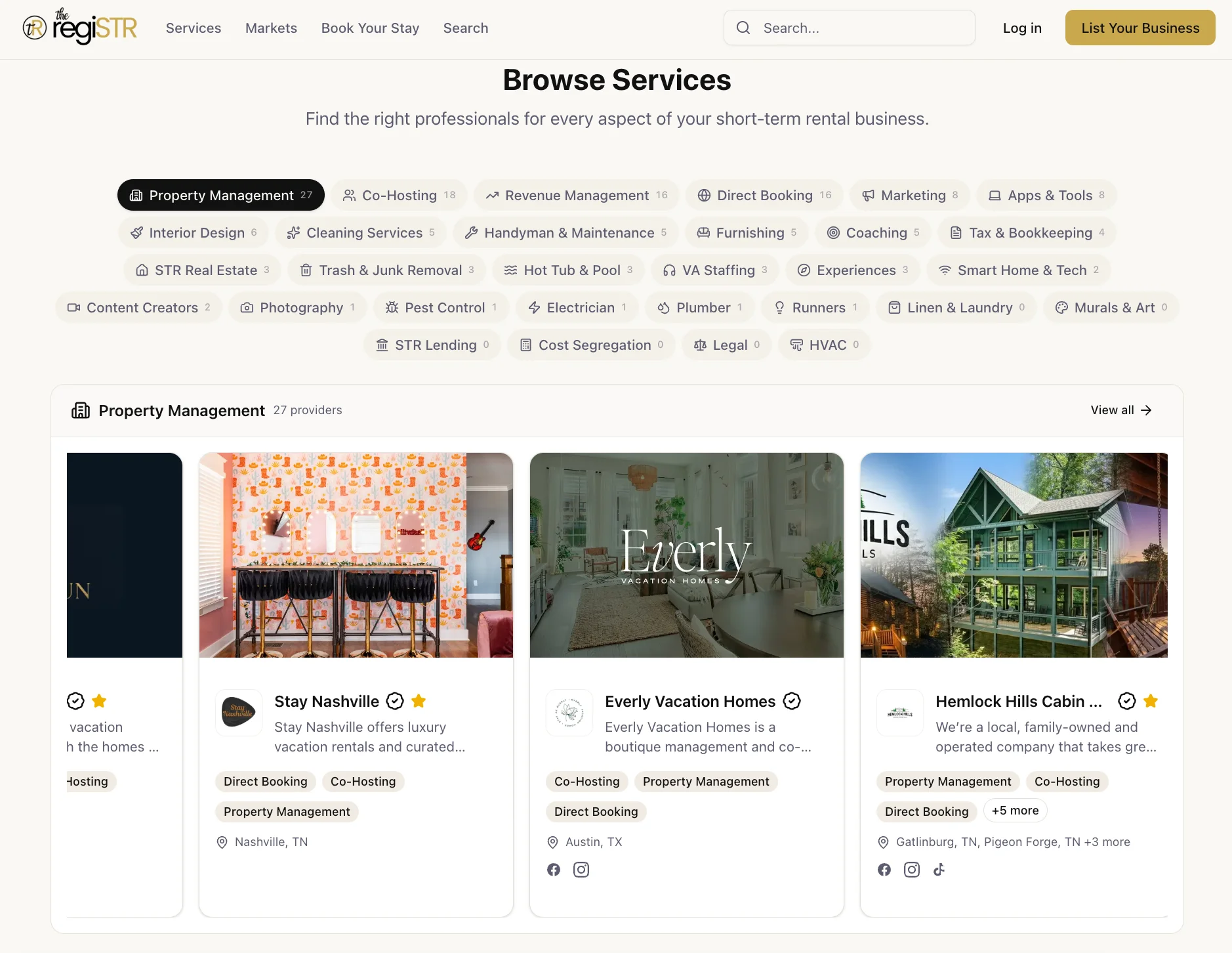
The regiSTR organizes every vendor category by market and service type, which is particularly useful for operators who own properties in markets they do not live in. Instead of piecing together a vendor network through cold outreach, you can browse vetted providers in your exact market across every category you need. Browse All STR Services to see which categories are available in your market.
Is Owning a Vacation Rental Profitable When Vendor Costs Are Factored In?
Owning a vacation rental is profitable when vendor costs are accounted for in the underwriting, not after the fact. The operators who struggle financially are typically those who modeled their revenue projections on platform gross income and forgot to subtract 15-25% for property management fees, 10-15% of gross for maintenance and repairs annually, cleaning and turnover costs on every occupied night, and platform commission fees. When those costs are modeled in from the start, the numbers either work or they do not.
According to Grand View Research, the U.S. short-term vacation rental market is projected to reach USD 76.46 billion in 2026, growing to USD 125.14 billion by 2033. That scale signals sustained operator demand, but it also signals intensifying competition, both for bookings and for reliable service providers. In high-demand markets, the best cleaners and the most capable property managers already have full client rosters. Operators who vet and onboard vendors early, before launching, have a structural advantage over those who scramble after their first booking confirms.
The profitability question also depends heavily on which vendor categories you outsource versus self-manage. Self-managing cleaning and co-hosting saves fee costs but introduces time and risk costs that most operators underestimate. The break-even calculation is different for every operator, but the pattern we consistently observe is this: operators who outsource strategically , spending on the vendor categories where professional execution produces the most guest-facing value , tend to outperform operators who try to minimize every vendor line item.
Almost 60% of respondents in a Statista survey indicated that short-term rentals are advantageous primarily because they provide an additional income source. That motivation is valid. But an additional income source that requires 30 hours a week of self-management and depends on vendors you found through a Facebook group post is not a passive income stream. It is a second job. The right vendor stack, properly vetted, is what separates an investment from an obligation.
What Questions Should You Ask Every Vendor Before You Hand Over a Key?
Asking the right questions before you hire a vacation rental vendor is the most reliable way to surface both competence and fit without waiting for a service failure to reveal them. The questions below apply across vendor categories, with adjustments for the specific role each vendor plays in your operation.
Questions for Cleaning and Turnover Vendors
- How many STR properties are you currently servicing on a regular basis?
- What is your guaranteed arrival window after a checkout, and what happens if you cannot make it?
- Do you supply all cleaning products and linens, or does the host provide them?
- How do you document the condition of the property between each turnover?
- Who covers your properties when you are unavailable?
Questions for Property Managers and Co-Hosts
- How many properties are you currently managing, and what is your team-to-property ratio?
- What dynamic pricing or revenue management tools do you use?
- How do you handle maintenance emergencies outside of business hours?
- What does owner reporting look like, and how frequently is it delivered?
- Can you provide references from STR owners with properties similar to mine?
- What are your fee structure and contract termination terms?
Questions for Maintenance and Repair Vendors
- Are you available for same-day or after-hours emergency calls?
- Do you carry general liability insurance that covers commercial short-term rental properties?
- Are you licensed for the specific type of work required (plumbing, electrical, HVAC)?
- How do you communicate with remote property owners on scope and cost before starting work?
Questions for Photographers
- Do you have a portfolio of STR listing photography specifically, not just real estate or commercial work?
- Do you understand Airbnb and VRBO listing photo requirements and aspect ratios?
- What is the turnaround time from shoot to delivered edits?
- Do you include a wide-angle hero shot, detail photography, and an exterior shot in your standard package?
You can find STR photographers who specialize in listing photography, and find STR property managers vetted by other operators in your market, directly through the regiSTR's service category pages. Every provider listed has been referred into the network by an existing member, which means the peer-vetting step is already done before you make first contact.
Frequently Asked Questions
What does it mean to vet a vacation rental vendor?
Vetting a vacation rental vendor means verifying their STR-specific experience, confirming their insurance and license status directly with issuing authorities, checking peer references from other STR operators, and assessing their communication protocols for time-sensitive situations like same-day turnovers and after-hours maintenance emergencies. It goes well beyond reading online reviews or accepting a verbal assurance of experience.
How do I find vetted vacation rental vendors in a market I don't live in?
The most reliable method is using a purpose-built STR service directory that filters providers by geographic market and service category. General directories do not distinguish between residential contractors and STR-experienced vendors, which creates significant risk for remote owners. The regiSTR organizes vetted providers by city and service type, with every listing backed by a referral from an existing network member, making remote vendor discovery far more reliable than cold outreach.
What is the difference between a co-host and a full-service property manager for short-term rentals?
A co-host typically handles day-to-day guest communication, check-in coordination, and oversight of cleaning crews, often serving as a local point of contact for a remote owner. A full-service property manager assumes broader operational responsibility, including pricing strategy, listing management, maintenance oversight, and owner reporting. Full-service management typically commands a fee of 15-25% of gross revenue, while co-hosting arrangements vary widely by market and scope.
What should I look for when vetting a vacation rental cleaning company?
Prioritize cleaners who have documented experience with STR-specific turnover timelines, including same-day transitions between checkout and check-in. Ask whether they can commit to a guaranteed turnaround window, whether they stock supplies or require the host to provide them, and how they handle last-minute schedule changes. A cleaner who cannot confirm their availability 48 hours in advance is a structural risk in any active STR operation.
How do I verify a vendor's insurance and license status?
Request the vendor's certificate of insurance and license number, then verify both directly with the issuing authority rather than relying on the document alone. For insurance, contact the carrier listed on the certificate and confirm the policy is active and covers commercial short-term rental work. For licenses, check the relevant state contractor licensing board or business registration database by name or license number: most states maintain publicly accessible lookup tools online.
Is it worth hiring a property manager for a short-term rental?
For most remote owners and operators managing more than two properties, professional management pays for itself through better pricing decisions, faster maintenance response, and consistent guest communication. Property managers typically charge 15-25% of gross revenue. The real cost comparison is not the fee versus zero: it is the fee versus the revenue lost from poor reviews, pricing errors, and deferred maintenance when self-managing without local support.
What is the 80/20 rule for Airbnb?
In short-term rental operations, the 80/20 principle suggests that roughly 20% of your vendors and operational decisions drive 80% of your guest experience outcomes. Specifically, your cleaner and your pricing strategy together account for the majority of review quality and revenue performance. This is why vetting those two vendor categories with the most rigor , before your first booking , pays outsized dividends on your overall operation.
What is the 75/55 rule for Airbnb?
The 75/55 rule refers to Airbnb's checkout task guidance: checkout processes should take guests no more than 75 seconds, and cleaning tasks listed for guests should require no more than 55 minutes of effort. For hosts, the operational implication is that your turnover vendor must complete their work within a tight post-checkout window, making guaranteed turnaround time a non-negotiable criterion when vetting cleaning and turnover services.
Ready to Stop Guessing on Vendors?
Running a profitable short-term rental means getting the right people in the right roles before your first guest ever walks through the door. The vendors you need exist in every active STR market. What has been missing, for most operators, is a reliable and STR-specific way to find and verify them without six months of trial and error.
That is the gap the regiSTR was built to close. Every provider in the directory has been referred in by a network member and is organized by market and service category, so you can find a vetted cleaner, property manager, photographer, or maintenance crew for your exact market in the time it takes to scroll a category page.

Stop cold-calling contractors who have never managed an STR turnover and stop relying on Facebook group recommendations that evaporate when something goes wrong. Browse vetted STR service providers by market and category at the regiSTR and sign up free to access the full directory. The key you hand over next should go to someone who has already been vouched for by operators just like you.
Content powered by inkSTR.co