
How to Hire an STR Property Manager Without Getting Burned

Hiring an STR property manager means vetting fee structure, contract terms, local market experience, and communication practices before you sign anything, not after. Get references from current clients, confirm what's included in the management fee, and have an attorney review termination and exclusivity clauses. Most costly hiring mistakes happen because owners skip one of these four steps.
- Management fees for short-term rental property managers typically run 15 to 30 percent of gross rental revenue, with some specialized operators charging as low as 10 percent or as high as 35 to 40 percent in premium markets.
- Setup fees of $200 to $800 per property and lease or re-lease fees of one to two months' rent are common add-ons that many owners miss when comparing quotes.
- Contract terms of six to twelve months with clear renewal and termination provisions are the industry standard, and the termination clause is where most owners get burned.
- Professional management companies now control an estimated 42 percent of the more than 7 million active short-term rental listings worldwide as of early 2026, according to Data Intelo, a sign that self-managing is no longer the default.
- The U.S. short-term rental market is projected to reach $76.46 billion in 2026, according to Grand View Research, meaning the pool of managers competing for your business is larger and more uneven in quality than ever.
- the regiSTR lists vetted STR property managers by market with peer-verified Vouch endorsements, so you can compare providers who have already cleared a referral bar instead of cold-calling names off a search results page.
Most owners who get burned by a bad property manager don't fail because they picked a dishonest one. They fail because they signed a vague contract, never asked about response-time obligations, or assumed a national brand's local rep would perform like the marketing promised. At the regiSTR, we track the STR service marketplace closely, and the pattern repeats across every market we cover: owners vet for price first and communication last, when it should be the reverse.
This guide is built specifically around how to hire an STR property manager, not a general residential landlord or a long-term leasing agent. Short-term rental management involves same-day turnovers, dynamic pricing across Airbnb and Vrbo, guest communication at odd hours, and compliance with local transient occupancy tax rules that a traditional property manager has never touched. In 2026, with professional management already controlling a large share of the global listing pool, the operators who win are the ones who know exactly what to ask before they hand over the keys.
What follows is a step-by-step framework: how to source candidates, what questions actually separate a good manager from a mediocre one, what belongs in the contract, and how to handle it if things go wrong mid-term. We also cover the two content gaps almost no other guide addresses: what a bad contract clause actually looks like next to a fair one, and how to calculate whether hiring a manager makes financial sense for your specific property.
Step 1: Decide If You Actually Need a Property Manager
The decision to hire an STR property manager comes down to a break-even calculation between your time, your local presence, and the fee you'd pay. If you live more than a short drive from your property, or you're managing more than one unit, self-managing usually costs more in hidden hours than it saves in fees.
Start with a simple exercise. Add up the hours you spend weekly on guest messaging, cleaner coordination, maintenance calls, and pricing adjustments. Multiply by what your time is worth professionally, not what you'd pay a stranger for the same task. Compare that number to a management fee running 15 to 30 percent of gross revenue.
Now factor in what a spreadsheet won't show: missed messages that cost you a booking, a maintenance issue that goes unresolved for three days because you're at your day job, or a guest dispute you handle badly because you're improvising. Self-managing landlords who reach burnout usually hit this point around their second property or their first out-of-state purchase.
There's also a tax and insurance dimension competitors rarely mention. A property manager who handles permit renewals and transient occupancy tax filings removes a compliance burden that carries real financial risk if missed, not just an inconvenience. If your market requires registration, like San Francisco's short-term rental ordinance under Administrative Code Chapter 41A, a manager who tracks renewal deadlines is worth more than the percentage fee suggests on paper.
If you decide self-managing still makes sense for now, a co-host arrangement is a middle ground worth exploring before jumping to full-service management. If you decide you're ready to hand off operations, browsing vetted STR property managers by market is the faster starting point than a general web search.
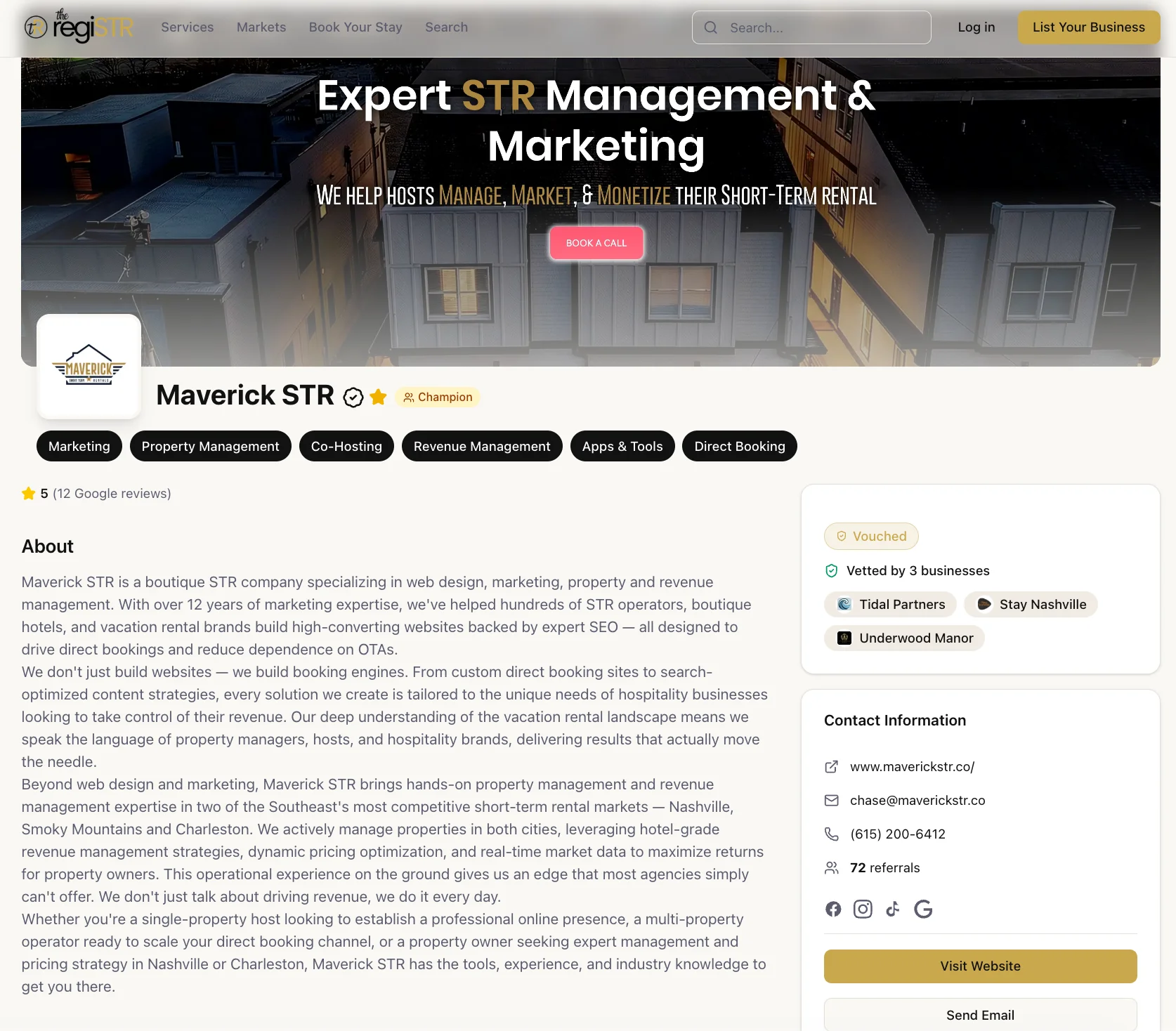
How to Hire a Property Manager for Airbnb?
Hiring a property manager for Airbnb requires sourcing at least three candidates, checking their current client references, confirming their fee structure in writing, and having a lawyer review the contract before signing. Skipping the reference check is the single most common mistake we see among first-time hosts.
First, source candidates from more than one channel. Local STR-specific real estate agents often know which managers are actually performing well versus which ones just market well. Professional bodies like the Vacation Rental Management Association (VRMA) maintain a directory of established managers, and a market-organized platform like the regiSTR surfaces providers who've been referred in by existing network members rather than paying for a listing.
Second, ask direct questions in the first call: How many properties do they currently manage in this specific market? How long have they operated STRs here, specifically, not residential rentals generally? What is their average client retention rate, and can they connect you with a current client for a reference?
Third, request their technology stack. A manager using dynamic pricing software and a channel manager to sync Airbnb, Vrbo, and direct bookings is operating at a different level of sophistication than one manually adjusting rates in a spreadsheet. Ask specifically what platform they use and how often pricing gets reviewed.
Fourth, confirm whether they handle tax filing and permit compliance as part of the base fee or as a separate line item. This single question eliminates a large share of billing surprises down the road.
Finally, never skip the reference check. A manager who hesitates to provide current client contacts, or offers only past clients, is signaling something. That's exactly the vetting criteria the regiSTR applies before a property manager appears in our directory: real operators vouching for real work, not anonymous star ratings that can be manipulated.
What Is the 75 55 Rule for Airbnb?
The 75 55 rule is a rough budgeting heuristic some STR operators use to estimate net income: roughly 75 percent of gross booking revenue survives after platform fees, cleaning costs, and operating expenses, and of that remaining figure, around 55 percent typically flows through as usable profit once mortgage, utilities, and reserve funds are deducted.
It's not a formal accounting standard, and you won't find it published by Airbnb or a tax authority. Treat it as a sanity check, not gospel. Your actual numbers depend heavily on your market's management fee norms, your mortgage structure, and your local transient occupancy tax rate, which varies significantly by city and county.
Where this matters for hiring a manager: if a candidate quotes a 30 percent management fee on top of typical operating costs, you need to run your own version of this math before signing. A high fee percentage isn't automatically bad if it comes with full-service marketing, maintenance coordination, and guest communication, but it needs to fit your specific revenue picture, not a rule of thumb pulled from a forum post.
We see owners get this backward constantly. They fixate on the management fee percentage without modeling what it actually nets out to against their specific ADR and occupancy. A 20 percent fee on a property that a skilled manager fills at 85 percent occupancy can outperform a 12 percent fee on a property sitting empty because the previous self-managed listing had stale photos and no dynamic pricing.
Run your own numbers with your actual nightly rate, your actual local tax obligations, and quotes from at least two or three managers before deciding a specific fee is too high or reasonable.
How Do You Manage an STR Property?
Managing an STR property involves five ongoing functions: guest communication and booking management, turnover cleaning coordination, dynamic pricing across listing channels, maintenance response, and regulatory compliance including tax filing and permit renewal. A property manager typically handles some or all of these depending on the service tier you select.
Full-service management covers all five functions under one contract, usually for the higher end of the 15 to 30 percent fee range. Co-hosting arrangements split responsibilities, with the co-host often handling guest communication and pricing while you retain control of maintenance vendor relationships and financial decisions.
A manager's day-to-day workflow typically includes: syncing calendars across Airbnb, Vrbo, and any direct booking channel to prevent double-bookings, scheduling cleaners within the checkout-to-checkin window, adjusting nightly rates based on demand signals, responding to guest inquiries within a defined window, and coordinating repairs when something breaks mid-stay. Some markets impose specific operational requirements that a good manager should already know. In Baltimore, for example, property owners must be able to respond to emergencies within 30 minutes, according to STR Profit Map, a requirement that makes a manager's after-hours response protocol a genuine hiring criterion, not a nice-to-have.
Ask any candidate manager to walk you through their actual daily and weekly workflow, not their marketing description of services. The specifics, who answers a 2am guest message, who has spending authority for a $150 repair, who reconciles monthly statements, reveal whether they're running a real operation or improvising.
If you're weighing whether to keep pieces of this in-house versus handing it fully to a manager, our related guide on running a short-term rental breaks down which functions owners most commonly retain even after hiring professional help.
What Is the 80 20 Rule for Airbnb?
The 80 20 rule applied to Airbnb hosting suggests that roughly 80 percent of your revenue or guest satisfaction outcomes typically come from about 20 percent of your operational effort, usually concentrated in a small number of high-impact decisions: pricing strategy, listing photography, and turnover reliability. In practice, this means the highest-leverage hiring decisions aren't the ones that take the most time. Getting your pricing strategy and turnover cleaning right matters more to your bottom line than micromanaging every guest message personally.
For property manager candidates, this translates to a specific interview question: which 20 percent of their service do they consider most critical to your outcomes? A manager who immediately points to pricing optimization and turnover consistency, rather than listing every feature in their brochure, understands where the actual leverage sits.
This is also where the case for full-service management gets stronger for owners who dislike the 80 20 framing in practice. If pricing and turnover reliability drive most of your results, and you don't have the bandwidth or local knowledge to execute those two functions well yourself, that's the exact gap a property manager is built to close.
the regiSTR's property management category lets you filter by market and compare which providers emphasize revenue optimization versus operational logistics, so you can match a candidate's strength to whichever 20 percent matters most for your property.
What Contract Clauses Separate a Fair Deal From a Bad One?
A fair STR management contract specifies exact fee percentages, a defined initial term of six to twelve months, clear termination notice periods, and owner retention of guest review ownership. A bad contract buries fees in vague "additional services" language, locks you into automatic multi-year renewals, or gives the manager exclusive control over your listing's review history.
Here's what that looks like in practice. A fair termination clause reads something like: either party may terminate with 60 days' written notice, with no penalty beyond fees earned for completed bookings. A bad termination clause reads: agreement automatically renews annually unless terminated in writing 90 days before the renewal date, with an early termination fee equal to three months of projected management revenue.
| Contract Element | Fair Clause Language | Red Flag Clause Language |
|---|---|---|
| Termination | 60 to 90 day written notice, no penalty for completed bookings | Automatic renewal with steep early exit fees |
| Exclusivity | Manager handles STR operations, owner retains listing ownership | Manager owns the Airbnb listing and guest review history |
| Fee Transparency | Base fee percentage stated, add-ons itemized separately | "Additional services as needed" with no defined rates |
| Spending Authority | Manager can approve repairs up to a stated dollar threshold without owner sign-off | No stated limit, owner discovers charges after the fact |
| Reporting | Monthly statements with occupancy, revenue, and expense detail | Reporting "available upon request" with no defined cadence |
The listing ownership clause deserves special attention. Some management agreements list the property under the manager's own Airbnb account, meaning if you terminate the contract, you lose your review history and have to rebuild your listing's reputation from zero. Insist on retaining ownership of your own listing account, with the manager operating as a co-host, not the account holder.
Set explicit spending authority limits in writing. A common structure allows the manager to approve repairs under a set dollar amount without prior approval, with anything above that threshold requiring your sign-off first. Without this clause, you may discover a $2,000 repair bill you never agreed to. Always have an attorney review the full agreement before signing, particularly the termination and exclusivity sections. This is standard advice across the industry, and it's advice worth actually following rather than skimming past.
How Do You Negotiate Fees and Terms Before Signing?
Negotiating an STR management contract means treating the first offer as a starting point, not a final number, and pushing specifically on fee structure, contract length, and exit terms rather than trying to negotiate everything at once. Managers expect negotiation on at least one of these three points. Start by getting quotes from at least two or three candidates before you negotiate with your preferred choice. Having a comparison number gives you leverage that a first-time host without competing quotes simply doesn't have.
On fees, ask directly: is this percentage negotiable if I commit to a longer initial term, or if I have multiple properties to place under one contract? Managers with capacity to fill often have more room to move than their initial quote suggests, particularly for owners bringing more than one unit. On contract length, push for the shorter end of the standard six to twelve month range if you're hiring your first manager. A shorter initial term lowers your risk if the relationship doesn't work out, and you can always renew into a longer term once you've confirmed performance.
On exit terms, this is the clause worth the most negotiating energy. Ask for a defined notice period with no early termination penalty tied to projected future revenue, only fees for bookings already confirmed and completed. A manager who refuses any flexibility here is telling you something about how they expect the relationship to go. Also negotiate review ownership and reporting cadence as part of the same conversation, not as afterthoughts. These cost the manager nothing to grant and protect you significantly if the arrangement ends.
What Happens If a Manager Underperforms Mid-Contract?
Mid-contract disputes with an STR property manager typically involve missed cash flow reporting, unauthorized rate changes, or unresolved guest complaints, and the right response depends on what your contract specifies for dispute resolution and notice periods. First, document everything in writing. If revenue reports are late, missing, or don't reconcile with what you can see on your own Airbnb or Vrbo host dashboard, save every communication and note dates.
Second, invoke the notice clause your contract should already specify. Most fair agreements include a cure period, typically 15 to 30 days, where you formally notify the manager of a specific performance issue and give them a chance to fix it before you can terminate for cause. Third, if the issue involves unauthorized spending above your agreed threshold, or a rate change made without your approval, request an itemized explanation in writing before your next payment cycle. This creates a paper trail if the dispute escalates.
Fourth, if a guest dispute arises and the manager's handling seems inadequate, ask to see the actual guest communication thread. A manager who resists sharing this, or who has been vague about outcomes, is a signal the relationship needs review. If informal resolution fails and the contract includes a cure period that's expired, review your termination clause for how to exit cleanly. This is exactly why the negotiation step above matters so much: a contract with a reasonable, clearly written termination clause turns a bad-fit relationship into a manageable exit instead of a costly one.
If you're navigating a dispute now, comparing your current arrangement against what's typical in your market is a useful gut check. Browsing other vetted property managers in your area gives you a realistic sense of whether your current fee, response times, and reporting cadence are actually out of line, or just uncomfortable.

What Services Should an STR Property Manager Actually Provide?
A full-service STR property manager provides marketing and listing optimization, booking management across Airbnb and Vrbo, turnover cleaning coordination, maintenance response, dynamic pricing, guest communication, financial reporting, and regulatory compliance including tax filing where applicable. Not every manager offers every item on this list, and that's fine as long as the contract is explicit about what's included versus what costs extra. A manager who bundles channel management and pricing into a base fee, versus one who charges separately for "pricing optimization" as an add-on, are offering functionally different products even if their headline percentage looks similar.
Some software-driven managers bundle channel management, dynamic pricing, and basic guest messaging into a smaller additional fee layered on top of a lower base management percentage. This model can work well for owners who want more hands-on control over cleaning and maintenance vendor relationships while outsourcing the booking and pricing logistics. Ask every candidate to list, in writing, exactly which of these eight functions their fee covers. This single request eliminates most of the ambiguity that leads to billing disputes six months into the relationship.
the regiSTR's directory organizes providers by these exact service distinctions, so you can filter for full-service property management versus a narrower co-hosting or revenue-management-only arrangement depending on what your property actually needs.
How Do You Verify a Property Manager's Reputation Before Signing?
Verifying a property manager's reputation means checking references from current clients, reviewing their standing with organizations like the Better Business Bureau, and confirming their actual portfolio size in your specific market, not their marketing claims about total properties managed nationwide. Ask for at least two current client references and actually call them. Ask the reference specifically about response times, billing accuracy, and how disputes were handled, not just whether they're "happy overall."
Check third-party review platforms for patterns, not isolated complaints. A single bad review from years ago matters less than a recent pattern of complaints about the same issue, missed communication, surprise fees, slow maintenance response. Confirm their actual local presence. National STR management brands sometimes use a local franchisee or contracted point of contact as the on-the-ground manager. Ask to meet that specific local contact, not just the sales representative who closed your deal, since that person is who you'll actually work with day to day.
Finally, ask how many properties they currently manage in your specific market, not company-wide. A manager overseeing sixty properties nationally but only four in your city may not have the local vendor relationships or market pricing knowledge you're paying for. This verification process is exactly what the regiSTR's Vouch system is designed to shortcut. Every property manager in our directory has been referred in by an existing network member and can be vouched for publicly by real STR operators who've actually worked with them, which cuts through marketing copy faster than a cold reference call.
Data Snapshot: What Owners Should Budget and Expect
The table below summarizes the industry benchmarks referenced throughout this guide, useful as a quick reference when comparing quotes from multiple candidates.
| Category | Typical Range | Notes |
|---|---|---|
| Base management fee | 15% to 30% of gross revenue | Can run as low as 10% or as high as 35 to 40% in premium markets |
| Setup fee | $200 to $800 per property | One-time onboarding charge, confirm if waived for multi-property owners |
| Lease/re-lease fee | 1 to 2 months' rent equivalent | Charged at turnover between long-term tenants in mixed-use portfolios |
| Contract term | 6 to 12 months | Shorter terms recommended for first-time management hires |
| Software bundle fee | 5% to 10% additional | Covers channel management, dynamic pricing, and basic guest messaging |
| Target occupancy | 70% to 90% annually | Varies significantly by location, seasonality, and property type |
These are industry-wide ranges, not guarantees for your specific property. Your actual costs depend on your market's competitive intensity, your property's price point, and how many services you're bundling into the base fee versus paying separately.
Common Mistakes to Avoid When Hiring an STR Manager
- Vetting for price only. The lowest fee percentage often correlates with the fewest included services, not the best deal.
- Skipping reference calls. A manager who hesitates to connect you with current clients is telling you something important.
- Signing before legal review. Termination and exclusivity clauses are where owners lose the most money and control.
- Ignoring listing ownership. If the manager holds your Airbnb account, you lose your review history if you switch providers.
- Not confirming local presence. A national brand name doesn't guarantee a competent local point of contact.
- Overlooking tax and permit responsibilities. Confirm in writing whether compliance is included or billed separately.
- Failing to set spending authority limits. Without a dollar threshold in writing, you may face repair bills you never approved.
Quick-Reference Summary: How to Hire an STR Property Manager
- Calculate your break-even point between self-managing and paying a management fee.
- Source at least three candidates through local agents, VRMA's directory, or the regiSTR's market listings.
- Ask about local portfolio size, technology stack, and tax/permit handling in the first call.
- Request and actually call at least two current client references.
- Compare fee structures line by line, not just the headline percentage.
- Negotiate contract length, termination notice, and listing ownership before signing.
- Have an attorney review the final agreement, particularly exit and exclusivity clauses.
- Set a defined dispute resolution and cure period in the contract for future protection.
Frequently Asked Questions
What is the regiSTR and how does it differ from general contractor directories?
the regiSTR is an invite-only short-term rental service directory that lists property managers, cleaners, photographers, and other STR vendors by market. Unlike general home services platforms, every visitor to the regiSTR is already searching for an STR-specific provider, and listed managers are referred in by existing network members rather than paying to appear.
How much does an STR property manager typically charge?
STR property manager fees typically run 15 to 30 percent of gross rental revenue, with some specialized operators charging as low as 10 percent and premium market operators charging up to 35 to 40 percent. Setup fees of $200 to $800 per property are also common as a separate one-time charge.
Should I sign a management contract without a lawyer reviewing it first?
No. Termination clauses, exclusivity terms, and listing ownership language are the areas where owners most commonly lose money or control mid-contract. A short legal review before signing costs far less than the consequences of a bad exit clause discovered eighteen months in.
What's the difference between a co-host and a full-service property manager?
A co-host typically handles guest communication and pricing while the owner retains control of maintenance and financial decisions, usually for a lower fee than full-service management. A full-service property manager covers marketing, bookings, cleaning coordination, maintenance, pricing, reporting, and often tax compliance under one contract.
How do I know if a property manager has real STR experience versus general rental experience?
Ask specifically how many properties they manage in your exact market, not company-wide, and how long they've operated short-term rentals as opposed to long-term leases. Request current client references and ask about their technology stack, since dynamic pricing software and channel manager use signal genuine STR-specific operations.
What should I do if my property manager stops sending accurate financial reports?
Document the missing or inaccurate reports in writing and invoke the cure period clause your contract should specify, typically 15 to 30 days for the manager to correct the issue. If the pattern continues past that window, review your termination clause for a clean exit path.
Is it worth hiring a property manager if I only have one STR property?
It depends on your proximity to the property and how much of your time goes into guest messaging, cleaner coordination, and pricing adjustments each week. Run the break-even math comparing your time cost against a 15 to 30 percent management fee before deciding, since out-of-state owners typically see the clearest case for hiring help.
How can I find vetted STR property managers instead of relying on generic search results?
Browse the regiSTR's property management category filtered by your specific market, where every listed provider has been referred in by an existing network member and can be publicly vouched for by real STR operators. This peer-verification process cuts through marketing claims faster than cold outreach or a general web search.
Conclusion: Hire With a Framework, Not a Gut Feeling
Learning how to hire an STR property manager comes down to four disciplines: run your own break-even math, vet candidates on specifics instead of marketing language, negotiate the exit terms as hard as the fee, and never skip the legal review. Owners who get burned almost always skipped one of these four steps, not because they picked a scammer, but because they signed a vague contract in a hurry. In 2026, with professional management already controlling a significant share of the world's active STR listings, the operators who protect their margins are the ones treating this hire like the business decision it is. The market has more options than ever, which makes the vetting framework above more important, not less.
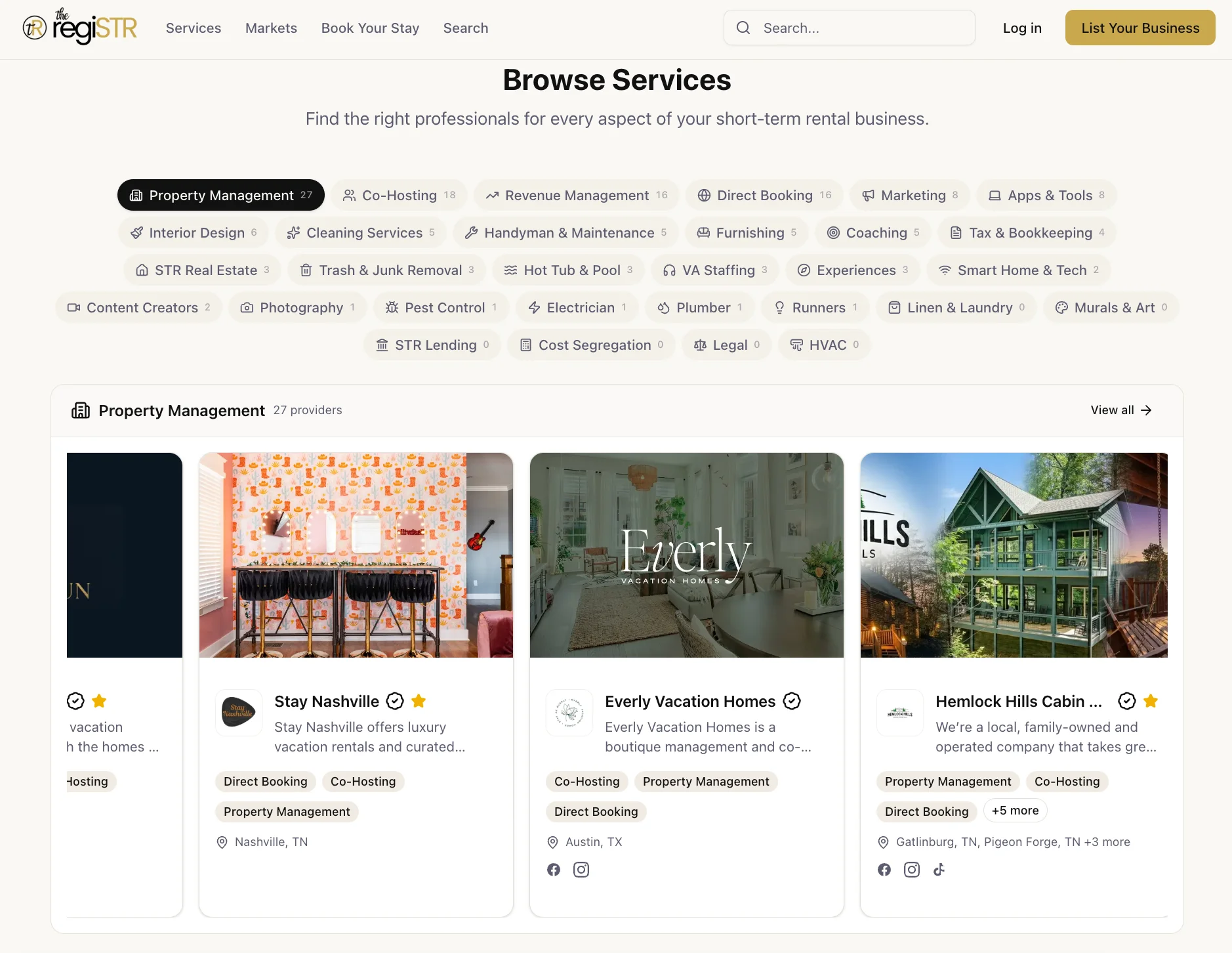
If you're ready to compare candidates instead of guessing, get started with the regiSTR and browse property managers vouched for by real STR operators in your specific market. Filtering by city and service tier takes a couple of minutes and gives you a shortlist that's already cleared a referral bar most cold-search candidates never face.
Content powered by inkSTR.co