Direct Booking Websites: How to Build One That Works
A direct booking website is a standalone site where guests can search availability, view pricing, and reserve your short-term rental directly with you, without routing the reservation through Airbnb or Vrbo. It typically pairs a front-facing site (photos, rates, calendar) with a backend booking engine that processes payment and blocks the calendar in real time. For hosts paying 15-20% in OTA commission on every reservation, a functioning direct booking site is the single biggest lever for keeping more of what a guest actually pays.
Key Takeaways
- Direct booking websites let hosts avoid the 15-20% commission that Airbnb and Vrbo charge per reservation, based on figures cited across industry sources tracking OTA fee structures.
- A functional setup requires two components: a guest-facing site with photos and pricing, and a booking engine that syncs calendar availability and processes secure payment.
- The U.S. short-term rental market is projected to grow 4.1% year-over-year in 2026, meaning more competition for guest attention both on OTAs and off them.
- Rate parity between your direct site and your OTA listings is not optional. Guests who find a cheaper price on Airbnb after visiting your direct site will book there instead.
- Building the site is the easy part. Driving qualified traffic to it through SEO, email, and social channels is where most hosts stall out.
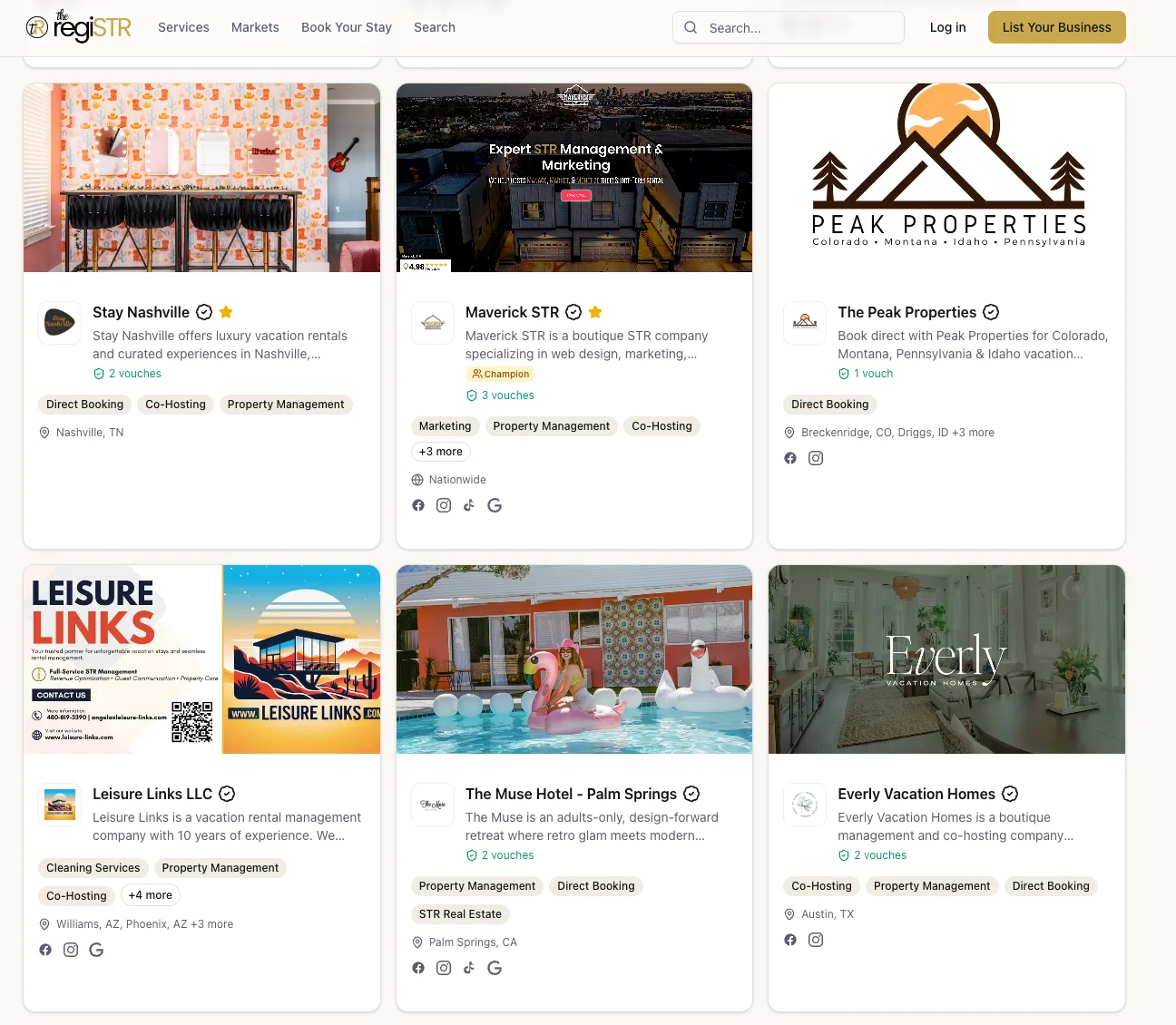
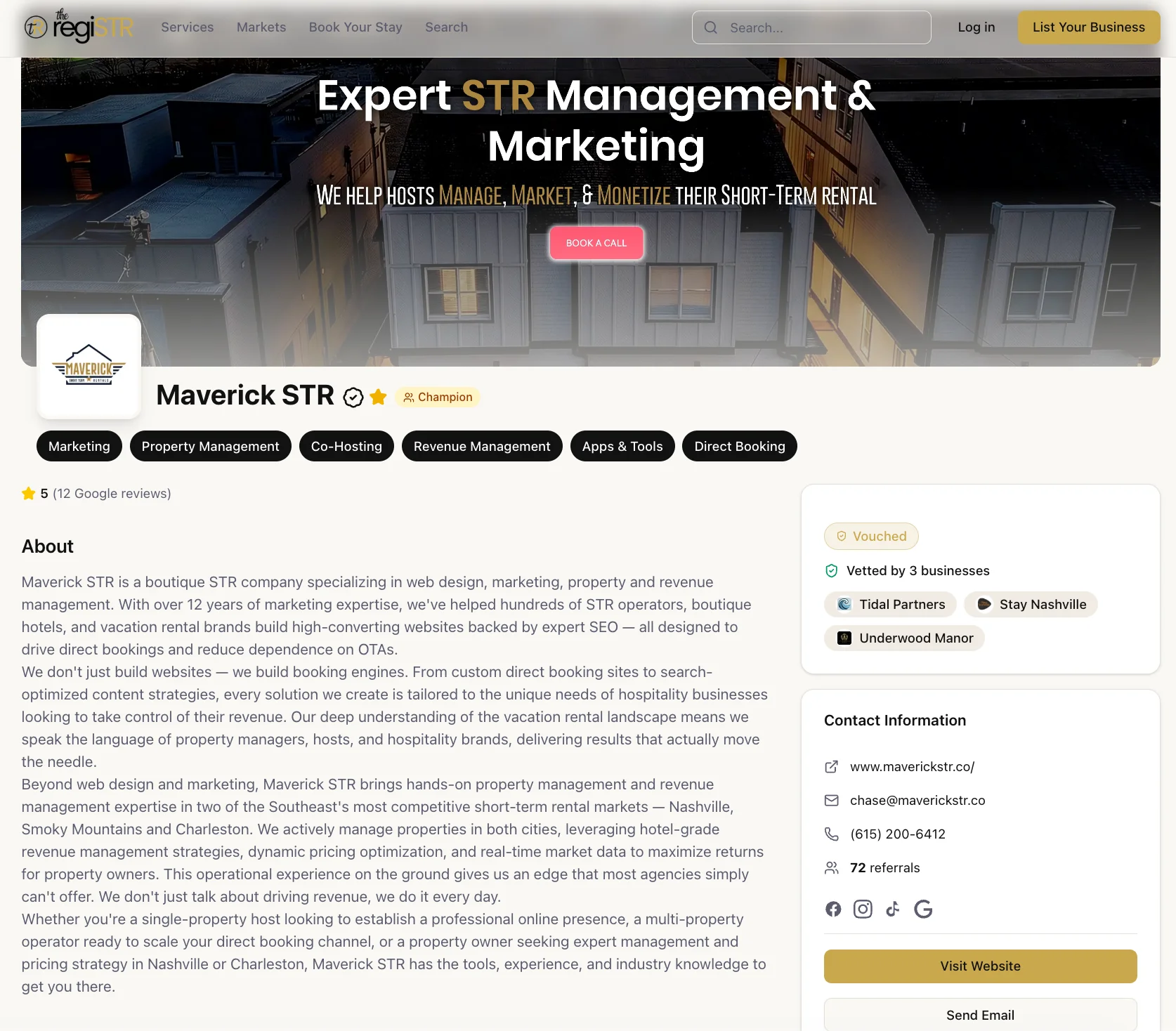
- The regiSTR connects hosts with STR-specialized website developers, SEO consultants, and social media managers who already understand direct booking mechanics, rather than generalist agencies learning the space on your dime.
If you're reading this because you just calculated how much OTA commission cost you last year, you're not alone. Most operators run that number once, wince, and then never build the direct booking infrastructure that would fix it. It sits on the "someday" list next to a dozen other operational upgrades.
At the regiSTR, we hear a version of the same complaint from hosts across every market we track: they know direct bookings would save money, but they don't know where to start, and the freelancer who built their cousin's restaurant site has never touched a channel manager. Direct booking websites are not generic small-business websites. They require calendar sync, payment processing tied to reservation dates, and content built to convert a browsing traveler into a paying guest.
This guide walks through what a direct booking website actually needs to function, the technical steps to launch one in 2026, the traffic strategies that make the site worth building, and where the compliance gaps most guides skip entirely. By the end, you'll have a framework for building or hiring out a direct booking site that doesn't just sit online looking nice while every reservation still routes through an OTA.
What Is a Direct Booking Website and Why Does It Matter in 2026?
A direct booking website is a property-specific or portfolio-specific site that allows guests to check availability and reserve a stay without an intermediary platform processing the transaction. It matters because OTA commissions, typically 15-20% per booking according to industry cost breakdowns, compound across every single reservation a property takes in a year.
Run the math on a property doing 180 nights a year at a reasonable average daily rate. Even a modest shift of 10-15% of those bookings to a direct channel, a target explicitly cited in market research on direct booking adoption, represents thousands of dollars in commission that stays with you instead of the platform.
The U.S. vacation rental market is projected to reach $76.46 billion in 2026, up from $72.00 billion in 2026. As the pool of available listings grows, projected to hit 1.77 million in the U.S. alone in 2026, OTA search results get more crowded and platform algorithms get harder to win. A direct channel is not a replacement for Airbnb or Vrbo visibility. It's insurance against being entirely dependent on it.
Direct booking capability is exactly the kind of infrastructure the regiSTR's directory of STR service providers was built to help hosts source, since website builders and channel managers designed for hotels rarely understand vacation rental workflows.
How Do You Build a Direct Booking Website Step by Step?
Building a direct booking website requires connecting three systems: a property management system or channel manager, a booking engine, and a public-facing website. Skipping any one of the three leaves you with either a pretty brochure site that can't take payment, or a booking engine with nowhere for guests to discover it.
- Step 1: Connect Your Property Management System or Channel Manager. Your PMS or channel manager is the source of truth for calendar availability. Whatever booking engine you choose needs a live integration here, otherwise you risk double-booking a night that's already reserved on Airbnb.
- Step 2: Choose a Booking Engine That Handles Payment and Calendar Sync. The booking engine processes the reservation, charges the card, and blocks the date across every connected channel. Some direct booking platforms report onboarding in under 15 minutes once the PMS connection is live, though most hosts spend longer configuring cancellation policies and deposit rules correctly.
- Step 3: Build or Customize the Guest-Facing Website. This is the layer guests actually see: photos, property descriptions, amenity lists, and a "Book Now" button that hands off to the booking engine. Templates speed this up, but generic templates convert worse than sites built specifically for vacation rental browsing behavior.
- Step 4: Set Up Secure Payment Processing. Guests need to trust that entering a card number on your standalone site is as safe as doing it on Airbnb. That means SSL certification, PCI-compliant payment processing, and clear cancellation terms displayed before checkout.
- Step 5: Test the Full Booking Flow Before Launch. Book a test reservation yourself, cancel it, and confirm the calendar released correctly on every connected channel. A broken sync here is invisible until a guest double-books your property.
- Step 6: Add Direct Booking Links Everywhere Guests Already Look. Post-stay emails, welcome booklets, digital check-in guides, and even a small printed card on the counter should all point to your direct site for the next stay.
Most first-time builders underestimate step 5. A calendar sync failure that shows a property as "available" on your direct site when it's actually booked on Vrbo doesn't just cost you a refund, it costs you a guest relationship you were specifically trying to build by going direct in the first place.
What Should Be Included in a Vacation Rental Booking Engine?
A vacation rental booking engine is the transactional layer of a direct booking website, responsible for real-time availability, payment processing, and reservation confirmation. At minimum, it needs live calendar sync, secure checkout, and automated guest communication triggered by the booking itself. Specifically, look for a booking engine that supports deposit and full-payment options, since guests booking direct expect the same flexibility they'd get on Airbnb. Many premium booking engines also bundle pre-signed guest agreements and automated check-in instructions, reducing the manual follow-up you'd otherwise handle by email.
| Feature | Why It Matters | Common Gap |
|---|---|---|
| Real-time calendar sync | Prevents double-booking across OTAs and direct site | Delayed sync (batch updates instead of instant) |
| Secure payment processing | Builds guest trust, meets PCI compliance | Missing SSL, no fraud screening |
| Automated guest agreements | Reduces manual paperwork per booking | Manual PDF sent after the fact |
| Deposit and cancellation logic | Matches guest expectations from OTA experience | Rigid, all-or-nothing payment terms |
| Mobile checkout flow | Most travel searches now start on mobile | Desktop-only booking forms |
Notably, some direct booking platforms charge a flat monthly or per-property subscription instead of a per-transaction percentage. That structure matters because a subscription model rewards volume: the more direct bookings you drive, the lower your effective cost per reservation, unlike commission-based tools where the fee scales with revenue no matter how much traffic you bring yourself.
How Do You Get More Direct Bookings Once the Site Is Live?
Getting more direct bookings requires driving qualified traffic to a site that already converts, since the best-built booking engine generates zero reservations without visitors. The three highest-leverage channels for most STR operators are search engine visibility, guest email retargeting, and social proof from past stays. First, search engine optimization matters because travelers increasingly search for a property or destination by name before ever opening Airbnb. A direct site that ranks for "[your property name] direct booking" or "[your city] vacation rental no fees" captures that intent before the guest ever compares platforms. Second, email remains the highest-converting channel for repeat guests. A past guest who loved their stay is far more likely to book direct next time if you email them a discount or early-access window before they default back to searching Airbnb. Third, social channels drive discovery for new guests who've never stayed with you. Instagram and Facebook posts that link straight to your direct booking site, rather than back to an OTA listing, keep that traffic in your own funnel from the first click.
The regiSTR's directory lists STR-focused website design, SEO, and social media providers who build this traffic strategy as a package rather than treating the website as a one-time deliverable with no follow-up plan.
How Do You Maintain Rate Parity Across OTAs and Your Direct Site?
Rate parity means your direct booking site and your OTA listings show the same nightly rate for the same dates, at all times. Breaking parity, even accidentally, either drives guests to book cheaper on Airbnb after browsing your direct site, or triggers a listing penalty from the OTA if your site undercuts them. For example, if you run a seasonal discount, that discount needs to sync across every channel simultaneously, not just the one you remembered to update first. As a result, most operators managing more than one channel rely on a channel manager that pushes rate and availability changes everywhere at once rather than updating each platform manually. Additionally, parity isn't just about price. Cancellation policy, minimum stay requirements, and cleaning fee disclosure all need to match across channels, or you risk a guest feeling misled when the direct-booked total differs from what they expected based on the OTA listing they compared it to.
What Legal and Compliance Requirements Apply to Direct Booking Sites?
Direct booking websites carry compliance obligations that OTA-only listings partially offload to the platform, including tax collection, guest data privacy, and jurisdiction-specific registration. When you book direct, you become responsible for calculating and remitting transient occupancy taxes yourself, rather than relying on Airbnb's automated collection in markets where it applies. Several major markets now require short-term rental operators to hold local permits or licenses tied to zoning and safety inspection, and many jurisdictions impose transient lodging taxes ranging from 5% to 15% of the nightly rate. As of December 22, 2026, New York now requires booking services to submit quarterly reports, with a $25 non-refundable filing fee, according to the New York Department of State. That kind of reporting obligation is a reminder that direct booking operators need to track their own compliance calendar rather than assuming a platform handles it silently in the background. Guest data privacy is the second overlooked piece. A direct site collecting names, payment details, and contact information needs the same data handling discipline OTAs already meet, including secure storage and clear disclosure of how that information gets used.
Because compliance rules vary so widely by city and state, this is one area where the regiSTR's Regulatory and Compliance category gets used most often by hosts moving from OTA-only to a mixed direct and platform strategy.
What Does a Direct Booking Website Cost to Build and Maintain?
Direct booking website costs vary based on whether you use a subscription-based booking engine, a percentage-based commission tool, or a fully custom build from a developer. Subscription models typically charge a flat monthly or per-property fee regardless of booking volume, while some platforms charge a commission in the 0-5% range per transaction, still far below the 10-15% OTA commissions they replace. At the premium end, full-service direct booking platforms that include marketing and distribution management can charge 15-50% of rental revenue, depending on the scope of service. That range only makes sense for hosts who want the platform handling guest acquisition entirely, not just processing the transaction. Custom-built sites from an independent developer carry an upfront design and integration cost, then ongoing hosting and maintenance. The tradeoff is control: a custom build lets you own the SEO strategy and content long-term instead of renting visibility inside someone else's platform ecosystem.
| Model | Typical Cost Structure | Best For |
|---|---|---|
| Subscription booking engine | Flat monthly/per-property fee | Multi-property operators with steady booking volume |
| Commission-based tool | 0-5% per transaction | New direct booking sites testing demand first |
| Full-service direct platform | 15-50% of rental revenue | Hosts wanting marketing and distribution handled entirely |
| Custom developer build | Upfront build cost plus hosting | Portfolio operators wanting full SEO and content control |
Comparing these models side by side is exactly what the regiSTR enables, since providers list their service structure by category and market rather than making you request five quotes just to compare pricing philosophy.
Should You Hire a Developer or Use a DIY Booking Platform?
Whether to hire a developer or use a DIY platform depends on how many properties you manage and how much SEO and content differentiation matters to your growth strategy. A single-property host chasing a quick launch often does better with a subscription platform and a template site. A multi-property operator investing in a long-term direct booking channel usually benefits from custom development. DIY platforms win on speed. Some report full setup, including payment integration and calendar sync, in under 15 minutes once your PMS connection is live. That speed comes at the cost of design and content flexibility, since templates are shared across thousands of other properties. Custom development wins on differentiation. A site built specifically around your property's content and SEO strategy can rank for search terms a templated site never will, but it requires ongoing maintenance and a developer relationship, not just a one-time build fee.
Not every host needs a custom build on day one. But operators managing three or more properties, where the SEO and branding investment compounds across the whole portfolio, tend to outgrow templated platforms faster than they expect. The regiSTR's Website Design and Development category is organized specifically for that transition point.
Common Mistakes Hosts Make With Direct Booking Websites
The most common mistake is launching a direct booking site and then doing nothing to drive traffic to it, treating the build itself as the finish line rather than the starting point. A site with zero visitors converts zero guests regardless of how well the booking engine functions. A second mistake is breaking rate parity without realizing it, usually by forgetting to sync a seasonal price change across every channel simultaneously. A third is skipping mobile optimization entirely, even though most travel research and booking activity now happens on a phone rather than a desktop browser. Finally, many hosts underestimate the compliance layer. Collecting payment directly means collecting and remitting occupancy taxes directly too, in whatever jurisdiction the property sits in, and that responsibility doesn't disappear just because the booking happened on your own site instead of a platform's.
- Launching the site without a traffic plan for SEO, email, or social
- Letting seasonal rate changes go out of sync across channels
- Ignoring mobile checkout experience
- Assuming tax collection is automatic when it isn't
- Choosing a generic web developer with no vacation rental experience
Frequently Asked Questions
What is a vacation rental direct booking?
A vacation rental direct booking is a reservation made through a property's own website or booking engine rather than through Airbnb, Vrbo, or another OTA. The host keeps the full nightly rate minus payment processing fees, instead of paying a platform commission typically in the 15-20% range.
How do I build a direct booking business for my vacation rental?
Building a direct booking business starts with connecting your property management system to a booking engine, then launching a guest-facing website with that engine embedded. From there, the business grows by driving traffic through SEO, past-guest email campaigns, and social channels that point directly to your own site instead of an OTA listing.
How can I promote direct reservations to bypass high platform fees?
Promote direct reservations by placing your booking site link in every guest touchpoint you control: pre-arrival emails, digital check-in instructions, welcome booklets, and post-stay follow-ups offering a discount for the next visit. Guests who had a good experience are the easiest audience to convert to a direct booking, since they already trust the property.
How do I encourage guests to book direct next time?
Encourage repeat direct bookings by capturing guest email addresses during the stay and following up with a modest discount or early-access booking window before their trip planning cycle starts again. A simple printed card at checkout with your direct site URL also works, since it reaches guests at the moment they're already happy with the stay.
How do I get more direct bookings from Instagram and Facebook?
Get more direct bookings from social channels by linking every post and story directly to your booking site rather than to an Airbnb listing, and by showcasing real guest photos and reviews that build trust before a traveler ever clicks through. Consistent posting that highlights the property's differentiators, not generic travel content, converts better than sporadic promotional posts.
How much does it cost to set up a direct booking website?
Costs vary by model: subscription-based booking engines typically charge a flat monthly or per-property fee, commission-based tools charge 0-5% per transaction, and full-service direct booking platforms handling marketing and distribution can run 15-50% of rental revenue. Custom developer builds carry an upfront design cost plus ongoing hosting and maintenance.
Do I still need Airbnb and Vrbo if I have a direct booking site?
Yes, most operators run direct booking sites alongside OTA listings rather than replacing them entirely. OTAs still drive discovery for new guests who've never heard of your property, while the direct site captures repeat guests and travelers who find you through search or social channels first.
Conclusion: Building a Direct Booking Website That Actually Converts
A direct booking website only pays off when the technical setup, the traffic strategy, and the compliance groundwork all function together. Skip any one piece and you end up with either a site nobody visits or a site that quietly creates a tax problem you didn't see coming. As the U.S. short-term rental market grows toward $76.46 billion in 2026, the operators capturing even a modest share of bookings directly are the ones keeping the most revenue as that growth plays out. The providers who can build this infrastructure properly, developers who understand PMS integrations, SEO consultants who know vacation rental search behavior, and social media managers who drive traffic that actually converts, exist. They're just hard to find on a general contractor directory built for plumbers and landscapers. Get started with the regiSTR and browse vetted, STR-specialized website, SEO, and marketing providers by market and service category.
If you're ready to stop losing 15-20% of every reservation to platform commission, start by browsing the full directory of STR service providers on the regiSTR, filtered by market and category, so you can compare website builders and marketing specialists the same way you'd compare cleaners or property managers.
Content powered by inkSTR.co