
What an Airbnb Listing Optimization Service Really Fixes
An airbnb listing optimization service audits and rewrites the elements of your listing that Airbnb's search algorithm and human guests both evaluate: your title, your photo order, your description, your amenities tags, and your pricing structure. The goal is not a cosmetic refresh. It is measurable movement in search ranking position, click-through rate, and ultimately your booking rate. Most services deliver visible ranking changes within 30 to 60 days when the underlying property and pricing are already competitive.
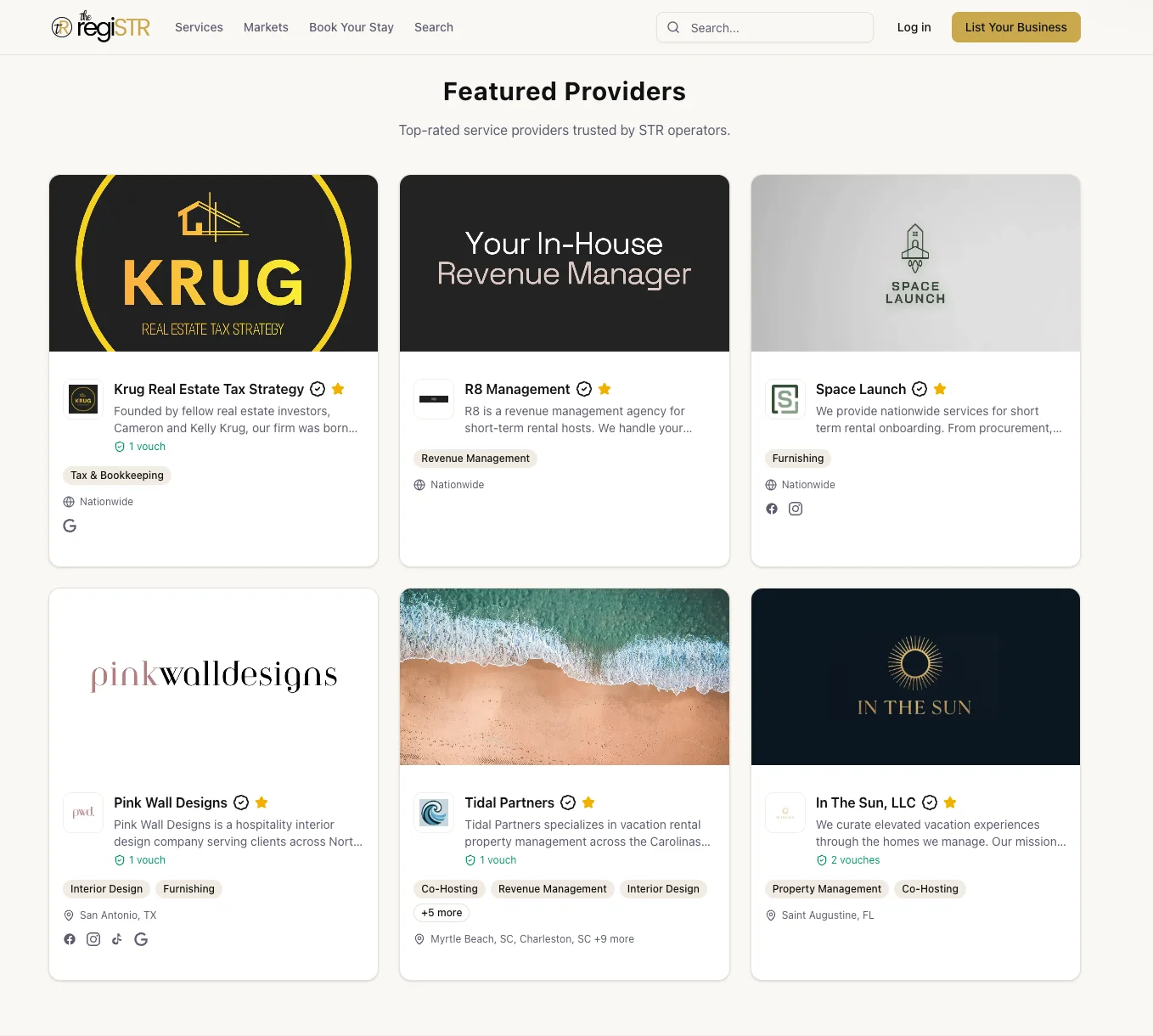
At the regiSTR, we track this category closely because it sits right next to the service categories we index every day: photography, revenue management, and STR consulting. What follows draws from the patterns we see across providers in our network and from the operational realities hosts describe when their listings stop converting.
- Airbnb listing optimization targets five core elements: title, photos, description, amenities data, and pricing strategy, all of which feed the platform's search and ranking algorithm.
- Industry research on top-performing optimization providers shows most clients see a 20 to 40 position improvement in Airbnb search rankings within 60 days of implementation.
- Weekly or continuous optimization models tend to outperform one-time audits because Airbnb's algorithm reweights listings constantly based on fresh conversion data.
- Professional management companies already control roughly 42% of active short-term rental listings globally across major OTAs, a signal that professionalized optimization is becoming the norm, not the exception.
- Optimization only works within the limits of your property and price point; no amount of title rewriting fixes a listing priced 20% above its comp set.
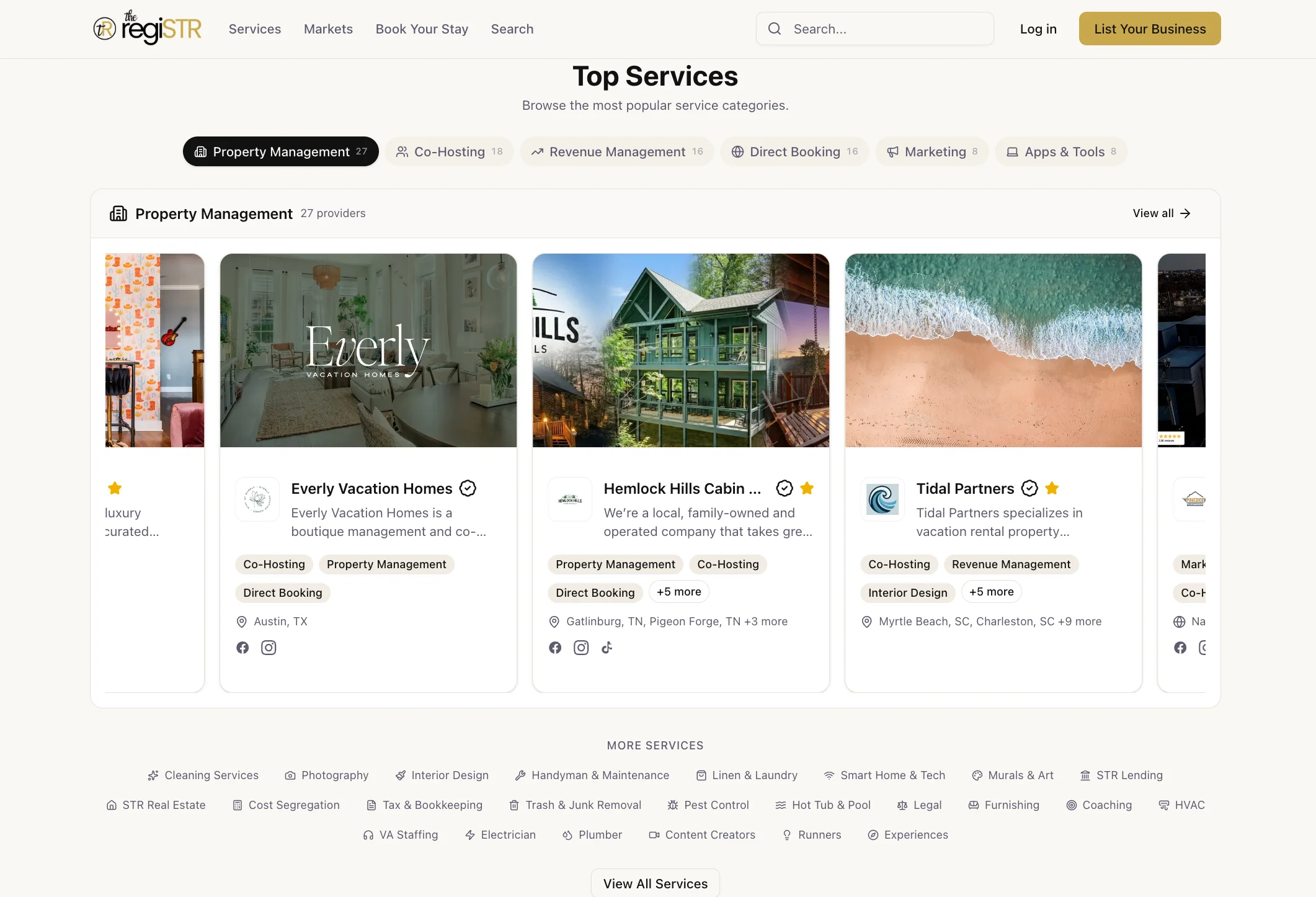
- The regiSTR's STR service directory lists vetted photographers, revenue managers, and consultants who handle the pieces that make listing optimization actually stick.
If your listing has slid down Airbnb's search results and you don't know why, you're not alone. Hosts in competitive markets watch their booking rate flatten even when nothing about the property changed. Usually something in the listing itself did, or a competitor's listing improved faster than yours.
This guide breaks down exactly what an airbnb listing optimization service does, section by section, and where the real booking-rate impact comes from versus where providers oversell results. We also cover the risks of outsourcing this work blindly, something most competitor content skips entirely.
As of 2026, the vacation rental market has grown enough that Airbnb's search algorithm has to work harder to differentiate listings. The global vacation rental market is projected to reach USD 106.5 billion in 2026, according to Grand View Research, up from an estimated USD 101.7 billion in 2026. More listings competing for the same guest searches means the mechanics of listing optimization matter more this year than they did two years ago.
What Does Airbnb Listing Optimization Actually Change?
Airbnb listing optimization is the practice of adjusting a listing's title, photo sequence, description copy, amenity tags, and pricing rules to improve how the platform's search algorithm ranks it and how guests convert once they see it. It is not a one-time task; the best providers treat it as an ongoing process tied to booking data.
Specifically, most services work across five levers. First, the title: Airbnb displays a limited number of characters on mobile, so the first several words carry disproportionate weight in both search relevance and guest click decisions. Second, photo order and quality: your hero image determines whether a guest clicks through at all. Third, description copy, which affects both search keyword matching and guest confidence at the booking decision point.
Fourth, amenities data: Airbnb's filter system relies on accurate, complete amenity tagging, and an incomplete amenities list can quietly remove your listing from filtered searches guests actually use. Fifth, pricing strategy, which interacts with search ranking because Airbnb's algorithm factors in conversion rate, not just static price.
Notably, one competitor's public audit tool breaks this into ten categories: photo quality, title optimization, description quality, amenities presentation, location description, search visibility, pricing strategy, reviews, host responsiveness, and guest experience. That level of granularity is useful context, even if you're not using that specific tool, because it shows how many small signals compound into a ranking outcome.
This is exactly why the regiSTR treats listing optimization as connected to, not separate from, photography and revenue management. A rewritten title paired with amateur photos will underperform. Browse Find STR Photographers on the regiSTR if your photo library is the weak link in your optimization plan.

How Does Listing Optimization Affect Your Booking Rate?
Booking rate improves when optimization increases both search visibility and guest conversion at the same time. A listing can rank higher in search and still fail to convert if the photos or description don't close the decision once a guest clicks through. The two effects work together, not independently.
Airbnb's ranking algorithm weighs click-through rate, time-on-listing, wishlist saves, and completed bookings as behavioral signals. As a result, when an optimization service improves your title and hero photo, click-through rate rises first. If the description and amenities don't back up that first impression, guests bounce, and the algorithm reads that bounce as a negative signal over time.
For example, a listing with a vague title like "Cozy Downtown Apartment" competes poorly against a specific title referencing a neighborhood landmark, guest count, and a standout amenity. Guests searching filtered results (pet-friendly, hot tub, workspace) will never see your listing if that amenity isn't tagged, regardless of how good your title is.
Continuous, weekly optimization models track search ranking across every bookable night in your calendar and cross-reference that against actual conversion data, with measurable ranking movement typically visible within 30 days. That cadence matters more than a single audit because Airbnb's algorithm reweights listings on a rolling basis, not just once at listing creation.
In our experience working with operators across the regiSTR network, hosts who pair listing optimization with active direct booking strategy see the compounding benefit fastest. Optimization gets guests to your Airbnb listing; a strong direct booking presence keeps future guests from needing Airbnb at all.
What's Actually Included in a Professional Optimization Service?
A professional airbnb listing optimization service typically bundles an audit, a rewrite, and an ongoing tracking component into one engagement, rather than delivering a single static report. The specific inclusions vary by provider, but the structure is fairly consistent across the category.
| Service Component | What It Covers | Typical Delivery Model |
|---|---|---|
| Search ranking audit | Current position, visibility in suggested widgets, click-through rate, competitor benchmarking against your comp set | One-time or recurring report |
| Title and description rewrite | Keyword-relevant title within character limits, description restructured for scanning and conversion | One-time, revisited quarterly |
| Photo strategy | Reordering existing images, identifying gaps, sometimes coordinating a reshoot | One-time, paired with a photographer |
| Amenities audit | Cross-checking listed amenities against Airbnb's filter categories to prevent invisible listings | One-time |
| Ongoing monitoring | Monthly performance reports, ranking tracking, re-optimization as the algorithm shifts | Recurring subscription |
Some providers separate findings into tiers, quick wins, medium-effort changes, and larger investment items, which helps hosts prioritize what to fix first instead of tackling everything at once. That triage approach is worth asking about before you sign on with any provider, because a report with fifty flagged issues and no prioritization is not actionable, it's overwhelming.
This is the same vetting logic the regiSTR applies across every service category we list. A provider who hands you a generic checklist without ranking urgency isn't giving you a real plan; they're giving you a to-do list. Browse Browse All STR Services to compare providers who structure their deliverables clearly.
One-Time Audit vs Ongoing Optimization: Which Do You Actually Need?
A one-time listing audit identifies problems at a single point in time, while ongoing optimization adjusts your listing continuously as Airbnb's algorithm, your comp set, and seasonal demand shift. The right choice depends on how competitive your market is and how much your booking calendar changes month to month.
A one-time audit makes sense for a new listing that has never been professionally reviewed, or for a host in a low-competition market where ranking volatility is minimal. It's a lower-cost entry point and gives you a clear list of fixes you can implement yourself.
Ongoing optimization makes more sense in markets with high listing density, where competitors are actively adjusting their own listings every week. If you operate in a metro with hundreds of comparable listings, a static, unchanging listing will lose ground even if nothing about it got worse. Your competitors simply got better.
Notably, most reputable ongoing services report ranking movement within 30 days of implementation, using consistent monitoring against both algorithm signals and actual conversion data. That monitoring is the piece a one-time audit cannot replicate, because a static report goes stale the moment your comp set changes.
We'd rather a host start with a focused one-time audit and layer in ongoing monitoring later than pay for a subscription they don't yet need. Not every listing needs monthly optimization on day one. If you're unsure which tier fits your situation, a STR marketplace resource can help you compare what different providers actually deliver before you commit to a recurring fee.
What Happens When Optimization Meets a Weak Location or Overpriced Listing?
Listing optimization cannot overcome a fundamentally uncompetitive price point or a genuinely weak location; it can only maximize the booking rate a property is capable of achieving given those fixed constraints. This is the honest limitation most optimization providers gloss over in their marketing.
For a strong property in a strong location, optimization work tends to produce the ranking gains providers advertise, typically that 20 to 40 position improvement within 60 days that shows up consistently in industry reporting. The underlying fundamentals support the algorithm's positive signals once the presentation catches up.
For a suboptimal property, say a unit with a poor floor plan, no outdoor space in a market where guests expect it, or a price sitting meaningfully above its comp set, optimization produces smaller, shorter-lived gains. A better title and photo set might lift click-through rate temporarily, but if guests convert at a lower rate once they see the actual space or price, the algorithm corrects back down within a few booking cycles.
This is the edge case most competitor content skips entirely: booking rate is a function of listing presentation, price competitiveness, and location desirability together, not any single lever in isolation. A provider who promises guaranteed ranking gains regardless of your property's fundamentals is overselling.
Pairing optimization with real revenue management, dynamic pricing tied to your actual comp set rather than a flat seasonal rate, addresses the piece optimization alone can't fix. The regiSTR's revenue management category exists precisely because pricing and listing presentation have to move together, not as separate projects.
What Are the Risks of Outsourcing Your Listing Optimization?
Outsourcing listing optimization carries real risk when a provider over-optimizes for algorithm signals at the expense of accuracy, brand voice, or local regulatory compliance. Not every optimization change is a net positive, and hosts should vet providers with the same scrutiny they'd apply to a property manager or cleaner.
Keyword stuffing is the most common failure mode. A title packed with every possible search term ("Luxury Modern Downtown Pet-Friendly Hot Tub Walk to Everything Sleeps 10") reads as spam to guests even if it technically hits more search filters. Airbnb's algorithm has gotten better at penalizing listings that guests bounce from quickly, so a keyword-stuffed title can backfire within a few weeks.
Misalignment with your actual property is another risk. A description that oversells amenities you don't consistently provide, say, claiming "resort-style pool access" for a shared community pool with limited hours, generates guest complaints and negative reviews faster than any ranking gain can offset. Optimization copy has to stay honest to what a guest actually experiences at check-in.
Regulatory misalignment is the risk category competitor content almost never addresses. Some optimization providers write descriptions or amenity claims that inadvertently violate local short-term rental ordinances, occupancy limits, or advertising rules around unpermitted units. Before hiring any optimization provider, confirm they understand your jurisdiction's short-term rental rules, not just Airbnb's algorithm.
This is exactly the vetting criteria the regiSTR applies when listing service providers in our directory: STR-specific experience, verifiable track record, and peer endorsement through our Vouch system, rather than a generic marketing agency treating your listing like any other e-commerce product page.
How Do You Compare Different Optimization Providers?
Comparing airbnb listing optimization providers requires evaluating four things side by side: reporting cadence, scope of service, pricing model, and whether the provider has verifiable short-term rental specific experience versus general digital marketing background.
Reporting cadence matters because a provider who delivers one static PDF and disappears cannot adjust to Airbnb's rolling algorithm updates. Ask specifically how often they revisit your title, photos, and pricing after the initial engagement, and what triggers a re-optimization pass.
Scope of service varies significantly. Some providers only touch text and photo ordering; others integrate pricing strategy and even coordinate professional photography as part of the package. Know exactly what's included before comparing quotes, because a lower headline price sometimes excludes the photography or pricing work you actually need.
Pricing models split roughly into one-time flat fees, monthly retainers, or a percentage tied to managed revenue, similar to how full-service STR managers typically charge 15 to 25% of gross revenue for comprehensive management. Understand which model you're agreeing to and what happens if your booking rate doesn't move within the promised window.
Finally, ask for STR-specific proof of work, not general marketing case studies. A provider who has only optimized long-term rental listings or general e-commerce copy will miss the nuances of Airbnb's specific algorithm behavior, occupancy-based pricing signals, and guest review dynamics. Comparing quotes is straightforward on the regiSTR: browse by market and service category, and check which providers have been vouched for by other STR operators before you commit to a contract.
How Do You Choose the Right Optimization Approach for Your Listing?
Choosing the right approach starts with an honest self-audit of your current listing's weakest link, not a blanket "optimize everything" engagement. Follow these steps in order.
- Step 1: Pull your current performance data. Check your search ranking position, click-through rate, and conversion rate inside Airbnb's host dashboard before hiring anyone. You need a baseline to measure improvement against.
- Step 2: Identify your weakest lever. If your photos are outdated or amateur, start there before touching your title copy. A rewritten title driving clicks to weak photos wastes the click-through gain.
- Step 3: Decide one-time vs ongoing. Low-competition markets can often get by with a single audit and a self-implemented fix. High-density metros need recurring monitoring to keep pace with competitor listings.
- Step 4: Vet for STR-specific experience. Ask any provider for examples of short-term rental listings they've worked on, not general marketing portfolios.
- Step 5: Pair optimization with pricing strategy. A better listing at the wrong price still underperforms. Confirm your provider addresses both, or budget for a separate revenue management engagement.
- Step 6: Set a re-evaluation date. Give any optimization work 30 to 60 days before judging results, matching the window most providers use to report ranking movement.
Common mistakes we see across the STR operators in our network: hiring a generalist marketing agency instead of an STR-specific provider, expecting overnight ranking jumps, and neglecting to fix the underlying photography before paying for copywriting. Each of these compounds into wasted spend if you don't catch it early.
Full-service property management typically runs 20 to 30% of gross revenue in competitive markets, and hosts sometimes assume listing optimization is a cheaper substitute for that level of service. It isn't. Optimization improves how your existing operation is presented; it doesn't handle guest communication, turnover coordination, or maintenance dispatch the way a property manager does. If you're weighing that broader decision, our guide on why a vacation rental business directory beats Google covers how to evaluate the full service stack, not just listing presentation.
Frequently Asked Questions
What is an airbnb listing optimization service?
An airbnb listing optimization service audits and improves the title, photos, description, amenities data, and pricing of an Airbnb listing to increase search ranking and booking rate. Providers typically deliver either a one-time audit and rewrite or an ongoing monitoring engagement tied to Airbnb's rolling algorithm updates.
How long does it take to see results from listing optimization?
Most providers report measurable ranking movement within 30 to 60 days of implementation, based on industry reporting from established optimization services. Results depend on how competitive your market is and how quickly Airbnb's algorithm reweights your listing based on new click-through and conversion data.
Does optimizing my listing guarantee more bookings?
No. Optimization improves the ceiling of what your listing can achieve given its actual price, location, and property condition; it cannot overcome an overpriced listing or an uncompetitive location. A weak underlying property will see smaller, shorter-lived gains than a strong one.
What's the difference between a one-time audit and ongoing optimization?
A one-time audit identifies problems at a single point in time and hands you a fix list. Ongoing optimization continuously adjusts your listing as Airbnb's algorithm and your comp set shift, which matters most in high-density, competitive markets where static listings lose ground.
Can listing optimization hurt my listing if done wrong?
Yes. Keyword-stuffed titles, overselling amenities you don't consistently provide, and descriptions that misalign with local short-term rental regulations can all backfire, generating guest complaints or algorithm penalties from high bounce rates. Vet any provider for STR-specific experience before hiring.
How do I find a vetted provider instead of a generic marketing agency?
Look for providers with verifiable short-term rental specific case studies, not general e-commerce or long-term rental marketing experience. The regiSTR's directory lists STR-focused providers across photography, revenue management, and consulting categories, filtered by market, with peer endorsements through our Vouch system.
Should I optimize my listing myself or hire a professional?
Self-optimization works for hosts with time to study Airbnb's search mechanics and a single property to manage. Hiring a professional makes more sense once you're managing multiple listings, operating in a high-competition market, or need ongoing monitoring you can't realistically do yourself every week.
Conclusion: What This Means for Your Booking Rate in 2026
An airbnb listing optimization service works by tightening the five levers Airbnb's algorithm actually weighs: title, photos, description, amenities, and pricing, then tracking ranking movement over a 30 to 60 day window. The gains are real but bounded by your property's fundamentals. No rewrite fixes a bad location or a price sitting outside your comp set.
As the vacation rental market grows toward a projected USD 106.5 billion in 2026, more listings are competing for the same searches, which makes presentation quality matter more than it did a few years ago. The hosts who treat optimization as one piece of a connected stack, alongside photography, pricing, and compliance, consistently outperform those chasing a single quick fix.
Finding a provider who understands STR-specific algorithm behavior, not general marketing tactics, is the difference between real ranking movement and a wasted retainer. Get started with the regiSTR to browse vetted photographers, revenue managers, and STR consultants by market, all vouched for by operators who've actually worked with them.
If your listing's photos are the weak link holding your booking rate back, start there before touching a single word of copy. Browse vetted STR photographers and revenue management consultants at theregistr.co/services.
Content powered by inkSTR.co