
STR Real Estate Explained: A 2026 Host's Guide

STR real estate refers to residential property, whether a single-family home, condo, or accessory unit, purchased or converted specifically to generate income through stays of less than 30 days on platforms like Airbnb and Vrbo. Unlike a traditional rental, an STR property is run more like a small hospitality business than a landlord arrangement.
Key Takeaways
- STR real estate is any property acquired or repurposed for short-term stays, typically defined as under 30 days, though some cities set the threshold at 7, 14, or 90 days.
- The global vacation rental market was valued at USD 101.7 billion in 2026 and is projected to reach USD 106.5 billion in 2026, according to Grand View Research, signaling continued institutional and individual investor interest.
- Over 55% of vacation rental properties were managed by professional companies in 2026, up from 42% in 2022, a clear sign that self-management alone is becoming less common among serious operators.
- Professional vacation rental managers typically charge 15 to 25% of gross rental revenue, a cost that owners weigh against the time and risk of self-managing.
- The so-called STR tax loophole depends on an average guest stay of seven days or fewer combined with material participation, a standard that requires documentation and, in most cases, a tax professional's guidance.
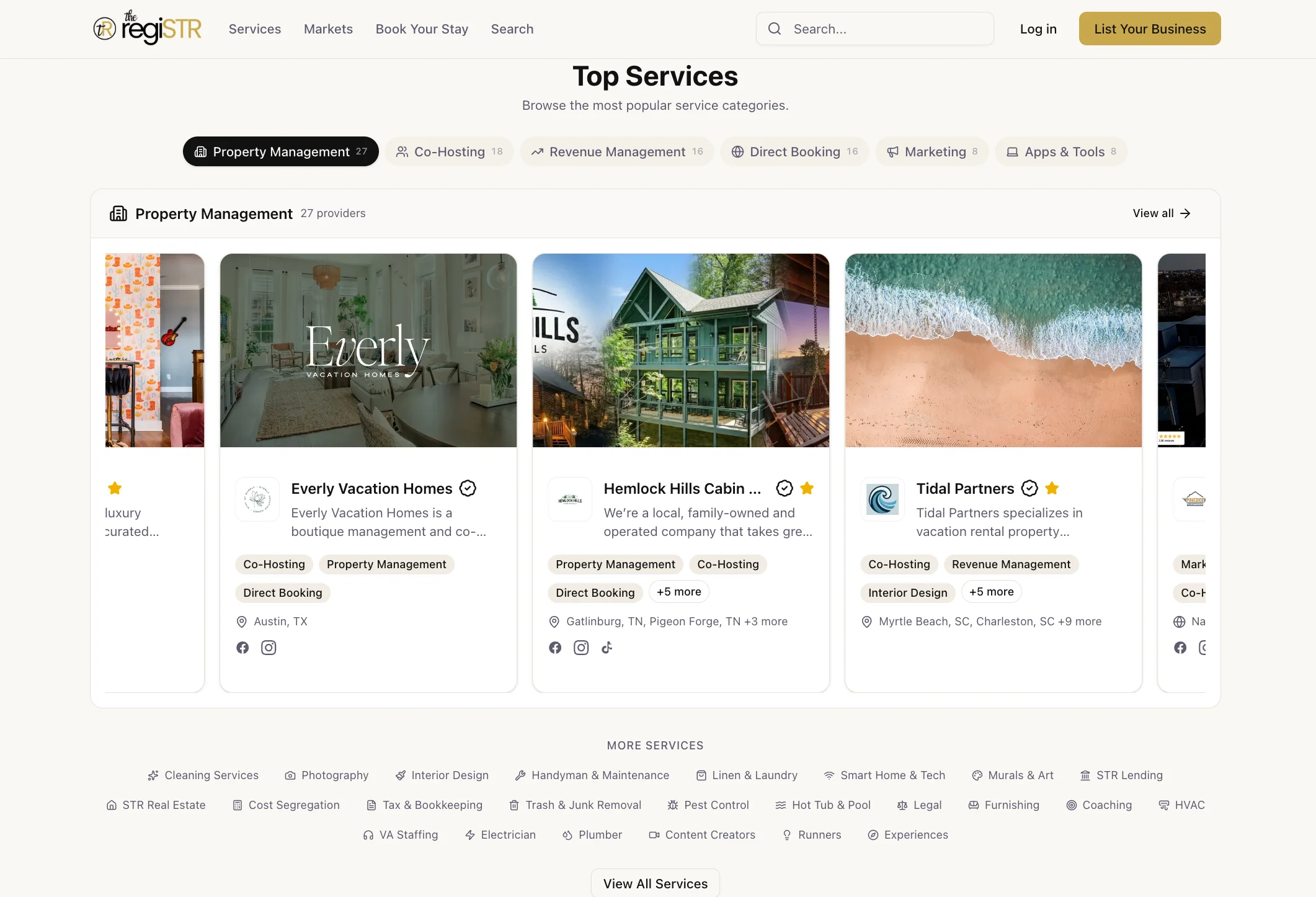
- Building a reliable operation means hiring vetted cleaners, photographers, and managers, and the regiSTR is built specifically to connect STR owners with providers who already understand this business.
If you've spent any time researching whether to buy an STR property or convert an existing one, you've probably noticed that most guides either oversimplify the definition or bury it under generic real estate advice. That's a problem, because STR real estate operates under a different rulebook than a duplex you rent out for twelve-month leases.
At the regiSTR, we work with STR operators across dozens of markets every week, from first-time hosts converting a single condo to portfolio investors running a dozen cabins. The pattern we consistently see: owners underestimate the operational lift of STR and overestimate how much a generic property manager or handyman understands about turnover timelines, guest communication, and platform-specific requirements.
This guide covers what STR actually means in a real estate context, whether the model still makes financial sense in 2026, how it differs from simply "doing Airbnb," and what the STR tax treatment can and cannot do for your return. We'll also flag where the operational gaps show up and where to find providers who have actually worked inside this industry.
What Is an STR in Real Estate?
STR stands for short-term rental, meaning a residential property rented to guests for stays generally under 30 days rather than the 6-to-12-month leases typical of traditional rental real estate. Specific thresholds vary by jurisdiction: some cities cap short-term stays at 7 or 14 days before a property is reclassified, while others use a 90-day cutoff for zoning purposes.
Almost any residential property can theoretically function as an STR, provided it clears local zoning and licensing rules. That includes single-family homes, condos, spare bedrooms, and even multifamily units converted unit-by-unit for short-term use. The common thread is turnover frequency: an STR property changes guests far more often than a long-term rental, which fundamentally changes how you staff and operate it.
This is also why STR real estate is closer to a small hospitality operation than a landlord role. You're not just collecting rent and fielding the occasional maintenance call. You're managing guest communication, nightly pricing, cleaning turnovers, and often a compliance calendar that a long-term rental never touches. Some markets, including tourism-dependent cities such as Kissimmee, Florida and Galveston, Texas, are described as STR-friendly because local demand and permitting frameworks support this model. Others actively restrict rentals under 30 days through zoning overlays.
The regulatory patchwork is one of the first things new owners underestimate. Many jurisdictions require a local business license before you can legally list a property, and some also enforce zoning overlays that prohibit STR use entirely in certain residential districts. Skipping this step is the single most common early mistake we see among first-time hosts entering the space in 2026.
Are STR Properties Still Profitable in 2026?
Yes, STR real estate remains profitable for most well-managed properties in 2026, though margins depend heavily on market selection, financing terms, and whether you self-manage or hire professional support. The global vacation rental market was valued at roughly USD 101.7 billion in 2026 and is projected to grow to USD 106.5 billion in 2026, according to Grand View Research, a sign that overall demand is not contracting even as the industry professionalizes.
Profitability at the property level looks different than it did five years ago. In some strong markets, an STR can generate enough income in 16 days or fewer to cover a monthly mortgage payment, which is the kind of cash-flow math that keeps investors interested even as competition rises. But that math only works if occupancy holds up, and occupancy increasingly depends on presentation quality, not just location. Financing has also gotten more demanding. Lenders commonly require a credit score of 680 or higher, a debt-to-income ratio between 28 and 36%, and cash reserves covering up to six months of expenses before approving an STR loan. Down payments on STR-specific mortgages often run to 30% or more of purchase price, and interest rates typically sit about one percentage point above primary-residence loans. That's a real cost of entry, and it filters out casual buyers who haven't done the underlying math.
Here's the part most profitability guides skip: the biggest lever on your margin isn't the mortgage rate, it's your vendor stack. A property with a professional photographer, a reliable turnover cleaner, and either a sharp co-host or full-service manager consistently outperforms an identical property run on ad hoc labor. Professional vacation rental managers typically charge 15 to 25% of gross revenue, and in 2026 more than 55% of vacation rental properties were managed by professional companies, up from 42% in 2022. That shift toward professionalization is not a coincidence. It's owners recognizing that the fee is often cheaper than the lost bookings and bad reviews that come from cutting corners.
Business travel is quietly reshaping the profitability picture too. Business travelers now account for 12 to 15% of vacation rental bookings, a segment growing at roughly twice the rate of leisure bookings. Properties set up to serve that guest, reliable Wi-Fi, a workable desk, flexible check-in, often see steadier midweek occupancy than pure leisure-focused listings.
Is STR the Same as Airbnb?
No. STR is the broader real estate category; Airbnb is one distribution platform within it. An STR property can list on Airbnb, Vrbo, Booking.com, or a direct booking website, and most serious operators use more than one channel to reduce dependency on any single platform's fees and algorithm shifts.
This distinction matters because a lot of new hosts conflate "starting a short-term rental" with "opening an Airbnb account," and then stop there. Doing so leaves revenue on the table. Airbnb and Vrbo typically charge host-side and guest-side service fees that eat into your nightly rate, and relying exclusively on one channel means you're fully exposed to that platform's search algorithm and fee structure.
A more resilient STR real estate strategy treats the platforms as acquisition channels, not the whole business. That means building a direct booking website, running basic SEO and content marketing so your property shows up in organic search, and using social media to build a repeat-guest base that books outside the OTA ecosystem entirely. This is exactly the kind of infrastructure the regiSTR's directory covers, connecting owners with website design, SEO, and direct booking specialists who understand STR specifically rather than generic small-business marketing.
The platforms themselves are also tightening compliance enforcement. Airbnb and similar services increasingly use automated local-law tools that withhold occupancy taxes or block unregistered listings in regulated markets, which means the "just list it and see what happens" approach is riskier in 2026 than it was even two years ago.
What Is the STR Rental Tax Loophole?
The STR tax loophole refers to a provision that allows short-term rental income and losses to be treated as non-passive for tax purposes, rather than passive like most long-term rental income. Non-passive treatment matters because it can let owners offset active income, such as wages, with rental losses, something a standard long-term rental cannot do under passive-activity rules.
The IRS uses an average guest stay of seven days or fewer as the key threshold for this treatment. Average STR stays typically fall between 6 and 7 nights, which is why this classification applies to so many properties in the space, but it is not automatic. The property owner must also materially participate in operating the rental, a standard with specific hour and involvement requirements that a qualified tax professional needs to evaluate against your actual situation.
We are not going to pretend this is simple, because it isn't. The rules involve documentation of hours worked, participation tests, and depreciation strategy (frequently paired with a cost segregation study) that varies by property and ownership structure. What we will say plainly: don't attempt this without a CPA who specializes in real estate, and specifically STR. General tax preparers frequently miss the nuances of the material participation test, and getting it wrong on an audit is far more expensive than the fee you'd pay a specialist upfront.
Separately, tax compliance also touches your local obligations. As one example, New York's Department of State requires certain filers to submit quarterly reports, with a non-refundable filing fee of $25 per report and the first report in a recent cycle due December 22, 2026. Requirements like this vary widely by state and city, so confirm your specific obligations with the relevant local agency rather than assuming a single national rule applies.
How Do STRs Compare to Long-Term Rentals?
STRs differ from long-term rentals primarily in turnover frequency, pricing model, and operational intensity: an STR turns over guests every few days at nightly or weekly rates, while a long-term rental (LTR) holds one tenant for months at a fixed monthly rate. That single difference cascades into almost every other operational decision you'll make.
| Factor | Short-Term Rental (STR) | Long-Term Rental (LTR) |
|---|---|---|
| Typical stay length | Under 30 days, often 6 to 7 nights average | 6 to 12 months or longer |
| Pricing model | Nightly or weekly, dynamic based on demand | Fixed monthly rent |
| Turnover labor | Cleaning after nearly every stay | Cleaning only at move-out |
| Tax treatment | Potentially non-passive if average stay is 7 days or fewer with material participation | Generally passive activity |
| Regulatory exposure | Zoning, licensing, occupancy tax, platform compliance rules | Standard landlord-tenant law |
| Vendor needs | Cleaners, photographers, revenue managers, co-hosts | Occasional maintenance, leasing agent |
Notably, an STR also requires a different kind of vendor bench. A long-term rental owner might go months without calling anyone. An STR owner needs a cleaner on a recurring schedule, a photographer for listing refreshes, and often a revenue manager adjusting nightly rates around local events and seasonality. This is precisely the gap the regiSTR's directory fills, giving owners a way to find vetted providers by market and service category instead of piecing together a vendor list through Facebook groups and cold calls.
What Should You Check Before Converting a Property Into an STR?
Converting an existing house or condo into STR real estate requires clearing zoning, licensing, insurance, and, if applicable, HOA approval before you ever list it. Skipping any one of these steps is the most common and most expensive mistake first-time STR owners make.
- Confirm zoning eligibility. Check your city or county planning department for overlays that restrict or ban stays under 30 days in your specific residential zone. This varies block by block in some cities.
- Apply for the required business license or STR permit. Many jurisdictions require registration before your first guest checks in, and operating unregistered can result in fines or forced delisting from Airbnb and Vrbo.
- Review HOA governing documents. If your property sits within a homeowners association, check the covenants for explicit short-term rental restrictions, minimum stay requirements, or rental caps before you invest in furnishings.
- Update your insurance policy. A standard homeowner's policy typically does not cover short-term rental use. You'll need a landlord or STR-specific policy that covers guest liability and business-use exposure.
- Register for and understand occupancy tax obligations. Many destinations impose transient occupancy or lodging taxes, commonly in the 5 to 15% range of the nightly rate, and some platforms now collect these automatically, but you're still responsible for confirming compliance.
- Line up your vendor stack before launch. Cleaner, photographer, and either a co-host or manager, ideally all secured before your listing goes live, not after your first bad review.
That last step is where the regiSTR earns its keep. Instead of scrambling to find a cleaner the week before your first check-in, you can browse vetted STR cleaning services and STR-specialized photographers by market before you ever list the property.
What Does It Actually Cost to Run an STR Property?
Running STR real estate costs more in ongoing operational spend than a comparable long-term rental, primarily due to recurring turnover cleaning, professional photography refreshes, and either management fees or the time cost of self-managing. Professional vacation rental managers typically charge 15 to 25% of gross rental revenue, a range that sits well above the flat monthly fee a long-term rental property manager might charge.
Beyond the management fee itself, factor in recurring turnover cleaning (which happens far more often than end-of-lease cleaning on an LTR), periodic photography updates to keep your listing competitive, and, increasingly, revenue management or dynamic pricing support. The vacation rental management software market, valued at USD 0.92 billion in 2026 and projected to reach USD 2.38 billion by 2034, reflects how many operators are now paying for tools, not just labor, to manage pricing and channel distribution. Where owners consistently overspend is on trial and error. Hiring the wrong cleaner, discovering mid-season that your photographer shot with an iPhone in portrait mode, or paying a property manager who goes quiet after month three: these are avoidable costs. Comparing quotes side by side, with actual STR experience as a filter rather than general handyman or residential-cleaning experience, is exactly what browsing vetted STR service providers on the regiSTR is designed to solve.
Which Markets Work Best for STR Real Estate Investment?
The best STR markets combine strong tourism or business-travel demand with a regulatory environment that permits short-term rental use, since even the highest-demand location is worthless if zoning or licensing rules block your operation. Tourism-driven destinations such as Kissimmee, Florida and Galveston, Texas are frequently cited as STR-friendly because local demand aligns with permitting frameworks that support the model.
Beyond raw tourism volume, look at drive-market access. Many successful STR investors target properties within a day's drive of a major metro area, which captures weekend leisure demand without relying entirely on flights. Growing business-travel demand, now 12 to 15% of vacation rental bookings and growing at roughly twice the pace of leisure bookings, also rewards markets near business districts, convention centers, or corporate campuses where longer weekday stays are common.
Regionally, Europe held a 33 to 35% revenue share of the global vacation rental market in 2026, with North America holding roughly a third, while Asia Pacific is growing fastest as disposable incomes rise. For a U.S.-based investor, that regional data matters less than local zoning specifics, but it does confirm that STR demand is broad-based rather than concentrated in a handful of niche destinations.
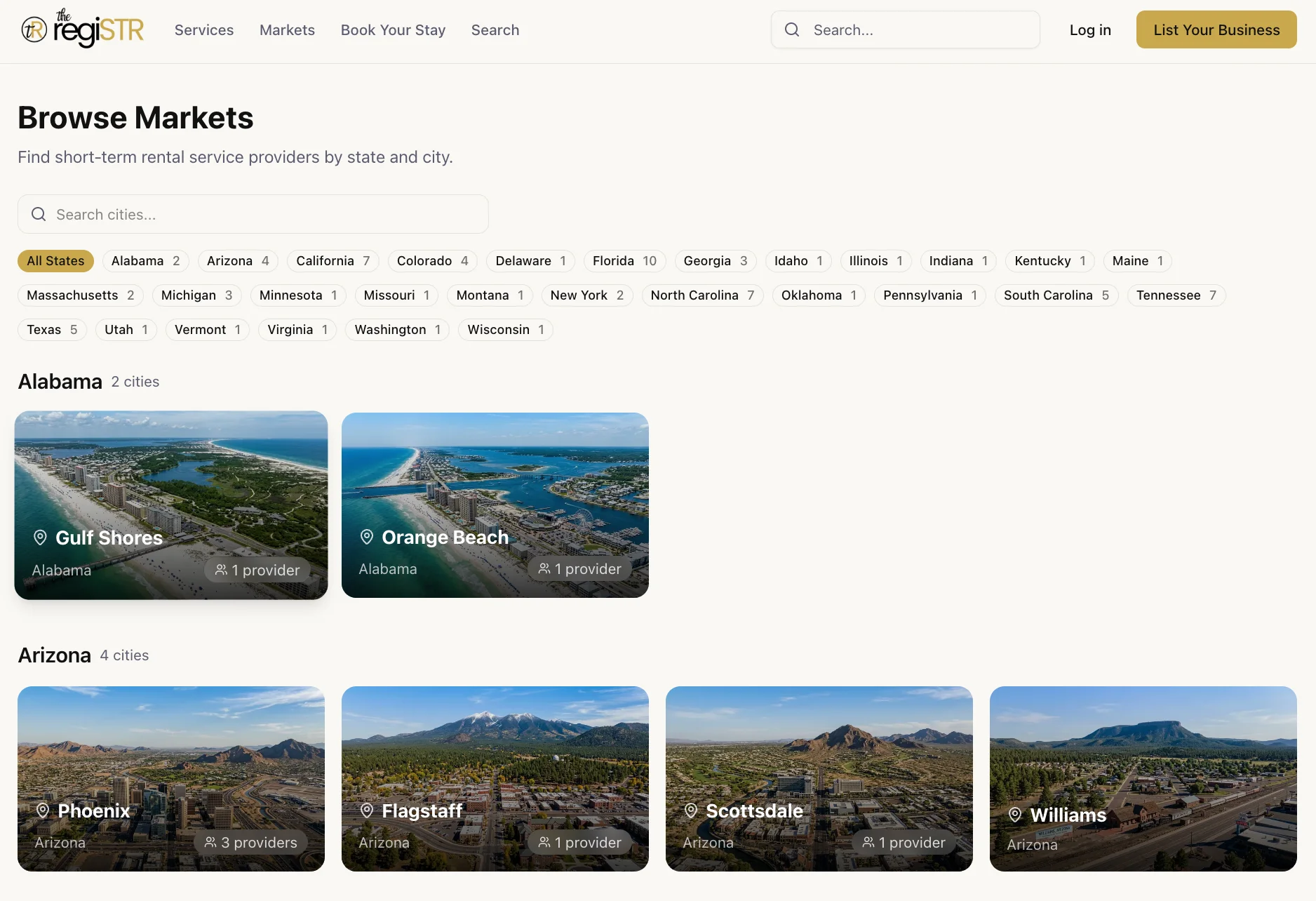
Once you've picked a market, the next challenge is finding local vendors who actually understand it. Hosts in unfamiliar markets consistently tell us the same thing: cold-calling handymen and cleaners off Google Maps wastes weeks. Browsing the regiSTR's market pages lets you filter providers by city so you're contacting people who already work in STR, not general contractors who've never handled a same-day turnover.
Deep Dive: How the STR Tax Loophole and Depreciation Actually Interact
The interaction between the STR tax loophole and depreciation is where the real financial upside lives, but it's also where owners get into trouble without proper guidance. Non-passive tax treatment (achieved through the 7-day average stay threshold plus material participation) allows STR losses, including accelerated depreciation from a cost segregation study, to offset active income like W-2 wages in the year they're incurred.
A cost segregation study breaks a property's value into components with shorter depreciation schedules (flooring, appliances, landscaping) rather than depreciating the entire structure over the standard residential period. Combined with non-passive classification, that accelerated depreciation can generate a paper loss substantial enough to meaningfully reduce taxable income in the property's first year, assuming the material participation test is met and properly documented.
Here's the part competitors gloss over: material participation isn't a checkbox, it's a documented standard with specific hour thresholds and involvement tests that the IRS can and does scrutinize. Hiring a full-service property manager who handles everything without your involvement can actually undermine your ability to claim material participation, since some tests require substantial personal involvement in operations. This is a genuine trade-off between operational convenience and tax positioning that a generalist accountant may not flag. If you're pursuing this strategy, work with a CPA who specializes in real estate and STR specifically, and get the participation documentation right from day one, not retroactively during an audit.

How Do You Build a Vendor Stack for a New STR Property?
Building a reliable vendor stack for STR real estate means securing a turnover cleaner, listing photographer, and management or co-hosting support before your first booking, not reactively after a problem occurs. The order of priority differs slightly depending on whether you're a first-time host or a scaling investor.
- Cleaning and turnover: Prioritize this first. A cleaner unfamiliar with same-day turnover windows will cost you check-in delays and bad reviews within the first month.
- Photography: Listing photos directly affect click-through and booking conversion on Airbnb and Vrbo. A generalist real estate photographer without STR listing experience often misses the wide-angle, natural-light approach that OTA algorithms and guests respond to.
- Co-hosting or full-service management: Decide early whether you'll self-manage, hire a co-host for partial support, or bring on full-service management at 15 to 25% of gross revenue. This decision shapes every other hire.
- Maintenance and repairs: Line up a handyman comfortable with fast-turnaround STR issues (a broken lockbox or dead Wi-Fi router at 9pm on a Saturday) rather than a contractor used to scheduled weeks out.
- Revenue management: Not every STR needs this from day one, but once you're managing more than one or two properties, dynamic pricing support typically pays for itself by capturing peak-weekend rate gaps you'd otherwise miss.
Every one of these categories is exactly what the regiSTR's directory organizes by market and service type, from STR property managers to maintenance and handyman services to interior designers who understand STR staging specifically. If you're weighing whether to self-manage at all, our related piece on what it really costs to run vacation rentals without professional support walks through that decision in more detail.
Data & Evidence: STR Real Estate Market Snapshot for 2026
Verified market data helps separate genuine STR real estate opportunity from hype. Multiple independent research firms peg the global vacation rental market between USD 98 billion and USD 106 billion for 2026, depending on methodology, with growth continuing through the early 2030s at a compound annual rate generally in the 3.7 to 4.6% range.
| Metric | Figure | Source |
|---|---|---|
| Global vacation rental market, 2026 | USD 101.78 billion to USD 106.5 billion (estimate range) | Grand View Research / Polaris Market Research |
| Projected market size, 2033-2034 | USD 121.9 billion to USD 138.77 billion | Grand View Research / Polaris Market Research |
| Vacation rental management software market, 2026 | USD 0.92 billion, growing at 11.1% CAGR to 2034 | Mordor Intelligence / DataIntelO |
| Share of properties professionally managed, 2026 | Over 55%, up from 42% in 2022 | Coherent Market Insights |
| Business traveler share of bookings | 12 to 15%, growing about 2x the leisure segment | Coherent Market Insights |
| Typical management fee | 15 to 25% of gross rental revenue | Industry standard range |
The professionalization trend is the standout data point here. A jump from 42% to over 55% professionally managed properties in three years tells you the market is maturing quickly. Hosts who try to compete on self-managed guest experience against professionally staffed listings in 2026 are increasingly at a disadvantage, particularly in competitive metro and vacation-destination markets.
Practical Guidance: How to Evaluate an STR Real Estate Opportunity
Evaluating an STR real estate opportunity requires checking regulatory eligibility, running realistic operating cost projections, and stress-testing occupancy assumptions against off-season reality, not just peak-season numbers a seller or listing agent shows you.
- Verify zoning and licensing before you make an offer. Contact the local planning department directly rather than relying on a seller's representation that "STR is allowed here."
- Run the numbers with a realistic vendor cost stack. Include cleaning, photography, management fees (15 to 25% of gross if going full-service), maintenance reserves, and occupancy tax obligations, not just mortgage and utilities.
- Stress-test off-peak occupancy. Many STR pro formas only show peak-season projections. Ask what a realistic shoulder-season and off-season occupancy rate looks like before committing.
- Check financing requirements early. Expect a credit score requirement around 680 or higher, debt-to-income in the 28 to 36% range, and reserves covering up to six months of expenses.
- Decide your management model before closing. Full-service, co-host, or self-manage. This decision affects both your time commitment and your tax positioning under the material participation standard.
- Line up your vendor network before your first booking. Don't wait until a guest is already checked in to discover your cleaner doesn't answer texts.
Common mistakes we see repeatedly: buying based on peak-season revenue projections alone, ignoring HOA restrictions until after closing, and assuming a residential insurance policy covers short-term rental liability. Each of these is avoidable with a bit of upfront diligence.
Frequently Asked Questions
What does STR mean in real estate specifically?
STR stands for short-term rental, meaning a residential property rented to guests for stays typically under 30 days rather than the multi-month leases used in traditional rental real estate. The exact stay-length threshold varies by city and can be set at 7, 14, 30, or 90 days depending on local ordinance.
Is buying an STR property still a good investment in 2026?
STR real estate remains a viable investment in 2026 for buyers who verify local zoning and licensing before purchase and budget realistically for management, cleaning, and photography costs. The global vacation rental market is projected to reach roughly USD 106.5 billion in 2026, according to Grand View Research, indicating continued demand, though margins depend heavily on market selection and vendor quality.
Can I list my STR property on multiple platforms at once?
Yes, and most experienced operators do. Listing across Airbnb, Vrbo, and a direct booking website reduces dependency on any single platform's fees and search algorithm, and helps you build a repeat-guest base that books outside OTA commission structures entirely.
How does the STR tax loophole actually work?
The STR tax loophole allows rental income and losses to be classified as non-passive, rather than passive, if the average guest stay is seven days or fewer and the owner materially participates in operations. This classification can allow rental losses, including accelerated depreciation, to offset active income like wages, but it requires documented participation and should be set up with a CPA experienced in real estate taxation.
Do I need a business license to run an STR property?
In most U.S. jurisdictions, yes. Many cities and counties require a local business license or STR-specific permit before you can legally list a property, and some also enforce zoning overlays restricting short-term rental use in certain residential districts. Requirements vary significantly by location, so verify with your city or county planning office directly.
What's the difference between self-managing and hiring a property manager for an STR?
Self-managing means you personally handle guest communication, cleaning coordination, pricing, and maintenance, while a professional property manager typically charges 15 to 25% of gross revenue to handle those functions on your behalf. Over 55% of vacation rental properties were professionally managed as of 2026, up from 42% in 2022, reflecting a broader shift away from full self-management as the operational demands of STR have grown.
How do I find reliable STR service providers in a new market?
The fastest approach is browsing a directory built specifically for short-term rental vendors, filtered by city and service category, rather than cold-calling general contractors or residential cleaners off a maps search. The regiSTR organizes cleaners, photographers, property managers, and maintenance providers by market specifically so STR owners can find vendors who already understand turnover timelines and guest expectations.
Are STR properties riskier than long-term rentals?
STR properties carry different risk than long-term rentals, primarily regulatory and operational rather than tenant-related. Zoning changes, licensing requirements, and occupancy tax rules can shift with local policy, and the higher turnover frequency creates more operational touchpoints (cleaning, guest communication, maintenance) than a long-term rental's single annual tenant turnover.
Conclusion: Is STR Real Estate Right for Your Portfolio?
STR real estate offers real income potential in 2026, with the global vacation rental market projected near USD 106.5 billion this year, but the model rewards owners who treat it like a hospitality business rather than a passive investment. Success depends on clearing zoning and licensing first, budgeting realistically for the 15 to 25% management fee range or the time cost of self-managing, and understanding that the STR tax loophole requires genuine material participation, not just a hopeful conversation with your accountant.
The operational side is where most owners either win or lose margin. Get your vendor stack right, cleaner, photographer, manager or co-host, and you're competing with the roughly 55% of properties already run professionally. Get it wrong, and you're absorbing the cost of bad reviews and missed turnovers instead. Get started with the regiSTR to browse vetted STR service providers by market and category, and stop rebuilding your vendor network from scratch every time you expand into a new city.
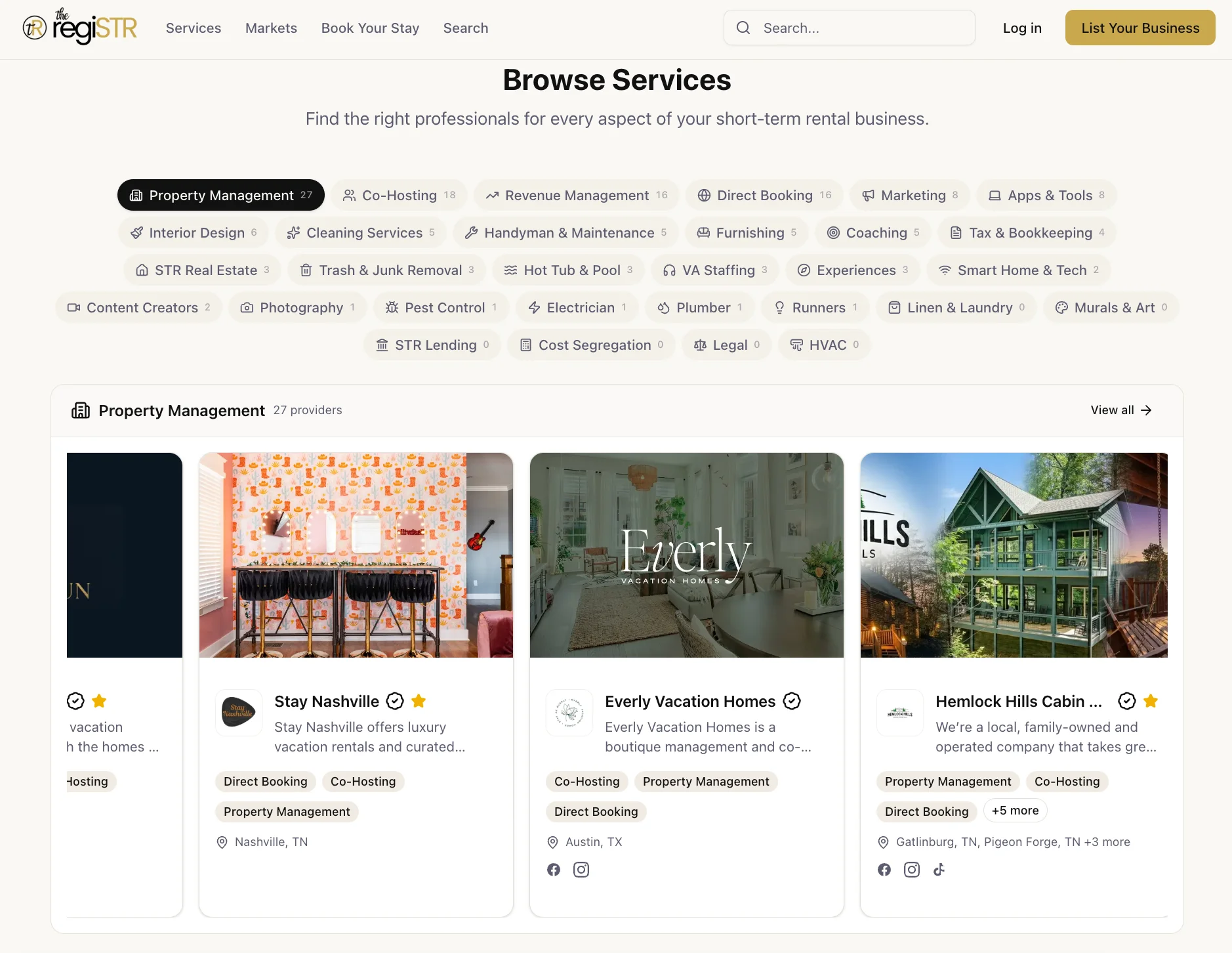
If you're weighing whether to hand off day-to-day operations on your STR real estate, browse vetted STR property managers by market on the regiSTR and compare providers before committing to a management contract. Sign up free at theregistr.co to see who's already working in your city.
Content powered by inkSTR.co