Properties and Management: What STR Owners Need to Know

Properties and management, in the short-term rental context, means the operational work of running a vacation rental profitably: pricing it, marketing it, cleaning it between guests, fixing what breaks, and handling every guest interaction from inquiry to checkout. It is the sum of dozens of small decisions repeated every turnover cycle.
Key Takeaways
- STR property management covers guest communication, dynamic pricing, cleaning coordination, maintenance, and compliance, not just rent collection like traditional residential management.
- The U.S. property management industry generated approximately $139.9 billion in revenue in 2026, according to IBISWorld, with roughly 340,000 businesses operating in the space.
- Management fee models for STRs commonly run as a percentage of monthly booking revenue, often falling in the broader 4% to 12% range cited across the wider property management industry, though full-service STR management typically sits at the higher end due to the labor-intensive nature of turnovers.
- The median annual wage for property, real estate, and community association managers was $66,700 in May 2026, according to the U.S. Bureau of Labor Statistics, with employment projected to grow 4% through 2034.
- Full-service STR managers, co-hosts, and self-managing hosts represent three distinct operating models, each with different cost, control, and time tradeoffs.
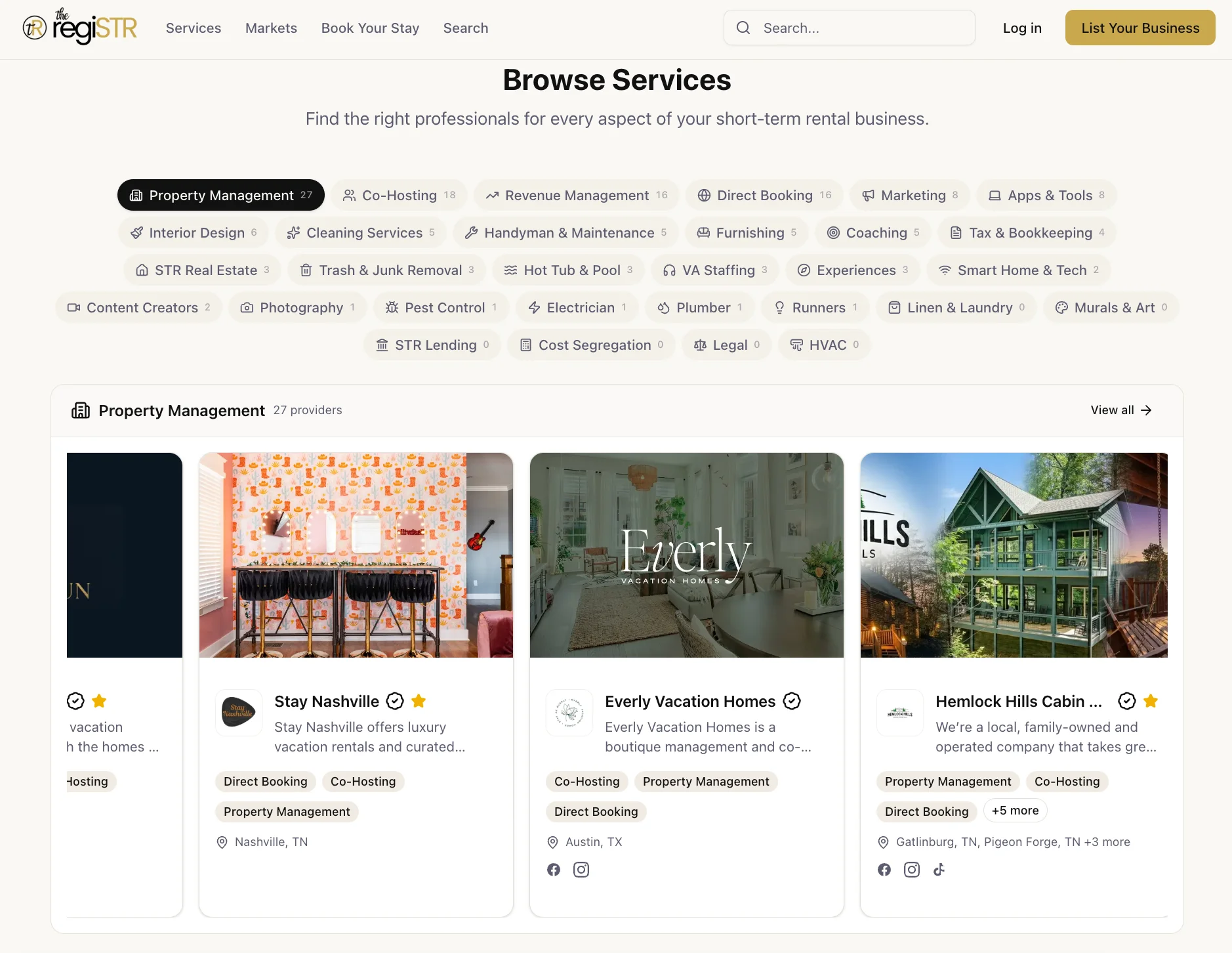
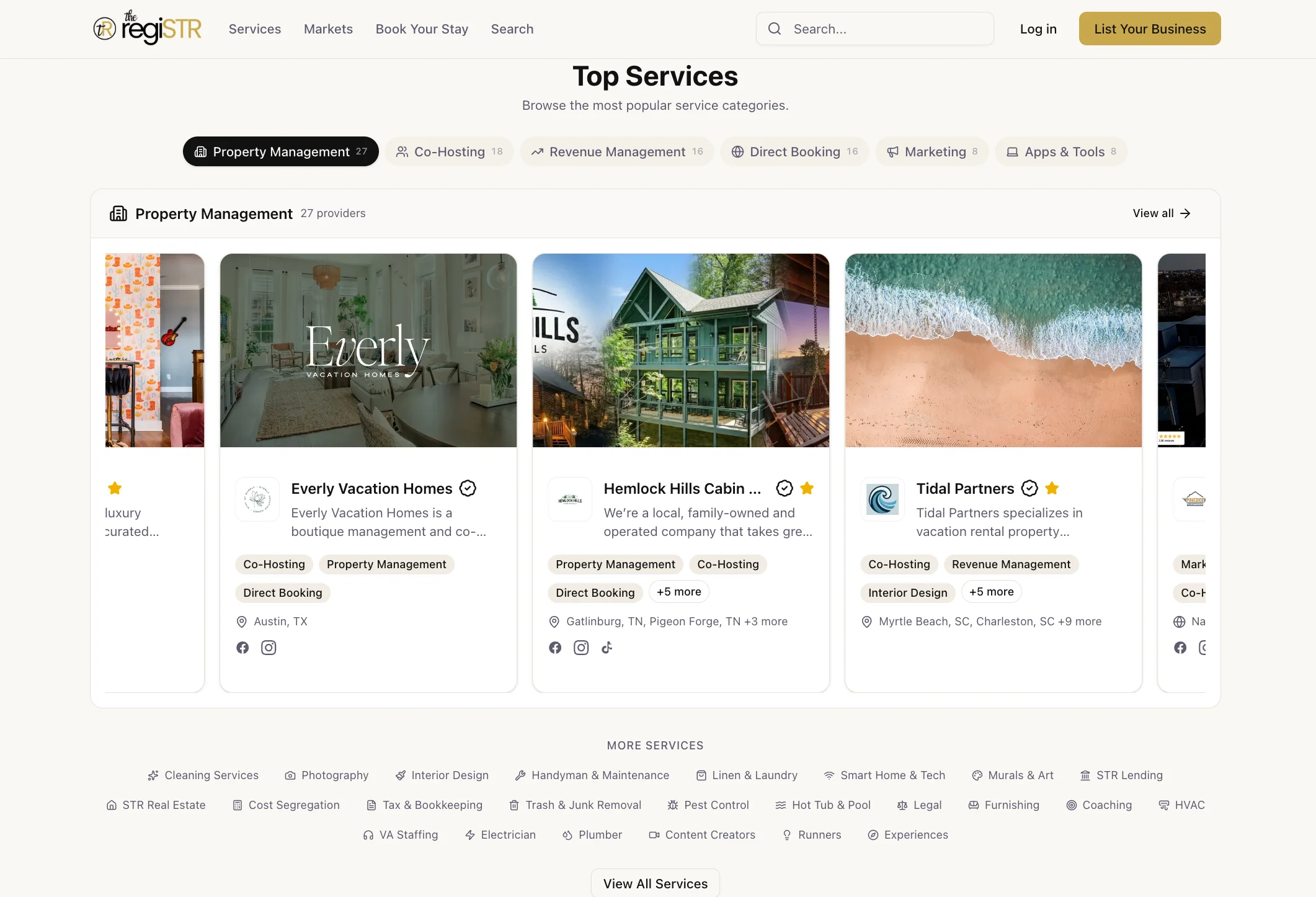
- the regiSTR connects hosts with vetted property managers, cleaners, and co-hosts by market, so you can compare real options instead of guessing from a Google search or a Facebook group thread.
If you searched for "properties and management," you are probably trying to figure out one of two things: whether you should hire someone to run your short-term rental, or what exactly a property manager does once you sign a contract. This article covers both, plus the pricing math, the different types of managers you will run into, and where the highest-paying roles in this field actually sit.
At the regiSTR, we index STR property management companies, co-hosts, cleaners, and maintenance crews across dozens of active vacation rental markets. The pattern we see most often: hosts either overpay for services they do not need, or underpay and get burned by a manager who cannot handle the operational load a short-term rental actually demands. Traditional residential property management and STR property management share a name, but the day-to-day work looks almost nothing alike.
A long-term rental manager might visit a property twice a year. An STR manager is coordinating cleaners, adjusting nightly rates, and answering guest messages every single day the unit is booked, sometimes multiple times a day during peak season. That difference in operational tempo is the reason generic property management advice does not translate cleanly to vacation rentals, and it is why this guide focuses specifically on what properties and management means for hosts running Airbnb and Vrbo listings in 2026.
What Exactly Does Property Management Do?
Property management for short-term rentals is the coordinated handling of every operational task required to keep a vacation rental booked, clean, priced correctly, and compliant with local law. Specifically, this includes guest communication, dynamic pricing adjustments, turnover cleaning coordination, maintenance dispatch, and financial reporting back to the owner.
A full-service manager typically handles listing optimization on Airbnb and Vrbo, calendar syncing across channels, guest screening, check-in logistics, and 24/7 guest support for issues that come up mid-stay. Industry research on rental management describes this bundle as covering marketing, screening, lease or booking agreements, rent or revenue collection, financial reporting, maintenance coordination, inspections, legal compliance, and conflict resolution, and STR management maps onto nearly all of those same categories, just compressed into a much shorter booking cycle.
Where STR management diverges sharply from traditional residential management is the maintenance and cleaning cadence. A long-term rental manager coordinates a repair maybe once a quarter. An STR manager is scheduling a cleaner for same-day turnover between an 11am checkout and a 4pm check-in, and if that cleaner runs late, the manager is the one fielding the angry guest message. This is why vetting a manager on STR property managers who specialize in vacation rentals, rather than a general residential firm dabbling in Airbnb, matters more than most first-time hosts realize.
Financial reporting is also a distinct function. A good STR manager sends monthly statements showing gross booking revenue, platform fees, cleaning costs, maintenance spend, and net payout, not just a lump sum deposit with no breakdown. If your current manager cannot produce that level of detail on request, that is a red flag worth acting on before your next contract renewal.
What Is the 2% Rule for Properties?
The 2% rule is a rough real estate investment screening guideline stating that a rental property's monthly gross rent should equal roughly 2% of its purchase price for the deal to generate strong cash flow. A $200,000 property, under this rule, would need to generate around $4,000 in monthly rent to be considered a strong cash-flowing investment.
This rule originated in long-term rental investing and is used as a fast, back-of-envelope filter before an investor runs a full underwriting model. It is not a guarantee of profitability, and it does not account for property taxes, insurance, vacancy, or management fees, which is why serious investors treat it as a screening tool rather than a final decision.
For short-term rental investors specifically, the 2% rule needs adjustment because STR gross revenue potential is typically higher than long-term rent in tourist-heavy markets, but so are the operating costs. A cabin that would rent long-term for $1,500 a month might generate $4,000 to $6,000 a month in STR bookings during peak season, but that revenue comes with cleaning costs, higher utility bills, furnishing depreciation, and management fees that a long-term rental never carries.
As a result, many STR investors use a modified version: comparing projected gross STR revenue against purchase price while separately underwriting the full operating expense stack, including the property management fee itself. If you are running these numbers on a potential purchase, it is worth pulling actual comparable performance data for the specific market before relying on any generic percentage rule, since STR markets vary enormously by seasonality and regulation.
What Is the Highest Paying Job in Property Management?
The highest paying roles in property management sit at the portfolio and regional director level, overseeing multiple properties or an entire market segment, followed closely by asset managers who handle capital planning and disposition decisions rather than daily operations. Compensation in these senior roles significantly exceeds the industry's median wage.
According to the U.S. Bureau of Labor Statistics, the median annual wage for property, real estate, and community association managers was $66,700 as of May 2026, a figure that spans the full range from on-site apartment managers to senior portfolio directors. Employment in this occupation category, which included approximately 466,100 jobs in 2026, is projected to grow 4% from 2026 to 2034, adding roughly 39,000 openings annually as the industry continues to professionalize.
Within short-term rental specifically, the highest-earning operators are typically not employees at all. They are entrepreneurs who own or co-host multi-property STR management companies, earning management fees across a portfolio of client properties rather than a salary. A co-host or boutique STR manager who successfully builds a book of 15 to 20 properties, charging a percentage of gross booking revenue on each, can substantially outearn a salaried apartment community manager, though that income comes with the volatility of running a small business rather than the stability of a paycheck.
Revenue managers and dynamic pricing specialists occupy a related high-earning niche, since their compensation is often tied directly to the revenue lift they generate for owners. That performance-based structure rewards operators who genuinely understand STR demand curves and seasonality, which is a different skill set than traditional leasing management.
What Are the Three Main Types of Property Managers?
Short-term rental hosts generally choose between three distinct management models: full-service property managers, co-hosts, and self-management with a la carte vendor support. Each model represents a different tradeoff between cost, control, and time commitment.
Full-Service Property Managers
A full-service STR property manager handles nearly every operational task, including listing creation, dynamic pricing, guest communication, cleaning coordination, and maintenance dispatch. These companies typically charge a percentage of gross booking revenue, and in competitive tourist markets that percentage tends to sit at the higher end of the broader property management fee range, given the labor intensity of turnover-based operations compared to standard residential leasing.
Co-Hosts
A co-host operates similarly to a full-service manager but usually works with a smaller portfolio and often takes a more hands-on, personalized approach. Co-hosts are common among owners who want local, boots-on-the-ground support in a market they do not live in, without committing to a large management company's standardized systems. Pricing structures vary, and many co-hosts specialize in a single niche, such as guest communication only, while the owner retains control of pricing and vendor selection.
Self-Management With Vendor Support
Self-managing hosts handle guest communication and pricing themselves but still contract out cleaning, maintenance, and sometimes photography individually. This model offers the most control and the lowest fixed overhead, but it demands the most owner time, particularly for hosts managing multiple properties or properties outside their home market.
| Management Type | Owner Time Required | Cost Structure | Best Fit |
|---|---|---|---|
| Full-service property manager | Minimal | Percentage of gross booking revenue | Out-of-state owners, multi-property portfolios |
| Co-host | Low to moderate | Percentage or flat fee, varies by scope | Owners wanting local support without full outsourcing |
| Self-management with vendors | High | Pay per service (cleaning, maintenance, photography) | Hands-on owners, single-property hosts near their unit |
Comparing these models side by side is exactly what the regiSTR's directory of STR service providers is built for, letting you browse full-service managers and co-hosts in your specific market rather than relying on word of mouth alone.
How Do I Decide Between Self-Managing and Hiring a Property Manager?
Deciding between self-management and hiring a property manager comes down to a handful of measurable factors: how many units you own, how far you live from the property, whether you can respond to guest issues at any hour, and what your vacancy costs actually run when a booking falls through. Distance is often the deciding factor. If you live more than an hour from your rental, coordinating same-day maintenance or a last-minute cleaner replacement gets exponentially harder, and every hour of delay risks a bad review that suppresses future bookings.
Unit count matters just as much. One property is manageable for most hands-on owners. Three or more properties, especially across different markets, usually pushes past what a single person can handle without burning out or letting guest response times slip. If you are the burned-out self-managing landlord who started solo to save on fees and has since hit a wall, that wall is the signal, not a failure.
Run the actual math before deciding. Add up your time spent on guest messages, cleaner coordination, and maintenance calls over a typical month, then value that time at what you would otherwise earn or what it costs you in stress and missed opportunities. Compare that number against what a full-service manager or co-host would charge as a percentage of your booking revenue. Many owners are surprised which side of that equation actually wins once the full picture is on paper.
What Services Do STR Property Management Companies Actually Provide?
STR property management companies provide a bundle of services spanning marketing, pricing, guest operations, cleaning coordination, maintenance, and financial reporting, typically sold as one package rather than a la carte. The specific mix varies by company, so reading the contract's scope of work section closely matters more than trusting a sales pitch.
Standard inclusions across most full-service contracts cover listing creation and optimization on Airbnb and Vrbo, professional or semi-professional photography, dynamic pricing adjustments based on local demand, 24/7 guest messaging, cleaner scheduling and quality control, maintenance vendor dispatch, and monthly owner statements. Some companies also handle direct booking website setup, though that is more often a specialized add-on than a core service. Notably, not every company handling STR listings understands the operational tempo a vacation rental demands, which is a gap general residential property managers routinely fall into when they add Airbnb management as a side offering.
Compliance and regulatory support is an increasingly common inclusion as of 2026, given how frequently local short-term rental ordinances change. A manager who tracks permit renewals, occupancy tax filings, and local registration requirements on your behalf removes a genuine liability risk, particularly in markets with active enforcement. This is a service category worth asking about explicitly, since not every management contract includes it by default. Hosts navigating this specific challenge can browse vetted STR property managers who list compliance support as part of their scope.
What Should a Vacation Rental Management Contract Include?
A vacation rental management contract should clearly define the fee percentage or flat rate, the exact services covered, the cancellation and termination terms, and how financial reporting will be delivered. Vague contracts are the single biggest source of owner disputes after signing.
Specifically, look for a defined fee structure stating whether the percentage applies to gross booking revenue or net revenue after platform fees, since that distinction can meaningfully change your actual take-home. The contract should also spell out who pays for supplies like linens and toiletries, whether maintenance costs beyond a set threshold require owner approval, and what the notice period is if either party wants to exit the agreement. As a result, a contract missing any of these four elements is worth renegotiating before signing, not after a dispute arises.
Termination terms deserve particular scrutiny. Some management agreements lock owners in for a full year with no exit option, while others allow a 30- or 60-day notice period. Given how much can change with a manager's performance or your own circumstances over a year, shorter notice periods generally favor the owner, and a manager confident in their service quality should not need a long lock-in to keep your business.
Data and Evidence: The Property Management Industry by the Numbers
The U.S. property management industry generated approximately $139.9 billion in revenue in 2026, growing at a 1.2% compound annual rate from 2021 to 2026, according to IBISWorld. That growth has been accompanied by rapid business formation, with the number of operating businesses climbing at a 3.1% compound annual rate over the same period to reach roughly 340,000 companies in 2026.
The vacation rental segment specifically continues expanding within that broader industry. The global vacation rental market was estimated at $106.5 billion in 2026 and is projected to reach $121.9 billion by 2033, a 3.7% compound annual growth rate, according to Grand View Research. A separate forecast from Mordor Intelligence estimates the market at $109.4 billion in 2026, growing to $136.78 billion by 2031 at a 4.57% CAGR, with the Asia-Pacific region identified as the fastest-growing regional segment.
Supply keeps climbing alongside demand. U.S. short-term rental listings were projected to reach 1.77 million in 2026, up from 1.69 million in 2026, while demand growth is projected at 4.1% year over year in 2026, a slight moderation from 4.7% growth the year prior. Technology adoption is accelerating in parallel: property management software use is common across roughly 68% of North American property managers, and AI tool adoption among managers has been reported rising sharply year over year in recent industry benchmark surveys.
| Metric | Figure | Source |
|---|---|---|
| U.S. property management industry revenue (2026) | $139.9 billion | IBISWorld |
| U.S. property management businesses (2026) | ~340,000 | IBISWorld |
| Global vacation rental market (2026) | $106.5 billion | Grand View Research |
| U.S. STR listings projected (2026) | 1.77 million | Industry compilation |
| Median property manager wage (2026) | $66,700/year | U.S. Bureau of Labor Statistics |
Property Management vs. Asset Management: What's the Real Difference?
Property management refers to day-to-day operational decisions, cleaning, guest communication, pricing tweaks, and maintenance dispatch, while asset management refers to higher-level capital decisions like refinancing, major renovations, or deciding when to sell a property. Confusing the two leads owners to expect strategic portfolio advice from a manager whose contract only covers operations.
A property manager decides whether to raise your nightly rate for a holiday weekend. An asset manager decides whether it makes financial sense to add a second bedroom to boost your revenue ceiling, or whether current market conditions favor selling the property outright. Most STR management contracts cover only the property management layer, which is appropriate for the fee structure involved, but owners scaling into a multi-property portfolio should recognize that asset-level strategy is a separate skill set, often handled through STR consulting rather than standard management services. This distinction matters most for scaling investors weighing whether to add a fourth or fifth property, since that decision requires portfolio-level analysis a standard property management contract was never designed to provide.
How Should I Compare Property Management Costs Across Providers?
Comparing property management costs requires building out a full worksheet that adds the base management fee percentage to every additional charge: cleaning coordination fees, maintenance markup, onboarding or setup fees, and any charge for owner-requested reporting beyond the standard monthly statement.
Industry data on management fee structures shows monthly fees are commonly charged as a flat rate or, more typically, as 4% to 12% of monthly rent across the broader property management industry, according to Investopedia. A $2,000 monthly rental at that structure would run $80 to $240 per month, though STR-specific full-service management in high-demand tourist markets typically runs toward the higher end of comparable ranges, given the added labor of turnover cleaning coordination and daily guest messaging that long-term rentals never require.
Do not stop at the headline percentage. Ask every prospective manager for their full fee schedule in writing, including setup fees, cleaning markup (some managers add a margin on top of the actual cleaner's rate), and whether maintenance work above a certain dollar threshold requires separate approval or comes with its own coordination fee. Two managers quoting the same headline percentage can end up costing very different amounts once these line items are added. This is exactly the kind of side-by-side comparison the regiSTR was built to make easier: browsing multiple STR property management providers by market means you can request full fee schedules from several companies at once instead of negotiating blind with a single local referral.
What Mistakes Do Owners Make When Hiring a Property Manager?
The most common mistake owners make is choosing a manager based solely on the lowest fee percentage without verifying STR-specific experience, response time guarantees, or actual client references from other short-term rental owners. Price alone tells you almost nothing about operational competence.
- Skipping reference checks with current STR clients. A manager can show polished marketing materials while quietly struggling with turnover timing on their actual portfolio. Ask for two or three current clients you can call directly.
- Not clarifying who pays for supplies and consumables. Linens, toiletries, and welcome amenities can become a recurring point of confusion if the contract does not specify who covers the cost.
- Ignoring the manager's cleaner network quality. A property manager is only as reliable as the cleaning company they subcontract to. Ask specifically how they vet and back up their turnover cleaners.
- Signing a long lock-in period on a first contract. A trial period of three to six months protects you if the relationship does not work out as expected.
- Failing to confirm compliance and permit tracking. As of 2026, local STR regulations shift frequently, and assuming your manager tracks renewals automatically is a risky assumption to leave unverified.
Boutique property management companies and larger firms both have a place in this market, but the vetting process should look the same regardless of company size: references, a written fee schedule, and a clear scope of work before you sign anything.
How Do I Find STR-Specific Property Managers in a Market I Don't Live In?
Finding an STR-specific property manager in a market you do not live in requires searching a directory organized specifically for short-term rental vendors, rather than general contractor sites that mix residential leasing agents with vacation rental specialists. General directories rarely filter by STR experience at all.
Out-of-state owners face a particular challenge: they cannot drive by and meet a manager in person before signing, and word-of-mouth referrals dry up fast outside your home market. That is the exact gap the regiSTR's market pages were built to close, aggregating property managers, co-hosts, cleaners, and maintenance vendors by city so you can compare multiple options in an unfamiliar market without starting from a blank Google search. Every listed provider was referred into the network, and the platform's Vouch system lets other STR operators publicly endorse providers they have actually worked with, which carries more weight than an anonymous star rating. Browsing by market also surfaces adjacent services worth bundling, since a manager's cleaning and maintenance vendor relationships in that specific city often matter as much as the manager's own reputation.
Frequently Asked Questions
How do I find a hotel management company for my property?
Hotel management companies typically serve larger multi-unit or branded properties, while short-term rental properties like single-family homes and condos are better matched with STR-focused property managers or co-hosts. If your property operates more like a boutique vacation rental than a hotel, search for STR property management specifically rather than hospitality management firms, since their fee structures and service scope differ significantly.
What does a rental management company do?
A rental management company handles the operational tasks of running a rental property, including marketing the listing, screening or communicating with guests, collecting payment, coordinating maintenance, and providing financial reporting to the owner. For short-term rentals specifically, this also includes dynamic pricing adjustments and coordinating same-day cleaning turnovers between guest stays.
What does the 80/20 rule mean in property management?
The 80/20 rule, also called the Pareto principle, suggests that roughly 80% of a manager's operational headaches or maintenance costs typically come from around 20% of properties or issues in a portfolio. In practice, this means a small number of problem properties, difficult guests, or recurring maintenance issues often consume a disproportionate share of a manager's time, which is why identifying and addressing those outliers early tends to improve overall portfolio efficiency.
What services are available for vacation home management?
Vacation home management services typically include listing creation and optimization, dynamic pricing, guest communication, cleaning and turnover coordination, maintenance dispatch, and financial reporting. Additional services like interior design staging, professional photography, and direct booking website development are also common, though they are sometimes offered as add-ons rather than included in a base management fee.
How much does an STR property manager typically charge?
STR property management fees are commonly structured as a percentage of gross booking revenue, and industry-wide property management fee ranges commonly fall between 4% and 12% of monthly rent, according to Investopedia, though full-service STR management in competitive tourist markets often runs toward the higher end given the added labor of turnover coordination. Always request a full written fee schedule that includes any additional charges beyond the base percentage.
Should I hire a co-host or a full-service property manager?
Choose a co-host if you want more personalized, hands-on local support and are comfortable retaining some control over pricing or vendor selection, and choose a full-service property manager if you want nearly all operational tasks handled without your involvement. Co-hosts often work with smaller portfolios and can offer more direct communication, while full-service managers typically bring standardized systems across a larger client base.
What is the difference between a property manager and an asset manager for vacation rentals?
A property manager handles daily operations like guest communication, cleaning coordination, and pricing adjustments, while an asset manager focuses on capital-level decisions such as refinancing, major renovations, or deciding when to sell. Most standard STR management contracts cover only the property management layer, so scaling investors needing strategic portfolio advice typically need to seek that separately through STR consulting services.
Conclusion
Properties and management, for a short-term rental owner, comes down to matching the right operational model, full-service, co-host, or self-managed, to your unit count, distance from the property, and available time. The math rarely lies: run your actual hours spent on guest messages and maintenance calls against what a manager would charge, and the right decision usually becomes obvious. With the U.S. property management industry now generating close to $140 billion annually and STR listings climbing past 1.77 million in 2026, the vendor pool keeps growing, but so does the range in quality between providers.
Whether you land on full-service management or decide to keep self-managing with strong vendor support, the next step is the same: find providers with verified STR experience rather than gambling on a general listing site. Browse vetted property managers, co-hosts, and cleaning companies by market at the regiSTR, and compare real options before your next contract renewal.
If you are ready to stop piecing together your vendor network through cold calls and Facebook groups, browse vetted property management providers by city on the regiSTR's property manager directory. Sign up free and compare real options in your specific market.
Content powered by inkSTR.co