STR Insights Tool, Explained: What It Does and Its Limits
An STR insights tool is a data platform that aggregates Airbnb and VRBO performance metrics, such as revenue, occupancy, and average daily rate, by market so investors can compare where a short-term rental is likely to perform best before they buy. It answers a narrow question well: which market, on paper, looks strongest. It does not tell you who will clean the property, manage the guests, or keep you compliant once you own it.
Key Takeaways
- An STR insights tool pulls revenue, occupancy, and average daily rate data from Airbnb and VRBO listings, then aggregates it at the market level rather than the individual property level.
- Subscription pricing for this category of tool commonly runs in the range of roughly $195 per month, $450 per quarter, or $1,600 per year, based on published plan structures in the market.
- Data coverage is typically limited to the United States, so international investors researching markets outside the US need a different source entirely.
- Professional management companies now oversee an estimated 42% of all global short-term rental listings as of early 2026, according to DataIntelo, meaning market data alone rarely tells the full profitability story.
- The global vacation rental market is projected to reach roughly $101 billion to $109 billion in 2026 depending on the research firm, according to Mordor Intelligence and Polaris Market Research, underscoring why so many new tools exist to help investors pick a lane.
- Once the market data points you toward a location, the regiSTR is where you find the vetted cleaners, property managers, and revenue managers who actually run the property day to day.
If you're weighing a short-term rental purchase in 2026, you've probably run into an STR insights tool during your research phase. These platforms exist because picking a market blind, based on a gut feeling about a city you visited once, is how a lot of investors end up with a property that cash flows worse than the spreadsheet promised.
This guide breaks down what these tools actually measure, what they cost, where their data stops being useful, and what you still need to figure out on your own once the numbers point you toward a market. We work with STR operators across dozens of markets through the regiSTR, and the pattern we consistently see is investors who nail the market selection step but then have no plan for who runs the property once they close.
We'll also cover the four questions that show up most often in search: how much STR insights tools cost, whether short-term rentals are still profitable in 2026, whether STR and Airbnb mean the same thing, and what the 2% rule actually calculates.
What Does an STR Insights Tool Actually Do?
An STR insights tool is software that compiles historical and current short-term rental performance data, typically revenue, occupancy rate, and average daily rate, and organizes it by geographic market so investors can compare locations side by side. The core function is market comparison, not property-level underwriting.
Most platforms in this category structure their product around two or three components. First, a market profile view, where you select a specific US city or metro (New York City is a common default) and see aggregated STR metrics for that area. Second, a market browser with filters that let you scan multiple markets at once, layering in housing market data alongside the short-term rental numbers. Some tools add a comparison report feature so you can put two or three markets side by side in one view.
What these tools generally do not do is break performance down by bedroom count, property type, or individual listing. You get the market aggregate. If you want to know how a specific three-bedroom cabin with a hot tub actually performed last winter, that level of granularity typically isn't part of the standard output. Property valuation estimates, where included, are usually derived from third-party data tied to the addresses of active short-term rental listings in that market, not from an appraisal.
How Much Do STR Insights Cost?
Pricing for STR insights tools typically follows a tiered subscription model, with published plans in the range of roughly $195 per month, $450 per quarter, or $1,600 per year. The annual plan usually offers the best per-month rate, but the upfront commitment is significant for someone still deciding whether a market is worth entering.
That monthly price point draws criticism in user reviews, specifically around the lack of clarity on how many markets a subscriber can actually access at that tier. If you're comparing five or six candidate markets before you commit to a purchase, you'll want to confirm exactly what "unlimited market access" means under a given plan before you pay for it. Some tools cap the number of saved reports or comparison exports even on paid tiers.
It's worth putting this cost in context. A $1,600 annual subscription is a rounding error compared to the cost of buying in the wrong market. The vacation rental management software market alone is projected to grow from roughly $0.92 billion in 2026 to $2.38 billion by 2034, according to DataIntelo, which tells you how much capital is flowing into tools designed to reduce this exact kind of guesswork. Paying for data isn't the expensive part of this business. Paying for a bad property manager in a market you researched for five minutes is.
What these subscription costs don't cover is anything operational: no cleaner sourcing, no property manager vetting, no compliance research. That's a separate spend, and it's one hosts consistently underestimate when they build their first-year budget.
Is STR Still Profitable in 2026?
Short-term rentals remain profitable for a meaningful share of operators in 2026, though margins have compressed compared to the peak years, and profitability now depends far more on market selection, pricing discipline, and operational quality than it did five years ago. The easy-money phase of this business is over.
Consider the demand picture first. Booked listings on Airbnb and VRBO have remained roughly 25 to 30 percent below pre-pandemic levels in aggregate, according to Statista, even as the overall market has grown in dollar terms. That gap matters: it means supply has grown faster than booking volume in many markets, which is exactly the dynamic that erodes occupancy and pushes down average daily rate for individual hosts who bought without checking saturation.
On the sentiment side, almost 60% of respondents in Statista's host surveys say short-term rentals are advantageous because they provide an additional income source, and just over 50% of respondents feel positively about the impact short-term rentals have on residents' quality of life. Those numbers suggest the category still has support, but they're not overwhelming majorities, and that ambivalence shows up in regulatory tightening in a growing number of cities.
Demand growth is also decelerating. Stayfi projects short-term rental demand to grow by 4.1% year-over-year in 2026, down from 4.7% growth in 2026. That's still growth, but it's slowing growth, which means the markets that were forgiving of mediocre operations in 2022 are less forgiving now. Profitability in 2026 increasingly favors operators who run a tight ship: fast turnovers, professional photography, dynamic pricing, and a management setup that doesn't miss guest messages at 11pm.
This is where an STR insights tool and a service directory like the regiSTR solve different halves of the same problem. The insights tool tells you where the demand curve looks favorable. The directory is where you find the STR property managers and revenue management specialists who turn a favorable market into an actually profitable property.
Is STR the Same Thing as Airbnb?
STR stands for short-term rental, and it's the broader category; Airbnb is one platform, among several, that hosts use to list an STR property. Vrbo, Booking.com, and direct booking websites are other distribution channels for the same asset class. An STR in real estate simply refers to a property rented out for short stays, typically under 30 days, rather than a traditional 12-month lease.
This distinction matters more than it sounds like it should, because a lot of first-time investors treat "Airbnb" as synonymous with the entire business model, and that framing leads to under-diversified booking strategies. A property listed only on Airbnb is exposed to that single platform's algorithm, fee structure, and policy changes. Hosts who list across Airbnb, Vrbo, and their own direct booking site spread that platform risk and typically capture a larger share of total revenue since they're not paying a platform commission on every direct-booked night.
An STR insights tool that only pulls data from Airbnb and Vrbo is, by definition, only measuring a portion of the total short-term rental market, since it can't see direct bookings or activity on smaller regional platforms. That's a coverage gap worth knowing about if you're using aggregated revenue figures to underwrite a deal.
If your long-term plan includes building a direct booking channel to reduce OTA dependency, that's a separate service category entirely, covered by website design, SEO, and content marketing providers who specialize in the STR space. It's a different skill set than market research, and it's one worth planning for from day one rather than bolting on after your first year of Airbnb-only bookings.
What Is the 2% Rule for Rentals?
The 2% rule is a quick screening formula used by real estate investors: a rental property should generate monthly gross rent equal to at least 2% of its purchase price for the deal to be worth deeper analysis. On a $300,000 property, that means a target of roughly $6,000 in monthly gross rental income to pass the initial screen.
The 2% rule was built for long-term rental underwriting, and it applies loosely, at best, to short-term rentals. STR revenue is seasonal, occupancy-dependent, and heavily influenced by turnover cleaning quality, listing photography, and pricing strategy, none of which the 2% rule accounts for. A property that clears the 2% threshold on paper can still underperform if it sits vacant during shoulder season or if guest reviews tank because turnovers were rushed.
Where an STR insights tool adds value here is filling in the occupancy and average daily rate assumptions that make a 2% rule calculation more realistic for a short-term rental specifically, rather than borrowing a long-term rental benchmark. Multiply projected average daily rate by a realistic occupancy percentage for that market, not 100%, and you get a far more honest monthly revenue estimate than a rule of thumb built for annual leases.
Treat the 2% rule as a first-pass filter, not a final answer. Use it to eliminate properties that are obviously overpriced relative to rental potential, then move to market-specific STR data, and finally to a realistic operating budget that includes cleaning, maintenance, management fees, and platform commissions before you decide the deal actually works.
What Should You Compare Before Choosing an STR Insights Tool?
Choosing among STR data platforms comes down to comparing data coverage, granularity, pricing transparency, and how well the output maps to an actual underwriting decision, not just how polished the dashboard looks. Most tools in this category pull from the same limited pool of public and semi-public Airbnb and Vrbo data, so differentiation often comes down to how the data is filtered and presented.
| Evaluation Factor | What to Check | Why It Matters |
|---|---|---|
| Geographic coverage | US-only vs. international markets | Most tools in this category cover US markets only; confirm before assuming a target market is included |
| Data granularity | Market-level aggregate vs. bedroom-count or property-type breakdown | Market averages can mask big performance gaps between a 2-bedroom condo and a 5-bedroom cabin in the same city |
| Data source transparency | Which platforms (Airbnb, Vrbo) feed the numbers, and how often it updates | Stale or single-source data skews your revenue assumptions |
| Pricing structure | Monthly, quarterly, or annual plans, and any cap on markets or reports | Published monthly rates for this category commonly run near $195; confirm what's actually included at that tier |
| Property valuation method | Third-party estimate vs. appraisal-based | Valuation estimates are directional, not a substitute for a real comp analysis |
| Export and reporting tools | Ability to save comparisons and share with a lender or partner | Useful when you're underwriting with a co-investor or applying for financing |
Notably, none of these evaluation criteria touch the operational side of running the property. A market data tool can tell you Scottsdale has strong average daily rates in Q1. It won't tell you which local cleaning company can actually hit a same-day turnover window during that same Q1 rush.
How Do You Turn Market Data Into an Actual Underwriting Decision?
Turning STR market data into a real go or no-go decision requires layering in your specific property's projected costs, not just the market's average revenue figures. This is the step most first-time buyers skip, and it's where an STR insights tool alone leaves you exposed.
Start with the market's average daily rate and a realistic, not optimistic, occupancy assumption. Then subtract platform commissions (typically taken as a percentage of the booking on Airbnb and Vrbo), cleaning and turnover costs, property management fees if you're not self-managing, utilities, insurance, and any local occupancy tax obligations. Many jurisdictions require hosts to collect and remit local occupancy taxes similar to hotel taxes, with rates varying by city and province, so confirm the specific requirement with your local tax authority before finalizing a budget.
Regulatory friction is the other variable market data tools rarely surface well. Some cities cap the number of rental days per year to qualify for short-term rental status. Others restrict STRs entirely in residential-zoned areas, or require registration with a local authority before you can legally advertise the listing. As one example of how specific these rules get, New York City's short-term rental framework limits listings to no more than two guests under its current rules, according to the NYC Office of Special Enforcement as of January 2026. New York also requires businesses operating in this space to file a quarterly report with a $25 non-refundable filing fee, with the first report due December 22, 2026, and subsequent reports due the first day of every January, April, July, and October, according to the New York Department of State. Rules like this vary enormously by city, so verify the current requirement with the specific municipal office before you buy.
Once the numbers clear your bar and the regulatory picture is confirmed, the next step is building the operating team: a cleaner who guarantees your turnover window, a property manager if you're not local, and a photographer who can shoot the listing to actually convert lookers into bookers. That's the point where market research ends and hiring begins, and it's exactly the gap the regiSTR's directory was built to close.
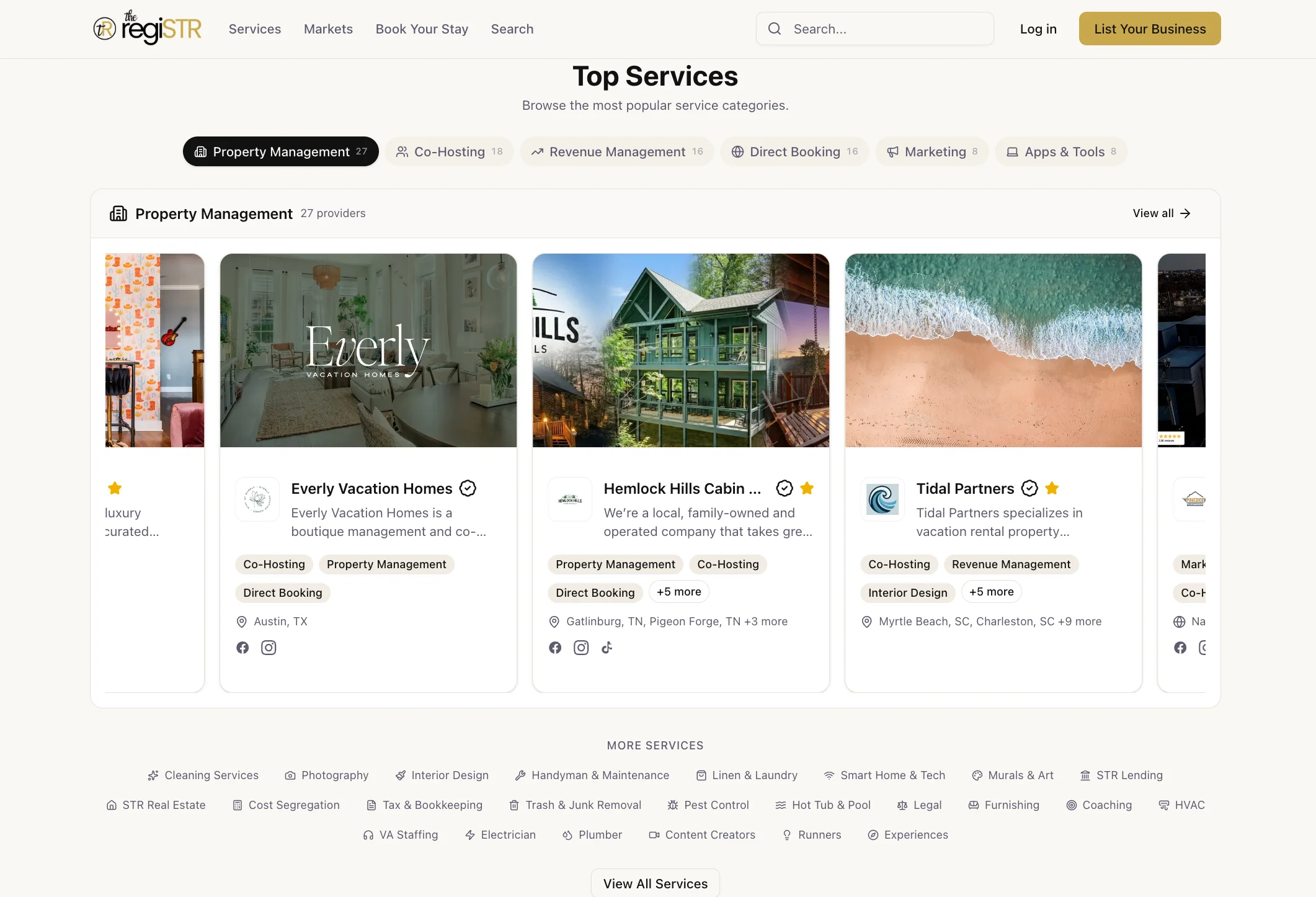
What Should You Prioritize After the Market Research Is Done?
Once market data has narrowed your search to a specific city or metro, prioritize your operational hires in a sequence that matches how the property will actually generate income, starting with turnover cleaning and ending with growth-stage services like revenue management.
- Lock in a turnover cleaner first. A cleaning company that can't commit to a guaranteed window between checkout and the next check-in isn't the right fit for STR, regardless of how good the reviews look. Ask specifically about same-day turnaround capacity before you sign anything.
- Decide on self-managing versus hiring a property manager or co-host. Out-of-state owners in particular underestimate how much time guest messaging, maintenance coordination, and cleaner scheduling take once bookings start coming in.
- Get professional photography before your first listing goes live. Listing photos are one of the highest-leverage, lowest-cost investments you'll make; amateur photos routinely lose bookings to competitors with better visuals in the same market.
- Confirm local licensing and tax registration. Check with the specific city or county office rather than relying on a general summary, since requirements change and vary block by block in some jurisdictions.
- Add revenue management once you have a few months of booking history. Dynamic pricing tools and revenue managers work best when they have real performance data to optimize against, not a blank slate.
- Build toward direct bookings over time. A website, basic SEO, and an active social presence reduce your dependency on OTA commissions, but this is a 12-to-24-month build, not a day-one requirement.
Common mistake: buying the property based on strong market-level data, then spending the next three months scrambling to find a cleaner, a manager, and a photographer after the first guest is already booked. Line up at least your cleaner and, if you're remote, your property manager, before your listing goes live.
How Do You Get More Direct Bookings Once the Property Is Up and Running?
Encouraging guests to book direct starts with giving past guests a specific reason to skip the OTA next time, typically a modest discount, loyalty perk, or simply a direct line of communication they didn't have through the platform. This only works if you've captured guest contact information during their stay, which most hosts still fail to do systematically.
Social channels play a supporting role here, not a primary one. Posting property photos on Instagram or Facebook builds brand recognition, but it rarely converts to a booking without a clear, working link to a direct booking page and a reason to click it, such as a returning-guest rate or an exclusive add-on. If you're getting a handful of impressions on posts but no bookings, the gap is usually the booking infrastructure, not the content itself.
Building a real direct booking business takes a functioning website with live availability and pricing, basic SEO so the site actually surfaces in search, and enough of a content presence that past guests remember your property name instead of just "that Airbnb in Gatlinburg." This is a nationwide service category, meaning you can hire specialists in this exact work regardless of where your property sits, and it's a separate hire from the local, boots-on-the-ground team you build for cleaning and maintenance.
What Does STR-Friendly Actually Mean?
STR-friendly describes a property, HOA, zoning designation, or lender policy that explicitly permits short-term rental use, as opposed to one that's silent on the issue or actively restricts it. The term shows up most often in real estate listings and HOA documents, where it signals to buyers that short-term rental use has already been vetted and approved.
An "STR-friendly" label on a listing is not a guarantee of profitability, only permission to operate. A condo can be technically STR-friendly under its HOA bylaws and still perform poorly if the local market is oversaturated or the building has restrictions on guest count or minimum stay length that limit your booking flexibility. Always request the actual HOA rules in writing rather than trusting a listing agent's characterization of "STR-friendly."
This is also where STR insights tool data and zoning research need to be checked together, not separately. A market can show strong average daily rates in the aggregate data while individual buildings or neighborhoods within that market remain off-limits due to local zoning or HOA restrictions that a market-level dashboard won't surface.
Frequently Asked Questions
How much do STR insights tools typically cost?
Published pricing for this category commonly runs around $195 per month, roughly $450 per quarter, or approximately $1,600 annually, based on standard subscription structures in the market. Annual plans generally offer the best effective monthly rate, though you should confirm exactly how many markets and reports are included at each tier before committing.
Is short-term rental investing still profitable in 2026?
Yes, for operators who run efficient, well-managed properties in markets that haven't reached saturation, though margins have compressed compared to the peak years. Booked listings on Airbnb and Vrbo remain roughly 25 to 30 percent below pre-pandemic levels according to Statista, and demand growth is projected to slow slightly to 4.1% in 2026 per Stayfi, so profitability increasingly depends on operational quality rather than simply owning a property in a hot market.
Is STR the same thing as Airbnb?
No. STR stands for short-term rental and refers to the entire category of properties rented for short stays, while Airbnb is just one booking platform hosts use to distribute those listings. Vrbo, direct booking websites, and other channels are also part of the STR ecosystem.
What is the 2% rule for rental properties?
The 2% rule suggests a rental property's monthly gross rent should equal at least 2% of its purchase price to justify further analysis. It was designed for long-term rentals and applies loosely to short-term rentals, since it doesn't account for occupancy variability, seasonality, or turnover costs specific to STR operations.
What does STR-friendly mean in real estate listings?
STR-friendly means a property, HOA, or zoning designation explicitly permits short-term rental use, as opposed to being silent on or restricting it. It signals permission to operate, not a guarantee of strong performance, so always confirm the specific rules in writing rather than relying on the label alone.
How do I encourage past guests to book direct instead of through Airbnb?
Capture guest contact information during their stay, then offer a specific incentive for a direct rebooking, such as a modest discount or a returning-guest perk not available through the OTA. This requires a working direct booking website with live pricing, since a social media post alone rarely converts without a clear place to complete the booking.
What's the difference between an STR insights tool and a full-service short-term rental directory?
An STR insights tool focuses on pre-purchase market data, such as revenue, occupancy, and average daily rate by city. A directory like the regiSTR focuses on the operational side that comes after you buy, connecting you with vetted cleaners, property managers, photographers, and revenue managers by market so you can actually run the property once the data has pointed you toward it.
Does professional property management affect STR profitability?
Yes, significantly. Professional management companies now oversee an estimated 42% of all global short-term rental listings as of early 2026, according to DataIntelo, a share that has grown as owners recognize that consistent turnover quality, pricing, and guest communication drive occupancy and reviews more than market selection alone.
Conclusion: Data Points You to a Market, People Run the Property
An STR insights tool answers one question well: where should you look. It compares Airbnb and Vrbo revenue, occupancy, and average daily rate across US markets, typically for a subscription in the range of $195 monthly or $1,600 annually, and that data is genuinely useful for narrowing a buying decision. But it stops at the market level. It won't tell you who's cleaning the property on a three-hour turnover, who's answering guest messages at midnight, or whether your building actually allows short-term rentals despite what the listing says.
With the global vacation rental market projected to reach somewhere between $101 billion and $195 billion in 2026 depending on the research firm, the operational side of this business is only getting more competitive. The properties that win aren't just in the right market. They're run by the right people. Get started with the regiSTR once your market research is done, and browse vetted cleaners, property managers, and revenue specialists by city to build the team your data-backed purchase actually needs.
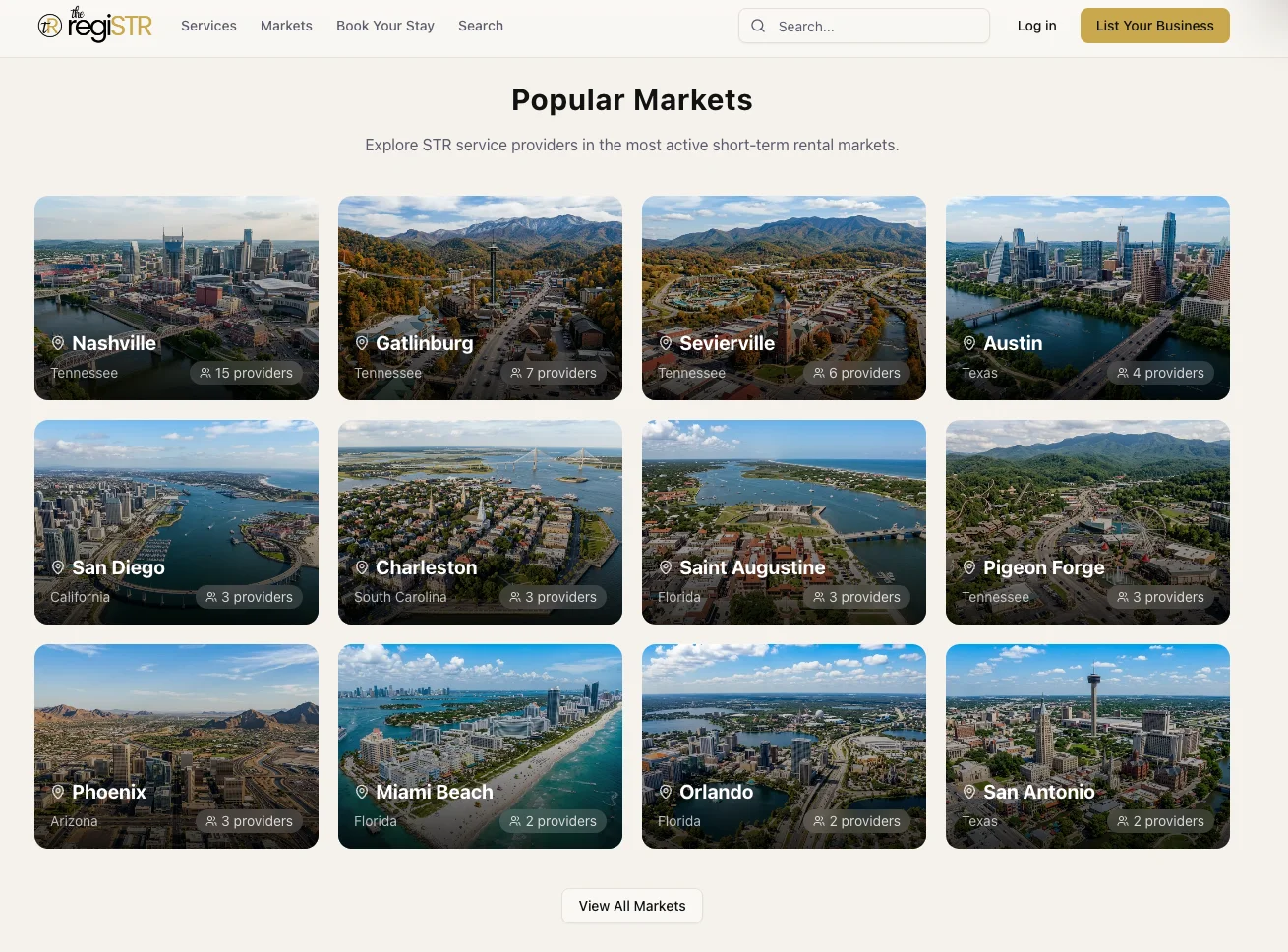
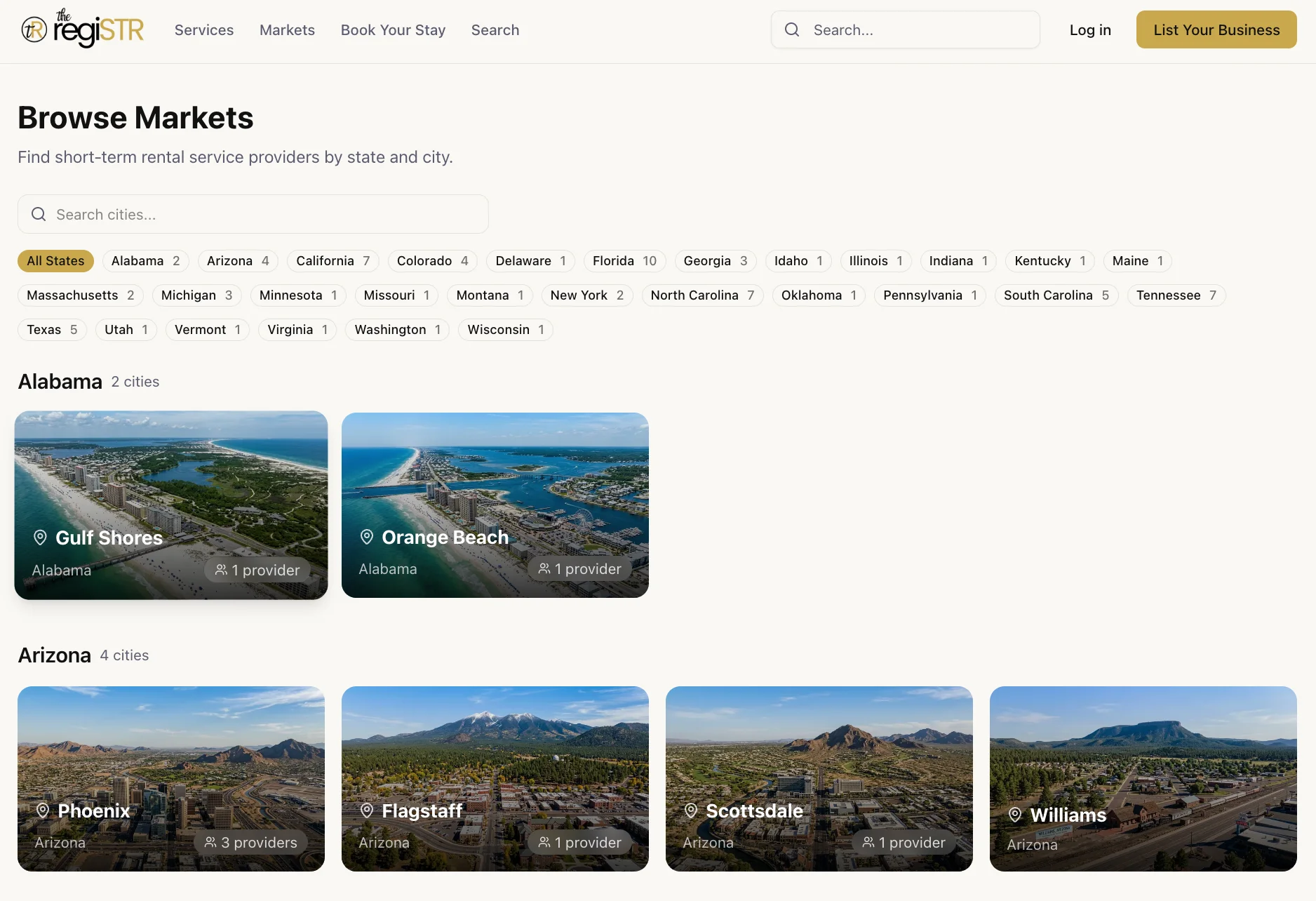
Once your STR insights tool points you toward a market like Nashville, Scottsdale, or Gulf Shores, browse all STR services on the regiSTR to find the vetted cleaners, property managers, and photographers already working in that exact city. Sign up free at theregistr.co and filter providers by market and service category in under a minute.
Content powered by inkSTR.co