What an STR Dynamic Pricing Consultant Actually Does
An STR dynamic pricing consultant is a revenue management professional who combines pricing software with human judgment to set nightly rates for short-term rentals, catching the errors that automated algorithms cannot detect on their own, like local events, brand positioning, and owner-specific goals. Software adjusts price based on data. A consultant adjusts the software's output based on context.
Key Takeaways
- Properties using dynamic pricing strategies earn 20 to 40 percent more revenue than those on fixed rates, according to industry research cited by AirROI, but the tool alone doesn't guarantee you capture that upside.
- A documented case study showed a two-bedroom Austin property moving from a $125 average nightly rate to $142 (a 13.6 percent increase) and occupancy climbing from 65 percent to 78 percent after dynamic pricing was properly implemented.
- Most OTA data scraping tools that feed pricing algorithms refresh only every 24 hours, which means the software you're paying for is often reacting to yesterday's market, not today's.
- Roughly 40 percent of Airbnb bookings happen within 7 days of check-in, a window where automated rules frequently misfire without a human reviewing the calendar.
- An STR dynamic pricing consultant earns their fee by managing the judgment calls software can't make: event overrides, owner communication, brand positioning, and correcting bad data before it costs you a booking.
- the regiSTR's Revenue Management and Dynamic Pricing directory connects hosts directly with vetted consultants who already understand these gaps, filtered by market and service tier.
If you've ever watched your pricing tool drop your rate the same week a festival sold out three blocks from your property, you already understand the limits of automation. Software reacts to patterns. It does not know your market the way someone who lives in it does.
That gap is exactly where an STR dynamic pricing consultant earns their fee in 2026. At the regiSTR, we've tracked a consistent pattern across the providers in our network: hosts who pair a pricing tool with a human consultant outperform hosts running the software solo, particularly during high-volatility periods like holiday weekends, local conventions, and shoulder-season transitions.
This article breaks down what a dynamic pricing consultant does that software cannot, when hiring one actually makes financial sense, and how to vet a candidate before you hand them control of your calendar. We'll also cover the cost tradeoffs, because a consultant is not free, and pretending otherwise would be dishonest.
What Does Dynamic Pricing Even Mean for a Short-Term Rental?
Dynamic pricing is a rate-setting method that adjusts your nightly price continuously based on demand signals like occupancy pace, booking window, day of week, and competitor rates, rather than locking in one flat rate year-round. It replaces guesswork with data-informed adjustments.
Static pricing sets one number and leaves it alone regardless of what's happening in the market. Dynamic pricing responds. For example, an occupancy-based rule might raise rates 10 percent when the next 30 days are already 80 percent booked. A lead-time rule might add a 15 percent premium to last-minute bookings inside a 3-day window, since desperate travelers pay more. A length-of-stay rule might discount 7-night-plus bookings by 10 percent to reduce turnover costs.
Weekend pricing is another standard lever: Thursday through Saturday nights are commonly priced 20 percent higher than weeknights in leisure markets. These rules run automatically inside pricing software, adjusting your calendar dozens of times a week without you touching a dashboard.
The revenue upside is real. Properties using dynamic pricing strategies earn 20 to 40 percent more revenue than fixed-rate listings, based on industry research cited by AirROI. But the rules themselves are only as good as the data feeding them, and that's the first crack where a consultant's judgment matters more than another algorithm update.
What Does an STR Dynamic Pricing Consultant Do Differently From Software Alone?
An STR dynamic pricing consultant reviews, overrides, and contextualizes the output of pricing software, applying local market knowledge, owner goals, and brand strategy that no algorithm currently accounts for. The software sets the baseline. The consultant decides when the baseline is wrong.
Here's the distinction that matters: pricing software processes historical booking patterns, competitor rates, and demand signals through a fixed set of rules. It cannot pick up the phone and ask a chamber of commerce whether a festival got cancelled. It cannot sense that your market's biggest wedding venue just booked out an entire weekend, pulling 40 rooms of demand into your competitive set. A consultant catches that.
Specifically, a consultant handles five judgment categories software cannot replicate on its own:
- Owner relationship management. When a rate drop spooks an owner mid-season, a consultant explains the strategy behind it. Software just executes.
- Brand positioning. A consultant decides whether your property should price at a premium to signal quality, or match the market to maximize occupancy. That's a strategic call, not a data output.
- Event-specific overrides. Local festivals, conventions, and construction closures often aren't in any scraped dataset. A consultant who works your market catches these before the algorithm does.
- Crisis and PR judgment. If a price spike during a natural disaster or emergency draws guest complaints, a consultant knows when to pull back rates for reputation reasons, even if the algorithm says demand justifies the price.
- Cross-tool reconciliation. Consultants who manage multiple properties often blend data from several sources rather than trusting one algorithm's output blindly.
This is the gap we built the regiSTR's Revenue Management and Dynamic Pricing category to close. Every consultant listed there was referred into the network by an existing member, so the roster reflects professionals who've actually managed live STR calendars, not generalists reading a pricing blog.
Why Do Automated Pricing Tools Get Rates Wrong?
Automated pricing tools get rates wrong because they depend on scraped OTA data that is frequently stale, incomplete, or misread against your specific property's context. The tool is only as accurate as the data feeding it, and that data has real limitations.
First, timing. Most companies that scrape Airbnb and VRBO listing data for competitive pricing intelligence refresh that data only every 24 hours. In a market where 40 percent of bookings happen within 7 days of check-in, a full day of lag means your algorithm is pricing against yesterday's competitive landscape, not today's.
Second, market segmentation gets messy. The STR sector is typically split into three data categories for pricing analysis: truly urban markets, leisure/urban hybrid markets, and pure vacation rental markets. A rural cabin market with lower OTA distribution and heavier reliance on direct bookings produces thinner, less reliable scraped data than a dense urban market. Algorithms trained on urban patterns can misfire badly when applied to a hyper-seasonal mountain or beach property.
Third, OTAs are actively getting harder to scrape. Platforms have shifted away from guest-facing friction like CAPTCHAs toward automated bot-detection methods, which means the pricing tools relying on that scraped data face growing accuracy gaps as detection technology improves. As a result, the "source of truth" alternative, pulling direct booking and owner blockout data straight from a property management system, is becoming a more trusted input than scraped comp-set data alone.
A consultant who understands these mechanics doesn't just trust the software's number. They cross-check it. That's a service you won't get from a subscription dashboard alone, and it's exactly the kind of vetting criteria we apply when listing revenue management providers on the regiSTR.
Should You Hire a Dynamic Pricing Consultant or Just Use Software?
Whether you need a consultant or software alone depends on your portfolio size, market volatility, and how much time you can personally dedicate to reviewing your calendar every week. A single, low-volatility property in a stable market can often run well on software with light manual oversight. A multi-property portfolio in an event-driven or seasonal market usually cannot.
| Factor | Software Alone | Consultant + Software |
|---|---|---|
| Best for | Single property, stable demand | Multi-property portfolios, volatile or event-driven markets |
| Data review | Automated rules only | Human review of anomalies and stale data |
| Event overrides | Rarely detected in real time | Caught before rates go live |
| Owner communication | None | Included as part of the relationship |
| Cost structure | Flat monthly subscription | Subscription plus a management fee or percentage of revenue |
| Time commitment from host | Weekly dashboard checks | Minimal, delegated to consultant |
Here's our honest take: not every STR needs a dedicated consultant on day one. A first-time host with one property in a predictable market can start with a pricing tool and self-manage the overrides. But once you're managing three or more units, or operating in a market with heavy seasonality (think Gatlinburg's fall foliage surge or a coastal market's hurricane-season swings), the math on a consultant starts to work in your favor fast, because the revenue lift from catching even a handful of mispriced weekends typically outweighs the fee.
Cost is the part most articles skip. A pricing software subscription runs as a flat monthly fee regardless of your revenue. A consultant typically layers on top of that, either as a flat monthly retainer or a percentage of managed revenue, which means their incentives are aligned with pushing your rates higher, not just cheaper. That's a real tradeoff worth weighing against your current revenue and how much of your own time you're spending second-guessing the software.
How Do You Vet a Dynamic Pricing Consultant Before Hiring One?
Vetting a dynamic pricing consultant means confirming they understand STR-specific revenue metrics, have managed live portfolios, and can explain their pricing logic in plain terms rather than hiding behind a black-box dashboard. A consultant who can't explain a decision isn't managing your revenue, they're guessing alongside the algorithm.
Ask these questions in your first call:
- How do you use RevPAR, ADR, and Occupancy Rate to evaluate my property specifically? A qualified consultant should be fluent in revenue per available night, average daily rate, booking window, length of stay, market share, rate positioning, and revenue index without needing you to define the terms.
- What pricing software do you use, and how do you override it? If they can't name specific rules they adjust manually, they're not adding value beyond the subscription price.
- How do you handle event-driven demand in my market? This tests whether they actually know your local calendar or are relying purely on scraped data.
- Do you rely on OTA-scraped comp data, or do you also use direct PMS data? Consultants who blend both sources are correcting for the staleness in scraped data rather than trusting it blindly.
- What's your fee structure, and what happens if revenue drops? Get this in writing before signing anything.
- Can you show me a before-and-after example from a comparable property? A credible consultant should have concrete numbers, not vague claims about "optimized revenue."
Red flags to walk away from: a consultant who guarantees a specific revenue increase, who can't explain their pricing logic when asked directly, or who has never managed a property outside their own portfolio. Revenue management is a skill built through repetition across different markets and property types, not a certification you earn once and coast on.
This is precisely the vetting criteria the regiSTR applies before listing a Revenue Management and Dynamic Pricing provider. Every consultant on the platform has been referred in by a network member, and the Vouch system lets other STR operators publicly confirm they've actually worked with that consultant, not just clicked a five-star rating.
What KPIs Should a Dynamic Pricing Consultant Track for Your Property?
The core KPIs a dynamic pricing consultant should track are RevPAR, ADR, occupancy rate, booking window, length of stay, market share, rate positioning, and revenue index, each measuring a different piece of your property's revenue performance against the market. Tracking only one metric, like occupancy, without the others gives you an incomplete picture.
RevPAR (revenue per available night) is calculated by dividing total revenue by total available nights, capturing both rate and occupancy in a single number. ADR (average daily rate) divides total revenue by booked nights only, showing what you're actually charging guests who book. A property can have a strong ADR and a weak RevPAR if occupancy is low, which is exactly the kind of blind spot a consultant is trained to catch.
Market share compares your occupancy against the broader market average, telling you whether you're capturing your fair share of demand or losing bookings to comparable properties. Rate positioning compares your ADR to comparable listings, showing whether you're priced at a premium, at parity, or below market. Revenue index compares your RevPAR to the market's RevPAR, the cleanest single number for judging overall performance against your comp set.
A documented case study illustrates how these metrics move together: a two-bedroom Austin property saw ADR rise from $125 to $142, occupancy climb from 65 percent to 78 percent, and monthly revenue grow from $2,500 to $3,400, a 36 percent increase, after dynamic pricing was properly implemented and reviewed. During a peak event weekend, that same property's nightly rate reached over $300, more than double its prior baseline. That kind of swing only happens when someone is actively watching the calendar for the right moment to push rates, not waiting for a rule to trigger automatically.
What Are the Biggest Challenges in STR Dynamic Pricing Right Now?
The biggest challenges in STR dynamic pricing in 2026 are market volatility, inconsistent data quality, limited competitor monitoring accuracy, guest perception of fairness, system complexity, regulatory constraints, and predictive accuracy gaps, all of which require human oversight to manage effectively.
Market volatility means demand can shift overnight due to weather, cancellations, or a single large event, and a pricing rule built on historical averages won't catch it in real time. Data availability and quality remain a persistent problem because scraped OTA data, refreshed only every 24 hours in most cases, lags behind actual market movement. Competitor monitoring is harder than it sounds too: knowing what a comparable property charges tonight is different from knowing what they'll charge next weekend.
Guest perception of fairness is an underdiscussed risk. A guest who books at $300 a night and later discovers a neighbor paid $180 for the same weekend can leave a scathing review over perceived price gouging, even if the pricing was market-justified. A consultant weighs that reputational risk against pure revenue math, something a rules-based algorithm has no mechanism to consider.
Regulatory constraints add another layer. Some jurisdictions have begun scrutinizing pricing practices tied to platform parity clauses; notably, the EU Court of Justice ruled against Booking.com's use of price parity clauses in September 2026, a signal that pricing autonomy is an active legal and regulatory conversation globally. Predictive accuracy, meanwhile, remains genuinely difficult: even sophisticated software cannot fully predict demand shocks from sudden events, which is why overall occupancy improvements from optimized dynamic pricing tend to land in a modest 2 to 3 percent range on top of whatever baseline gains the tool already delivers, rather than a runaway windfall.
Is Web Scraping for Competitor Pricing Data Even Legal?
Web scraping publicly accessible pricing data is generally legal in the United States, provided it doesn't violate the Computer Fraud and Abuse Act, the Digital Millennium Copyright Act, or a specific website's terms of service. This matters because most automated pricing tools depend on scraped comp-set data to function.
The key legal precedent here is the 2019 case of LinkedIn vs. hiQ Labs, which established that scraping publicly accessible online data is generally permissible under U.S. law. That ruling underpins a lot of the pricing intelligence industry that STR software depends on. But legality doesn't solve the accuracy problem discussed earlier: OTAs are increasingly resilient to scraping, shifting from guest-facing friction like CAPTCHAs toward automated bot-detection systems, which is steadily degrading the reliability of scraped comp data even where it remains technically legal to collect.
This is part of why the industry is shifting toward "source of truth" data: pulling real booking and blockout data directly from property management systems rather than depending entirely on scraped OTA listings. A consultant who understands this distinction, and who blends both data types, is applying a level of technical judgment that a subscription tool running on scraped data alone cannot replicate.
How Do You Combine a Pricing Tool With a Human Consultant?
A hybrid pricing model uses software to handle continuous, rules-based adjustments while a consultant reviews outliers, overrides errors, and manages the strategic decisions software isn't built for. This combination consistently outperforms either approach used alone.
In practice, the workflow looks like this: the software runs its standard rules, occupancy-based increases, lead-time premiums, length-of-stay discounts, weekend surcharges, continuously in the background. The consultant logs in on a set schedule, typically weekly, to review flagged anomalies: unusual rate drops, gaps in the competitive set, or upcoming dates where local knowledge suggests the algorithm is underpricing an event weekend. They manually override those specific dates while leaving the rest of the calendar on autopilot.
This model respects what software does well (constant recalculation, tireless monitoring) while inserting human judgment exactly where it's needed most. It's also more cost-efficient than a fully manual pricing approach, since the consultant isn't rebuilding your calendar from scratch every week, just correcting the specific spots where automation falls short.
Finding a consultant who already thinks this way, rather than one who either ignores the software entirely or defers to it blindly, is the differentiator. That's exactly why we organized the regiSTR's Revenue Management and Dynamic Pricing category around providers who describe their actual workflow, not just their software stack, in their profile.
Practical Guidance: How to Choose the Right Pricing Approach for Your Property
Choosing between software-only pricing and a consultant-assisted model comes down to your portfolio size, your market's volatility, and how much revenue is at stake if the algorithm gets it wrong. Here's a simple framework to work through before you commit to either path.
- Audit your current occupancy and ADR trend for the last 12 months. If you can't answer this off the top of your head, you're not tracking the metrics closely enough to know whether software alone is working.
- Identify how many high-volatility weekends you have per year. Festivals, conventions, holiday weekends. More than a handful is a strong signal a consultant's event overrides will pay for themselves.
- Calculate your time cost. If you're spending more than an hour a week second-guessing your pricing dashboard, that's an hour you could redirect elsewhere by delegating to a consultant.
- Request a sample audit from a candidate consultant. A credible consultant should be willing to review your last quarter's pricing and point out specific missed opportunities before you sign anything.
- Confirm fee structure and reporting cadence in writing. Know exactly how often you'll get reports and how the fee is calculated, flat retainer versus percentage of revenue, before the first invoice arrives.
Common mistake: hosts who assume a pricing tool is "set it and forget it." It isn't. Every rules-based system needs periodic recalibration as your market shifts, and skipping that review is how properties end up underpriced for months without anyone noticing.
Frequently Asked Questions
What is an STR dynamic pricing consultant?
An STR dynamic pricing consultant is a revenue management professional who reviews and adjusts automated pricing software output for short-term rentals, applying local market knowledge, event awareness, and owner strategy that algorithms can't generate on their own.
Do I still need pricing software if I hire a consultant?
Yes. Consultants typically work on top of pricing software rather than replacing it, using the tool for continuous rules-based adjustments while personally reviewing anomalies, overrides, and event-specific decisions the software would miss.
How much more revenue can dynamic pricing generate compared to fixed rates?
Properties using dynamic pricing strategies have been shown to earn 20 to 40 percent more revenue than fixed-rate listings, according to industry research cited by AirROI, though results vary significantly by market volatility and how well the pricing is actively managed.
What's the difference between RevPAR and ADR?
RevPAR (revenue per available night) divides total revenue by all available nights, capturing both occupancy and rate together. ADR (average daily rate) divides total revenue only by booked nights, showing what guests actually paid, without factoring in vacancy.
Is dynamic pricing software accurate on its own?
Not always. Most pricing tools rely on scraped competitor data that refreshes only every 24 hours in many cases, which can leave the software reacting to outdated market conditions, especially since roughly 40 percent of bookings happen within 7 days of check-in.
How do I find a vetted STR dynamic pricing consultant?
Look for a consultant who can explain their pricing logic in plain terms, has managed live STR portfolios, and blends software output with direct booking data rather than relying solely on scraped comp data. The regiSTR's Revenue Management and Dynamic Pricing directory lists providers who've been referred into the network and vouched for by other STR operators.
Does dynamic pricing work the same way in every STR market?
No. The STR industry is generally segmented into truly urban, leisure/urban, and pure vacation rental markets for pricing analysis, and rural or hyper-seasonal properties often have thinner, less reliable pricing data due to lower OTA distribution, which makes local expertise more valuable in those markets.
Conclusion
The direct answer holds: an STR dynamic pricing consultant does what software alone cannot, applying local judgment, event awareness, and owner strategy on top of algorithmic pricing, and that combination is where properties in volatile or seasonal markets consistently see the strongest results in 2026. Software gets you most of the way there. A consultant catches the rest.
If you're managing one steady property, a pricing tool and a weekly check-in might be all you need. But if you're juggling multiple units, an event-heavy calendar, or a market where scraped data consistently lags reality, the math on a consultant tends to favor hiring one sooner rather than later.
Get started with the regiSTR by browsing vetted Revenue Management and Dynamic Pricing consultants filtered by market and service category. Every provider was referred into the network by an existing member, and the Vouch system lets you see which STR operators have actually worked with them before you make the first call.
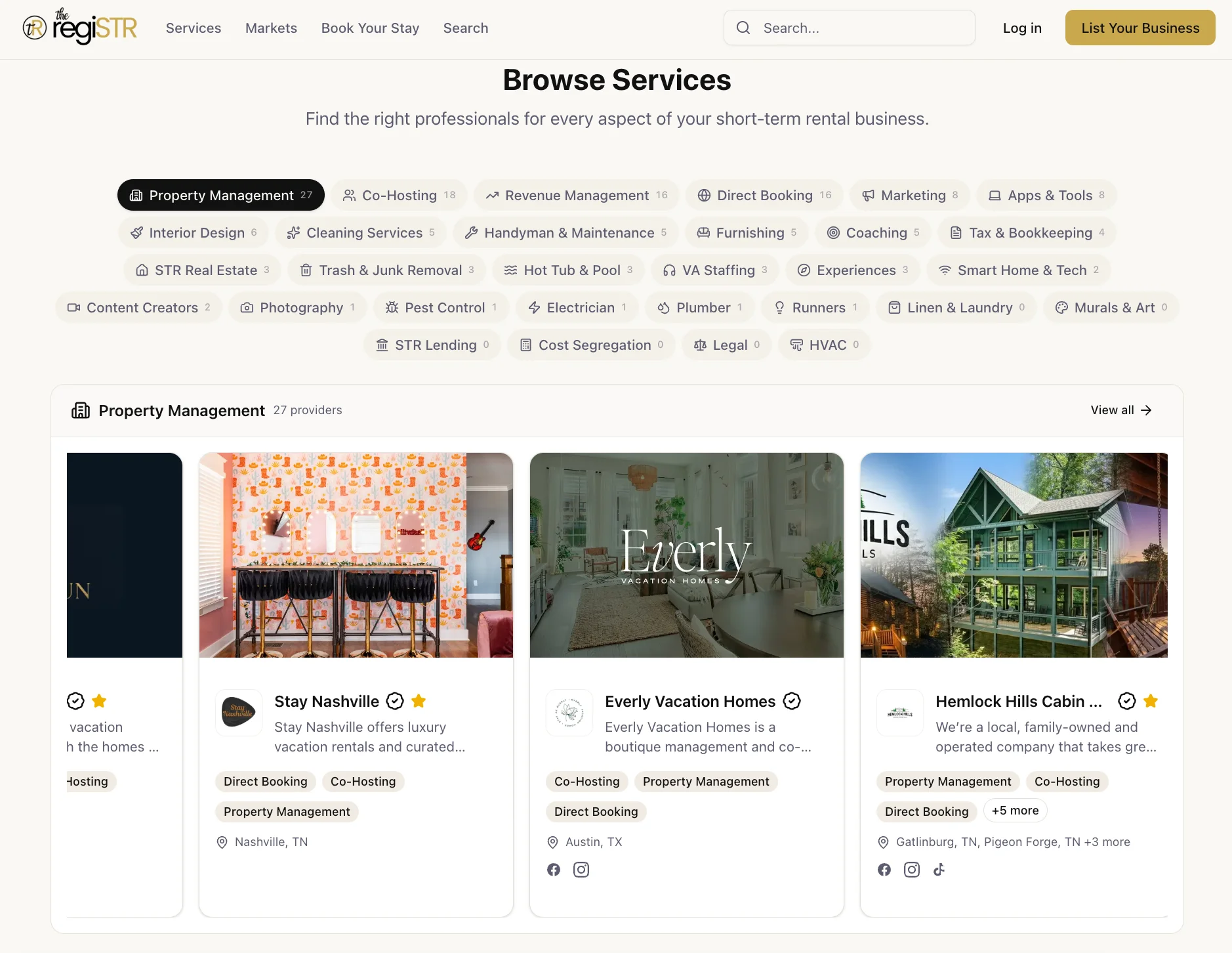
Getting your pricing strategy right is one piece of running a profitable short-term rental. The vendors who can help with the rest, cleaners, photographers, maintenance crews, are organized by market on the regiSTR's directory of STR property managers and related service categories, so you're not rebuilding your vendor network from scratch every time you scale into a new market.
Content powered by inkSTR.co