How to Find STR Vendors Remotely in Any Market

To find STR vendors remotely, start with a purpose-built short-term rental directory filtered by market and service category, then layer in video interviews, insurance verification, and peer-vouched references before signing any vendor agreement. The entire vetting process, from first contact to first service date, can be completed without ever visiting the market in person.
- Finding STR vendors remotely is fully achievable in 2026, but only if you use STR-specific directories rather than general home-services platforms that mix in residential contractors with no turnover experience.
- The five vendor categories every remote operator must source first are: turnover cleaners, a licensed handyman, a co-host or local property manager, a locksmith or smart-lock installer, and an STR-specialized photographer.
- Remote due diligence requires video walkthroughs, certificate-of-insurance checks, and peer references from other STR operators, not anonymous star ratings, which are easy to game and impossible to verify.
- Vendors who understand STR turnover timelines, the gap between a 10am checkout and a noon check-in, operate at a fundamentally different level than general cleaners or handymen hired off a broad contractor board.
- Negotiating tiered pricing or volume discounts is possible even without local presence, but it requires a clear picture of your projected booking volume before the first conversation.
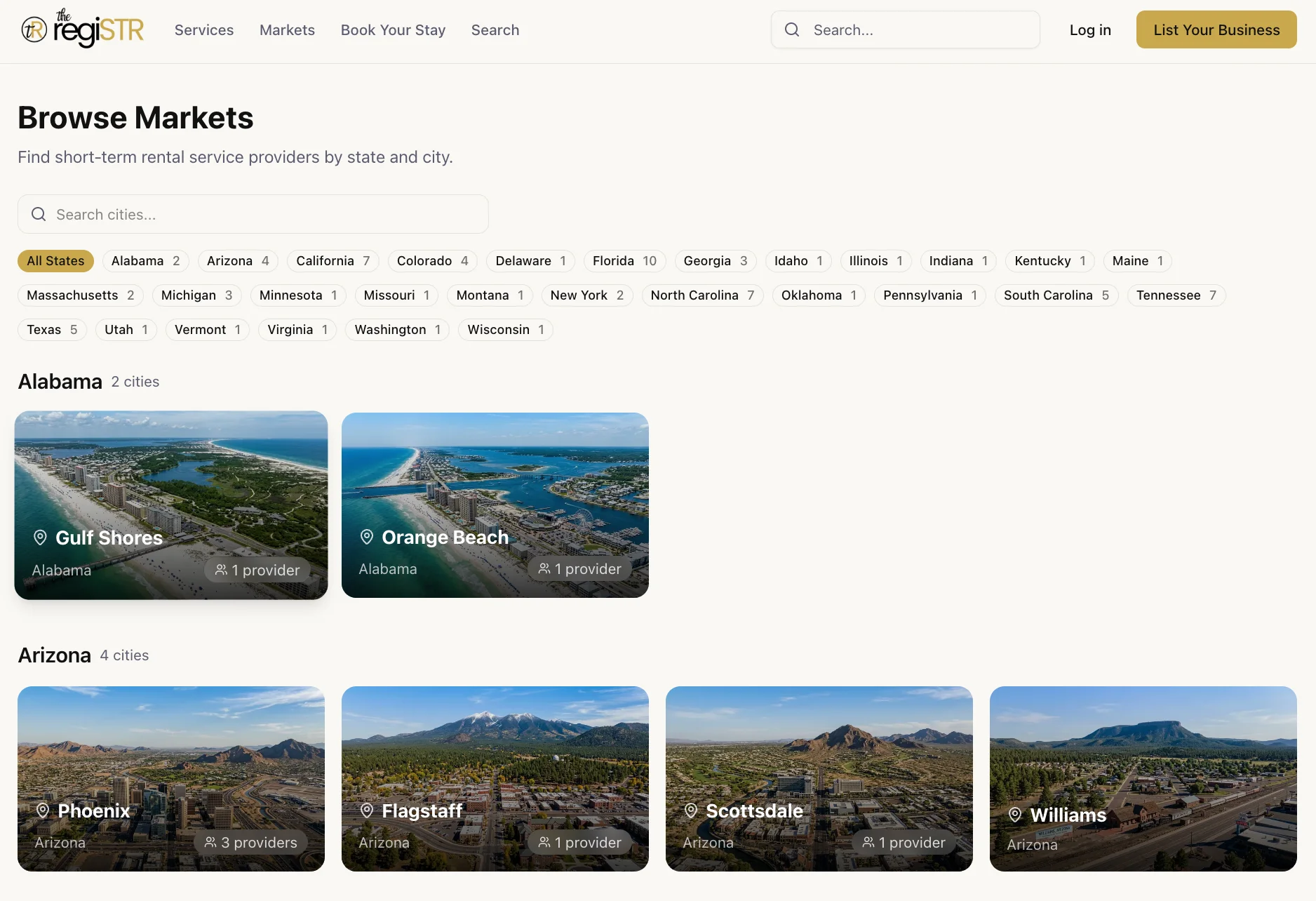
- the regiSTR organizes vetted STR service providers by market and category, so you can filter specifically to your market and see peer-vouched profiles without cold-calling strangers from a Google search.
Why Is Finding STR Service Providers Without Local Knowledge So Hard?
Finding STR vendors remotely is difficult because general business directories are not organized for short-term rental workflows. A Google search for "cleaners in Pigeon Forge" surfaces residential maid services alongside move-out crews and commercial janitorial companies. None of them necessarily understand same-day turnover, linen restock protocols, or what happens when your checkout guest runs late and your next guest arrives in 90 minutes.
The problem compounds when you factor in distance. You cannot drop by to inspect a cleaner's work. You cannot walk the property with a handyman to explain the quirks of the HVAC system. Every conversation happens over the phone or video call, which means you are relying entirely on the quality of your vetting questions and the reliability of whoever vouches for this vendor.
At the regiSTR, we see this pattern constantly across the providers in our network: out-of-state investors spend weeks posting in Facebook groups, collecting names from hosts in other markets who have no first-hand experience with the specific city in question, and eventually hiring someone based on a hunch. The results are predictable. A cleaner who cannot commit to a guaranteed turnaround window is not the right fit for STR, full stop. And discovering that after your first double-booking crisis costs you far more than the time it would have taken to vet properly.
The markets where remote owners struggle most are not necessarily the most competitive ones. They are the markets where the STR vendor ecosystem is fragmented: smaller beach towns, mountain destinations, and mid-tier cities where professional STR cleaners and co-hosts exist but are not easy to find through general-purpose directories. This guide gives you the framework to find them anyway.
What Is the Best Way to Find a Vendor for Your Short-Term Rental?
The best way to find a short-term rental vendor remotely is to use a directory organized specifically for STR operators, filtered by geographic market and service category, with peer endorsements from other hosts who have hired the provider. This approach surfaces STR-experienced professionals rather than general contractors who have never managed a same-day turnover.
General home-services platforms aggregate every type of contractor in a given zip code without distinguishing between residential and STR experience. The result is a long list of providers where most are functionally irrelevant to your needs. An STR-specific directory solves this at the filter level, before you ever make contact with a single provider.
Here is the sequence we recommend for every new market:
- Define your vendor stack before you search. Every STR needs, at minimum, a turnover cleaner, a handyman on call, and someone who can conduct an in-person inspection when something goes wrong. Photograph your needs, then source in priority order.
- Filter by market first. A provider who services Nashville is not going to drive to Murfreesboro for a two-hour turnover. Market-specific filtering saves you from wasted conversations.
- Look for STR-specific experience signals. Does the cleaner's profile mention turnover timelines or same-day availability? Does the handyman list vacation rental clients? These details separate specialists from generalists.
- Check peer endorsements, not star ratings. Anonymous five-star reviews are easy to manufacture. A named endorsement from a real STR operator, with their property context attached, carries actual weight.
- Schedule a video call before committing. Ask the vendor to walk you through their process for a standard turnover, not a general description of their services. The specificity of their answer tells you everything.
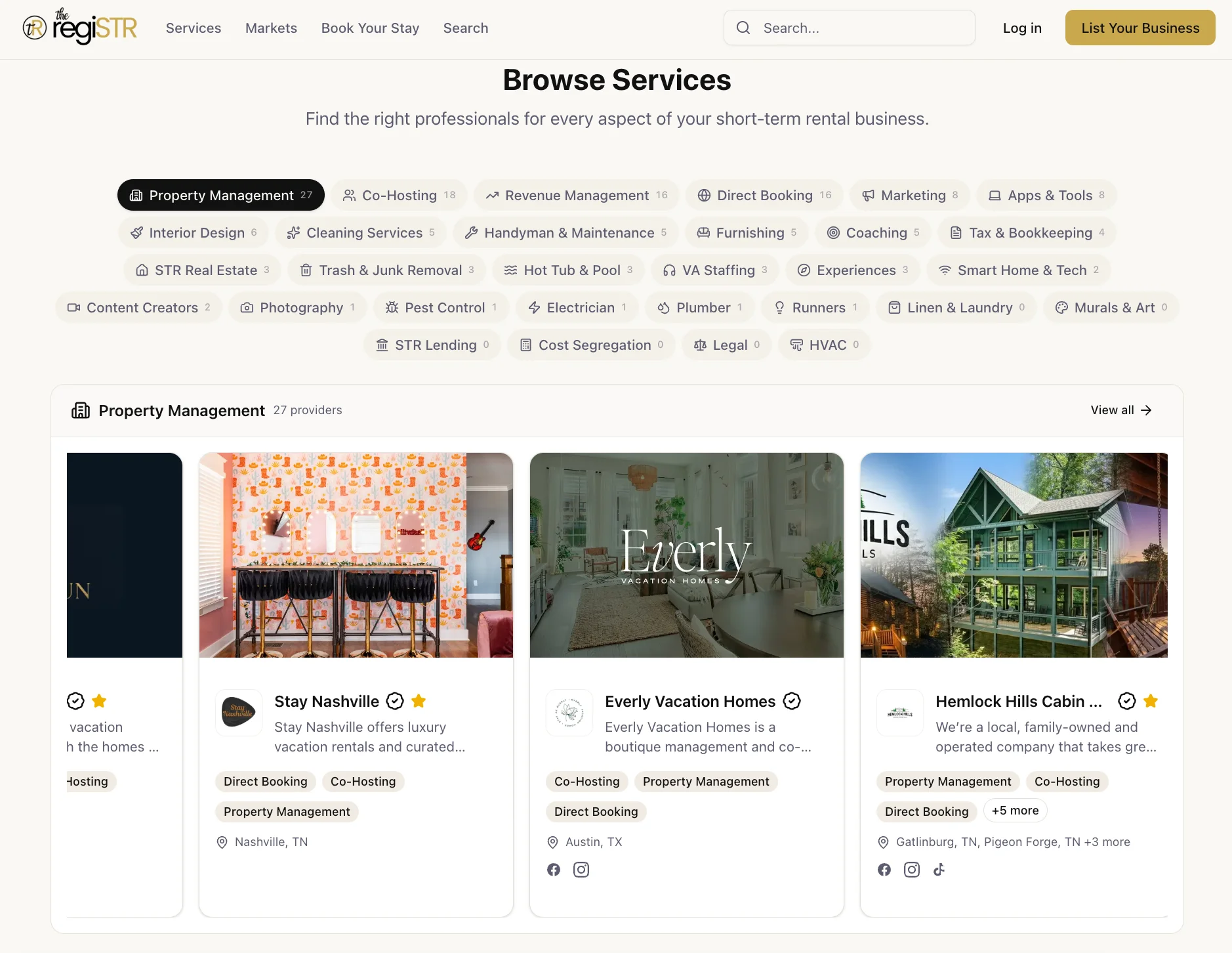
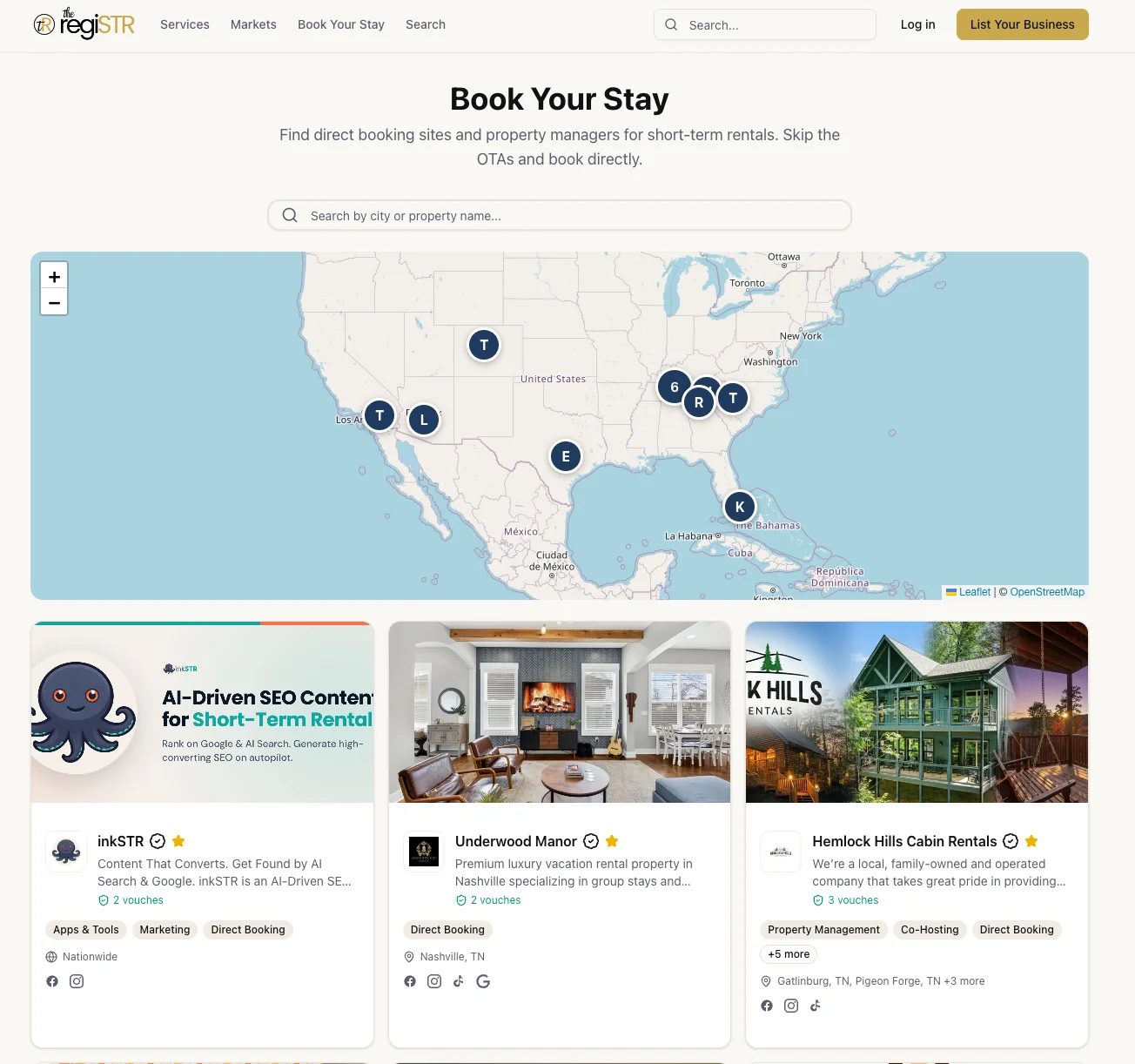
The regiSTR's market directory pages are organized exactly this way: browse by city, filter by service category, and read peer-vouched profiles from operators who have already hired and worked with each provider. It replaces the Facebook group post and the Google scroll with a structured search built for this specific use case. Browse all STR service categories to see the full vendor stack available in your market.
How Do You Vet STR Vendors Without Visiting the Market in Person?
Remote vendor vetting for STR properties relies on three non-negotiable checks: a live video walkthrough of the property conducted by the vendor before the first service date, a current certificate of insurance naming your LLC or entity as additionally insured, and at least two references from other STR operators in the same market who have hired this vendor within the past 12 months.
Most operators skip at least one of these. The video walkthrough feels redundant when you have already described the property over the phone. The insurance certificate feels like a formality. The STR-specific references feel like overkill when the vendor has a good general reputation. Each of these shortcuts creates a gap that eventually costs you.
Video Walkthroughs as a Remote Inspection Tool
Ask every prospective cleaner or handyman to conduct a video walkthrough of the property before their first service date. This achieves two things simultaneously. First, it confirms the vendor can navigate the property independently, a skill that matters enormously when you are not on-site to answer questions. Second, it gives you a baseline visual record of the property's condition before service begins, which protects you in any future dispute about damage.
A vendor who refuses a pre-service video call or treats it as unnecessary is telling you something important about how they communicate remotely. That is a red flag, not a stylistic preference.
Insurance Verification for Remote Operators
Every vendor you hire should carry general liability insurance with a minimum coverage level appropriate for their service category. Cleaners and handymen working inside occupied or recently occupied vacation rentals carry real liability exposure. Ask for the certificate directly, not just their word that they are covered.
If your property is held in an LLC, request that your entity be named as an additional insured on the certificate. Many professional STR vendors are already accustomed to this request. If the vendor is surprised by it or resistant, that tells you they have not worked with serious STR investors before.
References That Actually Transfer
A reference from a residential cleaning client does not tell you how a cleaner performs under STR pressure. Request references specifically from other short-term rental operators in the same market, ideally operators managing properties of similar size and booking volume to yours. Ask the reference one specific question: "Has this vendor ever missed a turnover window, and how did they handle it?" The answer to that question is worth more than any star rating.

How to Find Vendors in Your Market Area Without Being There
Finding vendors in a specific STR market area without local presence means using STR-specific directories filtered by geography, joining the local host communities in that market, and building relationships with the vendors who are already embedded in the local STR ecosystem, particularly the ones who work with the property managers or co-hosts already operating there.
The fastest path into any new STR market is through the existing operator network. The cleaners, handymen, and photographers who are already working with established hosts in that market are almost always the right starting point. They understand turnover timelines. They know the quirks of the local property type, whether that means mountain cabins with hot tub maintenance requirements in Gatlinburg or high-rise condos with elevator logistics in Miami. And they have already been pre-screened, in a practical sense, by the hosts they work with.
STR-Specific Directories with Market Filters
A directory that organizes providers by market and service category solves the core discovery problem in a way that Google Maps simply cannot. General search results surface whoever has the best local SEO, which is not necessarily correlated with STR experience. A curated STR directory surfaces providers who have been specifically referred in by other operators in that market.
The regiSTR's market pages do exactly this. Each city or metro page aggregates every listed service category, from turnover cleaners to property managers to handymen and maintenance providers, in one place. You can browse the full vendor landscape for a market you have never visited, compare profiles, and read peer endorsements from operators who have actually hired these vendors. That is a fundamentally different experience from cold-calling contractors from a Google search page.
Local STR Host Facebook Groups and Forums
Every active STR market has at least one local Facebook group or forum where hosts share vendor recommendations. These groups are imperfect, recommendations are informal and the same names tend to circulate regardless of current quality, but they are useful for one specific purpose: confirming whether a vendor you found elsewhere is known in the local community.
Post with specificity. "Looking for a turnover cleaner in Destin who can handle same-day bookings on a 3-bedroom beachfront condo" gets better responses than "looking for a good cleaner." The specificity signals that you are a serious operator, which attracts responses from serious hosts rather than vendors posting their own names in reply.
Co-Hosts and Property Managers as Vendor Networks
A co-host or local property manager who already operates in your target market typically brings a pre-built vendor network with them. This is one of the most underrated benefits of hiring a co-host for a single property: you are not just getting oversight, you are buying access to a vetted local vendor stack that the co-host has built through trial and error over multiple properties.
Ask any co-host candidate directly: "Who are the two or three cleaners you trust most in this market, and what makes them the right fit for STR work?" The specificity of the answer tells you a lot about how embedded they actually are in the local operator community.
What Vendor Categories Should Remote STR Operators Source First?
Remote STR operators should prioritize sourcing vendors in this order: a turnover cleaning crew with STR-specific experience, a licensed handyman or maintenance contact who can respond within 24 hours, a local co-host or property manager for on-site oversight, an STR-specialized photographer for listing optimization, and a smart-lock or keyless entry installer if the property does not already have remote access capability.
The cleaning crew is the highest-frequency, highest-stakes vendor in your entire stack. A bad cleaner affects every single guest. A missing handyman only surfaces during emergencies, but those emergencies tend to arrive at the worst possible time, typically on a Friday afternoon when your property is booked solid for the next two weeks. Source both before your first booking goes live, not after your first problem surfaces.
| Vendor Category | Why It's Critical for Remote Ops | Key Vetting Signal |
|---|---|---|
| Turnover Cleaner | Affects every guest stay; same-day turnovers require STR-specific experience | Can they commit to a guaranteed turnaround window in writing? |
| Handyman / Maintenance | Emergency response is impossible to manage remotely without a trusted local contact | Do they have STR clients and a policy for after-hours callouts? |
| Co-Host / Property Manager | Physical presence for inspections, guest check-ins, and vendor coordination | How many STR properties do they currently oversee in this market? |
| STR Photographer | Listing photos are a one-time investment with ongoing revenue impact | Can they show an existing STR portfolio with before/after comparisons? |
| Smart Lock / Access Installer | Remote access management is non-negotiable when you are not on-site | Do they have experience with Airbnb and Vrbo keyless entry integrations? |
For photography specifically, the difference between a generalist photographer and one who understands OTA listing performance is measurable. Wide-angle hero shots, natural light staging, and the correct sequence of rooms in a listing gallery are not instincts that every photographer has. Find a photographer who has shot Airbnb or Vrbo listings before, not just residential real estate. Browse STR photographers by market on the regiSTR to see providers with verified short-term rental portfolios.
How Do You Negotiate with Vendors When You Have No Local Presence?
Negotiating with STR vendors remotely is most effective when you lead with projected volume rather than price sensitivity. A cleaner who serves five of your properties in one market, or a handyman who becomes your exclusive contact for an entire portfolio, is a fundamentally better client for that vendor than a one-property owner who haggles on rate. Position yourself as a growth partner from the first conversation.
Remote operators often assume their lack of local presence weakens their negotiating position. The opposite is frequently true. A vendor who works with a remote owner across multiple properties in a market gets predictable, recurring volume without the overhead of client management. That is a desirable client profile, especially for cleaners who are building a reliable base of recurring STR accounts.
Volume and Exclusivity Arrangements
If you own or plan to own multiple properties in a market, raise the possibility of an exclusivity or priority arrangement early. Some STR cleaners will agree to reserve first-response capacity for a host who guarantees a minimum booking volume per month. This is not a formal contract in every case, but even an informal "you are my first call every time" commitment, documented in writing, gives both sides clarity.
Tiered pricing, where the per-turnover rate decreases as volume increases, is a standard conversation in markets where professional STR cleaning crews operate at scale. You need to know your projected booking volume before raising it. Arriving at that conversation without data does not serve either party.
Setting SLAs in Writing Before the First Booking
A service level agreement, or SLA, with your cleaner does not need to be a formal legal document. It needs to answer five questions: What is the guaranteed turnaround window? What happens if checkout is delayed? How are supply restocks handled and billed? What is the protocol when a cleaner discovers damage? And how are no-shows handled with less than 24 hours' notice?
Getting these answers in writing before the first booking protects you. It also filters out vendors who are not serious about STR work: a professional who has done this before will have answers ready. A vendor who has never thought about it is telling you exactly where their experience level sits.
What Red Flags Should You Watch for When Hiring STR Vendors Remotely?
The most reliable red flags when hiring STR vendors remotely are: inability to commit to a specific turnaround window, resistance to being named on your insurance certificate, no references from other STR operators in the same market, and a communication style that relies on phone calls rather than text or app-based messaging. Remote operations require remote-friendly communication, and vendors who still operate entirely by phone call create bottlenecks you cannot afford at scale.
Pay attention to response time during the vetting process itself. A cleaner who takes four days to return a quote inquiry is showing you exactly how they will communicate when you have a guest checking in and a maintenance issue needs to be escalated. Response patterns during vetting are a direct preview of operational responsiveness.
Watch for vendors who cannot describe what STR turnover means in practice. Ask a prospective cleaner: "Walk me through what you do between a 10am checkout and a 2pm check-in on a three-bedroom property." A vendor with genuine STR experience will describe a specific sequence, linens first or bathrooms first, supply check, damage walkthrough, photo documentation. A vendor without that experience will describe a general cleaning process that sounds reasonable but misses the operational pressure of the checkout-to-check-in window entirely.
We have also seen a consistent pattern at the regiSTR across markets: vendors who are unwilling to use a property management app or channel manager dashboard for task confirmation are significantly harder to manage remotely. You do not need your cleaner to be a software expert, but a vendor who refuses any kind of digital task coordination is a mismatch for a remote operation.
Do I Need an LLC Before Hiring STR Vendors as a Remote Operator?
You do not legally need an LLC to hire STR vendors, but operating without one exposes your personal assets to liability in the event of a vendor-related incident at your property. Most STR-experienced vendors, particularly cleaners and maintenance providers, are accustomed to working with property held in an LLC, and many insurance carriers require or prefer it for naming additional insured parties on vendor policies.
The practical answer for most remote operators is: set up the LLC before your first booking, not before your first vendor conversation. The LLC formation protects you at the moment a guest or vendor sustains an injury on your property, and that moment can arrive earlier than most first-time hosts expect.
From a vendor management perspective, operating through an LLC also gives you a cleaner way to structure payments, manage 1099 documentation for independent contractors, and separate your personal finances from your property's operating expenses. These are operational advantages that compound quickly once you are managing more than one property.
Regulatory requirements vary significantly by market. Some jurisdictions require a business license tied to a legal entity for short-term rental operation. Others apply the license to the property itself. If you are entering a new market for the first time, the regulatory and compliance category in the regiSTR directory lists STR-focused consultants and advisors who specialize in exactly this type of market-specific guidance, covering local permit requirements, entity structuring, and occupancy tax registration.
Frequently Asked Questions About Finding STR Vendors Remotely
What is the fastest way to find vetted STR vendors in a market I've never visited?
The fastest approach is to use an STR-specific directory filtered by market and service category, rather than a general home-services platform. STR-specific directories surface providers who have been referred in by other operators in that market and who understand short-term rental workflows like same-day turnovers and guest communication protocols. The regiSTR's market pages organize every major service category, from cleaning and maintenance to photography and co-hosting, by city, so you can build a vendor shortlist without cold-calling contractors from a Google search.
How do I verify a cleaner's STR experience when I can't visit the property in person?
Ask the cleaner to walk you through their exact process for a same-day turnover on a video call, specifically what they do in the window between a 10am checkout and a noon or 2pm check-in. STR-experienced cleaners describe a structured sequence: linen removal and restocking, bathroom reset, supply inventory check, damage documentation with photos. A cleaner without genuine STR experience will give you a generic residential cleaning description that misses the time pressure entirely. Also request references from at least two other STR operators in the same market, not residential cleaning clients.
Do I need to visit a market before hiring vendors there?
No. A full remote vetting process, including video walkthroughs, insurance verification, peer reference checks, and a trial service date, is sufficient for most vendor categories. The video walkthrough, where the prospective cleaner or handyman tours the property via video call before their first service date, is particularly valuable because it confirms the vendor can navigate the property independently and establishes a baseline condition record. Physical visits are useful for building relationships but are not required for a rigorous remote vetting process.
What should a vendor SLA include for a remotely managed STR?
A vendor service level agreement for remote STR operations should answer five questions in writing: the guaranteed turnaround window for turnovers, the protocol for delayed checkouts, how supply restocks are handled and billed, the damage reporting process with photo documentation requirements, and the no-show or cancellation policy with notice requirements. These do not need to be formal legal contracts, but written confirmation of these terms, even via email or app message, protects both parties and filters out vendors who have not thought through STR-specific logistics.
Can I negotiate volume discounts with STR vendors before I have a full booking calendar?
Yes, but the conversation is more productive when you arrive with a realistic projection of your booking volume rather than an abstract promise of future business. Vendors, particularly cleaners, respond to specific numbers: projected monthly turnover count, average property size, and expected seasonality. A tiered pricing structure, where the per-turnover rate decreases above a certain monthly volume threshold, is a standard arrangement in markets with a mature STR vendor ecosystem. Present the projection, propose the tier structure, and get the terms in writing before your first booking goes live.
What makes an STR directory better than a general contractor directory for finding remote vendors?
An STR-specific directory filters providers by short-term rental experience before they ever appear in search results, which general contractor directories do not do. General platforms aggregate every cleaner or handyman in a given zip code without distinguishing between residential and STR workflows. An STR directory, specifically one that uses a referral-gated onboarding process and peer endorsements from other operators, surfaces providers who already understand turnover timelines, OTA guest communication standards, and the operational reality of same-day transitions. The audience match is exact: every visitor to an STR directory is an operator looking for STR-specific services.
How do I onboard a remote vendor without being physically present?
Remote vendor onboarding for STR properties follows a five-step sequence: send the vendor a detailed property guide covering access codes, appliance instructions, supply locations, and your damage reporting protocol; conduct a video walkthrough of the property before the first service date; confirm insurance documentation and additional insured status; run a paid trial service on a low-stakes booking date before handing over your peak calendar; and establish a digital communication channel, text, a property management app, or a shared task platform, as the primary method for service confirmations and issue reporting. Vendors who resist any of these steps are signaling that they are not set up for remote management relationships.
How do I find STR vendors in a completely new market with no existing network?
In a brand-new market with no existing contacts, start with a market-specific STR directory to identify providers who are already listed and peer-endorsed, then cross-reference those names in the local host community, typically a city-specific Facebook group or a regional Airbnb host forum. A co-host or property manager who already operates in that market is often the fastest entry point: they bring a pre-built vendor network that has already been tested across multiple properties. Ask your prospective co-host to name the cleaners and handymen they currently rely on and why. The specificity of their answer tells you exactly how embedded they are in the local STR ecosystem.
How to Build a Reliable Remote STR Vendor Network That Scales
Building a scalable remote STR vendor network means treating your vendor relationships as long-term business partnerships rather than transactional service arrangements. The operators who manage multiple properties across multiple markets most efficiently are the ones who have invested in vendor relationships early, before they needed them at scale, and who have formalized those relationships with written agreements, fair payment terms, and consistent communication.
Pay on time, every time. This sounds obvious, but late payments are one of the fastest ways to lose a reliable vendor in a market where you have no local leverage to replace them quickly. Many STR cleaners and handymen operate as small independent businesses with their own cash flow pressures. Being the client who pays on the agreed date makes you the client they prioritize when their calendar gets tight.
Build redundancy into every vendor category. You need a primary cleaner and a backup cleaner. A primary handyman and at least one alternative contact for emergency situations. Relying on a single vendor in any category creates a single point of failure in your operation, and that failure will surface at the worst possible moment. In markets where qualified STR vendors are scarce, sourcing a backup early, before you need one, is significantly easier than finding one under pressure.
For operators scaling across multiple markets, the regiSTR's directory structure becomes more useful, not less, as the portfolio grows. Each market page gives you a fresh vendor shortlist for a new city without rebuilding your research process from scratch. Providers who list their services and the markets they cover make it immediately clear whether they are relevant to your next expansion target. Browse vetted STR service providers by market and category to start building your remote vendor stack today.
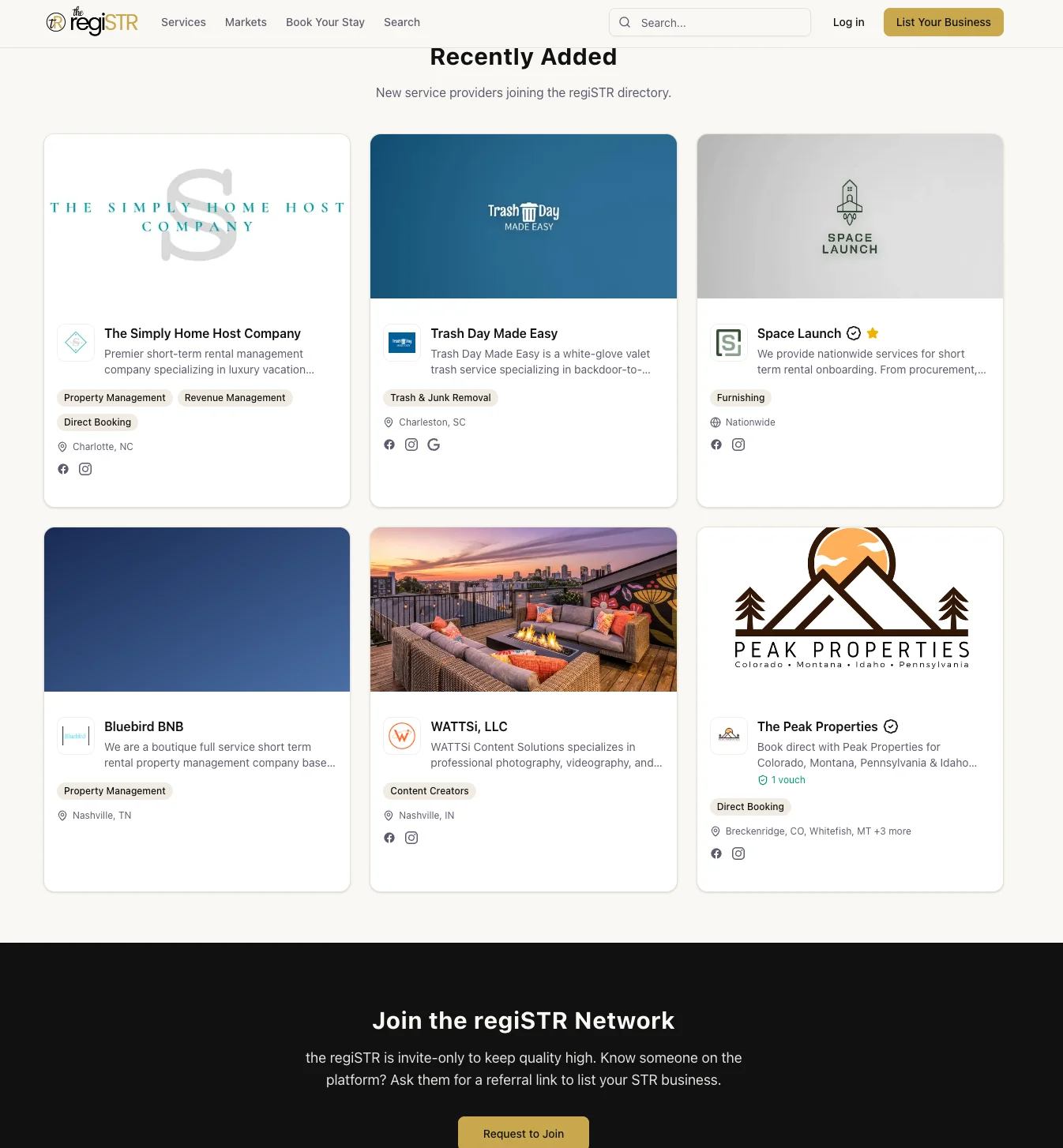
The regiSTR directory, shown above, organizes STR service providers by category so remote operators can filter to exactly the market and service type they need, without scrolling through irrelevant general contractors. Providers like Bluebird Bnb, The Peak Properties, and Maverick Str represent the type of STR-specialized operators whose profiles are visible directly in the directory alongside their market coverage and service focus.
Ready to Build Your Remote STR Vendor Network?
Running a short-term rental profitably from a distance comes down to the quality of the team you assemble before your first guest arrives. The vendors are out there in every active market. The framework for finding them remotely, using STR-specific directories, video vetting, peer references, and written SLAs, is repeatable across every new market you enter. What has been missing is a reliable way to surface the right providers without spending weeks on cold outreach and Facebook group threads.
That is exactly the gap the regiSTR was built to close. Whether you are sourcing your first turnover cleaner in a market you have never stepped foot in or building out a full vendor stack for your third investment property, the directory gives you a starting point that has already been filtered for STR experience and peer-vouched by other operators.
Browse vetted STR vendors by market and service category at the regiSTR. Sign up free and filter to your market in under two minutes.
Content powered by inkSTR.co