6 Airbnb SEO Tips for Hosts That Actually Move Rankings
Airbnb's search algorithm rewards listings that keep guests booking, staying, and leaving good reviews, not listings that simply exist longer on the platform. The seven tactics below, tightening your title and description, fixing your photo set, managing pricing and availability, protecting your response metrics, and building a review velocity strategy, are the levers that actually move a listing's placement in Airbnb search results in 2026.
Key Takeaways
- Listings with high-quality, verified photos receive 17.51% more bookings than listings with poor or unverified photos, roughly 13 additional booked nights per year, according to Airbnb SEO research cited by industry analytics sources.
- Average Airbnb search-impression-to-booking conversion sits around 0.16% in early 2026, with best-in-class listings reaching as high as 0.30%.
- Industry benchmark sources put typical Airbnb listing-page booking conversion between 0.4% and 3%, with above 3% considered excellent.
- A median of roughly 1 booking per 47 first-page search impressions (about 2.1% impression-to-booking conversion) is a common industry reference point for gauging listing performance.
- Review freshness matters: a listing with 10 five-star reviews from the past two months can outperform one with 50 five-star reviews from two years ago.
- the regiSTR connects hosts with STR-specific SEO and content marketing providers who already understand these algorithm mechanics, instead of generalist marketers guessing at what Airbnb rewards.
Most hosts treat Airbnb SEO like a mystery box: change a photo, tweak a title, cross your fingers. It isn't. Airbnb's ranking system, like any marketplace search algorithm, weighs a specific set of performance signals: conversion rate, response time, cancellation rate, review recency, and how completely you've filled out your listing. Chase those signals directly and the placement follows.
We built the regiSTR because too many hosts were getting SEO advice from generic marketing blogs that had never actually managed a turnover calendar or watched a listing's search position move after a title change. What follows is drawn from what we track across STR-specialized marketing providers in our network: the seven changes that consistently correlate with better placement, plus the four questions hosts ask most often about gaming the system versus actually earning better rank in 2026.
1. Rewrite Your Title Around One High-Intent Search Phrase
Your Airbnb title is a ranking signal, not just a headline. It should lead with your strongest, most specific selling point, location proximity, a standout amenity, or a guest need, rather than generic adjectives like "cozy" or "beautiful."
An example structure that performs well: naming a neighborhood landmark plus a concrete amenity, similar to "Beachfront Studio, Walk to Pier, Free Parking" rather than "Charming Beach Getaway." Guests searching Airbnb type specific needs into filters and search bars, and the algorithm rewards titles that match those query patterns.
Industry guidance recommends keeping titles under roughly 50 characters so the full phrase displays on mobile search results without truncating. Longer titles get cut off exactly where your best keyword sits.
This is one area where a generalist copywriter without STR experience tends to underperform, because they write titles that sound appealing but don't map to how guests actually search. Providers listed under Browse All STR Services on the regiSTR who specialize in SEO and content marketing for short-term rentals build titles around actual search behavior data, not just brand voice.
2. Fill Every Listing Field, Not Just the Ones Guests See First
Airbnb's search algorithm treats listing completeness as a ranking input. Empty amenity checkboxes, a thin house rules section, or a description that stops at two sentences all signal an unfinished or low-effort listing, and the platform deprioritizes those in search.
Neil Patel's guidance on Airbnb optimization recommends listing at least 8 to 9 amenities explicitly, including accessibility features and proximity to local landmarks, rather than relying on guests to infer them from photos.
BNBCalc's research recommends keeping your summary field under 500 characters while still front-loading your primary keyword phrase in the first 250 characters of the description, since that's the portion visible before a guest taps "read more."
Go through your listing section by section: amenities, house rules, neighborhood description, and check-in instructions. Each gap is a missed opportunity for both search matching and guest trust.
3. Fix Your Photo Set Before Anything Else
Photo quality is one of the most measurable Airbnb SEO factors available. Listings with high-quality, verified photos receive 17.51% more bookings than listings with poor or unverified photos, equivalent to roughly 13 additional booked days per year, according to Airbnb SEO industry research.
Industry guidance recommends at least 20 high-resolution photos per listing, including lifestyle shots of amenities like a coffee station or dedicated workspace, not just wide shots of empty rooms. The Airbnb Community itself recommends captioning every photo with a specific guest activity, for example "enjoy toasting marshmallows around the firepit," rather than a bare description like "backyard."
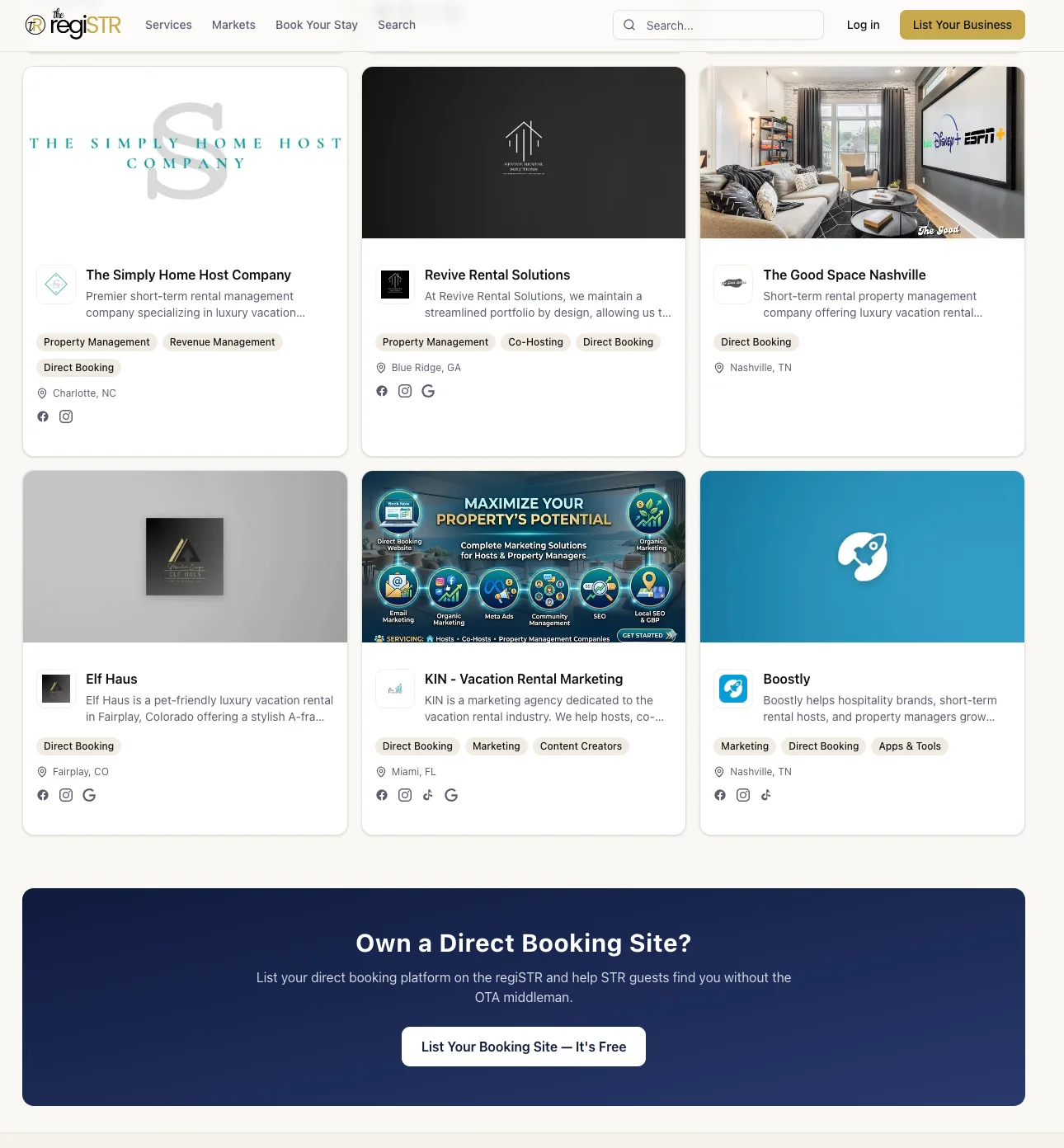
This is exactly the gap we see most often among first-time hosts: they hire a friend with a good camera or shoot on a phone in portrait mode, and the listing underperforms for months without the host understanding why. Hosts can browse Find STR Photographers on the regiSTR to connect with photographers who've specifically shot for Airbnb and Vrbo listing performance, not generic real estate or event photography.
What Is the 80/20 Rule in Airbnb?
The 80/20 rule in Airbnb, as most operators use the term, refers to the idea that roughly 80% of a listing's bookings and revenue come from about 20% of its performance drivers, typically pricing accuracy, photo quality, and review recency. It's a general prioritization heuristic, not an official Airbnb ranking formula.
In practice, this means a host with limited time or budget should focus first on the handful of levers with outsized impact: fixing photos, tightening the title, and correcting pricing errors, rather than spreading effort thin across every minor listing field.
We've watched hosts spend hours rewriting house rules while their calendar sits blocked for dates that should be open, or their price is set 30% above the comp set with no seasonal adjustment. Those pricing and availability errors erase far more revenue than an imperfect house rules paragraph ever will.
If you're not sure which 20% matters most for your specific listing, that's a diagnostic a revenue management or STR consulting provider can run in an afternoon. Browsing providers by category on Browse All STR Services is faster than guessing at priorities on your own.
What Is the 75-55 Rule in Airbnb?
There is no officially documented "75-55 rule" published by Airbnb, and we don't treat it as an established industry standard. Some hosts use informal shorthand numbers like this to describe response-rate or occupancy targets, but the specific figures circulating online vary depending on who's citing them and aren't consistently sourced.
What Airbnb does publicly weight, and what's verifiable, are response time, response rate, cancellation rate, and Instant Book adoption as ranking-relevant performance metrics. Rather than chasing an unverified named rule, track the metrics Airbnb actually surfaces in your Host dashboard: response rate, average response time, and cancellation history.
If a specific benchmark number matters for your market or property type, a revenue manager who works exclusively with short-term rentals can tell you what's realistic for your comp set in 2026, rather than applying a generic rule that may not fit a beachfront condo the same way it fits a mountain cabin.
4. Set Pricing and Availability So the Algorithm Sees a Live, Responsive Calendar
Airbnb's search algorithm favors listings with accurate, actively managed calendars over listings with stale pricing or long blocks of unexplained unavailability. A calendar that hasn't been touched in months signals a disengaged host, and disengaged hosts get deprioritized.
Industry pricing guidance recommends discounting last-minute dates within a 7-day window by roughly 15 to 25% below your standard rate, since empty near-term nights hurt both revenue and your occupancy-based ranking signals. It also recommends keeping cleaning fees below roughly $75 where market conditions allow, because an inflated total price relative to your nightly rate can make your listing look less competitive in search filtering.
Block unavailable dates immediately rather than leaving them open and declining requests, and set your minimum and maximum night counts so guests can't even submit a request you'd reject. Every declined request or unresponsive block on your calendar works against your response and acceptance metrics.
Dynamic pricing and revenue management is one of the service categories most STR portfolio operators outsource once they own more than one property, since manually adjusting rates across a multi-property calendar every week isn't sustainable. That's a category listed directly on the regiSTR.
What Are Red Flags for Airbnb Hosts?
Red flags for Airbnb hosts fall into two categories: signals that hurt your own listing's search ranking, and warning signs when you're evaluating a service provider or property manager. On the ranking side, a rising cancellation rate, slow response times, and a thin or outdated photo set are the three most damaging self-inflicted red flags.
On the vetting side, if you're hiring help to run your listing's marketing or operations, watch for providers who promise guaranteed ranking positions, since no legitimate provider controls Airbnb's algorithm outcomes. Also watch for anyone recommending keyword stuffing in your title or description, misleading amenity claims, or manipulating reviews through incentivized or fake feedback. All three violate Airbnb's platform policies and can get a listing suspended.
Frequent, unexplained price swings are another red flag guests notice and Airbnb's algorithm may interpret as inconsistent host behavior. Set a pricing strategy and stick to it, adjusting on a predictable cadence rather than daily overcorrections.
This is exactly the vetting standard we apply before any provider is listed on the regiSTR. If a marketing or SEO provider is promising outcomes that violate Airbnb's terms of service, that's a disqualifying red flag, not a selling point, when you're comparing providers on Browse All STR Services.
5. Protect Your Response Rate and Cancellation History
Response rate and cancellation rate are two of the clearest, most documented ranking inputs Airbnb uses, and they're entirely within a host's control. A slow or inconsistent response pattern signals to the algorithm that guests booking your listing may face poor communication after checkout, which Airbnb weighs heavily since guest experience drives repeat platform usage.
Cancellations are treated even more strictly. A pattern of host-initiated cancellations can suppress a listing's search visibility for weeks, independent of how strong your reviews or photos are. Guests who get canceled on rarely rebook, and Airbnb's algorithm is built to protect against that outcome repeating.
For hosts managing multiple properties or juggling a day job alongside hosting, this is often the metric that slips first. A co-host or property management provider can absorb same-day guest messaging and emergency response so your metrics stay intact even when you're unavailable.
Hosts looking to hand off this responsibility can compare co-hosting and full-service options through Find STR Property Managers, filtered by market so you're seeing providers who actually operate in your city.
6. Build Review Velocity, Not Just Review Volume
Review recency is a documented ranking factor separate from your overall review count. A listing with 10 five-star reviews from the last two months can outperform a listing with 50 five-star reviews collected over two years, because Airbnb's algorithm treats recent positive activity as a stronger current-relevance signal than historical volume.
This means a listing that goes quiet, few bookings, few reviews, for several months can lose search position even if its lifetime review average stays high. Consistent booking flow that generates a steady trickle of fresh five-star reviews matters more than a strong review count sitting untouched since 2023 or 2026.
The fastest way to protect review velocity is protecting the guest experience end to end: fast checkout-to-checkin turnovers, spotless cleaning, and accurate listing photos that match reality so guests aren't disappointed on arrival. A mismatch between photos and reality is one of the most common causes of a three-star review that stalls momentum.
Hosts who find their cleaning quality is inconsistent, and inconsistent cleaning is one of the top drivers of review score drops, can compare vetted turnover services through Find STR Cleaners, filtered by city rather than relying on general residential cleaning listings.
What Are the Top Tips for Airbnb Hosts?
The top tips for Airbnb hosts working on search visibility in 2026 combine platform-native optimization with off-platform strategy. On-platform, prioritize response time, cancellation avoidance, photo quality, and a keyword-focused title before touching secondary listing fields.
Off-platform, many experienced multi-property operators are also investing in a direct booking website with proper SEO, structured data using LodgingBusiness and Offer schema types, and a page load speed under roughly 2.5 seconds. This reduces dependence on OTA commission fees over time, separate from Airbnb's internal search algorithm.
Third, monitor your listing's search placement using a private or incognito browser, since Airbnb personalizes search results based on a logged-in guest's history, location, and device. Comparing your position while logged in gives you a distorted, unreliable picture of where you actually rank for a new guest.
Fourth, treat every listing change as a test with a control period. Change one variable, title, cover photo, or price, and give it at least two to three weeks before drawing conclusions, since Airbnb's algorithm needs booking activity to recalculate placement.
How Do You Test SEO Changes Without Guessing?
Testing Airbnb SEO changes properly means isolating one variable at a time and measuring against a defined baseline, rather than changing five listing fields at once and assuming whichever change gets credit for a booking uptick.
A basic testing framework looks like this:
- Record your current search impressions, click-through rate, and booking conversion for a two-week baseline period, checked in an incognito browser to avoid personalization skew.
- Change one element only, for example your cover photo or title, and leave every other listing field untouched.
- Wait a minimum of two to three weeks before evaluating results, since Airbnb needs sufficient booking activity to recalibrate your search position.
- Compare impressions-to-click and click-to-booking conversion separately, since a title change primarily affects clicks while a pricing change primarily affects conversion.
- Document the result before testing the next variable, building a record of what actually moved your listing rather than relying on memory or assumption.
Most hosts skip this discipline entirely and end up with a listing that's been "optimized" a dozen times with no clear record of what worked. This structured approach is closer to how a dedicated SEO and content marketing provider would treat a client account, and it's the same framework we recommend to providers listed on the regiSTR who manage multiple host portfolios.
Where Airbnb SEO Ends and Direct Booking SEO Begins
Airbnb's internal search algorithm is entirely separate from Google's search algorithm, and hosts often conflate the two when reading generic SEO advice. Optimizing your Airbnb listing title and photos has zero effect on whether your direct booking website ranks on Google, and vice versa.
If you're building a direct booking presence to reduce OTA dependency, that's a Google SEO project: local landing pages, page speed under 2.5 seconds, structured data markup, and content marketing built around your specific market and property type. This is a genuinely different skill set than Airbnb listing optimization, and it requires ongoing content work rather than a one-time listing edit.
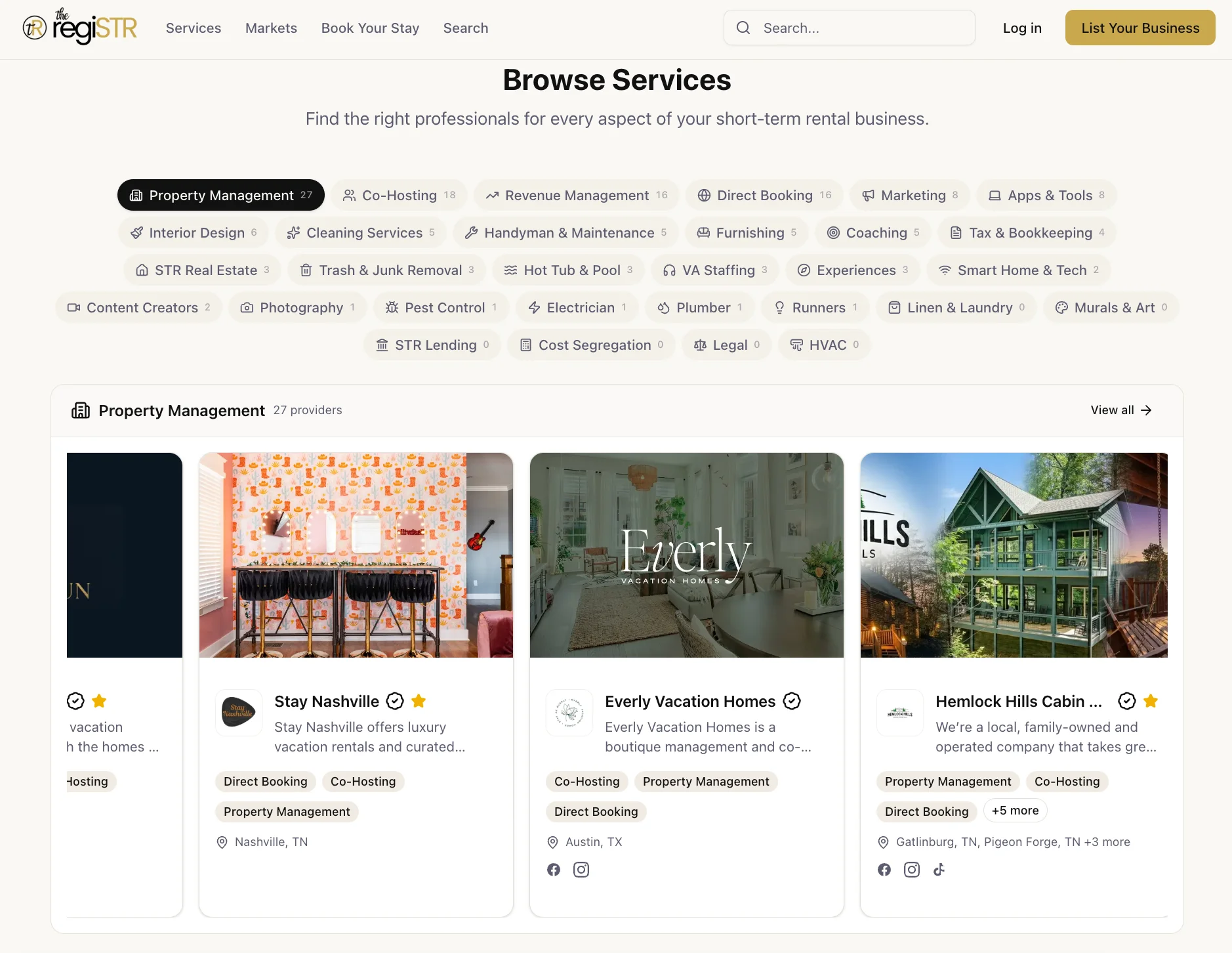
This is one of the service categories we see hosts underinvest in the longest, mostly because it feels less urgent than a slow week of Airbnb bookings. But every dollar earned through a direct booking avoids the OTA commission entirely. Providers offering website design, SEO, and content marketing specifically for STR operators are listed nationwide on the regiSTR, since this work is delivered remotely regardless of where your property sits.
Data Snapshot: Airbnb Search Performance Benchmarks in 2026
| Metric | Typical / Average | Strong Performance |
|---|---|---|
| Search impression to booking conversion | Around 0.16% | Up to 0.30% |
| Listing page booking conversion | 0.5% to 1.5% | 1.5% to 3%, above 3% is excellent |
| Search to listing click-through rate | 20% to 40% | Higher end of range |
| Listing to booking conversion | 1% to 5% | Higher end of range |
| Impressions per booking (industry reference) | Roughly 1 per 47 impressions | Fewer impressions needed per booking |
| Photo quality impact on bookings | Baseline | 17.51% more bookings with verified high-quality photos |
These benchmarks come from Airbnb's own performance documentation and industry analytics sources, not internal Airbnb algorithm disclosures, since Airbnb doesn't publish its exact ranking formula. Use them as directional targets rather than guaranteed outcomes for your specific market.
Common Mistakes Hosts Make Chasing Airbnb SEO
The most common mistake is changing multiple listing elements simultaneously and attributing any resulting booking change to the wrong variable. This makes it impossible to build a reliable playbook for your specific property over time.
A second common mistake is copying a title or description structure from a listing in a completely different market or property type, assuming what worked for a downtown studio will work for a mountain cabin. Guest search intent differs by property type and destination, and your keywords should reflect what your specific guest is actually searching for.
A third mistake is neglecting pricing while focused entirely on copy and photos. A beautifully written listing priced 25% above comparable inventory in your market still won't convert, because pricing is the single factor guests filter on hardest before they even click into a listing.
A fourth mistake, and one we flag constantly, is outsourcing SEO to a generalist digital marketing agency with no STR experience. They'll optimize for generic search principles without understanding Airbnb's specific weighting of response time, cancellation rate, and review recency, none of which apply to a typical e-commerce or local business SEO engagement.
Frequently Asked Questions
What is an Airbnb virtual assistant?
An Airbnb virtual assistant is a remote worker who handles administrative and guest-facing tasks for a host, such as responding to inquiries, managing bookings, coordinating cleaners, and updating pricing calendars. They're distinct from a full co-host in that they typically don't hold platform-level account permissions or make strategic pricing decisions on their own.
How do I improve my Airbnb ranking?
Improving Airbnb ranking starts with the metrics Airbnb documents as performance signals: response time, cancellation rate, review recency, and booking conversion. Prioritize fixing your photo set and title first since those drive click-through rate, then protect response and cancellation metrics, since those affect whether Airbnb continues surfacing your listing to new searchers.
What is an Airbnb hosting assistant?
An Airbnb hosting assistant is functionally similar to a virtual assistant or co-host, a person or service that manages day-to-day guest communication, booking questions, and calendar updates on behalf of the property owner. The exact scope of responsibilities varies by provider, so clarify upfront whether they handle pricing decisions, maintenance coordination, or only guest messaging.
What are the best tools for new vacation rental hosts to streamline operations?
New hosts typically need a channel manager to sync calendars across Airbnb and Vrbo, a dynamic pricing tool to adjust rates by season and demand, and a reliable vetted vendor network for cleaning, maintenance, and photography. Rather than researching each category separately, browsing Browse All STR Services lets a new host see vetted options across every category in one place, organized by market.
Does changing my Airbnb title too often hurt my ranking?
Frequent, unnecessary title changes can create inconsistency in how Airbnb's search index matches your listing to guest queries, and they make it harder for you to isolate what change actually affected performance. Test one title change, give it two to three weeks, then decide whether to keep it before testing again.
Is Instant Book required for good Airbnb SEO?
Instant Book isn't strictly required, but Airbnb has historically favored Instant Book listings in search placement because they reduce guest friction and typically convert faster. If you're comfortable with the guest screening tradeoffs, enabling Instant Book is one of the lower-effort changes with a documented placement benefit.
How often should I update my Airbnb pricing to stay competitive?
Pricing should be reviewed at least weekly, with automatic adjustments for last-minute dates within a 7-day window discounted roughly 15 to 25% below standard rate to avoid empty near-term nights. Static, unchanged pricing across seasons is one of the most common reasons a well-photographed listing still underperforms in bookings.
Conclusion
Airbnb SEO for hosts in 2026 isn't about outsmarting a black-box algorithm. It's about controlling the handful of documented, measurable signals, photo quality, response time, cancellation rate, review recency, and pricing accuracy, that Airbnb's search system was built to weigh. Fix your title and photos first, protect your operational metrics second, and treat every change as a test with a real control period.
Most hosts don't have the bandwidth to run that testing discipline alone while also managing turnovers and guest messages. That's the exact gap STR-specialized SEO, content marketing, and revenue management providers fill, and it's why we built the regiSTR as a directory where every provider actually understands Airbnb's ranking mechanics instead of applying generic marketing playbooks.
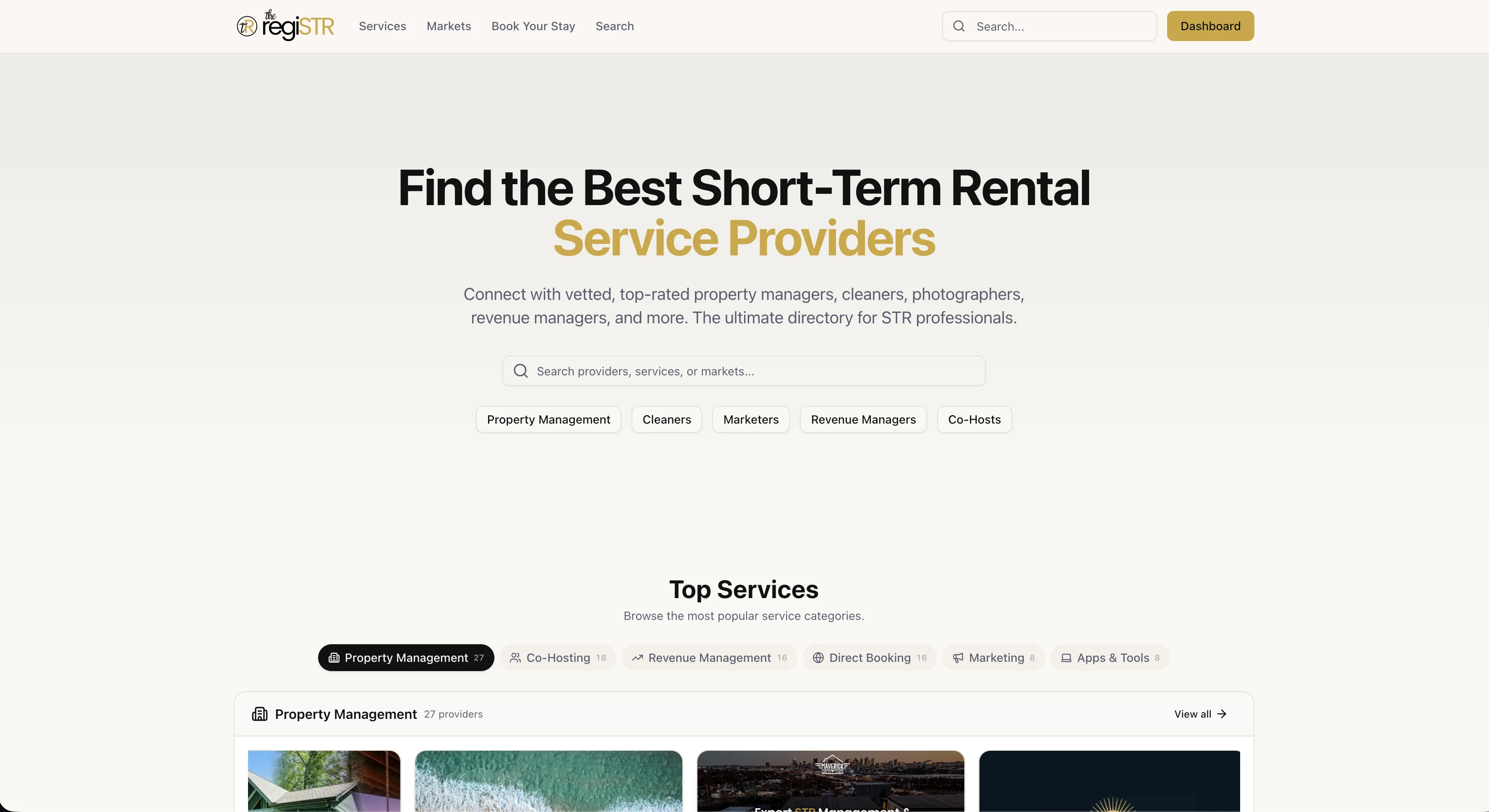
If your listing's photos, title, or pricing strategy haven't been touched in months, that's the fastest place to start. Get started with the regiSTR and browse vetted SEO, content marketing, and revenue management providers by market at theregistr.co.
Content powered by inkSTR.co