What Is STR in Real Estate? A Host's Guide to 2026

STR in real estate stands for short-term rental: a fully furnished residential property, such as a house, condo, apartment, cabin, or single room, rented to a guest for a stay shorter than 30 consecutive days, typically booked through platforms like Airbnb, Vrbo, or Booking.com.
Key Takeaways
- STR stands for short-term rental, defined by most jurisdictions as a furnished residential stay of fewer than 30 consecutive nights, though some cities use 28-day or 90-day thresholds instead.
- The IRS applies a separate 7-day average stay rule, under Treas. Reg. Sec. 1.469-1T(e)(3)(ii)(A), for the tax treatment often called the short-term rental loophole.
- The global short-term rental market was valued at $119.1 billion in 2026 and is projected to reach $279.4 billion by 2034, growing at an 11.2% CAGR from 2026 to 2034, according to a Global Short Term Rental Market Research Report.
- STRs differ from traditional 6-to-12-month leases in pricing model, tax treatment (transient occupancy tax versus standard landlord-tenant rules), and permitting requirements.
- Professionally managed STRs typically pay 15-25% of gross revenue for full-service property management and run 70-85% occupancy in strong tourist markets, according to industry benchmark data.
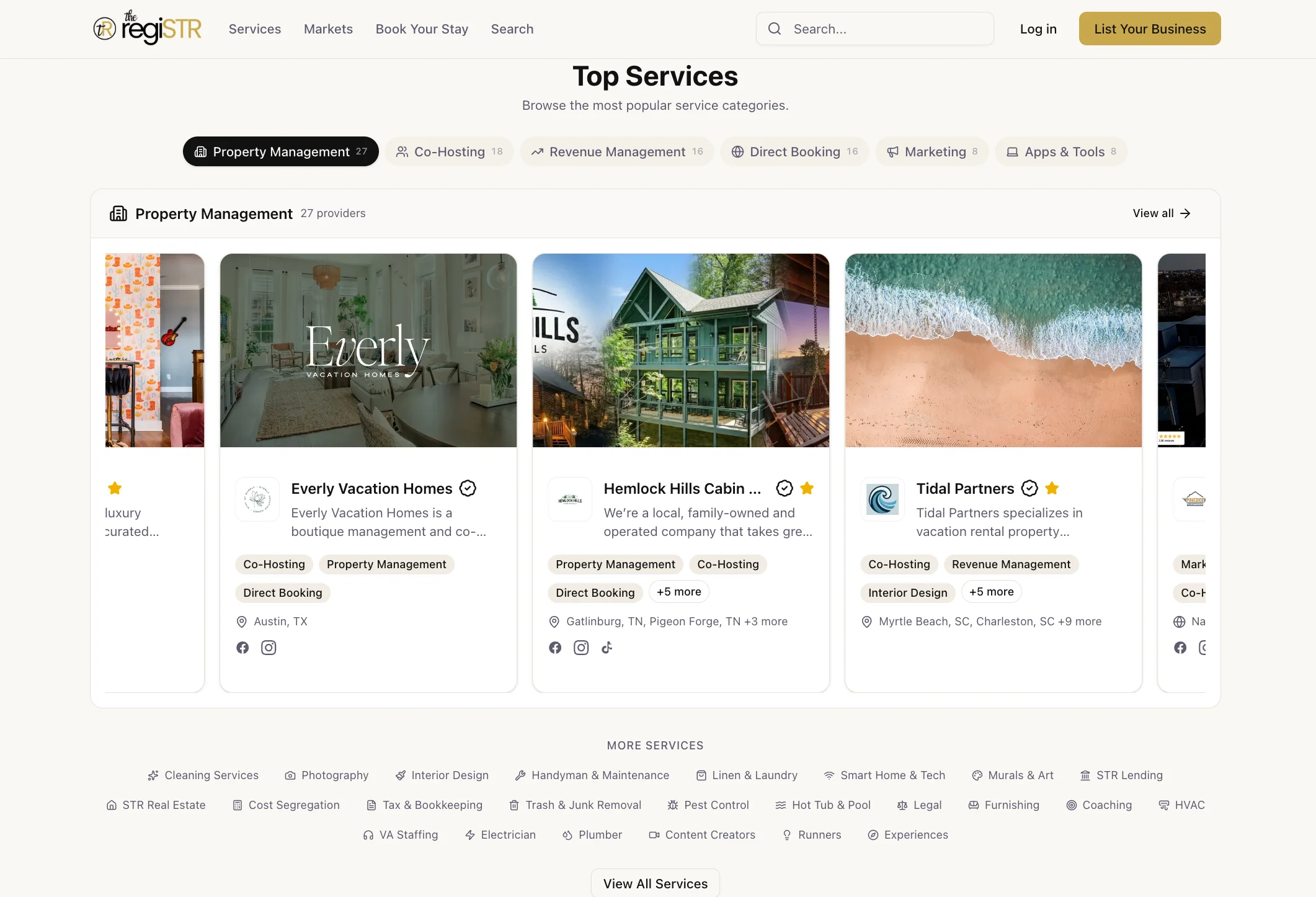
- Finding vetted STR-specific vendors, cleaners, managers, photographers, and compliance consultants across your exact market is exactly what the the regiSTR directory was built to solve.
If you've bought a condo, converted a spare bedroom, or picked up your first vacation cabin, you've probably seen "STR" show up in zoning documents, lender paperwork, or investment forums and wondered exactly where the line sits between this and a regular rental. It matters more than it sounds. Get the definition wrong and you can misjudge your tax exposure, apply for the wrong permit, or underwrite a deal using assumptions that don't match how your city actually regulates these properties.
We built this guide because at the regiSTR, we've indexed vendors and worked with operators across dozens of active short-term rental markets, and the confusion around what actually qualifies as an STR is one of the most common questions we hear from first-time hosts and out-of-state investors alike. This isn't a semantic debate. Duration thresholds determine your tax form, your local licensing burden, and whether your HOA even allows the arrangement.
What follows covers the core definition, how STR differs from a long-term lease, the duration thresholds that trip people up, the tax rules including the so-called STR loophole, and what actually goes into deciding if an STR is a sound investment for you in 2026.
What Is STR in Real Estate, Exactly?
STR in real estate refers to a furnished residential property rented to a guest for a short, defined stay rather than under a traditional lease. Most jurisdictions set the cutoff at fewer than 30 consecutive days, though the exact number shifts depending on where the property sits.
Unlike a hotel room, an STR is residential housing stock: a single-family home, condo unit, apartment, cabin, or even a room inside someone's primary residence, a setup often called house hacking. What separates it operationally from a long-term rental is the business model behind it. You're not signing a 12-month lease and collecting monthly rent. You're running something closer to a small hospitality operation, with dynamic nightly pricing, guest turnover between stays, and a cleaning cadence that has nothing in common with a residential landlord's schedule.
Notably, STRs must be residential property. A property zoned or operated as commercial hotel stock doesn't fall under the STR definition, even if the stays are short. That distinction matters for zoning boards and for lenders evaluating financing.
Booking generally happens through Airbnb, Vrbo, or Booking.com, though a growing share of operators are building direct booking channels to reduce platform fee dependency. As of 2026, that shift toward direct bookings is one of the more consistent trends we track across the providers listed in our directory.
How Does an STR Differ From a Long-Term Rental?
The core difference between an STR and a long-term rental is duration and business structure: STRs rent by the night or week to transient guests, while long-term rentals lock in a tenant under a lease running 6 to 12 months or longer. That single distinction cascades into nearly every other operational and legal difference.
A long-term lease follows standard landlord-tenant law: security deposits, notice periods for termination, habitability standards enforced through housing court. An STR generally sits outside that framework and instead falls under hospitality-style regulation: transient occupancy tax, business licensing, and often a dedicated STR permit separate from a general rental license.
Pricing works differently too. A long-term rental has one fixed monthly rent. An STR's nightly rate moves with demand, day of week, local events, and season, which is why dynamic pricing tools have become close to a standard expectation for competitive operators rather than a nice-to-have.
| Factor | Short-Term Rental (STR) | Long-Term Rental |
|---|---|---|
| Typical stay length | 1 to 29 nights | 6 to 12+ months |
| Pricing model | Dynamic, per night or week | Fixed monthly rent |
| Governing framework | Transient occupancy tax, STR permits | Landlord-tenant law, lease agreements |
| Turnover frequency | Frequent, often multiple per week | Rare, typically annual |
| Guest profile | Tourists, business travelers, temporary housing | Long-term residents |
Turnover cadence is the operational detail most new hosts underestimate. A long-term rental owner might coordinate a cleaner once a year between tenants. An STR host is coordinating cleaning, restocking, and inspection between nearly every guest, sometimes with a checkout-to-checkin window under three hours. That's a different labor model, and it's why vetted STR cleaning services matter so much more here than they do for a standard landlord.
What Duration Threshold Actually Defines an STR?
There is no single national duration threshold that defines an STR. Most guides and municipalities use fewer than 30 consecutive days as the general rule, but the specific cutoff varies significantly by jurisdiction and by which agency is applying it.
Some cities set the line at 28 days. Others cap it at 14 days for zoning purposes. A number of local governments extend the definition out to 90 days, particularly in markets trying to draw a line between vacation rentals and mid-term corporate housing. Meanwhile, the IRS uses a completely separate standard for tax purposes: an average customer stay of 7 days or fewer (or 30 days or fewer with significant services provided) is the threshold that determines whether rental income gets treated differently for tax purposes.
This layering is exactly what the biggest content gap in most STR explainers misses: hosts need to understand that municipal duration thresholds and IRS duration thresholds are two entirely different rulesets that happen to use similar-sounding numbers.
| Threshold Type | Typical Range | Governs |
|---|---|---|
| Municipal zoning/licensing | 14, 28, 30, or 90 days | Whether a permit or STR license is required |
| IRS tax classification | Average 7 days or fewer | Material participation and passive-loss rules |
| HOA/condo bylaws | Often 30 or 90 days minimum | Whether short-term leasing is allowed at all |
Notably, some HOAs set their own minimum stay rules independent of city code, and those bylaws can be stricter than local law. Before you buy a condo intending to run an STR, check the HOA covenants first. City approval doesn't override an HOA restriction, and this is one of the most common reasons we see hosts get blindsided after closing.
What Is the STR Tax Loophole?
The short-term rental tax loophole refers to an IRS provision that lets STR income and losses be treated as non-passive when a property has an average guest stay of 7 days or fewer and the owner materially participates in operating it. That reclassification allows STR losses, including depreciation, to offset other active income like a W-2 salary, something standard passive rental losses generally cannot do.
The rule lives in Treas. Reg. Sec. 1.469-1T(e)(3)(ii)(A). It's not a workaround or a gray area; it's a documented regulatory provision that real estate investors have used for years, and it's become more visible since cost segregation and bonus depreciation strategies gained mainstream attention among STR investors.
Two conditions have to hold at the same time. First, the average length of stay across the year must be 7 days or fewer (there's also a secondary path involving 30 days or fewer if you provide significant personal services, similar to a hotel). Second, you must materially participate in the operation, generally meaning you're spending substantial time on the business yourself rather than fully outsourcing it to a hands-off property manager. That second condition is where a lot of investors trip up. If you hire a full-service property manager and hand off nearly everything, you may not meet the material participation bar even if your average stay length qualifies. This is a tax strategy question that depends heavily on your specific financial picture, and we'd tell any operator considering it to run the numbers with a CPA who specializes in real estate before restructuring around it.
What we can say from working alongside operators in the network: hosts who use this strategy successfully tend to track their hours meticulously and lean on STR-specific bookkeeping and consulting support rather than winging it. If that's a gap in your operation, the regiSTR's directory includes STR consulting and advisory providers who specialize in exactly this kind of tax-aware structuring, separate from general business accountants.
Is STR Property a Good Investment?
STR property can be a strong investment when the market supports sufficient occupancy and the regulatory environment is stable, but it carries more operational complexity and cost than a buy-and-hold long-term rental. Whether it's "good" depends heavily on your specific market, property type, and appetite for active management.
The upside case is real. Almost 60% of respondents in Statista's survey data indicated that short-term rentals are advantageous because they provide an additional income source for hosts. Well-positioned STRs in strong tourist markets typically run 70-85% occupancy for professionally managed properties, and the nightly-rate model can outproduce a comparable long-term rental's fixed monthly income, particularly in high-demand seasons.
The downside case is just as real, and most investment content glosses over it. STR income is choppier than long-term rent, with seasonal dips that can leave a property cash-flow negative for months at a time. Management fees for full-service operators run 15-25% of gross revenue, on top of cleaning, maintenance, furnishing, and platform commissions. Net operating margins for professionally managed STR portfolios generally land in the 10-20% range after all of that, which is a meaningfully thinner margin than a lot of first-time investors expect walking in.
Regulatory risk is the wildcard. Some destinations cap the number of nights a unit can be rented on STR platforms annually, particularly in residential zones, specifically to manage housing pressure. If you buy a property assuming unlimited STR use and the city later tightens that cap, your underwriting can fall apart overnight. As of 2026, this kind of regulatory tightening has become more common rather than less, and it's one of the reasons a compliance-focused consultant is worth the fee before you close on a deal.
STR vs. Multifamily and Condo-HOA Considerations
Single-family STRs generally face the fewest structural obstacles but the highest exposure to city-level zoning changes. Condo units inside an HOA face a second layer of restriction: even where the city permits STRs, the HOA bylaws can prohibit or cap them independently. Multifamily conversions, where an investor converts one or more units in a small building to STR use, tend to draw the most local scrutiny because they shift housing stock away from residents, and several jurisdictions specifically restrict STR use in multifamily zoning as a result.
Before buying with STR intent, pull the HOA covenants, the current zoning code, and any pending ordinance changes. That single-day diligence step prevents most of the expensive surprises we hear about after the fact.
Is STR the Same as Airbnb?
STR is not the same as Airbnb. STR is the general real estate and regulatory category, while Airbnb is one specific booking platform used to market and book STR properties, alongside Vrbo and Booking.com. Every Airbnb listing is an STR, but not every STR is booked through Airbnb.
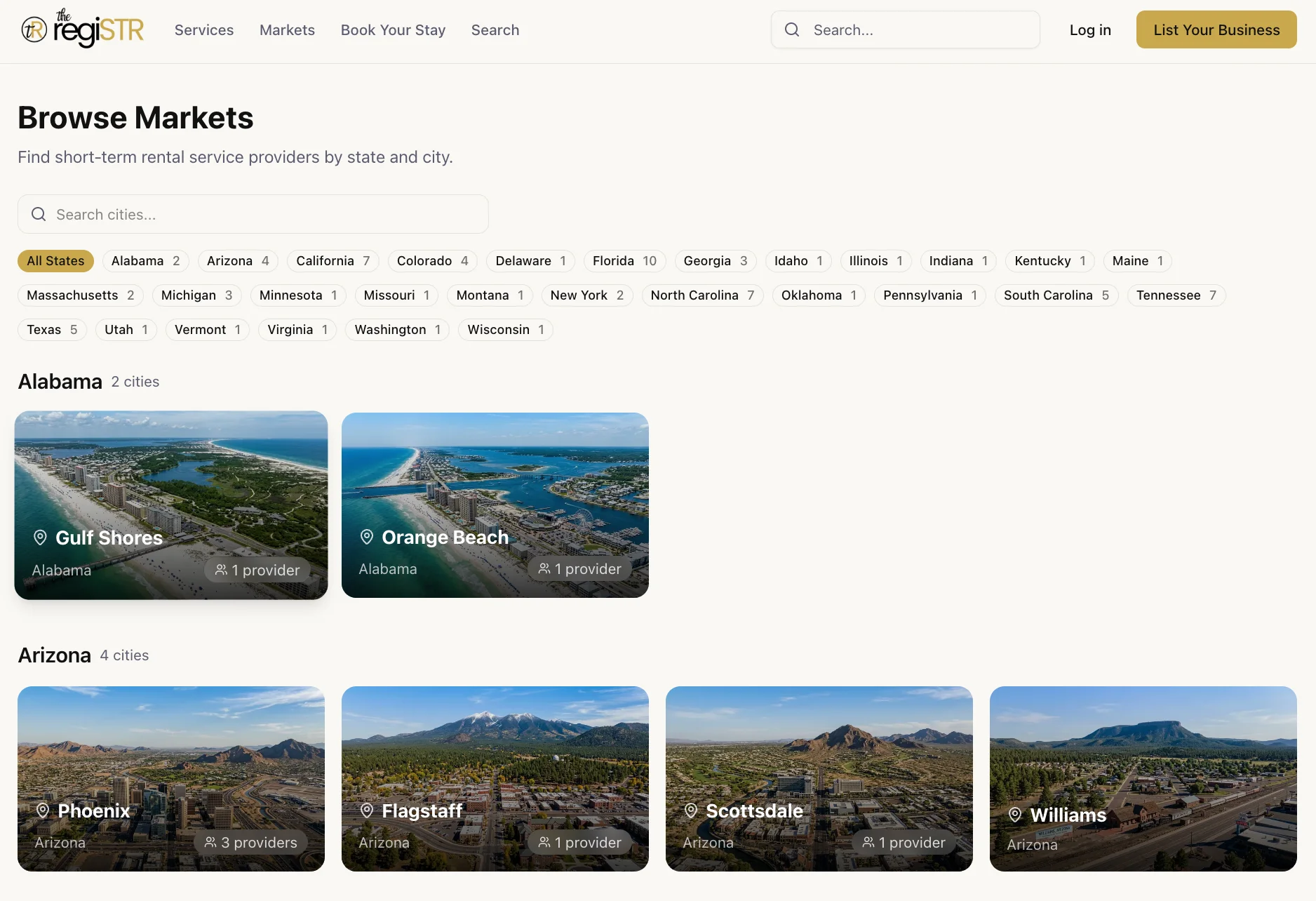
This distinction matters more than it seems, especially for compliance purposes. City ordinances, transient occupancy tax obligations, and HOA restrictions attach to the property and how it's used, not to which platform lists it. Delisting from Airbnb and moving to Vrbo, or building a direct booking website, doesn't change your STR classification or exempt you from local licensing. It also matters for revenue strategy. Operators who rely solely on one platform are exposed to that platform's fee structure and algorithm changes. A growing number of hosts we see across the network are diversifying across Airbnb, Vrbo, and direct booking channels simultaneously, treating each as one demand source rather than the whole business. If building that kind of direct booking infrastructure, a website, SEO, and a marketing engine that captures travelers before they land on a platform search, sounds like a gap in your current setup, that's exactly the kind of specialized digital service listed under the regiSTR's website design and marketing categories, built for STR operators specifically rather than general small businesses.
Are STRs a Good Investment in 2026?
STRs remain a viable investment category in 2026, supported by continued global growth in short-term rental demand, but the calculus has shifted toward markets with regulatory clarity and away from oversaturated urban zones facing tighter caps. The sector is growing, but growth is increasingly concentrated rather than universal.
The macro numbers back this up. The global short-term vacation rental market generated $149.2 billion in 2026 and is projected to reach $362.4 billion by 2033, growing at an 11.8% CAGR, according to Grand View Research's Short Term Vacation Rental Market Outlook. Asia Pacific led global STR revenue in 2026 at $45.9 billion, representing 38.5% of the total market, a signal that international demand is a growing share of the picture, not just domestic U.S. travel. But growth at the category level doesn't guarantee returns for every individual property. Statista also reports that short-term rental market booked listings on Airbnb and Vrbo have remained 25 to 30 percent below pre-pandemic levels in certain segments, which is a reminder that recovery has been uneven across markets and property types. And just over 50% of respondents in Statista's survey felt positively about short-term rentals' impact on residents' quality of life, a figure that shows public sentiment is roughly split, not overwhelmingly favorable, which helps explain why regulatory tightening keeps showing up market by market.
What actually determines whether an STR investment works in 2026 is less about the macro trend and more about three specific things: whether your city's regulatory posture is stable or actively tightening, whether you can staff reliable local vendors if you don't live near the property, and whether your management cost structure leaves room for margin after fees. Get those three right and the macro tailwinds help. Get them wrong and no amount of category growth saves a bad individual deal.
What Regulations and Compliance Requirements Apply to STRs?
STR regulatory compliance generally requires a local business license, often a separate STR-specific permit, and ongoing collection and remittance of transient occupancy tax, which functions like a hotel tax and typically ranges from around 5% to 15% of nightly revenue depending on the jurisdiction.
Requirements stack by layer. City or county governments handle permitting and licensing. State governments may layer on separate registration or reporting obligations. HOAs add another restriction level entirely independent of government rules. For example, New York's STR framework limits listings to no more than two guests under current rules from the NYC Office of Special Enforcement as of January 2026, a restriction that has meaningfully changed how hosts in that market structure their listings. Internationally, some European regions require STR hosts to register rental units with national or municipal tourism authorities and display an authorization number directly in the listing, a compliance step American hosts moving into international markets often overlook entirely.
Missing a permit or failing to remit occupancy tax isn't a minor paperwork issue. It can mean forced delisting, fines, or a revoked permit that takes months to reinstate. Because rules change by city and sometimes shift year to year, this is exactly the kind of moving target that benefits from a dedicated compliance consultant rather than a DIY reading of a municipal code page. The regiSTR's Regulatory and Compliance category connects operators with STR-focused consultants who track these ordinance changes by market, rather than a general business attorney who last touched STR law two years ago.
What Does It Actually Cost to Run an STR?
Running an STR typically costs 15-25% of gross revenue for full-service property management alone, before factoring in cleaning, maintenance, furnishing, insurance, and platform commissions. Many STR-specific software tools add another $10 to $50 per unit per month on top of that for pricing and channel management.
Break that down by category and the picture gets clearer. Cleaning and turnover happen far more often than in a long-term rental, since you're paying per turn rather than once a year. Maintenance responsiveness matters more too: a broken HVAC unit in a long-term rental is an inconvenience; the same failure during an active STR guest stay is a same-day emergency with a refund or relocation cost attached if it isn't fixed fast.
- Property management: 15-25% of gross revenue for full-service management
- Software and channel tools: roughly $10-$50 per unit per month
- Transient occupancy tax: approximately 5-15% of nightly revenue, jurisdiction dependent
- Cleaning and turnover: varies by market and turnover frequency, generally the largest recurring line item after management fees
- Net operating margin: typically 10-20% for professionally managed portfolios after all costs
Most first-time hosts underestimate cleaning and maintenance costs specifically because they're comparing against a long-term rental mental model where those costs happen once a year instead of multiple times a month. If you're building a budget for the first time, this is where quotes from multiple STR-specific vendors, not general handyman services, matter most. Comparing providers side by side by market and category is exactly what browsing vetted property managers on the regiSTR is designed to make simple.
How Do You Evaluate an STR Deal Before Buying?
Evaluating an STR deal properly means underwriting the property using STR-specific performance metrics, occupancy rate, average daily rate (ADR), and revenue per available rental (RevPAR), rather than the cap-rate math used for long-term rental underwriting. Skipping this step is the single most common mistake we see among new STR investors.
First, pull comparable occupancy and ADR data for your exact submarket and property type; a downtown condo and a mountain cabin ten miles apart can have wildly different seasonal demand curves. Second, run your projected RevPAR (occupancy multiplied by ADR) against your full cost stack, management fees, taxes, cleaning, and financing, to get a realistic net margin rather than a gross revenue number that looks impressive but ignores expenses. Third, stress-test the deal against a regulatory downside: what happens to your returns if the city caps annual rental nights or raises the occupancy tax rate. If the deal only works under the most favorable regulatory assumption, it's not a safe deal.
- Pull occupancy and ADR comps for the exact submarket and property type.
- Calculate projected RevPAR and subtract your full cost stack for a realistic net margin.
- Confirm HOA bylaws and current zoning allow STR use at your intended duration.
- Stress-test the deal against a regulatory tightening scenario.
- Line up local vendors, cleaning, maintenance, and management, before closing, not after.
That last step is the one people skip most often, and it's the one that causes the most first-90-day pain. Buying the property is the easy part. Building a reliable vendor bench in a market you may not live in is where most of the operational stress actually lives, which is precisely the gap the regiSTR exists to close.
Data & Evidence: STR Market Growth and Benchmarks
The data consistently shows an STR market that is growing globally while becoming more operationally professionalized. The global vacation rental management software market alone is projected to reach approximately $238.05 million in 2026 and grow to about $356.8 million by 2035, a signal that operators are increasingly running STRs with dedicated software rather than spreadsheets, according to StayFi's VRM Insider 2026 report.
| Metric | Figure | Source |
|---|---|---|
| Global STR market size, 2026 | $119.1 billion | Global Short Term Rental Market Research Report 2034 |
| Projected STR market size, 2034 | $279.4 billion (11.2% CAGR) | Global Short Term Rental Market Research Report 2034 |
| Asia Pacific STR revenue share, 2026 | $45.9 billion (38.5% of total) | Global Short Term Rental Market Research Report 2034 |
| Short-term vacation rental market, 2026 | $149.2 billion | Grand View Research |
| Typical full-service management fee | 15-25% of gross revenue | Industry benchmark data |
| Typical occupancy, strong markets | 70-85% | Industry benchmark data |
Notably, Asia Pacific's dominant regional share signals where future growth is concentrating, driven by rising middle-class travel demand and digital-nomad-friendly policy in several countries. For U.S.-based investors, the more immediately relevant trend is regulatory: as more cities formalize STR-specific licensing and occupancy caps, the operators who treat compliance as a first-class part of underwriting, not an afterthought, are the ones who protect margin through 2026 and beyond.
Frequently Asked Questions
What does STR stand for in real estate?
STR stands for short-term rental, referring to a furnished residential property rented to guests for a stay generally under 30 consecutive days. It covers single-family homes, condos, apartments, cabins, and rooms within a primary residence booked through platforms like Airbnb, Vrbo, or Booking.com.
How many days makes a rental "short-term"?
Most jurisdictions define short-term as fewer than 30 consecutive days, though some cities use a 28-day or 90-day threshold instead. The IRS applies a separate 7-day average stay rule for tax purposes, which is a different calculation than any municipal zoning or licensing threshold.
Is the STR tax loophole legal?
Yes, the short-term rental tax loophole is a documented IRS provision under Treas. Reg. Sec. 1.469-1T(e)(3)(ii)(A), not an aggressive gray-area workaround. It requires an average guest stay of 7 days or fewer and material participation in the property's operation, and it's worth reviewing with a real estate-focused CPA before restructuring your tax strategy around it.
Do I need a permit to run an STR?
In most U.S. cities, yes. Many municipalities require a general business license plus a separate STR-specific permit before you can legally list and operate the property, and you'll typically need to register for and collect transient occupancy tax as well. Requirements vary significantly by city and county, so always confirm current rules with your local planning or licensing office before listing.
Can an HOA block short-term rentals even if the city allows them?
Yes. HOA bylaws operate independently of city zoning and can prohibit or restrict short-term rentals even where local law permits them. Always review HOA covenants before purchasing a condo or planned-community property with STR intent, since city approval does not override HOA restrictions.
What's the difference between STR and Airbnb?
STR is the broader real estate category describing any short-term rental property, while Airbnb is just one platform used to book STRs, alongside Vrbo and Booking.com. Every Airbnb listing qualifies as an STR, but STR compliance and tax obligations attach to the property itself, not to whichever platform lists it.
How much does it cost to hire a property manager for an STR?
Full-service STR property management typically runs 15-25% of gross revenue, which usually covers guest communication, pricing, and vendor coordination but often excludes cleaning fees charged separately. Costs vary by market and service tier, so comparing multiple providers side by side is the most reliable way to gauge fair pricing for your specific property.
Are short-term rentals still a good investment in 2026?
STRs can still perform well in 2026, supported by continued global market growth projected at an 11.2% to 11.8% CAGR depending on the market segment. But returns increasingly depend on choosing markets with regulatory stability and building a dependable local vendor network rather than relying on broad category growth alone.
Conclusion: The Real Answer to What STR Means for Your Property
STR in real estate means a furnished residential property rented for a short, defined stay, typically under 30 days, governed by a patchwork of municipal thresholds, HOA rules, and IRS tax provisions that don't always line up neatly with each other. Getting the definition right protects you from permit surprises, tax missteps, and deals that only work on paper.
The category is growing globally, projected to reach $279.4 billion by 2034 according to industry research, but individual property performance still comes down to three things: regulatory stability in your specific market, a management cost structure that leaves real margin, and a vendor network you can actually trust. That third piece is where most first-time and out-of-state operators lose the most time and money, and it's the exact problem we built the regiSTR to solve.
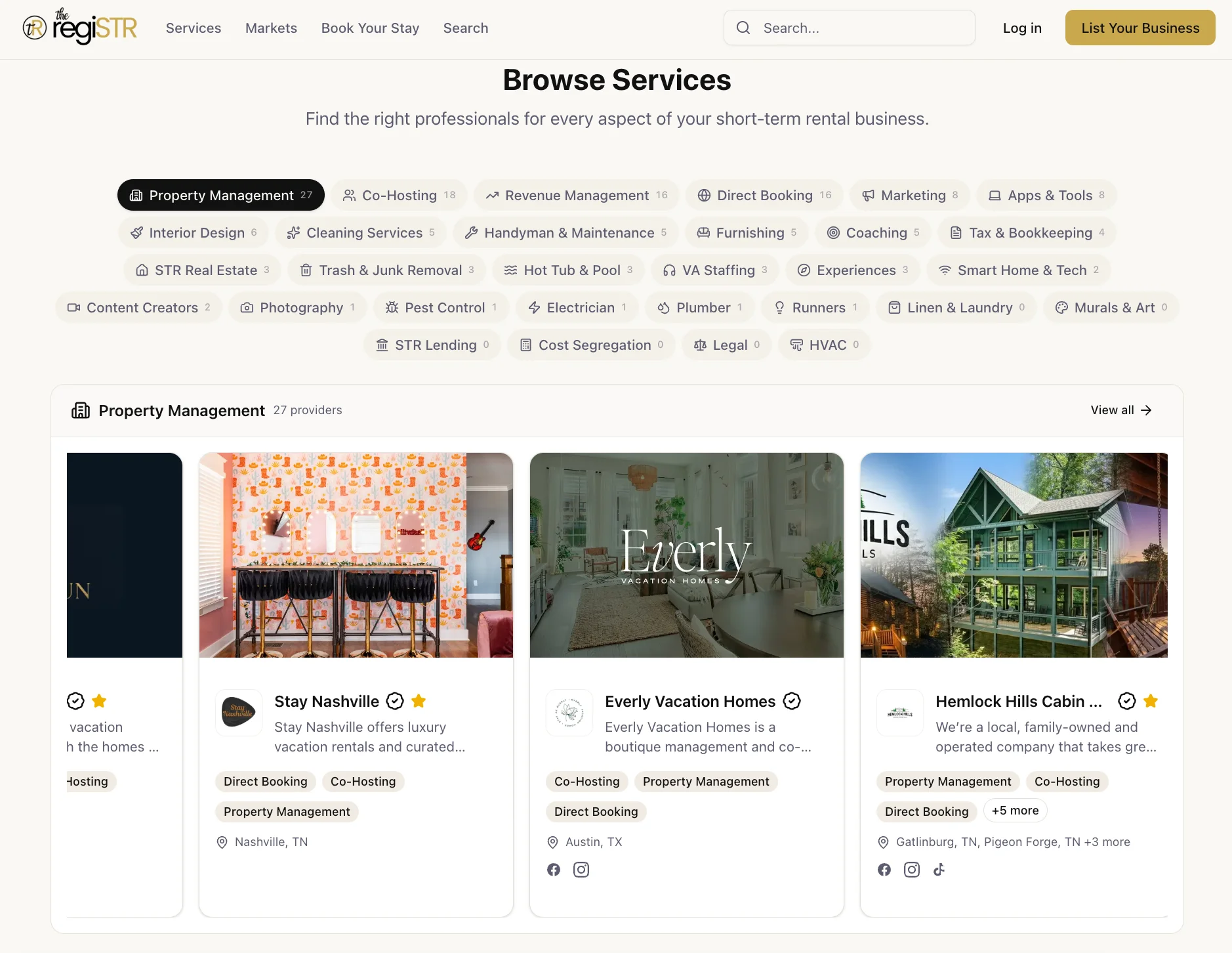
Whether you're closing on your first STR condo or trying to figure out which local cleaner and manager can actually handle same-day turnovers, get started with the regiSTR to browse vetted property managers, cleaners, and compliance consultants by market before you ever need to make a cold call. Sign up free and search by city and service category at theregistr.co.
Content powered by inkSTR.co