
STR San Antonio: 2026 Permit Rules and Vendor Guide
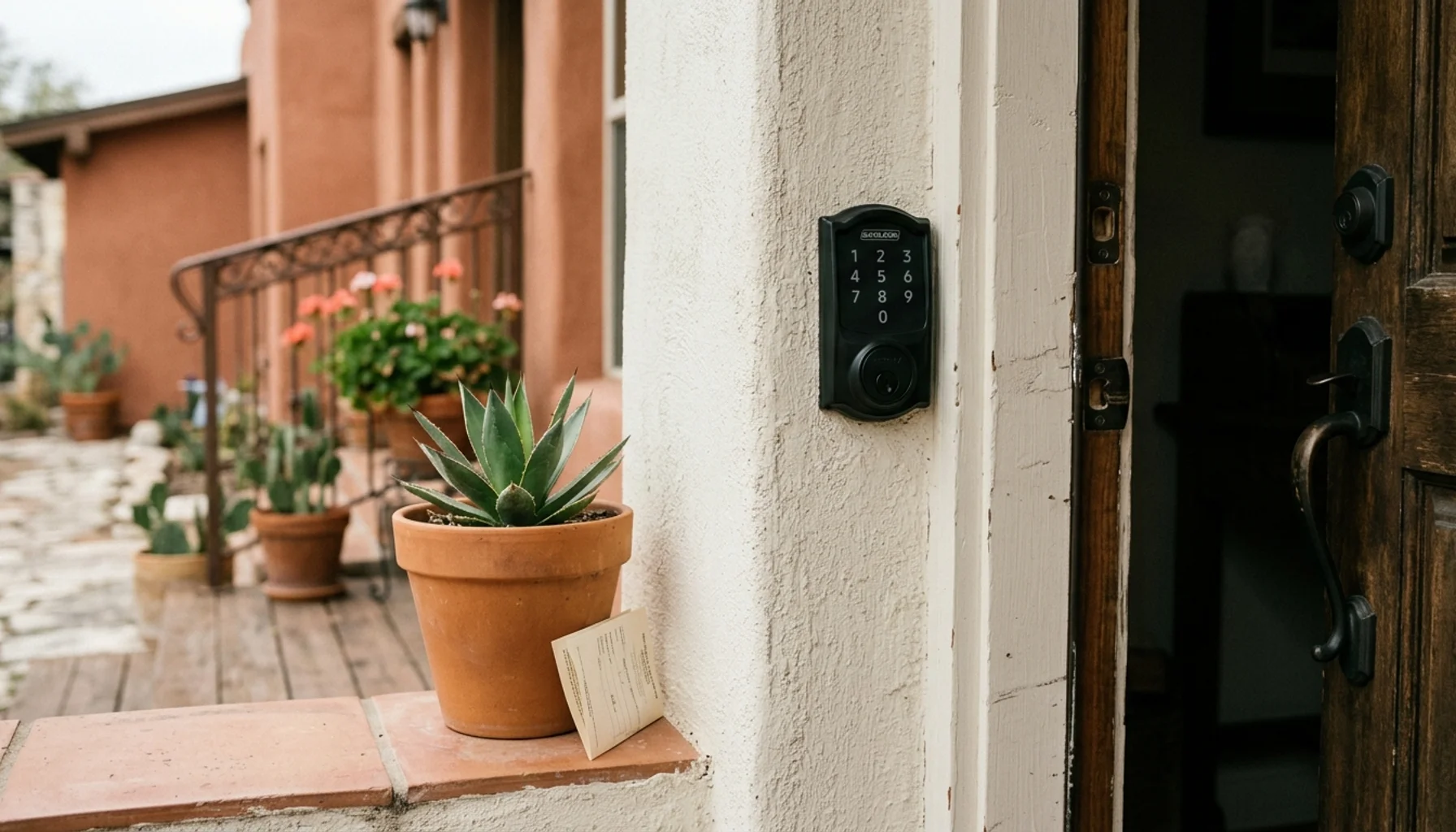
Yes, STR San Antonio operators need a city permit to legally operate. San Antonio requires either a Type 1 (owner-occupied) or Type 2 (non-owner-occupied) short-term rental permit under an ordinance passed in June 2026, and operating without one risks fines starting at $200 per day.
Key Takeaways
- San Antonio's STR ordinance (Ordinance 2024-06-13-0433) requires a Type 1 or Type 2 permit for any rental under 30 consecutive days, with the permit application fee set at $300 for Type 1 and $450 for Type 2 as of July 2026.
- Type 2 (non-owner-occupied) permits are capped at 12.5% of single-family, duplex, triplex, or quadraplex units per block face, meaning some San Antonio neighborhoods are already at capacity.
- Combined hotel occupancy tax in San Antonio totals 16.75%, layered across city, convention center, county, and state taxes, and every registered host must file a monthly report even with zero income.
- As of the FY2025 STR Annual Report, San Antonio had 3,339 active STR permits citywide, and 63% of active listings currently show registration or compliance evidence.
- San Antonio's average Airbnb listing earns $22,026 annually with a 38.5% occupancy rate and $206 average daily rate, but the gap between top-performing and bottom-tier properties is substantial.
- Once you're permitted and compliant, the regiSTR connects you with vetted local cleaners, property managers, and maintenance crews who already understand San Antonio's turnover timelines and regulatory landscape.
Running a short-term rental in San Antonio in 2026 means operating under one of the stricter regulatory frameworks in Texas. The city moved from a largely unregulated market to a permit-and-density system in 2026, and that shift changed how hosts plan everything from acquisition to vendor sourcing.
If you're a first-time host trying to figure out whether your property qualifies for a permit, or an out-of-state investor trying to understand San Antonio's rules before you close on a property, this guide covers the permit types, density math, tax obligations, and enforcement mechanics you actually need. We've also built this around the operational gaps most STR permit guides skip: neighborhood-level density realities, what happens once you cross into unincorporated Bexar County, and how to actually staff a compliant property once your permit clears.
At the regiSTR, we work with hosts across dozens of markets, and San Antonio is one where regulatory literacy matters as much as pricing strategy. Get the permit wrong and the best cleaner or photographer in the city won't save your listing from a shutdown notice.
Is STR Required in Texas?
Short-term rental permitting in Texas is set at the city or county level, not statewide, so whether you need a permit depends entirely on your property's jurisdiction. San Antonio itself enforces mandatory permitting through its 2026 ordinance, but Texas has no single state STR license requirement covering all municipalities.
This is a common point of confusion for hosts moving from other states. Texas doesn't operate a centralized STR registry the way some states do. Instead, cities set their own rules: Austin, Houston, and Dallas each run different permitting frameworks, and unincorporated areas of a county often have no permitting requirement at all, though they may still fall under other zoning restrictions.
For San Antonio specifically, the requirement is unambiguous. Every property rented for less than 30 consecutive days (and not less than 12 hours) to a single occupant falls under the ordinance, unless it operates as a hotel, motel, or bed and breakfast, which are regulated separately. If your property sits inside San Antonio city limits, you need a Type 1 or Type 2 permit before you list.
The state-level piece that does apply everywhere in Texas is the 6% Texas State Hotel Occupancy Tax, collected by the Texas Comptroller of Public Accounts regardless of which city your property sits in. That's a separate filing obligation from your city permit, and hosts frequently miss it because they assume the city tax covers everything.
If you're weighing whether San Antonio's regulatory load is worth the market's revenue potential compared to nearby Texas metros, that's exactly the kind of strategic question STR consulting and advisory professionals answer daily, and it's a category you can browse directly through the regiSTR's service directory.
Does San Antonio Allow Short-Term Rentals?
San Antonio allows short-term rentals in most residential zoning districts, but the city classifies its regulatory approach as high-intensity, requiring licensing, permits, occupancy tax registration, and adherence to density caps. STRs are prohibited only in C-3, L, I-1, and I-2 zoning districts.
The legal framework runs through two layers of city code. The Unified Development Code § 35-374.01 governs zoning and density, while City Code Chapter 16, Article XXII, added by Ordinance 2024-06-13-0433 in June 2026, governs the permitting and day-to-day operational rules. Both matter: one determines whether you're even eligible to apply, the other determines what you must do once you're operating.
San Antonio distinguishes between two permit types. A Type 1 permit applies to owner-occupied properties, evidenced by a homestead exemption, voter registration, or similar proof of primary residence. A Type 2 permit applies to non-owner-occupied investment properties, which is the category most out-of-state and portfolio investors fall into.
Here's where it gets more restrictive than most Texas cities: Type 2 permits are capped at 12.5% (one-eighth) of single-family, duplex, triplex, or quadraplex units per block face. The math rounds down, so a block face with 14 qualifying units allows only one Type 2 permit, not two. At least one Type 2 permit is always allowed per block face regardless of how the density math rounds, and existing bed and breakfasts count toward that density calculation.
Multi-family buildings follow a different scale. Buildings with 5 to 7 units get one Type 2 permit. Buildings with 8 or more units get 12.5% of total units. If your target property sits in a multi-family building, run this math before you make an offer, not after.
One more layer that trips up first-time buyers: the city only enforces zoning and development ordinances. It does not enforce HOA covenants or deed restrictions. A neighborhood can be fully STR-legal under city code and still have an HOA that bans short-term rentals outright. Confirm HOA status separately from your city permit research.
Which San Antonio Neighborhoods Are Already Near Their Type 2 Cap?
Density caps apply block face by block face, not neighborhood-wide, which means saturation is granular and changes as new permits get issued. Popular tourist-adjacent areas, particularly blocks close to the River Walk, King William, and the Pearl District, tend to see faster Type 2 uptake because investor demand concentrates there. If a block face is already full, you can't simply wait for a permit to open up. Instead, you'd need to request a special exception from the Board of Adjustment, which costs $400 for homestead-exempt properties or $600 for others. Since the ordinance took effect, 87 special exception cases have been heard, with roughly 25% approved overall. In 2026 alone, 29 cases were heard with 19 approved, suggesting the Board has become somewhat more receptive to exceptions as the ordinance has matured, though approval is still far from guaranteed. Before making an offer on any property, check current permit density for that specific block face through the city's BuildSA portal rather than assuming availability based on neighborhood reputation alone.
What Is a STR Neighborhood?
An STR neighborhood, in the San Antonio context, refers to a residential zoning district where short-term rental permits are legally allowed, subject to the city's density and block-face restrictions. It's not an official planning designation; it's shorthand hosts use for areas where STR activity concentrates and where permit competition is highest.
San Antonio doesn't zone specific neighborhoods as "STR districts" the way some cities create dedicated overlay zones. Instead, eligibility runs through the general residential zoning categories, with the exclusions limited to commercial and industrial districts (C-3, L, I-1, I-2). That means STR eligibility is broad on paper, but real-world density caps concentrate actual permit activity in specific pockets: areas near downtown, the River Walk corridor, and neighborhoods with strong short-term travel demand.
Accessory dwelling units (ADUs) add another wrinkle to the "STR neighborhood" question. An ADU can operate as a short-term rental only if the owner resides at the main house or in the ADU itself. If the owner doesn't live on-site, the property must be zoned to allow more than one dwelling unit. This rule catches a lot of investors who bought a property specifically for its ADU income potential without checking owner-occupancy requirements first.
Properties that received a City Housing Incentive present a separate restriction: they cannot hold a Type 2 permit while that incentive remains active. If you're evaluating a property that benefited from a city incentive program, confirm its status before assuming you can convert it to a non-owner-occupied rental.
Understanding neighborhood-level density and zoning is exactly the kind of local knowledge that's hard to build from outside the market. That's a gap STR consulting professionals and local property managers fill regularly, and it's why browsing vetted STR property managers who already work San Antonio's block faces can save you months of research.
What Is the 80/20 Rule for Airbnb?
The 80/20 rule for Airbnb generally refers to the observation that roughly 80% of a host's bookings, revenue, or guest satisfaction issues come from about 20% of factors, whether that's listing photos, pricing strategy, or a small set of recurring operational problems. It's a prioritization framework, not an official Airbnb policy.
Applied to San Antonio's market specifically, the data supports this pattern clearly. The top 10% of San Antonio Airbnb properties earn $5,877 or more per month, while the bottom 25% average around $956 per month, a gap of more than six times. Top-tier properties also hit 77% or higher occupancy compared to roughly 20% for the bottom quartile, and command nightly rates of $357 or more versus around $106 at the low end.
That spread isn't random. It traces back to a concentrated set of factors: professional photography, accurate dynamic pricing, responsive guest communication, and consistent turnover quality. Miss any one of those and your listing drifts toward the bottom quartile regardless of your property's underlying appeal.
For San Antonio hosts specifically, applying an 80/20 lens means prioritizing the handful of vendor relationships that move the needle most: a photographer who understands OTA listing performance, a cleaner who guarantees same-day turnover reliability, and either a revenue manager or a well-configured dynamic pricing tool. Everything else (linens, decor upgrades, minor amenities) matters less than these core few.
This is precisely the logic behind the regiSTR's category structure. Rather than making you evaluate every possible service type equally, we organize the directory around the categories that actually move revenue and occupancy: STR photographers, cleaning and turnover services, and revenue management, so you can focus vetting time where it counts.
What Does San Antonio's STR Permit Application Actually Require?
San Antonio's STR permit application requires proof of ownership, a floor plan, a 24-hour operator contact, Hotel Occupancy Tax registration proof, and a sworn self-certification covering liability insurance and annual fire extinguisher inspection. Applications are submitted through the city's BuildSA portal.
Here's the practical walkthrough most guides skip. You'll first create or log into an account on BuildSA (aca-prod.accela.com/COSA), the city's permitting software. From there, you select the short-term rental permit application and choose Type 1 or Type 2 based on your occupancy status.
You'll need to upload a floor plan showing sleeping areas and a parking plan showing where guests will park on-site. Proof of ownership gets checked against Bexar County Appraisal District records, so if you recently purchased the property and county records haven't caught up yet, bring your recorded warranty deed as backup documentation.
The application also requires proof that you've registered for Hotel Occupancy Tax collection, plus a sworn self-certification confirming you carry liability insurance and have had your fire extinguisher inspected within the past year. Note that the ordinance doesn't specify a minimum liability coverage dollar amount, so hosts should confirm appropriate coverage levels with their own insurance provider rather than assuming a city-mandated minimum exists.
As of July 2026, the non-refundable application fee is $300 for Type 1 and $450 for Type 2, and that same fee applies again at renewal. Permits are valid for three years, are non-transferable, and cover exactly one unit each. Complete applications typically get issued within 5 business days, but you have only 45 calendar days from submission to reach "complete" status before the application lapses and you'd need to start over.
- Create or log into your BuildSA account and locate the short-term rental permit application.
- Confirm your permit type: Type 1 for owner-occupied, Type 2 for non-owner-occupied.
- Check block-face density availability for Type 2 applications before submitting.
- Gather required documents: floor plan, parking plan, proof of ownership, HOT registration, and insurance/fire extinguisher self-certification.
- Submit the application and pay the $300 (Type 1) or $450 (Type 2) fee.
- Respond promptly to any city requests for additional information; you have 45 calendar days to reach complete status.
- Await approval, typically within 5 business days of a complete application.
- Once permitted, register for and begin filing monthly Hotel Occupancy Tax reports, even in months with zero rental income.
How Much Tax Does an STR Host Pay in San Antonio?
STR hosts in San Antonio pay a combined hotel occupancy tax of 16.75%, layered across four separate taxing authorities: the City of San Antonio general HOT at 7.00%, the City Convention Center HOT at 2.00%, Bexar County HOT at 1.75%, and the Texas State HOT at 6.00%.
The city collects all three city and county-administered taxes on the county's behalf through a third-party platform called Neumo (formerly known as Avenu Insights). The state-level 6% tax is collected separately by the Texas Comptroller of Public Accounts, meaning San Antonio hosts file in two different systems, not one.
| Tax Layer | Rate | Collected By |
|---|---|---|
| City of San Antonio HOT | 7.00% | Neumo (city-administered) |
| City Convention Center HOT | 2.00% | Neumo (city-administered) |
| Bexar County HOT | 1.75% | Neumo (collected on county's behalf) |
| Texas State HOT | 6.00% | Texas Comptroller of Public Accounts |
| Combined Total | 16.75% | Two separate filing systems |
Every registered host, whether Type 1 or Type 2, must file a monthly HOT report through Neumo, even in months with zero rental income. If you had no bookings, you still enter "0" rather than skipping the filing. Missing filings or letting your HOT balance go 90+ days overdue is one of the triggers that can lead to permit revocation, alongside three or more confirmed citations within a rolling three-year window.
Bookkeeping across two tax systems and a monthly filing cadence is exactly the kind of recurring operational task that burns out self-managing hosts. If you're already juggling guest messages, cleaner scheduling, and maintenance calls, adding monthly dual-system tax filing to the pile is where a lot of owners decide it's time to hand off operations. STR consulting and bookkeeping support professionals who specialize in this exact tax structure are listed on the regiSTR, filterable by market.
What Happens If You Operate an STR Without a Permit in San Antonio?
Operating an unpermitted short-term rental in San Antonio results in fines of $200 to $500 per occurrence, with each day of continued violation counted as a separate offense. The city also enforces permit revocation for repeat violators and locks revoked hosts out of reapplying for the same address for 12 months.
Specifically, three or more confirmed citations within a rolling three-year window trigger revocation. So does an unpaid HOT balance sitting 90 days or more overdue, a missed renewal, or a city determination that the property qualifies as a "problem property." Once revoked, you can't simply reapply the next month; the 12-month lockout applies to that specific address regardless of who owns it.
Anyone, including neighbors, can report a suspected unpermitted STR through San Antonio's 311 system (311.sanantonio.gov), selecting "Property Maintenance & Construction" then "Short Term Rentals Permit." Reports can be filed anonymously, which means unpermitted listings in dense residential blocks are genuinely at risk of discovery, not just theoretically.
Separately, noise complaints for already-permitted STRs route through the San Antonio Police Department's non-emergency line at 210.207.SAPD (7273), while trash complaints go through 311. Parking issues also route through the SAPD non-emergency line. Understanding this reporting structure matters even if you're fully compliant, because guests occasionally trigger neighbor complaints, and knowing how those complaints get filed and processed helps you respond appropriately.
Physical safety compliance is checked as part of the permitting process and matters for enforcement too. Every unit needs a mounted, currently-inspected 2A:10B:C-rated fire extinguisher within 75 feet of every floor, smoke and carbon monoxide detectors meeting building code, an operable emergency escape in every rented sleeping area, and a posted evacuation plan. Sleeping areas that don't meet emergency escape requirements must stay locked and can't count toward your listed occupancy. Occupancy itself is capped by the San Antonio Property Maintenance Code, not by whatever number you'd prefer to list.
How Does San Antonio Compare to Austin, Houston, and Dallas for STR Rules?
San Antonio's STR regulatory approach ranks among the stricter frameworks in Texas, primarily due to its block-face density cap on Type 2 permits, a restriction not every major Texas city applies in the same form. Austin, Houston, and Dallas each run their own separate permitting systems with different eligibility rules and enforcement mechanics.
The practical difference for investors is this: San Antonio's density math means you can't simply assume a permit will be available once you close on a property. You need to check block-face saturation before you buy, not after. Other Texas metros structure their restrictions differently, sometimes through zoning overlays, sometimes through caps tied to different geographic units.
What San Antonio does offer that some cities don't is a relatively fast permit turnaround, typically 5 business days once your application is complete, and a three-year permit validity period that reduces how often you need to re-file paperwork compared to cities with annual renewal cycles.
If you're deciding between Texas markets for your next STR acquisition, run the density and tax math for each city before committing capital. A market with a lower ADR but simpler permitting can sometimes outperform a higher-revenue market where you can't even secure a permit for your target block.
What Does San Antonio STR Market Data Look Like in 2026?
San Antonio's short-term rental market in 2026 shows 5,430 active Airbnb listings generating an average of $22,026 in annual revenue per listing, according to AirROI's San Antonio market dataset covering August 2026 through July 2026. Average daily rate sits at $206, with occupancy averaging 38.5%.
RevPAR (revenue per available rental night) averages $81 citywide, though median properties generate closer to $63. Revenue growth was actually slightly negative year over year, down 1.3%, even as active listing supply grew 19.7%. That combination, more listings chasing roughly flat demand, is squeezing per-listing performance and raising the stakes on doing the operational basics well.
| Metric | San Antonio Average | Notes |
|---|---|---|
| Active listings | 5,430 | AirROI, Aug 2025-Jul 2026 |
| Average annual revenue | $22,026 | Per listing |
| Average daily rate (ADR) | $206 | Median properties: ~$170 |
| Occupancy rate | 38.5% | Median: ~39% |
| RevPAR | $81 | Median: $63 |
| YoY revenue growth | -1.3% | Slight market softening |
| Supply growth YoY | 19.7% | Intensifying competition |
Seasonality follows a distinct pattern. Peak months (March, December, and June) average $3,426 in monthly revenue with 46.1% occupancy and $212 ADR. The absolute peak month reaches $3,784 in revenue, 50.3% occupancy, and $218 ADR. Low season (January, February, and September) drops to $2,306 monthly revenue, 38.8% occupancy, and $187 ADR. Notably, ADR itself peaks in July, a different month than the overall revenue and occupancy peak, which tells you demand volume and price power don't move in perfect sync in this market.
Booking lead time in San Antonio averages around 30 days, shorter than many resort-style destinations, which rewards hosts who keep pricing and availability tightly managed rather than setting rates months in advance and forgetting about them.
How Do You Find Reliable STR Service Providers in San Antonio?
Finding reliable STR service providers in San Antonio means prioritizing vendors with documented short-term rental experience over general residential or commercial providers, since Airbnb turnover timelines, guest communication expectations, and compliance requirements differ substantially from standard property maintenance work.
Given San Antonio's compliance load, the cleaning, maintenance, and management vendors you hire need to understand more than turnover speed. A cleaner who also flags a broken smoke detector or a missing fire extinguisher inspection tag is protecting your permit, not just your guest reviews. A property manager who tracks your HOT filing deadlines alongside your booking calendar is preventing the kind of 90-day overdue balance that can trigger revocation.
This is where general contractor directories fall short for STR-specific hiring. A handyman found through a generic home services search has likely never dealt with a same-day turnover window or understood why a broken lock matters more urgently in a rental with back-to-back check-ins. The regiSTR was built specifically to close that gap: every provider in our network is invited by an existing member, and every listing is organized by market and service category, so San Antonio hosts can filter directly to vetted cleaners, maintenance and repair providers, or interior designers who already work this specific market.
Peer endorsement matters more here than star ratings. Our Vouch system lets real STR operators publicly attest to a provider they've hired, with their name attached, not an anonymous five-star review that could be gamed. For a market with San Antonio's compliance complexity, that kind of accountable recommendation carries real weight.
Frequently Asked Questions
Do I need a permit if I only rent my San Antonio property occasionally?
Yes. San Antonio's ordinance applies to any rental of a residential dwelling for less than 30 consecutive days, regardless of how frequently you rent it out. Even occasional hosts need either a Type 1 or Type 2 permit before accepting bookings.
Can I operate a short-term rental in my ADU in San Antonio?
You can operate an ADU as a short-term rental only if you, the owner, reside either at the main house or in the ADU itself. If you don't live on-site, the property must be zoned to allow more than one dwelling unit for the ADU to qualify as an STR.
Can I host events or weddings at my San Antonio short-term rental?
No. San Antonio's ordinance prohibits STRs from doubling as wedding venues, event spaces, restaurants, or meeting halls in residential districts. Selling prepared food or drinks for a fee is also prohibited, though offering a prepackaged snack basket as a complimentary gift is allowed.
What if my HOA bans short-term rentals but the city allows them?
Your HOA's ban still applies. San Antonio only enforces its own zoning and development ordinances; it does not enforce HOA covenants or deed restrictions. A property can be fully STR-legal under city code and still be prohibited by an HOA.
What happens if my property is in unincorporated Bexar County instead of San Antonio city limits?
Properties outside San Antonio's incorporated city limits are not subject to the city's STR ordinance, permit requirements, or block-face density caps. However, unincorporated Bexar County may have its own separate zoning or regulatory framework, so confirm your property's exact jurisdictional status with the appropriate county office before assuming city rules don't apply or that no rules apply at all.
How long is a San Antonio STR permit valid, and can I transfer it?
A San Antonio STR permit is valid for three years and covers exactly one unit. Permits are non-transferable, meaning a new owner of the same property must apply for their own permit rather than inheriting the previous owner's.
What triggers a San Antonio STR permit revocation?
Revocation is triggered by three or more confirmed citations within a rolling three-year window, an unpaid Hotel Occupancy Tax balance overdue by 90 days or more, a missed renewal, or a city determination that the property qualifies as a "problem property." Once revoked, the address is locked out from reapplying for 12 months.
Conclusion
Operating a compliant STR in San Antonio in 2026 comes down to three things: securing the right permit type for your ownership status, respecting block-face density limits before you buy or list, and staying current on the city's dual-layer tax filing system. With 3,339 active permits citywide and supply growing nearly 20% year over year, the operators who treat compliance as seriously as pricing and photography are the ones who avoid fines, revocation, and wasted acquisition capital.
The regulatory work is only half the operation. Once your permit clears, you still need a cleaner who understands same-day turnovers, a manager who tracks your HOT filings alongside your booking calendar, and a photographer who can turn your listing into one of San Antonio's higher-earning properties rather than one stuck in the bottom quartile. Get started with the regiSTR to browse vetted service providers across San Antonio's cleaning, maintenance, property management, and photography categories, all filterable by market and organized around real peer endorsements rather than anonymous reviews.
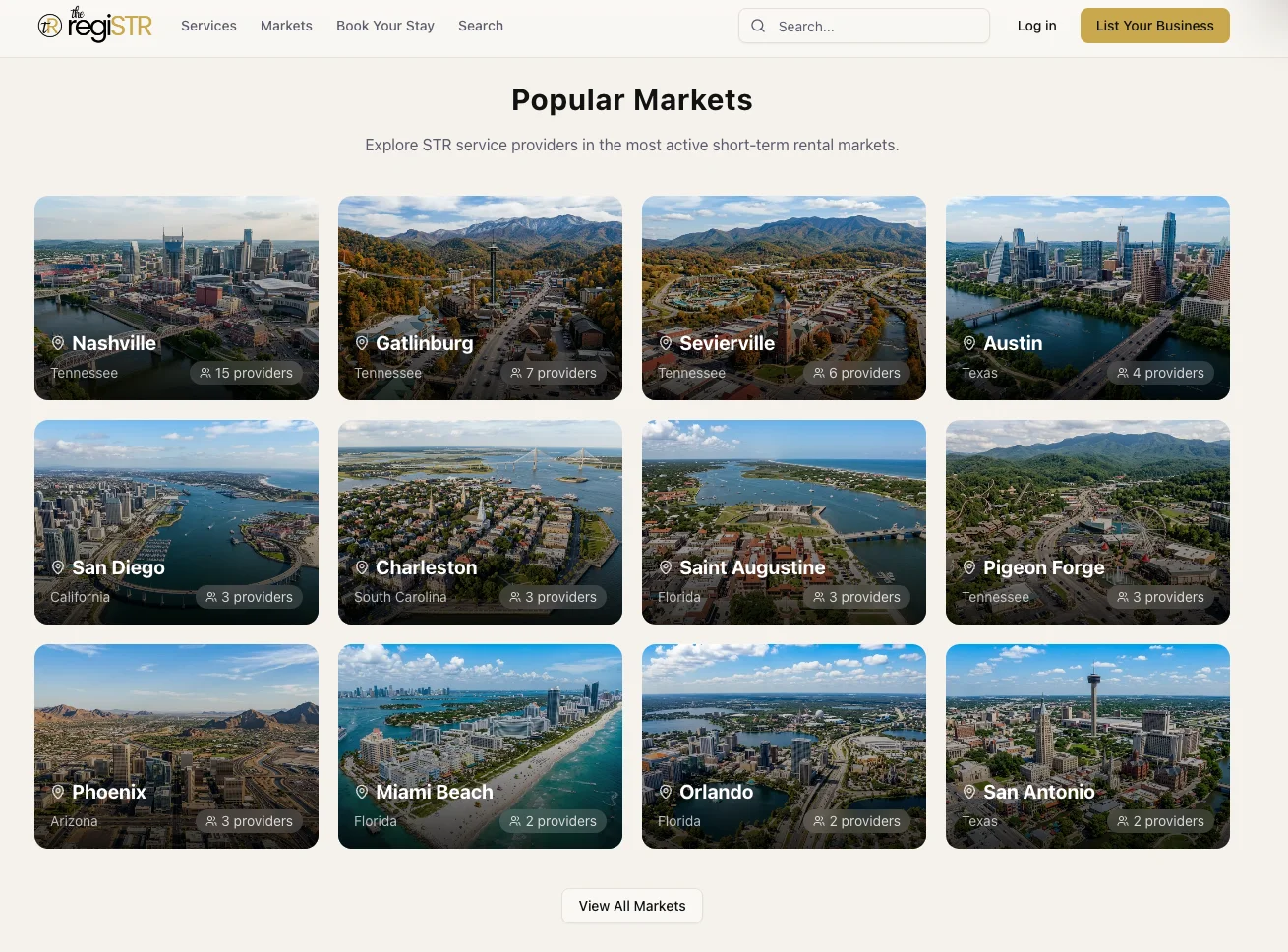
San Antonio is already listed among the regiSTR's tracked markets, alongside other high-activity vacation rental cities. Whether you're finalizing a permit application or already juggling bookings, browsing providers who already understand this city's density rules and tax layers beats starting your vendor search from a cold Google search. Browse all STR services on the regiSTR and filter by San Antonio to see who's already active in your market.
Content powered by inkSTR.co