STR Florida: Rules, Licensing, and Taxes for 2026

STR Florida operations require three separate layers of compliance: a state vacation rental license from the Florida Department of Business and Professional Regulation, tax registration with the Florida Department of Revenue, and adherence to whatever local zoning, registration, or safety rules your specific city or county still enforces under state preemption.
Key Takeaways
- Florida law defines a vacation rental under Florida Statutes 509.242 as a single-family, two-family, three-family, four-family dwelling, or condo/co-op unit rented as transient lodging and not part of a timeshare.
- Operating more than three transient rentals per calendar year, or advertising as regularly available for stays under 30 days, triggers the requirement for a DBPR vacation rental license, renewed annually.
- Florida imposes a 6% state sales tax on transient rental charges under Florida Statutes 212.03, plus county-level tourist development taxes that commonly range from 1% to 6% depending on the jurisdiction.
- Florida Statutes 509.032(7)(b) preempts most local governments from banning short-term rentals or regulating stay duration and frequency, but this preemption does not apply to local ordinances adopted on or before June 1, 2011.
- Cities like Miami still enforce zoning restrictions, requiring a Certificate of Use and Business Tax Receipt in eligible zones, with fines reported up to $5,000 per violation for noncompliant operators.
- The regiSTR is where Florida hosts find vetted property managers, cleaners, and compliance consultants who already understand this three-layer regulatory structure, organized by market so you are not vetting blind.
If you're trying to figure out whether your Florida condo, beach house, or Orlando-area investment property qualifies as an STR under state law, and what that means for licensing and taxes in 2026, you're dealing with a patchwork that trips up even experienced investors. Florida's regulatory structure sits at the intersection of state preemption, state licensing, state and county tax law, and whatever local rules survived that preemption. Most guides cover one layer and skip the other two.
This guide walks through all three layers using the actual statutory language, then gets into what changes at the city level in markets like Miami-Dade and the Disney corridor. the regiSTR tracks providers across every major Florida short-term rental market, and the pattern we see most often is hosts who nailed the DBPR license but missed a county tourist tax registration, or vice versa. Getting all three layers right the first time saves you from fines and delisting risk down the line.
As of 2026, Florida remains one of the largest and most actively regulated short-term rental markets in the country, with new legislative proposals introduced almost every session. What follows separates enacted law from proposals that never made it to the governor's desk.
Is STR the Same as Airbnb?
STR, or short-term rental, is a broader regulatory and industry category that includes any property rented for a short period, typically less than 30 days, regardless of which platform lists it. Airbnb is one booking platform among several, alongside Vrbo and direct booking websites, that STR operators use to market their properties.
In Florida, the legal term that matters is "vacation rental," defined in Florida Statutes 509.242. This statute does not mention Airbnb, Vrbo, or any specific platform by name. Instead, it defines a vacation rental by its use: a dwelling or unit rented as transient public lodging, not part of a timeshare project.
This distinction matters because your DBPR licensing obligation kicks in based on how you use the property, not which app you use to book it. If you list on Airbnb three times a year but also advertise your unit as regularly available for short stays on a personal website, the "advertised as regularly available" language in most guides still applies to you.
The practical takeaway: don't assume switching platforms, or listing on multiple platforms simultaneously, changes your regulatory status. Florida's licensing and tax obligations attach to the property's use and rental frequency, not to the marketing channel. Hosts moving between platforms, or adding a direct booking site to cut down on OTA fees, still carry the same DBPR license and tax registration obligations across every channel they use.
What Is the Short-Term Lease Tax Loophole and How Does It Work?
The so-called short-term lease tax loophole refers to the tax treatment threshold Florida draws at rentals of six months or less. Under this framework, longer-term leases avoid transient rental tax entirely, while any rental agreement of 180 days or fewer triggers Florida's transient rental tax obligations, regardless of whether the guest books through an OTA or directly with the owner.
This is not actually a loophole that benefits short-term operators; it works the opposite direction. The Florida Department of Revenue's guidance (publication GT-800034) treats any rental of six months or less as a taxable transient rental, subject to the 6% state sales tax under Florida Statutes 212.03, plus applicable discretionary sales surtax and county-level transient rental taxes.
Where hosts sometimes misunderstand the rule: signing a lease with language that technically extends past six months, without genuinely intending a long-term tenancy, does not exempt you from tax obligations if the actual occupancy pattern still functions as transient lodging. The Department of Revenue looks at substance, not just lease paperwork.
The real distinction that matters operationally is this: a genuine long-term lease of more than six months falls outside transient rental tax. Anything shorter, including a single weekend booking, falls inside it. There's no shortcut around collecting and remitting tax on stays under that threshold, and each transient rental accommodation must be separately registered by the owner or the owner's collecting agent.
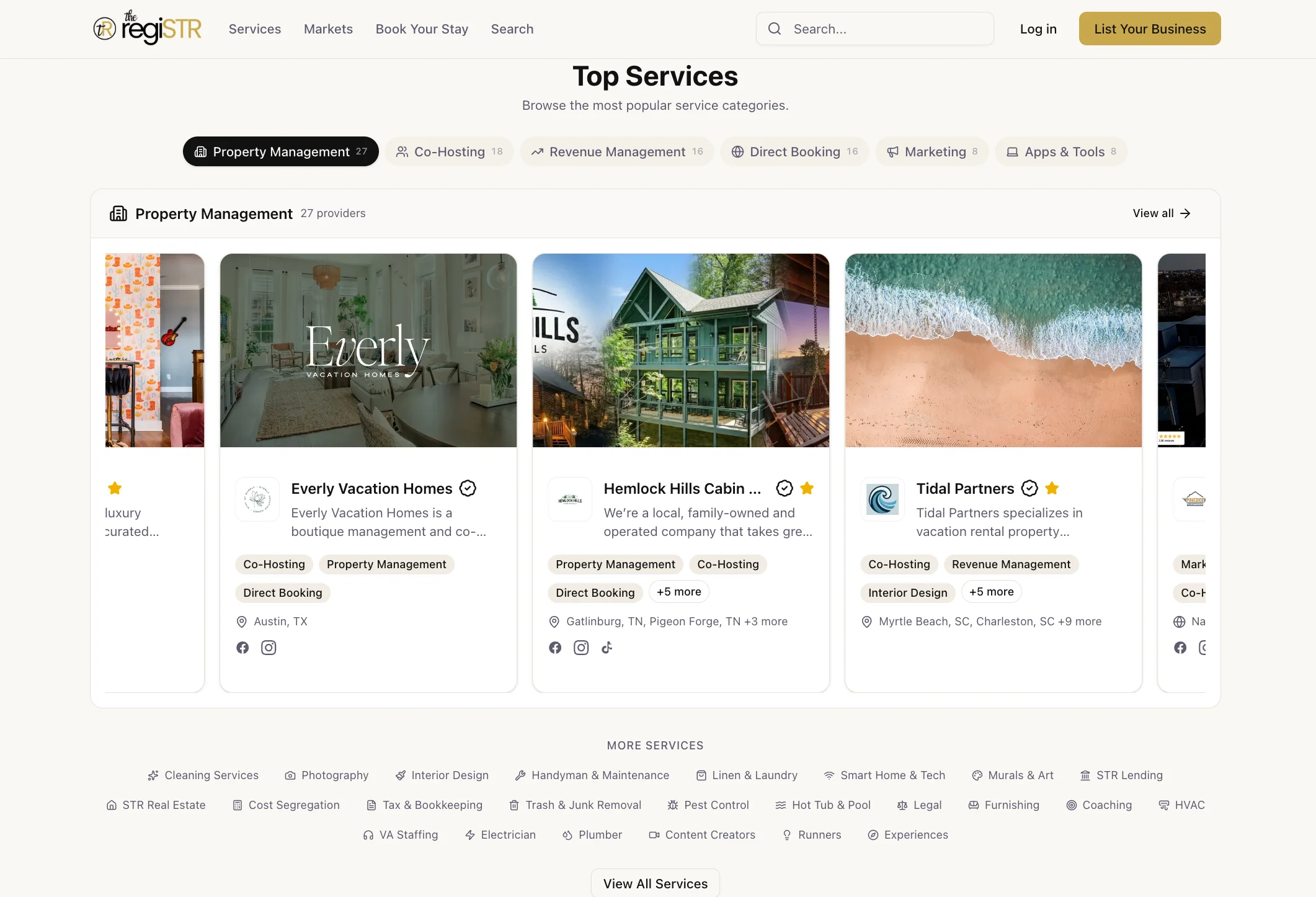
If your Florida rental strategy mixes long-term and short-term stays to manage tax exposure, a consultant with real Florida STR tax experience matters more than a generic bookkeeper. The regiSTR's Regulatory and Compliance category lists advisory professionals who track these thresholds specifically for vacation rental operators, not general landlord-tenant tax preparers.
What Are the Rules for Short-Term Vacation Rentals in Florida?
Florida's short-term vacation rental rules operate on three layers: a state license from DBPR, state and county tax registration, and local ordinances that survived state preemption. Every operational Florida STR needs to satisfy all three, not just the one that seems most visible.
Layer One: DBPR Licensing
A DBPR vacation rental license is required once your property meets the transient-rental definition under Florida Statutes 509.242, specifically operating more than three rentals per calendar year of stays under 30 days, or advertising the unit as regularly available for such stays. DBPR maintains separate application paths for a "Vacation Rental - Condo License" and a "Vacation Rental - Dwelling License," so you'll need to identify which category your property falls under before applying.
The license renews annually, and licensed properties must also comply with human-trafficking awareness training requirements that DBPR mandates for public lodging establishments. Licensing materials and correspondence go through DBPR's Tallahassee office; if you have questions about your specific application, DBPR's customer service line is 850-487-1395.
Layer Two: State and County Tax Registration
Once licensed, you register separately with the Florida Department of Revenue for the 6% state transient rental tax under Florida Statutes 212.03. Many counties add a tourist development tax, convention development tax, or tourist impact tax on top of the state rate, with local option rates commonly falling between 1% and 6% depending on which taxes your specific county has adopted.
State sales tax and any discretionary surtax get reported and remitted directly to the Department of Revenue. Many county-level transient rental taxes, by contrast, get reported and remitted directly to the county, not the state. This is where operators most often drop the ball: assuming one filing covers everything, when in fact you may owe two separate remittances to two separate agencies.
Layer Three: Local Ordinances That Survived Preemption
Florida Statutes 509.032(7)(b) blocks most cities and counties from banning vacation rentals outright or regulating how often or how long they can operate, but this preemption doesn't strip local governments of every regulatory tool. Local governments retain authority to require registration, enforce safety and noise rules, set parking requirements, cap occupancy, designate a responsible local contact, mandate posted notices, and conduct inspections.
The preemption also does not apply retroactively. Any local ordinance already on the books as of June 1, 2011 remains enforceable even if it would otherwise conflict with the state preemption language. This grandfather clause is why some Florida jurisdictions have noticeably stricter STR rules than neighboring cities, even though state law theoretically limits local control statewide.
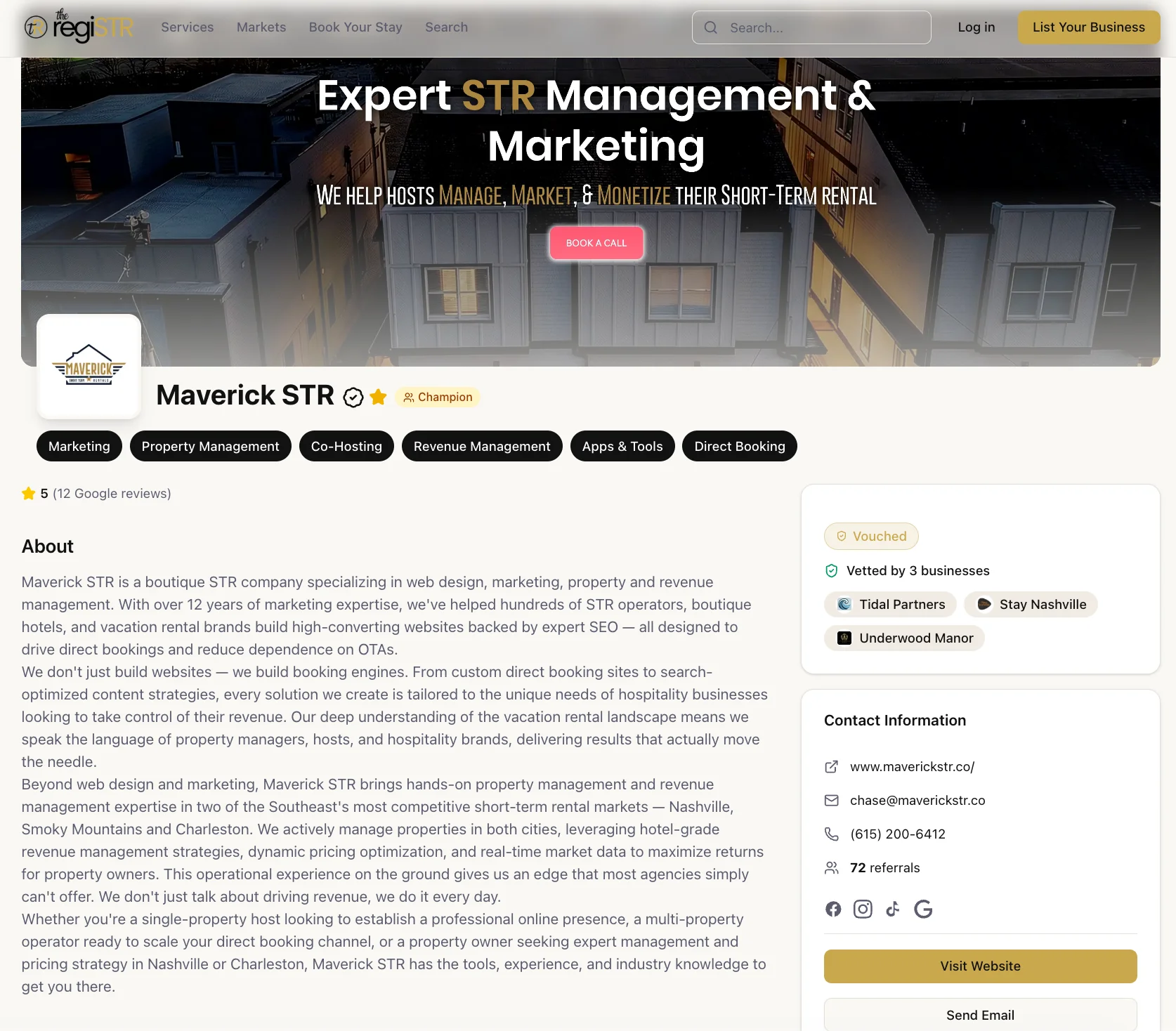
Comparing quotes and vetting a compliance consultant across these three layers is exactly what browsing Browse All STR Services on the regiSTR is built for: filter by market, see who specializes in Florida vacation rental compliance, and skip the cold-call phase entirely.
What Does STR Mean on Property?
On a property listing, deed record, or zoning document, STR stands for short-term rental, meaning the property is used, zoned for, or restricted from transient occupancy under 30 days. In Florida specifically, you'll also see the term "vacation rental" used interchangeably in statutes and DBPR paperwork, since that's the state's formal statutory label.
When you see "STR" flagged on a property disclosure or HOA document, it usually signals one of three things: the property is currently operating as a licensed vacation rental, the zoning designation permits or prohibits transient rental use, or an HOA/condo association has specific restrictions on rental frequency written into its declarations.
For condo and multifamily buyers, this designation matters more than almost any other factor in an STR investment decision. A unit zoned correctly under city code can still be blocked from short-term use entirely by condo association bylaws or CC&Rs, independent of what state law allows. Florida's preemption statute governs city and county regulation; it does not override private contractual restrictions like HOA declarations.
Before closing on any Florida property you plan to operate as an STR, request the current HOA declaration, condo bylaws, and any amendments specifically addressing rental minimums, responsible-party requirements, parking allocations, and occupancy caps. Zoning confirms legality at the government level. Association documents confirm legality at the private contract level. You need both cleared before you list your first booking.

How Do Florida Tax Rates and Licensing Fees Compare by Category?
Florida STR costs break into three distinct categories: a state license fee, a state sales tax rate, and a variable county tourist tax. Understanding which agency collects each cost, and at what rate, prevents the most common compliance mistake we see among Florida hosts: paying one tax and assuming it covers all obligations.
| Cost Category | Governing Authority | Rate or Fee | Frequency |
|---|---|---|---|
| DBPR Vacation Rental License | Florida Department of Business and Professional Regulation | Varies by license type; verify current fee with DBPR before applying | Annual renewal |
| State Transient Rental Tax | Florida Department of Revenue | 6% under Florida Statutes 212.03 | Ongoing, per rental charge |
| Discretionary Sales Surtax | Florida Department of Revenue | Varies by county; confirm current rate with the Department | Ongoing, per rental charge |
| County Tourist Development Tax | County tax collector | Commonly 1% to 6%, county-dependent | Ongoing, per rental charge |
Note the discrepancy you'll find across host forums on the exact DBPR license fee: some sources cite figures in the $150 to $175 range for annual renewal, but that number shifts periodically. Verify the current fee directly against DBPR's published fee schedule before budgeting, rather than trusting any secondhand figure, including this one.
Separately, remember that state sales tax and surtax get remitted to the Department of Revenue, while county tourist development tax often gets remitted directly to the county tax collector. Two different recipients, two different filing calendars in many counties. Missing one because you assumed a single combined filing covered everything is the most common compliance gap we see among newer Florida hosts working with the regiSTR's network of providers.
What Startup Costs Should You Budget for a Florida STR?
Florida STR startup costs span five categories: DBPR licensing, local business registration, safety equipment and inspections, insurance, and initial tax registration. Budgeting for only the license fee, while ignoring the other four, is the single biggest miscalculation new Florida hosts make heading into their first year.
- DBPR license application and annual renewal. Confirm the current fee for either the Vacation Rental - Condo License or the Vacation Rental - Dwelling License, whichever matches your property type.
- Local business tax receipt and certificate of use. Many Florida cities, including Miami, require these on top of the state license, and the application typically involves its own fee and processing timeline.
- Safety compliance and inspections. Some jurisdictions require inspections covering smoke detectors, occupancy limits, and code compliance, occasionally on a recurring schedule such as every two years.
- Insurance adjustments. Standard homeowner policies typically exclude commercial transient rental activity, so you'll need a policy rider or dedicated STR insurance product.
- Tax registration and quarterly filing setup. Registering separately with the Florida Department of Revenue and your county tax collector, plus setting up a system to track and remit collected taxes on schedule.
Every one of these five categories is easier to navigate with a local property manager or compliance consultant who has already run this checklist for other Florida properties in your specific county. That's a large part of why hosts turn to Find STR Property Managers on the regiSTR rather than piecing together a startup checklist from scattered forum posts.
How Do Miami and Orlando-Area Rules Differ From State Law?
Miami and the Orlando/Disney corridor apply meaningfully different local rules on top of Florida's baseline state law, because both regions have zoning ordinances that predate or otherwise survive state preemption. What's legal in one Florida city can be a zoning violation two counties away.
In Miami-Dade, a short-term vacation rental is defined locally as a dwelling unit, including condo, cooperative, or apartment-building units, rented for stays of less than 30 days. Miami restricts these rentals to T6 and T5 zoning designations and bans them outright in residential T3 zones. Operating in an eligible zone still requires a Certificate of Use and a Business Tax Receipt, and reported fines for violations can run up to $5,000 per incident.
In the Orlando and Disney-corridor area, many popular STR properties sit in unincorporated Orange or Osceola County rather than inside Orlando's municipal boundaries, which changes which local ordinance actually applies. Some jurisdictions in this category require annual vacation-rental registration paired with a safety inspection on a recurring cycle, covering items like smoke detectors, occupancy limits, and general code compliance, with daily fines reported up to $500 for operating without proper registration.
The lesson for any investor scouting a Florida STR purchase: never assume county-level or statewide rules automatically apply to your specific parcel. Zoning designation, municipal boundary, and even which side of an unincorporated line your property sits on can change your entire compliance obligation. This is exactly the kind of hyperlocal detail a Florida-based STR consultant or property manager tracks daily, and exactly why generic national guides undersell how granular this gets.
What Should a Florida STR Compliance Checklist Include for Condos and HOAs?
A Florida condo or HOA compliance checklist for short-term rentals must cover association-level restrictions separately from government zoning, because passing one does not guarantee you pass the other. Owners routinely discover this gap only after purchasing a property they cannot legally operate as an STR.
- Pull the current condo declaration or HOA CC&Rs and check specifically for minimum lease duration language, rental frequency caps, and any outright short-term rental prohibitions.
- Confirm zoning designation with the city or county planning department, independent of what the association allows, since both government zoning and private association rules must clear before you can legally operate.
- Check for a required Certificate of Use or local business tax receipt, particularly in Miami-Dade and other municipalities with formal zoning-based STR permitting.
- Review parking allocation rules in the association documents; many HOAs cap guest parking in ways that create real friction for turnover-day check-ins.
- Identify occupancy limits set by both the association and any local ordinance, and make sure your listing's stated max guest count doesn't exceed either.
- Confirm whether a responsible-party designation is required locally, meaning a local contact who can respond to complaints or emergencies in person.
- Check for noise ordinance specifics tied to the property, since HOA noise rules and municipal noise ordinances can carry separate enforcement and separate fines.
Multifamily and condo compliance is genuinely the most overlooked layer in Florida STR planning, largely because it lives in private contract documents rather than public statute. A property manager who specializes in condo-heavy Florida markets, listed through Find STR Property Managers, has typically already built a relationship with the associations in that building or complex, which speeds up approval considerably compared to a first-time owner navigating it alone.
How Does 2026 Legislation Affect Florida STR Operators?
Florida's legislature revisits short-term rental regulation nearly every session, and 2026 is no exception, with proposals ranging from stricter statewide registration requirements to expanded local enforcement authority. Not every bill introduced becomes law, and conflating a filed bill with enacted statute is one of the most common errors in Florida STR content online.
As of 2026, the enforceable statutory framework remains anchored in Florida Statutes 509.032(7)(b) for preemption, 509.242 for the vacation rental definition, and 212.03 for the state transient rental tax rate. Any article or forum post citing a different framework, or claiming a major statewide overhaul has already taken effect, should be checked directly against the current Florida Legislature website rather than taken at face value.
Given how frequently this area shifts, we recommend Florida hosts build a habit of checking the Florida Department of Revenue and DBPR sites at least once per quarter, particularly ahead of your quarterly tax filing deadlines. A compliance consultant who monitors this full-time catches proposed changes before they become enforcement headaches, which is the value proposition behind the regulatory and compliance providers listed on the regiSTR.
If you're scaling a Florida portfolio across multiple counties, tracking legislative movement market by market becomes a real operational burden. Our recently added providers in the regiSTR network for regulatory advisory work specifically flag when a client's specific county or city has active proposed ordinance changes, which is the kind of hyperlocal monitoring a generic national compliance service typically can't offer.
Frequently Asked Questions
Do I need a DBPR license if I only rent my Florida property occasionally?
If you rent more than three times per calendar year for stays under 30 days, or advertise your property as regularly available for such stays, you need a DBPR vacation rental license. Occasional rental below that threshold, without ongoing advertising as short-term lodging, generally falls outside the licensing requirement, but you should confirm your specific situation against current DBPR guidance.
Can my city ban short-term rentals entirely in Florida?
Most Florida cities and counties cannot ban short-term rentals outright or regulate their duration and frequency, because Florida Statutes 509.032(7)(b) preempts that authority at the state level. The exception is any local ordinance that was already adopted on or before June 1, 2011, which remains enforceable even where it conflicts with the general preemption.
What is the difference between DBPR licensing and Department of Revenue tax registration?
DBPR licensing governs whether you're legally permitted to operate a vacation rental at all, based on how often you rent and how the property is advertised. Department of Revenue tax registration is a separate obligation covering the 6% state transient rental tax on any rental of six months or less, and it applies regardless of whether you've crossed the DBPR licensing threshold.
Do condo associations have to follow Florida's state STR preemption law?
No. Florida's preemption statute limits what city and county governments can regulate, but it does not override private contractual restrictions in condo declarations or HOA CC&Rs. An association can still prohibit or restrict short-term rentals in its governing documents even where state and local law would otherwise permit them.
How much is the tourist development tax in Florida counties?
Florida county tourist development taxes, also called local option transient rental taxes, commonly range from 1% to 6% depending on which specific taxes a county has adopted, on top of the statewide 6% sales tax. Rates vary by county, so verify the current rate directly with your county tax collector before setting guest-facing pricing.
Does listing on multiple platforms change my Florida STR licensing obligations?
No. DBPR licensing and Department of Revenue tax obligations attach to how the property is used and how often it's rented, not to which booking platform lists it. Whether you list on one platform, several, or a direct booking website, the same three layers of Florida compliance apply.
What happens if I operate a Florida vacation rental without the required registration?
Penalties vary by jurisdiction, but reported fines for unregistered short-term rental operation in some Florida cities have run as high as $5,000 per violation, with certain jurisdictions imposing daily fines for continued noncompliance. Beyond fines, unregistered operation can also result in forced delisting from booking platforms and complications with insurance claims.
Should I hire a local property manager or handle Florida STR compliance myself?
Self-managing compliance is workable for a single property in a market you understand well, but it gets significantly harder across multiple counties or condo buildings with their own association rules. Many Florida hosts find that a property manager or compliance consultant who already has relationships with local associations and knows the specific county's tax filing calendar pays for itself in avoided penalties and faster approval timelines.
Conclusion
Operating an STR Florida property in 2026 means clearing three separate compliance layers: a DBPR vacation rental license tied to your rental frequency, state and county tax registration covering the 6% transient rental tax under Florida Statutes 212.03, and whatever local zoning or registration rules survived the state's preemption statute in your specific city or county. Skip any one layer and you're exposed to fines, delisting, or a stalled closing on a condo purchase you assumed was STR-ready.
The regulatory picture in Florida shifts by session, by county, and sometimes by which side of an unincorporated line your property sits on. Getting it right consistently, especially across a multi-property portfolio, is easier with a local property manager, cleaner, or compliance consultant who already tracks these details for a living. Get started with the regiSTR to browse vetted Florida providers by market and service category, rather than piecing together your compliance plan from forum threads and outdated blog posts.
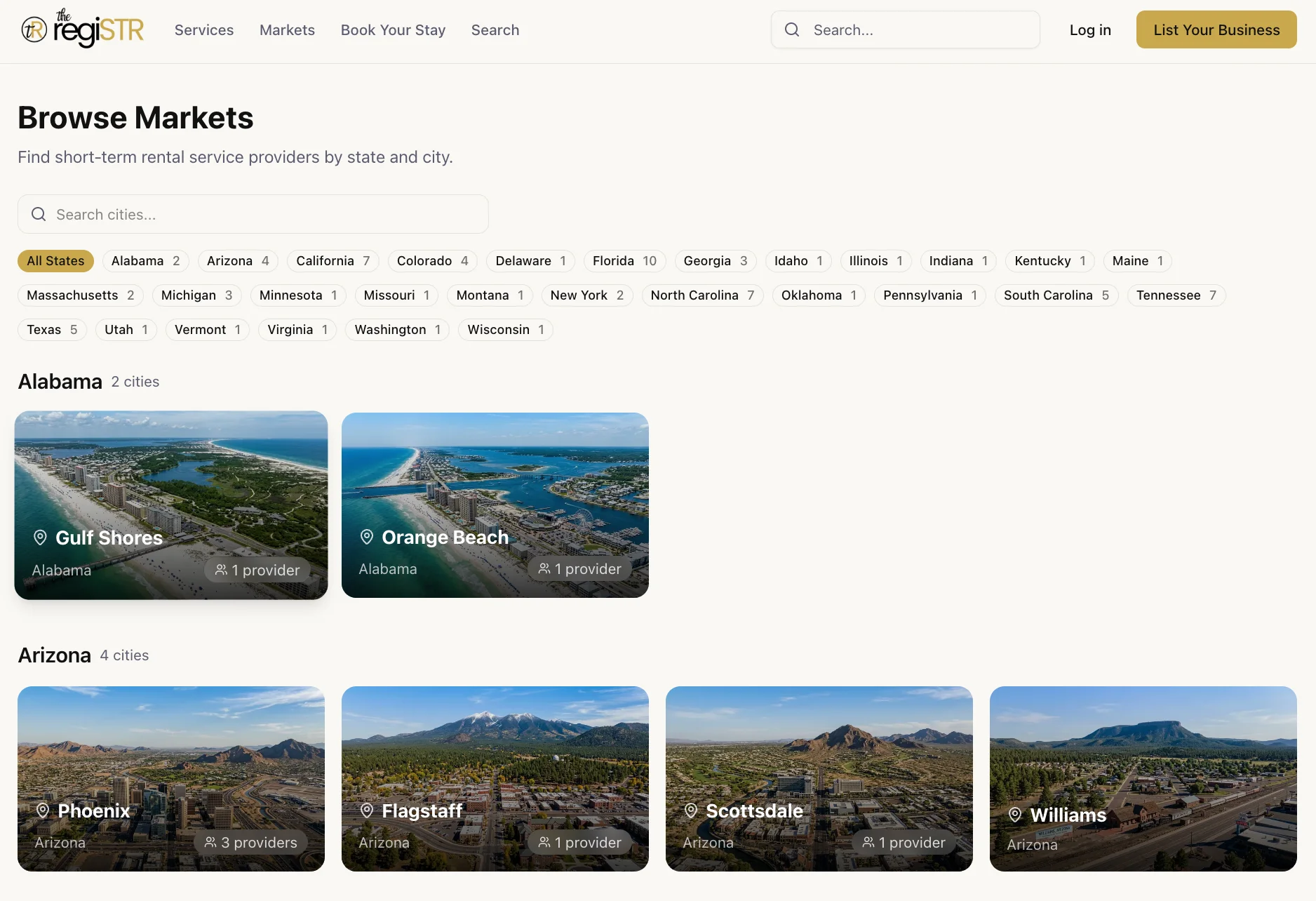
If you're setting up or scaling a Florida vacation rental, the regiSTR's market pages let you filter by city, from Miami to the Orlando corridor to the Gulf Coast, and see which property managers, cleaners, and compliance advisors already work in your specific market. Browse all STR service providers and sign up free to start comparing options instead of cold-calling your way through a Google search.
Content powered by inkSTR.co