STR Coaching: What It Is and Whether It's Worth It

STR coaching is paid mentorship, typically delivered through 1:1 calls, group cohorts, or hybrid programs, that teaches short-term rental hosts how to launch, price, automate, or scale a vacation rental business. Programs run anywhere from a single strategy session to multi-month packages, and the right fit depends entirely on whether you need a launch plan or a scaling system.
Key Takeaways
- STR coaching ranges from single-session Q&A calls to multi-month cohort programs, with curriculum typically covering market selection, pricing, automation, and portfolio scaling.
- The short-term vacation rental market in the U.S. is projected to reach $76.46 billion in 2026, growing to roughly $125.14 billion by 2033, according to industry market research, which is exactly why more hosts are paying for structured guidance rather than figuring it out alone.
- Approximately 42% of active STR listings globally are now professionally managed rather than self-managed, a professionalization trend that is driving demand for both coaching and vetted operational vendors.
- Coaching is not a substitute for operational execution. Even the best curriculum cannot clean a property, price a calendar in real time, or find you a licensed contractor in a market you've never visited.
- Most coaching programs teach you the "what" and "why" but leave you to independently source the cleaners, property managers, photographers, and compliance help you'll need to actually execute the plan.
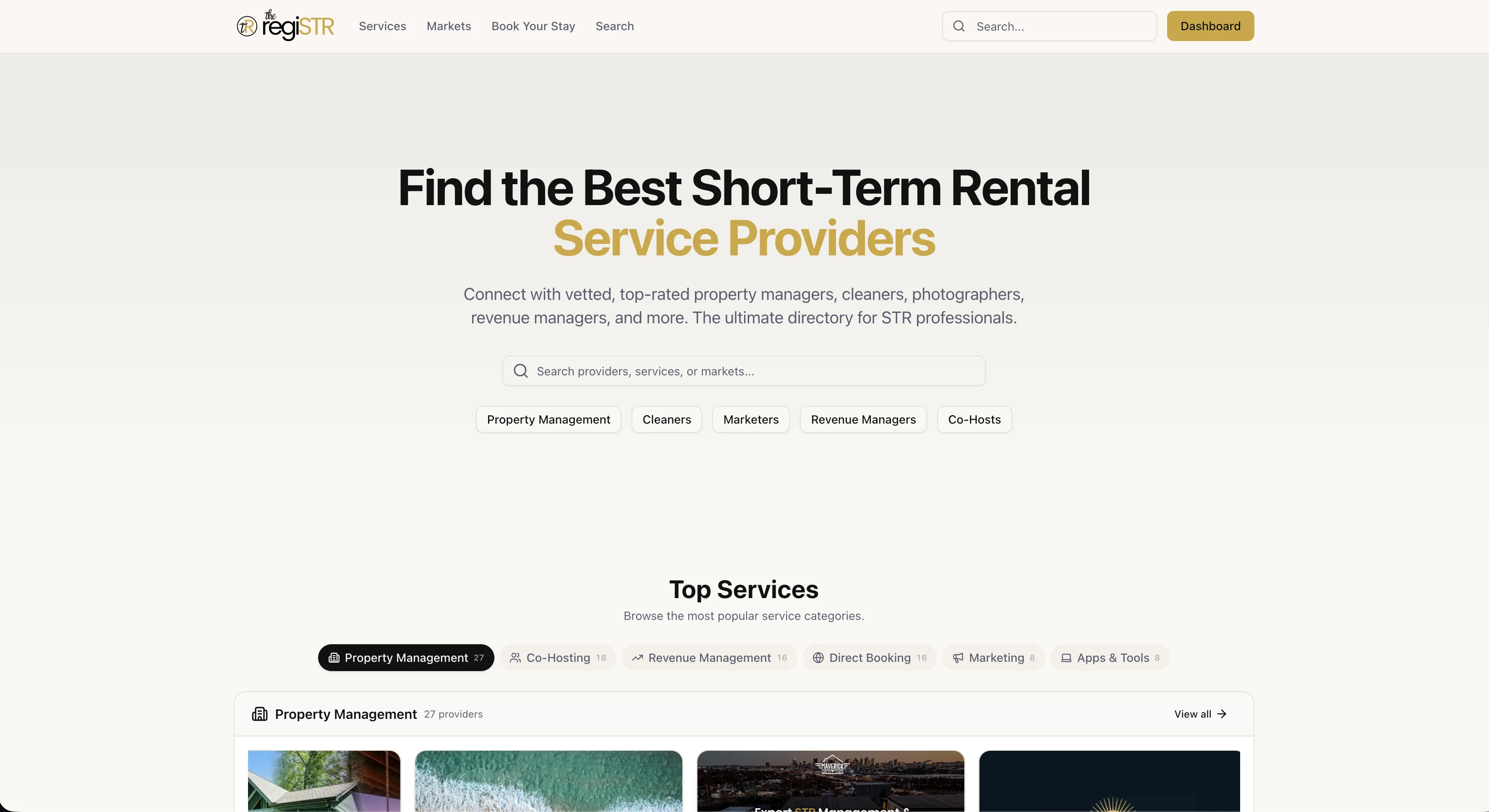
- The regiSTR fills the gap coaching programs leave open: a vetted directory of STR-specific service providers by market, so what you learn in coaching has somewhere to go once you're ready to build your operational team.
If you've searched "STR coaching," you're probably standing at one of two points: either you're about to buy your first short-term rental and don't know where to start, or you already own one to three properties and you're stuck, unsure how to systemize, price, or scale without burning out. Both situations are common, and both are exactly what STR coaching is designed to address.
At the regiSTR, we sit downstream of the coaching conversation. Coaches teach hosts the strategy; we're the directory hosts turn to once they need to actually execute that strategy with real vendors in a real market. That vantage point gives us a clear view of where coaching genuinely helps and where it runs out of runway.
This guide breaks down what STR coaching actually includes, what it costs, how the 1:1 versus group model works, and where coaching's value ends and operational execution begins. We'll also flag the questions almost nobody asks before signing a contract: what happens to your vendor network after the program ends, and how coaching compares to hiring a property manager outright.
What Is STR Coaching and What Does It Actually Include?
STR coaching is a paid mentorship service where an experienced short-term rental operator teaches you, individually or in a group, how to acquire, launch, price, and scale a vacation rental business. Curriculum typically spans market selection, listing optimization, dynamic pricing, automation tools, and financial systems.
Most programs bundle live calls (weekly or biweekly), a private community or Slack channel, and templated resources: pricing spreadsheets, welcome-guide templates, checklists for launch week. Some programs add 1:1 sessions with the lead coach; others rely entirely on group calls with occasional office hours.
Coaching differs from consulting in duration and structure. A consultant typically audits your specific property and delivers a one-time report. A coach walks alongside you over weeks or months, teaching a repeatable framework you're expected to apply to future properties, not just the one you own today.
It also differs meaningfully from hiring a property manager. A property manager executes day-to-day operations, guest messaging, and turnover coordination. A coach teaches you to build the systems yourself, or to know what to look for when you eventually hire someone else to run them. If what you actually need is someone to run your calendar and answer 2am guest texts, coaching is the wrong purchase; you want STR property management, not mentorship.
Is STR the Same as Airbnb?
STR, or short-term rental, is the broader industry category. Airbnb is one booking platform within that category, alongside Vrbo, Booking.com, and direct booking websites. A short-term rental is any furnished property rented for brief stays, typically days or weeks, regardless of which platform lists it.
This distinction matters for coaching because a program that only teaches "Airbnb optimization" leaves gaps if you're also listing on Vrbo or building a direct booking site. Strong STR coaching programs teach platform-agnostic principles: pricing logic, guest experience design, and operational systems that apply no matter where the booking originates.
It also matters for compliance. Airbnb and Vrbo both require hosts to confirm compliance with local zoning, noise, fire safety, and registration rules, and both platforms can delist properties that violate local STR regulations. A coaching program that treats "STR" and "Airbnb" as interchangeable often skips this compliance layer entirely, which is a real gap given how fast local ordinances change.
In our experience working with operators across dozens of markets, the hosts who run into trouble are the ones who learned "Airbnb hosting" as a platform trick set rather than "STR operations" as a business discipline. If your coach can't explain how their curriculum applies outside Airbnb's app, that's worth asking about before you pay.
What Is the 70/30 Rule in Coaching?
The 70/30 rule in STR coaching refers to a curriculum balance where roughly 70% of program time covers foundational strategy (market research, financial modeling, pricing, systems) and 30% covers execution support (live troubleshooting, feedback on your actual listing, direct answers to your specific property questions).
Programs that flip this ratio, heavy on generic strategy content and light on personalized execution help, tend to leave hosts with theory but no clear next step. You finish twelve weeks of modules and still don't know who to call about a broken water heater in a market three states away.
The better-structured programs we've seen build in dedicated office hours or 1:1 sessions specifically so the 30% execution slice has somewhere to land. If a program markets itself as "comprehensive" but offers no live Q&A or direct feedback mechanism, you're likely getting 100% strategy and 0% execution support, regardless of what ratio they advertise.
This is also where coaching hits its structural limit. Even a program with a perfect 70/30 split can teach you how to evaluate a cleaner's turnover workflow; it can't hand you a vetted cleaner in Scottsdale who already understands same-day turnaround windows. That's a discovery problem, not a strategy problem, and it's a different tool for a different job.
How Much Does STR Coaching Cost?
STR coaching pricing varies widely by format and duration, ranging from single-session consultations priced in the tens of dollars to multi-month intensive programs that run into the tens of thousands. As of 2026, industry pricing generally clusters around a few recognizable tiers.
Short, single-session formats, a 30-minute live Q&A call, for example, sit at the low end and work well for hosts with one specific question: which market to buy in, how to price a single listing, or how to interpret a permit requirement. Multi-week group cohort programs (6 to 12 weeks) occupy the mid-tier and typically bundle live calls, templates, and community access. Longer, high-touch programs (6 to 8 months) that include 1:1 mentorship, referral networks to realtors and CPAs, and guided property evaluations sit at the premium end of the market.
| Program Type | Typical Duration | Best For | What's Usually Included |
|---|---|---|---|
| Single-session Q&A | 30 to 60 minutes | Hosts with one specific question | Live call, direct answers, no ongoing access |
| Group cohort program | 6 to 12 weeks | New hosts launching first property | Weekly calls, private community, templates |
| Scaling-focused program | 6 weeks | Hosts with multiple properties operating 3+ years | Team-building frameworks, KPI systems, financial modeling |
| High-touch 1:1 program | 6 to 8 months | Hosts wanting hands-on mentorship | 1:1 meetings, referral network, property evaluations |
| Ongoing support subscription | Month-to-month | Operators wanting continued troubleshooting | Periodic check-ins, updates, ad hoc troubleshooting |
Before you pay for any tier, run the math against what you'd spend hiring the execution out instead. Full-service property management companies for vacation rentals typically charge 15 to 25% of gross monthly income, which for many hosts replaces the need for ongoing coaching entirely once the property is live. Coaching makes the most financial sense before launch or during a specific scaling inflection point, not as a permanent operational crutch.
What Does STR Stand for in a Mortgage?
In a mortgage or lending context, STR stands for short-term rental, referring to how a lender classifies a property's intended use and, in some cases, how they qualify projected rental income for underwriting purposes. Lenders distinguish STR-use properties from long-term rental or owner-occupied classifications because the income pattern, and the risk profile, differs.
Some lenders will count projected short-term rental income toward debt-to-income calculations using STR-specific appraisal methodology, while others still underwrite conservatively using long-term rental comparables. This distinction directly affects how much property you can qualify to buy, and it's a topic most STR coaching programs touch on only briefly, if at all, because coaches are operators, not mortgage professionals.
If financing is your current bottleneck rather than operations or pricing, that's a signal you may need a lender who specializes in investment and STR-use properties before you need a coach. Several coaching programs do maintain referral relationships to STR-friendly lenders, CPAs, and cost-segregation specialists as part of their curriculum, which is worth asking about directly during any sales call.
Once financing clears and you own the property, the mortgage question becomes irrelevant and the operational question takes over: who's going to clean it, manage it, photograph it, and keep it compliant. That's the point where coaching curriculum ends and a vendor network needs to begin, and it's exactly where the regiSTR's directory picks up the thread.
How Do 1:1 and Group Coaching Models Compare for STR?
One-on-one STR coaching pairs you directly with a single coach for personalized guidance on your specific property or portfolio, while group coaching places you in a cohort of hosts working through shared curriculum on a set schedule. Each model suits a different stage of host.
Group programs work well for hosts who are still building foundational knowledge: market selection, listing setup, basic pricing logic. The cohort structure creates accountability and community, and it's typically less expensive per host since the coach's time is spread across a group. Programs targeting new hosts, including ones aimed specifically at women entering the STR business, commonly use this model over a 6 to 12 week window.
1:1 programs suit hosts with unique circumstances: a specific market with unusual zoning, a portfolio approaching a scaling decision, or someone who wants direct access to a coach's referral network for realtors, CPAs, and cost-segregation specialists. These programs run longer, often 6 to 8 months, and cost significantly more because you're buying dedicated attention rather than a shared curriculum slot.
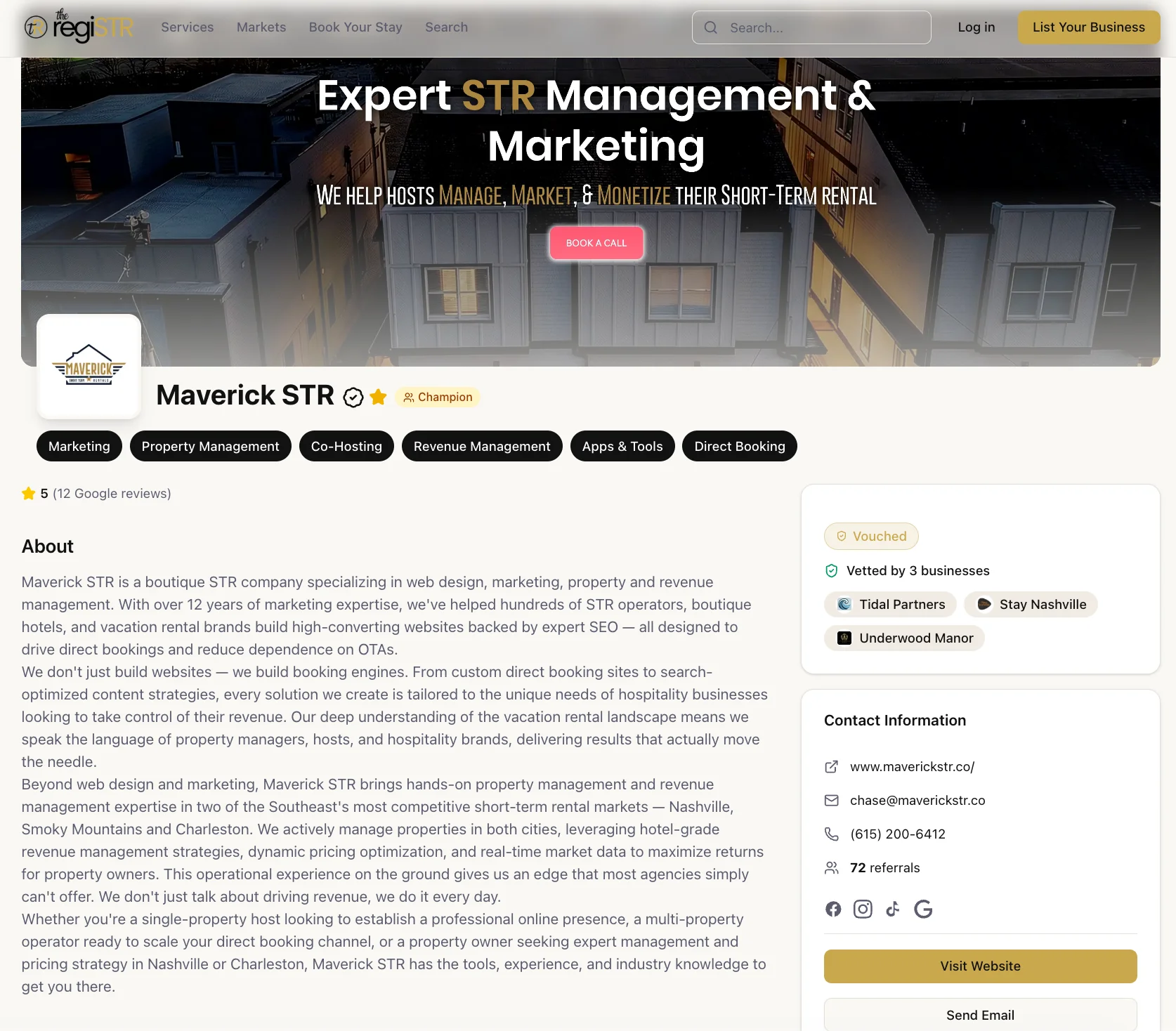
Neither model replaces the operational vendor relationships you'll still need once you're executing. A 1:1 coach can teach you exactly what to ask a property manager in an interview; they typically can't hand you three vetted property managers in your specific market to interview. For that, hosts we work with turn to STR Property Managers listed by market, where every provider has been referred into the network rather than cold-discovered through search.
What Should You Look for in an STR Coach's Track Record?
A credible STR coach's track record should include verifiable operational experience managing actual short-term rental properties, not just marketing or business coaching credentials applied to a new niche. Look specifically for years of direct STR operating experience, the scale of properties they've personally managed, and whether their curriculum reflects current platform rules rather than outdated strategy.
Ask direct questions before paying: How many properties have you personally operated, and for how long? What markets have you worked in, and do current regulations there still resemble what you experienced? Can you speak to a specific mistake you made and what it cost you? Coaches who answer with specifics, actual numbers, actual markets, actual mistakes, are more credible than those who answer with general confidence.
Watch for a common gap in this space: programs built by people whose STR experience is thinner than their marketing suggests, often padded out with general business coaching background instead. That's not disqualifying on its own, but it changes what you're paying for. You're buying business coaching applied to STR, not STR-specific operational insight.
Notably, almost 60% of respondents in one industry survey indicated that short-term rentals provide a valuable additional income source, according to Statista, and just over 50% felt positively about STRs' impact on residents' quality of life. A coach who can speak knowledgeably to both the financial upside and the community friction points of STR operation is demonstrating a more complete grasp of the business than one focused purely on revenue tactics.
What Do STR Coaching Programs Miss That Hosts Still Need?
STR coaching programs consistently miss three things: independent cost comparisons across coaching providers, measurable outcome tracking for graduates, and a clear handoff plan for finding operational vendors after the program ends. These gaps leave hosts with strategy but no straightforward path to execution.
First, almost no coaching program publishes a genuine cost-benefit comparison against alternative support models: fractional property managers, virtual assistants, or software-only pricing tools. That omission makes sense financially, coaches are selling coaching, but it leaves you without an apples-to-apples view of whether coaching is even the right spend for your specific situation.
Second, few programs report measurable graduate outcomes: average booking increase, revenue lift, or time saved. Testimonials are common; controlled, verifiable metrics are rare. Ask directly for outcome data before enrolling, and treat vague answers as a signal.
Third, and this is the gap that matters most operationally: coaching curriculum rarely integrates with the property management tools, channel managers, or CRMs you'll actually use day to day. You finish the program understanding dynamic pricing conceptually, but you still need to independently research, vet, and hire the revenue manager, cleaner, or channel manager rep who'll execute it.
That's precisely the handoff problem the regiSTR was built to solve. We're not a coaching program. We're the directory that sits on the other side of coaching, where the strategy you just learned meets vetted, market-specific providers: cleaners, photographers, revenue managers, co-hosts, and compliance consultants who already understand STR workflows. Sign up free and browse by market and category at theregistr.co.
How Does STR Coaching Compare to Hiring a Property Manager or Software Platform?
STR coaching teaches you to build and run your own systems; a property manager executes those systems on your behalf for a percentage fee; a software-only platform automates specific tasks (pricing, messaging) without human strategy or hands-on execution. The right choice depends on how much of the work you actually want to do yourself.
Coaching makes sense if you want to remain hands-on and build repeatable in-house systems, especially if you're planning to scale to multiple properties and want the operational knowledge to train future staff or co-hosts. It's a poor fit if you're already time-constrained and simply want the work off your plate.
Full-service property management typically costs 15 to 25% of gross monthly revenue, according to industry commission benchmarks, which is a real ongoing cost, but it buys execution, not just knowledge. Software platforms sit in between: vacation rental management software providers commonly target a take rate of 1.5 to 3.5% of gross booking revenue, automating pricing and channel distribution without the human strategy layer coaching provides.
Professional management is becoming the norm rather than the exception. Roughly 42% of active STR listings globally are now professionally managed using integrated software platforms for pricing, channel management, and compliance, a clear signal that the market is professionalizing faster than most self-managing hosts realize. If you've been self-managing and are burning out, that statistic alone is a reason to seriously evaluate whether coaching or a property manager is the better next move. Compare quotes directly by browsing STR Property Managers on the regiSTR, where every listed provider has been vetted and referred in by an existing network member rather than cold-discovered through generic search.
How Do You Choose the Right STR Coaching Program?
Choosing the right STR coaching program starts with identifying your actual bottleneck: acquisition, launch, pricing, or scaling. A program built for first-time hosts launching one property will waste a multi-property operator's time and money, and the reverse is equally true.
- Define your bottleneck first. Are you stuck before purchasing (market selection, financing), at launch (listing setup, pricing), or at scale (team building, KPIs, financial systems)? Match the program's stated audience to your actual stage.
- Verify the coach's operational track record. Ask for specific property counts, specific markets, and specific mistakes. Vague answers are a red flag.
- Ask about the 70/30 balance. Confirm how much of the program is live, personalized feedback versus recorded strategy content.
- Request graduate outcome data. Booking increases, revenue lift, time saved. If a program can't produce this, treat it as a program still building its track record.
- Clarify the post-program handoff. Ask directly: once I finish this program, where do I find vetted cleaners, photographers, and property managers in my market? If the answer is "you'll figure it out," budget separately for that search.
- Compare the total cost against alternatives. Run the math on coaching cost versus a property manager's ongoing fee versus a software platform's take rate before committing to any single path.
Common mistake: hosts sign up for high-touch, expensive 1:1 coaching when a lower-cost group cohort or even a single strategy call would have solved their actual problem. Match program intensity to problem size, not to marketing appeal.
Frequently Asked Questions
Is STR coaching worth the cost?
STR coaching is worth the cost when it solves a specific, well-defined bottleneck, such as market selection before a first purchase or a scaling framework for a growing portfolio. It's a weaker value proposition as an open-ended, ongoing service, since operational execution (cleaning, management, compliance) is a separate need that coaching alone doesn't fulfill.
What's the difference between STR coaching and STR consulting?
STR coaching is an ongoing mentorship relationship teaching repeatable frameworks over weeks or months, while STR consulting typically involves a one-time audit or property-specific report. Consulting answers "what should I do with this property"; coaching teaches "how do I think about STR businesses generally."
Do I need STR coaching if I'm hiring a full property manager?
If you're hiring a full-service property manager to handle day-to-day execution, coaching becomes less necessary since the manager already brings operational expertise. Coaching is more valuable when you plan to stay hands-on or when you want enough knowledge to properly vet and manage the property manager relationship itself.
How long does STR coaching typically take to show results?
Results depend heavily on your stage and effort applied outside of calls, but most cohort-based programs run 6 to 12 weeks for new-host curricula and 6 to 8 months for high-touch scaling programs. Coaching accelerates decision-making; it doesn't replace the time required to actually launch, staff, and stabilize a property.
Can STR coaching help with regulatory compliance?
Some programs touch on zoning, licensing, and permit basics, but most coaches are operators, not compliance attorneys, so treat this coverage as introductory rather than authoritative. For jurisdiction-specific compliance questions, work directly with a local STR-focused consultant, which you can find through the regiSTR's Regulatory and Compliance category filtered by your market.
What should I do after finishing an STR coaching program?
After finishing a coaching program, the next step is building your operational vendor team: a turnover cleaner, a property manager or co-host if you're not self-managing, a photographer for listing photos, and a maintenance contact. This is exactly the gap the regiSTR's directory closes, connecting hosts with vetted, market-specific providers once the strategy phase is complete.
Is group coaching or 1:1 coaching better for a first-time host?
Group coaching is generally the better fit for first-time hosts because foundational STR knowledge, market selection, pricing basics, listing setup, is largely universal and benefits from cohort accountability and lower cost. 1:1 coaching becomes more valuable once your situation has unique complications a shared curriculum can't address.
Conclusion: Making STR Coaching Actually Pay Off
STR coaching, at its best, gives you a repeatable framework for market selection, pricing, and scaling, and the U.S. short-term rental market's projected growth to $125.14 billion by 2033 means that framework has real staying power. But coaching ends where execution begins, and execution is where most hosts get stuck, not for lack of knowledge, but for lack of a vetted vendor to call.
Whether you just finished a coaching program or you're skipping coaching entirely to work directly with professionals, the next step is the same: build a team of STR-specific providers you can trust in your actual market, not a generalist you found through a cold search. That's the exact problem the regiSTR was built to close, one market and one service category at a time.
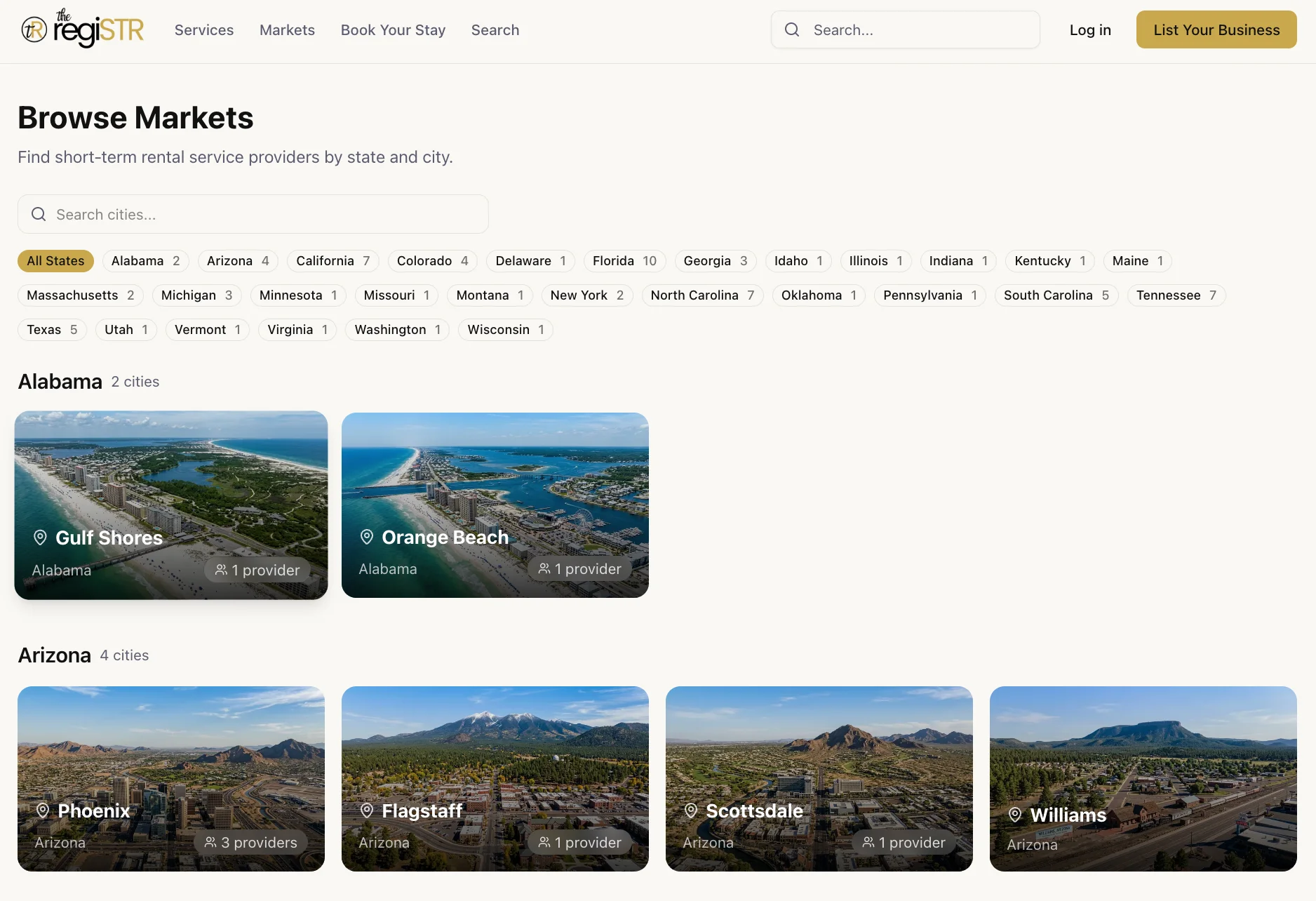
If you've just wrapped up an STR coaching program, or you're building your operational team without one, get started with the regiSTR and browse vetted cleaners, property managers, photographers, and compliance consultants by city and category. Sign up free at theregistr.co and turn what you learned into a working, staffed operation.
Content powered by inkSTR.co