STR Cleaning Services: What They Cost and How to Hire Right

STR cleaning services are turnover cleaning companies that specialize in preparing short-term rental properties, like Airbnb and VRBO listings, between guest stays. Unlike standard house cleaners, they work on tight windows, follow listing-specific checklists, restock guest supplies, and often report damage or maintenance issues back to the host.
Key Takeaways
- STR stands for short-term rental, and STR cleaning is also referred to as a "short-term rental turnover service" in the industry, distinct from standard residential housekeeping.
- Turnover cleaning typically covers washing, sanitizing, restocking, and inspecting a property between checkout and the next check-in, often on a tight same-day window.
- Pricing for STR cleaning varies significantly by property size, market cost of living, and how many extras (linens, hot tub checks, restocking) are bundled into the service.
- The global vacation rental market is projected at USD 109.4 billion in 2026, according to Mordor Intelligence, and that growth is pushing more cleaners into STR-specific specialization rather than general residential work.
- Not every cleaner who lists "Airbnb experience" on a profile actually understands turnover timelines. Hosts who vet for communication and guaranteed turnaround, not just price, avoid the most common hiring mistakes.
- The regiSTR lists STR-specific cleaning providers by market with peer endorsements attached, so hosts don't have to guess whether a cleaner has real turnover experience.
If you've ever had a cleaner ghost you 90 minutes before check-in, you already understand why STR cleaning is treated as its own category rather than a subset of house cleaning. A residential cleaner who does a great job on a bi-weekly schedule can still fall apart the first time they're asked to turn a three-bedroom cabin in under two hours.
At the regiSTR, we index STR service providers across dozens of active vacation rental markets, and turnover cleaning is consistently the category hosts search for first, and complain about most. The pattern we see: hosts don't fail because good cleaners don't exist in their market. They fail because they hired based on price or availability instead of turnover-specific competence.
This guide covers what STR cleaning actually includes, what it costs in 2026, how pricing breaks down by property type, and how to vet a cleaning company before you hand over your keys. We'll also flag the questions most hosts forget to ask until it's too late.
What Does STR Stand for in Cleaning Services?
STR stands for short-term rental, and in the cleaning industry, "STR cleaning" refers specifically to turnover cleaning performed on properties rented to guests for short stays, typically through platforms like Airbnb and VRBO. It is sometimes called a "short-term rental turnover service" instead of "cleaning," because the job includes tasks a standard cleaning visit does not.
The distinction matters operationally. A standard house cleaner shows up on a recurring schedule and cleans a home that's lived in daily. An STR cleaner works against a checkout-to-check-in clock, often same-day, and has to leave the property staged exactly as photographed for the listing. That means bed-making to hotel standard, restocking toiletries and coffee, and checking for guest damage before the next arrival. STR cleaning also typically includes inventory tracking. If a guest walks off with towels or breaks a lamp, the cleaner is often the first and only person to notice before the next guest arrives. Standard residential cleaning has no equivalent responsibility.
How Much Do I Pay Someone to Clean My Airbnb?
What you pay for Airbnb cleaning depends primarily on property size, your market's cost of living, and whether the service includes extras like linen laundering, restocking, or hot tub maintenance. Pricing structures generally fall into two categories: a flat per-turnover rate, or a rate that scales with bedroom and bathroom count.
Most hosts price turnovers into their nightly rate as a cleaning fee passed to the guest, which is standard practice on both Airbnb and VRBO. But the amount you're charged by your cleaner and the fee you pass to guests don't have to match exactly, and shouldn't if you're trying to stay competitive on total trip cost.
Cost drivers worth understanding before you request a quote:
- Square footage and bedroom count. A one-bedroom condo turnover takes a fraction of the labor time of a five-bedroom mountain cabin with multiple bathrooms.
- Linen service. Cleaners who launder linens on-site or via a partnered laundry service typically charge more than those who expect the host to supply pre-laundered linens.
- Same-day turnaround. A tight window between an 11am checkout and a 3pm check-in often carries a premium, especially if the cleaner has to bump another job to make it work.
- Market cost of living. Turnover cleaning rates in high-demand, high-cost markets tend to run above the national average, simply because labor costs more there across every service category.
- Extras. Hot tub servicing, restocking consumables, deep-cleaning add-ons, and post-stay inspection reports are usually priced separately from the base turnover.
Comparing quotes side by side is exactly what a directory should make easy, and it's a gap we built the regiSTR's Cleaning and Turnover Services category to close. Instead of collecting quotes through scattered Facebook group posts, hosts can browse providers by market and see what's actually included in each listing before reaching out.
How Much Should an Airbnb Cleaner Cost?
An Airbnb cleaner's cost should reflect the actual labor and time required for a full turnover, not just a flat residential cleaning rate applied to a vacation property. As a baseline, expect STR turnover pricing to sit noticeably higher than what you'd pay for a comparable one-time residential clean, because the scope of work is broader and the schedule is less flexible.
What separates a fair price from an inflated one usually comes down to what's bundled in. A cleaner who quotes a low base rate but charges separately for linens, restocking, trash removal, and inspection reports may end up costing more per turnover than a competitor who quotes a single all-in rate.
Here's a simple framework for evaluating whether a quote is reasonable for your market and property type.
| Property Type | What Drives the Price | What Should Be Included |
|---|---|---|
| Studio or one-bedroom condo | Lower labor time, faster turnaround expected | Full clean, trash removal, basic restock |
| Two to three bedroom home | Multiple bathrooms, more surfaces, more linens | Full clean, bed-making, linen handling, restock, photo verification |
| Four-plus bedroom or luxury property | Square footage, hot tubs, outdoor living spaces | Full clean, hot tub check, deep-clean rotation, inspection report |
| Same-day back-to-back turnover | Compressed labor window, scheduling premium | Guaranteed turnaround time, priority scheduling, direct communication line |
Notice that "guaranteed turnaround time" only shows up as a line item for same-day jobs, but it should be a standard expectation across the board. A cleaning company that can't commit to a specific window is not the right fit for STR, regardless of how reasonable their base rate looks on paper.
How Much Does It Cost for Someone to Clean Your Airbnb?
The total cost of cleaning your Airbnb includes more than the per-turnover fee: it also depends on how often you're booked, whether you need a backup cleaner for last-minute cancellations, and whether you're paying separately for supplies. As of 2026, more hosts are also factoring in cleaning management software costs, since a growing share of operators now use scheduling and checklist tools alongside their cleaning provider. According to Hostfully's 2026 Tech Stack Report, cleaning-management software adoption among STR operators ranges from roughly 52% to 88% depending on portfolio size, with larger operators far more likely to run cleaning through a dedicated platform rather than texting back and forth.
If you're running one property, your annual cleaning spend is really just turnovers multiplied by occupancy. If you're running a portfolio, the math gets more complex because you're paying for coverage across multiple markets, backup cleaners for no-shows, and possibly a coordinator to manage the schedule.
Three cost categories most hosts underestimate:
- Backup coverage. If your primary cleaner gets sick or double-books, you need a second option on file. Cleaners without a backup network are a liability during peak season.
- Supply replenishment. Toiletries, coffee, paper products, and cleaning chemicals add up across a busy calendar year and are often billed separately from the labor fee.
- Damage and re-clean costs. A cleaner who doesn't inspect thoroughly can miss damage that costs you a guest complaint, a refund, or a bad review, which is a far more expensive outcome than the cleaning fee itself.
This is where remote owners in particular get burned. If you own a property in a market you don't live in, you can't drop by to check the cleaner's work. That's exactly the gap our Find STR Cleaners directory was built to close: providers listed by market, with peer vouches from other operators who've actually used them.
What's the Difference Between STR Cleaning and Standard House Cleaning?
STR cleaning differs from standard house cleaning primarily in speed, scope, and accountability. A standard residential cleaner works on a recurring schedule in a home that's occupied daily, while an STR cleaner performs a full reset between two different sets of strangers, often within a two- to four-hour window.
Specifically, STR turnover cleaning includes tasks that simply don't exist in a residential cleaning contract: staging the property to match listing photos, restocking guest-facing consumables, checking for damage left by the previous guest, and reporting maintenance issues before they become a bad review. A standard cleaner isn't trained or paid to do any of that. Additionally, STR cleaners typically don't perform in-stay cleaning unless you've specifically contracted for it, which surprises first-time hosts who assume a "cleaning service" covers mid-stay tidying the way a hotel housekeeping team might.
The accountability difference is just as important. If a standard cleaner misses a spot, you notice it on your own schedule. If an STR cleaner misses a spot, a paying guest notices it within minutes of walking in the door, and it shows up in your review score. That's why hosts who've been burned once tend to get far more selective about who they hire next.
What Should I Look for When Vetting an STR Cleaning Company?
Vetting an STR cleaning company means checking for turnover-specific experience, not just general cleaning quality. The single biggest red flag is a cleaner who can't answer basic questions about same-day turnaround, because it usually means they've never actually done one.
Use these criteria on your first call, before you ever discuss price:
- Ask about their tightest turnaround window. If they can't name a specific number of hours, they haven't managed real STR scheduling pressure.
- Ask how they handle a late checkout. A good STR cleaner has a protocol. A bad one gets flustered or simply doesn't show up.
- Ask if they use a checklist specific to your listing. Generic cleaning checklists miss listing-specific staging details like throw pillow arrangement or amenity placement that match your photos.
- Ask how damage or missing items get reported. You want photo documentation, not a verbal "everything looked fine."
- Ask about backup coverage. One-person operations with no backup plan are a risk during your busiest weekends.
- Ask for references from other STR hosts specifically, not general residential clients. A cleaner with five-star reviews from homeowners has proven nothing about their ability to hit a two-hour turnover window.
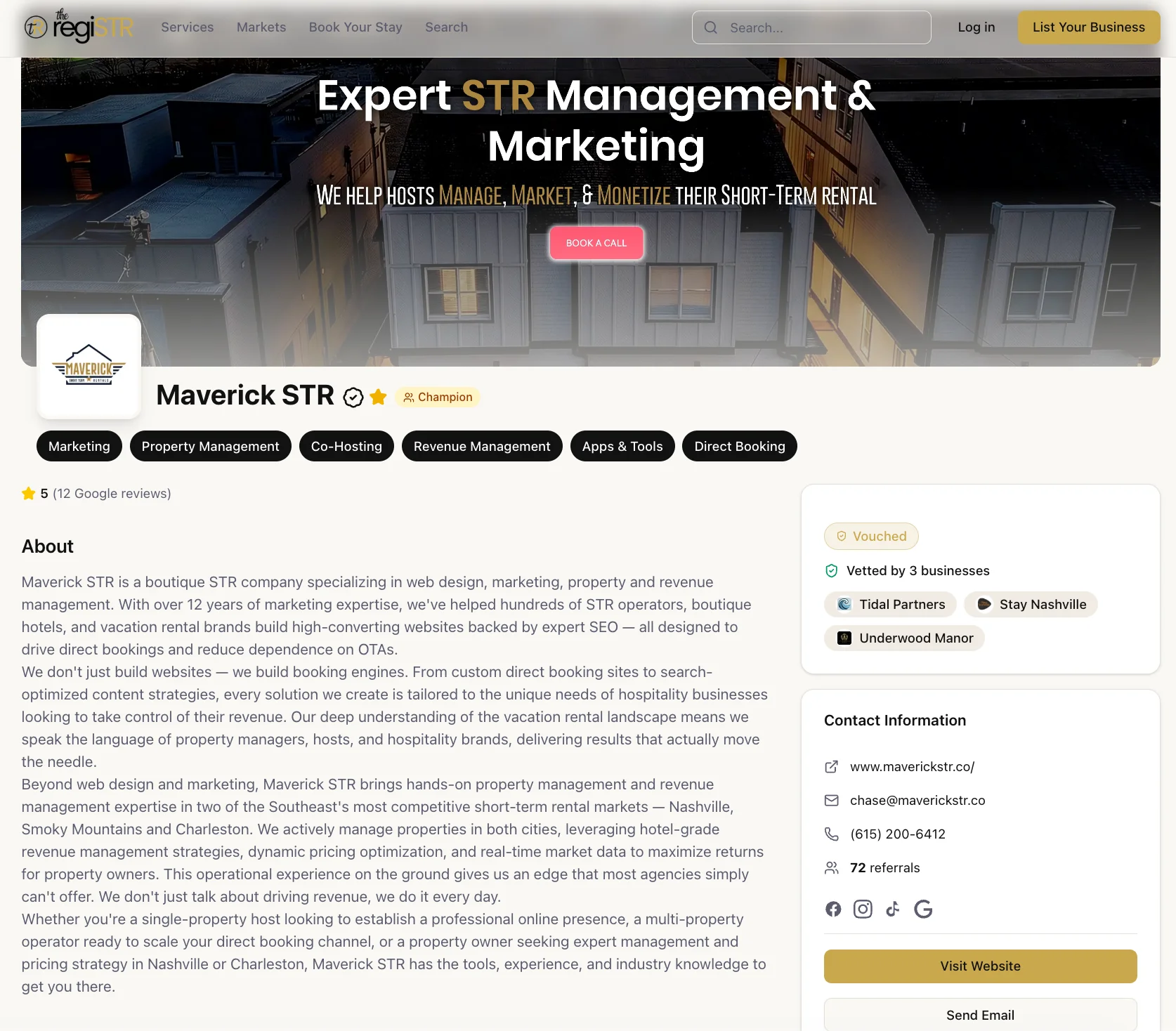
This is exactly the vetting criteria we apply when reviewing providers for the regiSTR's directory. Every cleaning company listed has been referred in by an existing network member, and hosts can see which other operators have vouched for them publicly, by name. That peer-verified layer is something a star rating on a general directory simply can't replicate.
How Do I Find a Reliable STR Cleaner in a Market I Don't Live In?
Finding a reliable STR cleaner remotely requires a market-specific directory rather than a generic search, because general platforms don't filter for turnover experience or verify that a provider actually understands vacation rental workflows. Cold-calling residential cleaning companies in an unfamiliar city and hoping one of them "does Airbnbs" is a slow, unreliable process.
Remote owners face a specific problem: you can't drive by and check the work, you don't have a local network to ask for recommendations, and time zone differences make same-day communication harder when something goes wrong. Facebook host groups can surface names, but there's no accountability layer behind those recommendations. For example, an owner managing a mountain cabin from three states away needs to trust that a cleaner will notice a broken hot tub jet or a stained mattress pad without being told to look for it.
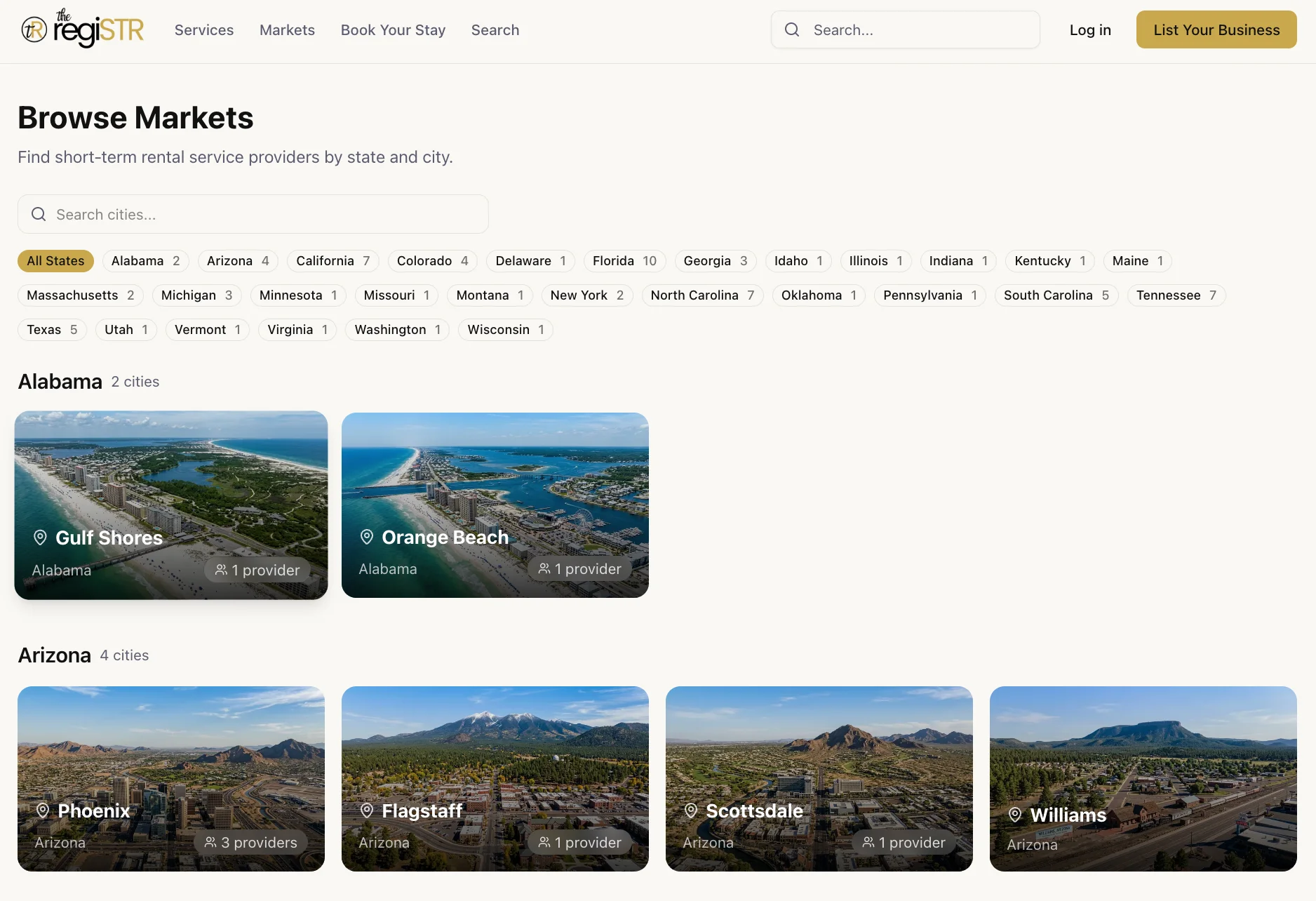
The regiSTR's market pages solve this by organizing every service category, cleaning included, by city and metro area. A host in Colorado managing a Gulf Coast property can browse vetted cleaners filtered specifically to that market, see which ones other operators have vouched for, and reach out without spending a weekend on Google Maps and unreturned voicemails.
What Technology Do STR Cleaning Companies Use in 2026?
STR cleaning companies increasingly rely on scheduling software, digital checklists, and photo verification tools to manage turnovers reliably, rather than relying on memory or paper checklists. As of 2026, this technology gap is one of the clearest signals separating a professional STR-focused operation from a residential cleaner picking up occasional gig work.
Photo verification in particular has become close to standard practice for serious STR cleaning providers. Cleaners photograph completed rooms and send them to the host or property manager before check-in, creating a record that protects both parties if a guest later disputes cleanliness. Checklist apps tied to individual listings also matter, because a generic "clean the bathroom" line item doesn't capture the specific staging details, like folded towel presentation or amenity basket placement, that match your listing photos.
According to Hostfully's 2026 Tech Stack Report, cleaning-management software adoption already ranges from roughly 52% to 88% of operators depending on portfolio size, and that number keeps climbing as more multi-property operators standardize their operations. If a cleaning company you're evaluating has never heard of turnover scheduling software, that's worth noting, not disqualifying on its own, but worth noting.
Data and Evidence: What the Market Tells Us About STR Cleaning Demand
The scale of STR cleaning demand is tied directly to the growth of the vacation rental market itself. According to Mordor Intelligence, the global vacation rental market is projected at USD 109.4 billion in 2026, up from USD 104.62 billion in 2026. Grand View Research separately projects the global market to reach USD 106.5 billion in 2026, growing from USD 101.7 billion in 2026.
Growth projections vary by source and methodology, but the direction is consistent: more listings, more turnovers, more demand for specialized cleaning labor. GMI Insights reports that the short-term segment specifically generated over USD 45 billion in revenue in 2023 and is expected to exceed USD 65 billion by 2032, a signal that short stays, and the turnover volume they require, are growing faster than the broader vacation rental category.
StayFi, citing Grand View Research, projects the U.S. short-term vacation rental market to reach USD 76.46 billion in 2026, growing to USD 125.14 billion by 2033 at a 7.3% CAGR. That U.S.-specific growth rate matters for cleaning providers because it points to sustained turnover volume domestically, not just overseas expansion.
| Source | 2026 Market Size Estimate | Growth Signal |
|---|---|---|
| Mordor Intelligence | USD 109.4 billion (global) | Rising from USD 104.62B in 2026 |
| Grand View Research | USD 106.5 billion (global) | 3.7% CAGR through 2033 |
| StayFi / Grand View Research | USD 76.46 billion (U.S. short-term segment) | 7.3% CAGR through 2033 |
| Research Nester | USD 7.7 billion (property management software) | Growing demand for operational tooling |
What does this mean for a host hiring a cleaner in 2026? Simply that the pool of both hosts and cleaning providers is expanding, which makes it more important, not less, to filter for real STR experience instead of assuming anyone advertising "vacation rental cleaning" actually has it.
What Mistakes Do Hosts Make When Hiring STR Cleaning Companies?
The most common mistake hosts make is vetting for price before vetting for reliability, which backfires the first time a same-day turnover gets tight. A cleaner who charges 15% less but shows up late or skips inspection steps ends up costing far more in refunded stays and damaged reviews.
Other recurring mistakes worth flagging:
- Hiring based on a single good review. One glowing testimonial doesn't tell you how a cleaner performs under a compressed turnaround or during a busy holiday weekend.
- Skipping a written agreement on turnaround time. Verbal promises evaporate during peak season. Get the turnaround window and communication protocol in writing.
- Not asking about backup staffing. A solo operator with no backup is a single point of failure for your entire calendar.
- Assuming in-stay cleaning is included. STR cleaners typically only handle checkout-to-check-in turnovers unless you've specifically contracted for mid-stay service.
- Ignoring insurance and liability coverage. If a cleaner damages property or is injured on-site, you want confirmation they carry appropriate coverage before that becomes your problem.
Not every one of these mistakes is fatal on its own. But stack two or three together and you've got a recipe for a bad review during your highest-demand weekend of the year. Providers listed on the regiSTR have already been referred in by network members, which filters out a meaningful share of these risks before you ever pick up the phone.
How Do STR Cleaning Companies Grow Their Client Base in 2026?
STR cleaning companies grow their client base by getting in front of hosts who are actively searching for turnover-specific services, rather than competing on general home services platforms where most inquiries come from residential clients who don't understand STR pricing or urgency. Word-of-mouth referrals from other hosts remain valuable, but they don't scale fast enough for a growing cleaning business.
General directories tend to mismatch cleaning companies with the wrong audience. A homeowner looking for a one-time deep clean and an STR host who needs a guaranteed two-hour turnover window are fundamentally different clients, and a directory that treats them the same wastes a cleaning company's time on unqualified leads. That's exactly why cleaning companies list on the regiSTR: direct visibility to hosts and property managers in their specific market who are already searching for STR-specific cleaning, not general housekeeping. Every visitor to the platform is already an STR operator, so the audience match is exact rather than incidental.
The regiSTR's Vouch system also gives cleaning companies a credibility mechanism that anonymous star ratings can't match. When a real, named host publicly vouches for a cleaning provider they've actually hired, that carries more weight with a prospective client than a five-star rating with no context behind it.
Frequently Asked Questions
What does STR mean in cleaning services?
STR stands for short-term rental. In cleaning services, STR cleaning refers specifically to turnover cleaning performed between guest stays on properties listed on platforms like Airbnb and VRBO, distinct from standard recurring residential housekeeping.
How much do I pay someone to clean my Airbnb?
What you pay depends on property size, market cost of living, and what's bundled into the service, such as linens, restocking, and same-day turnaround. Turnover cleaning generally costs more than a comparable one-time residential clean because the scope of work and scheduling pressure are both higher.
How is STR cleaning different from a standard deep clean?
A standard deep clean is typically a one-time, thorough service performed on your own schedule. STR turnover cleaning happens repeatedly, often same-day, and includes staging, restocking, and damage inspection tasks that a one-time deep clean doesn't cover.
Do STR cleaners provide linens and supplies?
Some do and some don't, so this needs to be confirmed before you sign anything. Cleaners who launder and provide linens as part of the service typically charge more than those who expect the host to supply pre-laundered linens and consumables.
How do I find a vetted STR cleaner if I don't live near my rental?
Use a market-specific directory rather than a general search or social media group. The regiSTR organizes cleaning providers by city and metro area with peer vouches attached, so remote owners can vet a provider's STR-specific reputation before making first contact.
What happens if my STR cleaner misses a same-day turnover?
This is exactly why you should confirm backup coverage before hiring. A reliable STR cleaning company has a documented protocol for late checkouts and a backup cleaner on call, rather than leaving you to scramble alone during a tight turnaround.
Should I hire an individual cleaner or a cleaning company for my STR?
Individual cleaners can work well for a single property but lack backup coverage if they're sick or double-booked. Cleaning companies with multiple staff members are generally more reliable for hosts with multiple properties or frequent same-day turnovers.
Final Thoughts on Hiring STR Cleaning Services in 2026
STR cleaning services are the operational backbone of a guest-ready rental, and the difference between a good hire and a bad one shows up fast, usually in your review score. As the vacation rental market keeps expanding toward the projected USD 109.4 billion in 2026 reported by Mordor Intelligence, the number of cleaners advertising "STR experience" is growing right alongside it. That makes vetting for real turnover competence more important, not less.
The framework is simple: ask about turnaround windows, confirm backup coverage, get communication protocols in writing, and don't let price alone drive the decision. Whether you're a first-time host with one listing or an investor managing a portfolio across three states, the same criteria apply.
Running a short-term rental profitably means getting the right people in the right roles, whether that's one cabin or a multi-state portfolio. The vendors exist. What's often missing is a reliable, STR-specific way to find and vet them in your exact market, and that's the gap the regiSTR was built to close.
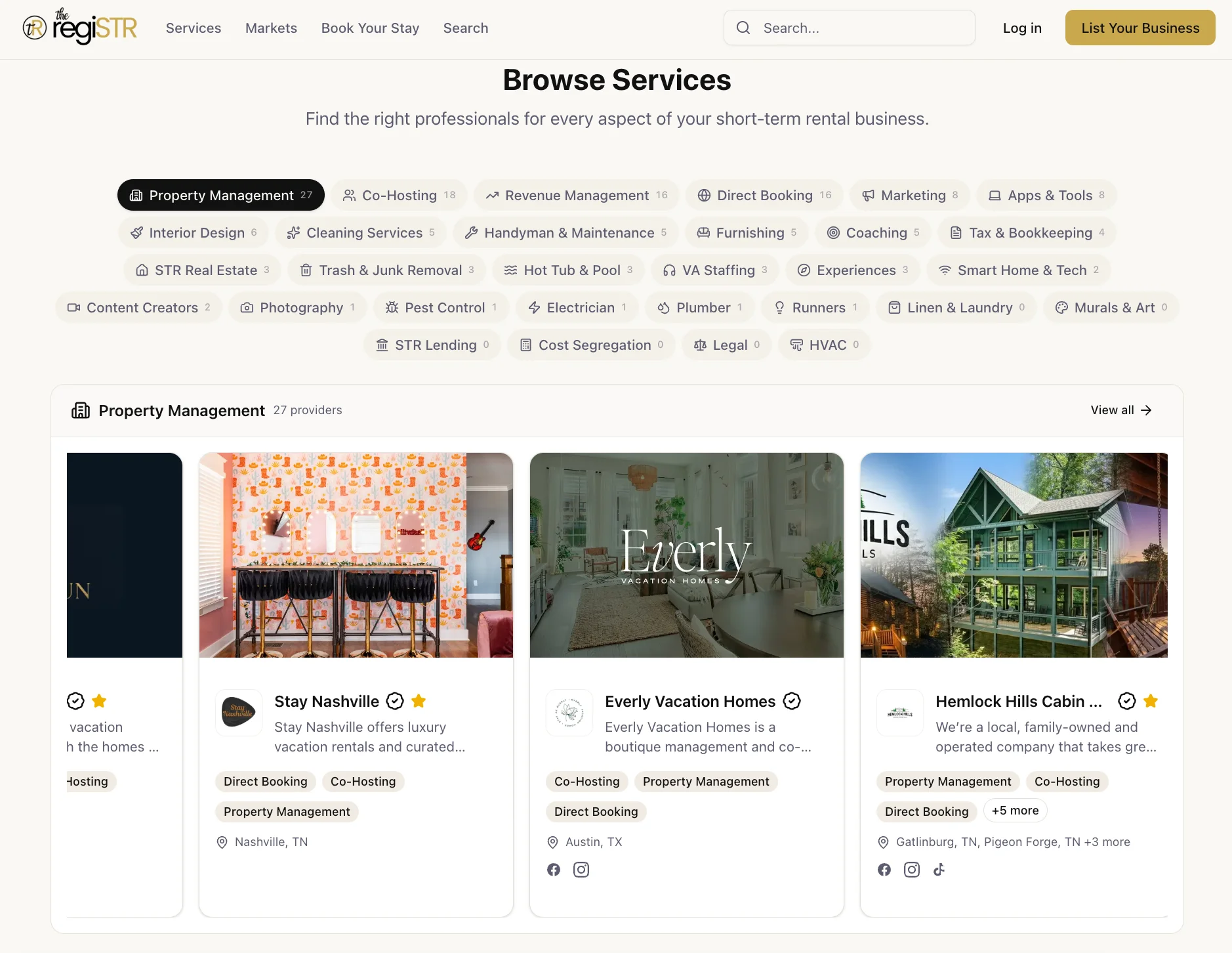
Instead of posting in host Facebook groups and hoping someone recommends a cleaner who actually understands turnover timelines, browse vetted STR cleaning providers by market on the regiSTR. Sign up free and filter by city and service category in under a minute to find providers other operators have already vouched for.
Content powered by inkSTR.co