
STR Business Solutions: A Host's Real Guide to Vendors

STR business solutions refers to the full stack of vendors, services, and tools a short-term rental operator needs to run a profitable, compliant, guest-ready property: cleaning and turnover, property management, photography, revenue management, maintenance, and regulatory guidance. In 2026, most hosts piece this stack together from several different providers rather than one company.
Key Takeaways
- STR business solutions cover at least seven core categories: cleaning, property management, photography, revenue management, maintenance, interior design, and regulatory compliance.
- The global vacation rental market reached an estimated $101.37 billion in 2026, up from $97.85 billion in 2026, according to Precedence Research, and it's projected to grow to roughly $138.74 billion by 2035.
- Offline booking still made up an estimated 70% of the market share in 2026 per Precedence Research, which means direct booking infrastructure is still an underused lever for most hosts.
- General business directories rarely filter for STR-specific experience, which is why so many hosts end up hiring cleaners or handymen who have never worked a same-day turnover.
- Regulatory complexity is increasing, not decreasing. Cities are adding licensing schemes, zoning restrictions, and reporting requirements that vary block to block in some markets.
- the regiSTR organizes STR business solutions by market and service category, with providers referred in by existing network members rather than pulled from an open, unvetted listing pool.
If you searched "STR business solutions" expecting a single company that handles everything, you're going to be disappointed by what actually exists in this industry. What you'll find instead, if you search that phrase directly, are a couple of generalist consultancies that happen to use "STR" as company initials, not as shorthand for short-term rentals. Neither has anything to do with Airbnb, Vrbo, or vacation rental operations.
That naming collision is common enough that it's worth addressing head-on. For anyone running a vacation rental, "STR" means short-term rental, and the business solutions you actually need look nothing like generic office consulting or UK payroll compliance. You need a cleaner who can turn a property in under two hours. You need a photographer who knows what an OTA hero shot looks like. You need someone tracking whether your city just changed its permit rules again.
This guide breaks down what STR business solutions actually mean for a host or investor in 2026, what each category costs to get wrong, and how the regiSTR fits into solving the vendor discovery problem that generic directories were never built to handle. We work across this industry every day, and the pattern we consistently see is hosts assembling their vendor stack through Facebook groups and word of mouth long after they could have found vetted providers faster.
What Exactly Are STR Business Solutions?
STR business solutions are the combined set of services, vendors, and operational tools that keep a short-term rental running: cleaning and turnover, property management or co-hosting, photography, maintenance, revenue management, interior design, and regulatory compliance. Unlike a single "business solutions" firm offering generalist consulting, this stack is inherently niche and market-specific.
First, understand that no single vendor typically covers all of these. A full-service property manager might bundle cleaning and guest communication, but you'll usually still need a separate photographer and, in many markets, a separate compliance consultant. Specifically, the categories that matter most are operational (cleaning, maintenance, co-hosting), strategic (revenue management, marketing, direct booking), and creative (photography, interior design and staging).
As a result, hosts who treat this as "I'll just find one company to handle it all" tend to end up disappointed. The regiSTR's directory structure reflects this reality directly: it's organized by service category and market precisely because that's how the industry actually operates, not as one bundled product.
Why Do General Business Directories Fail STR Hosts?
General business directories fail STR hosts because they filter by industry type (cleaning, real estate, photography) rather than by short-term rental experience specifically. A cleaner who's excellent for weekly residential service may have never handled a same-day turnover with a 90-minute window between checkout and check-in.
This gap shows up constantly. A photographer with a strong wedding portfolio doesn't automatically know how to shoot a wide-angle hero image that performs on Airbnb search results. A handyman who's great with long-term tenants may not understand why a broken thermostat during a guest's stay is an emergency, not a next-week appointment.
Additionally, most general directories rely on anonymous star ratings that can be manipulated or simply don't reflect STR-specific competence. A five-star rating for punctuality doesn't tell you whether that provider understands turnover timelines at all. That's exactly why providers list on the regiSTR: every visitor is already an STR operator looking for STR-specific services, and providers are referred in by other network members rather than self-submitted with no vetting.
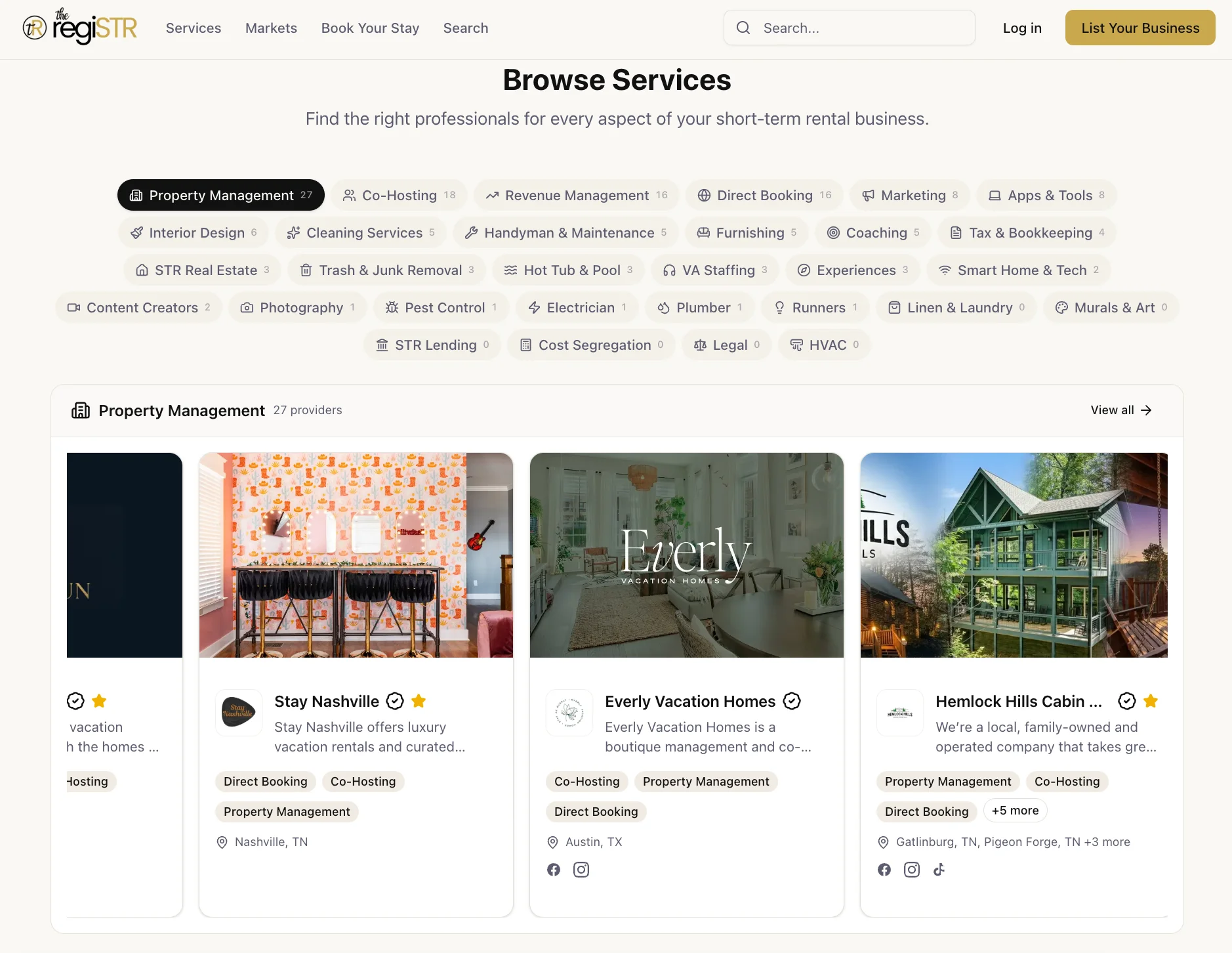
What Services Do STR Property Management Companies Provide?
STR property management companies typically provide guest communication, booking calendar management, cleaning coordination, pricing oversight, and maintenance dispatch, bundled under a single monthly or per-booking fee. Full-service management is the most comprehensive STR business solution available, but it isn't free, and it isn't the right fit for every operator.
Full-service fees vary significantly by market and service tier, and they tend to run on the higher end of the range in competitive vacation rental destinations. Before signing anything, ask specifically what's included: does the fee cover supply restocking, or is that billed separately? Is pricing strategy included, or do you need a separate revenue manager?
Co-hosting is a lighter alternative, where a local partner handles guest messaging and turnover coordination while you retain more control over pricing and bookings. This matters most for out-of-state owners who can't be on call for a maintenance emergency at 11pm on a Saturday in a market they've never lived in.
Hosts in the markets we cover can browse vetted STR property managers filtered by city, which shortcuts the months of trial and error most remote owners go through before finding someone reliable.
How Much Does Airbnb Turnover Cleaning Typically Cost?
Airbnb turnover cleaning costs vary by property size, market, and cleaning frequency, and pricing in high-demand vacation rental markets tends to run higher than the national average. Rather than quoting a flat number that won't hold up across markets, the smarter approach is understanding what drives the price up or down.
First, square footage and bedroom count are the biggest cost drivers, since more beds mean more linen changes and staging time. Additionally, same-day turnaround windows (checkout at 11am, check-in at 1pm) typically cost more than next-day cleans because the cleaner has less scheduling flexibility around your property.
In contrast, a cleaner juggling five other STR turnovers on the same day is a red flag regardless of price. If your cleaner can't guarantee a specific turnaround window, that's not a pricing problem, it's a reliability problem, and it will cost you a bad review eventually.
Finding a reliable STR cleaner in a market you've never visited used to mean posting in Facebook groups and hoping for a response. Browse vetted STR cleaning services by city on the regiSTR, where every listed provider has been referred in by an existing network member rather than pulled from a generic classifieds listing.
Should I Hire a Property Manager or Self-Manage My Short-Term Rental?
Whether to hire a property manager or self-manage depends on how much your time is worth against the fee, and how many properties you're running. Self-managing works fine for a single nearby property with light guest volume; it becomes unsustainable fast once you add a second property, an out-of-state location, or a full-time job on top of it.
Consider the real cost of self-managing: answering guest messages at odd hours, coordinating a cleaner's no-show, sourcing an emergency repair, and updating pricing manually every week. None of that shows up on an invoice, but it's a genuine cost in time and stress.
Burned-out self-managing landlords often assume professional management isn't worth the fee because they've never actually priced out what a bad month of self-managing costs them in missed messages, delayed repairs, or a guest refund from a bungled turnover. Full-service management fees are real money, but so is the opportunity cost of doing everything yourself.
If you're leaning toward handing off operations, this is exactly the vetting criteria the regiSTR applies when listing property managers: response time, transparent fee structure, and peer endorsements from other operators who've actually hired that manager, not just a star rating pulled from an anonymous review pool.
How Do I Find a Vacation Rental Photographer Who Understands Airbnb Listings?
A vacation rental photographer who understands Airbnb listings shoots specifically for OTA performance: wide-angle hero shots, natural light staging, and detail images that highlight amenities guests search for, like a hot tub or a full kitchen. A generalist real estate or wedding photographer usually doesn't know these conventions without direction.
Specifically, look for portfolio samples that show actual STR listings, not just staged interiors shot for a real estate MLS. The angles differ: real estate photography emphasizes square footage and layout for buyers, while STR photography sells an experience to a traveler scrolling through search results in seconds.
Ask whether the photographer offers virtual tours or video walkthroughs, since both increasingly factor into how listings convert on Airbnb and Vrbo. Additionally, ask about turnaround time. A photographer who takes three weeks to deliver edited images isn't going to work if you're trying to launch a new listing this month.
Find STR-specialized STR photographers in your market through the regiSTR, where listed providers have direct vacation rental portfolio experience rather than a generic commercial photography background.
What Should I Look For When Vetting a Vacation Rental Cleaning Company?
When vetting a vacation rental cleaning company, prioritize guaranteed turnaround windows, supply restocking capability, and communication workflow over price alone. A cleaner who can't commit to a specific turnaround time isn't the right fit for STR, no matter how competitive their rate is.
Ask these questions before hiring: Can you guarantee a turnaround within a defined window, even on same-day turns? Do you handle linen restocking and supply inventory, or is that on me? What's your backup plan if your regular cleaner calls in sick? How do you document completed cleans, photos, checklists, or nothing at all?
A red flag worth taking seriously: a cleaner who won't answer how many other STR properties they service on your turnover day. If they're stretched across too many same-day turns, your property is the one that slips when something goes wrong.
This is exactly the vetting criteria the regiSTR applies when listing cleaning providers in the directory, filtering specifically for STR turnover experience rather than general residential cleaning history.
How Do I Find STR Maintenance and Handyman Services in a Market I Don't Live In?
Finding STR maintenance and handyman services in a market you don't live in requires a vendor who understands that a broken HVAC unit during an active guest stay is an emergency, not a next-week job. General handyman directories don't filter for this urgency or STR familiarity.
Out-of-state owners face a specific version of this problem: the Google Maps scroll, the unreturned calls, the contractor who quotes a week out for a repair your guest needs fixed tonight. This is the single most common complaint we hear from remote owners managing properties across multiple markets.
Look for maintenance providers who explicitly list STR experience and same-day or next-day emergency response as part of their service offering. Additionally, confirm they actually service the specific market where your property sits, not just the broader metro area, since coverage gaps between neighboring towns are common.
Stop cold-calling contractors who've never dealt with an STR turnover. Find vetted STR maintenance providers for your exact market on the regiSTR, filtered by the cities they actually serve.
How Much Does an STR Property Manager Charge and What's Included?
STR property management fees vary by market and service tier, and full-service management typically runs on the higher end of the range in competitive vacation rental destinations compared to lighter co-hosting arrangements. A good management contract spells out exactly what's covered before you sign, not after your first billing cycle.
At minimum, a solid management contract should specify: fee structure (percentage of revenue versus flat fee), what's included in guest communication coverage, whether pricing strategy is bundled or billed separately, cleaning coordination responsibilities, and maintenance dispatch authority (does the manager need your approval for repairs under a certain dollar threshold?).
Compare the following structures side by side before deciding which fits your property:
| Service Model | Typical Scope | Best Fit For |
|---|---|---|
| Full-Service Property Management | Guest messaging, pricing, cleaning coordination, maintenance dispatch bundled under one fee | Out-of-state owners, first-time hosts, multi-property portfolios |
| Co-Hosting | Guest messaging and turnover coordination, owner retains pricing and booking control | Hosts who want local support without giving up strategic control |
| Self-Management with A La Carte Vendors | Owner handles guest messaging directly, hires cleaners/handymen individually | Nearby single-property owners with time to manage day-to-day |
Comparing quotes side by side is exactly what the regiSTR's directory enables. Browse property managers by city and service category to see how fee structures and included services actually differ before you commit to one.
How Do I Find an Interior Designer Who Specializes in Short-Term Rentals?
An interior designer who specializes in short-term rentals designs for durability, photogenic staging, and guest experience simultaneously, not just aesthetics. STR interior design differs from residential design because every surface needs to survive constant turnover, and every room needs to photograph well for a listing.
Look for a designer who asks about your guest profile and booking calendar before proposing a design plan. A property targeting families needs different furniture durability standards than one targeting couples on a romantic getaway. Additionally, ask whether they've sourced furnishings specifically for rental durability versus retail pieces meant for a primary residence.
Staging photography readiness matters too. A designer with STR experience understands that a living room needs to photograph well under the specific lighting conditions a listing photographer will use, not just look good in person.
Find STR interior designers who understand both durability and photogenic staging on the regiSTR, filtered by the markets where they've actually worked on vacation rental properties.
What Are the Biggest Content Gaps in Generic Business Solutions Advice?
The biggest gap in generic business solutions advice is treating short-term rental operations like any other small business, ignoring the specific regulatory, seasonal, and turnover pressures unique to vacation rentals. This gap explains why so much "business solutions" content online misses what STR hosts actually need.
Regulatory complexity is a distinct challenge in this space. Many cities have implemented licensing schemes, zoning changes, and increased taxes specifically targeting short-term rentals to address housing concerns and overtourism, which increases compliance complexity year over year. That means the regulatory advice that applied last year in your market may already be outdated.
Seasonality also behaves differently for STRs than for most small businesses. A cabin market's peak season might be four months long, while a beach market's peak might be different entirely, and your vendor stack (cleaning frequency, maintenance response time, pricing strategy) needs to flex with that seasonality in a way generic business advice never addresses.
STR consulting and advisory services exist specifically to bridge this gap. Rather than a generalist business consultant, look for someone who's worked specifically with vacation rental operators and understands platform-specific dynamics on Airbnb and Vrbo.
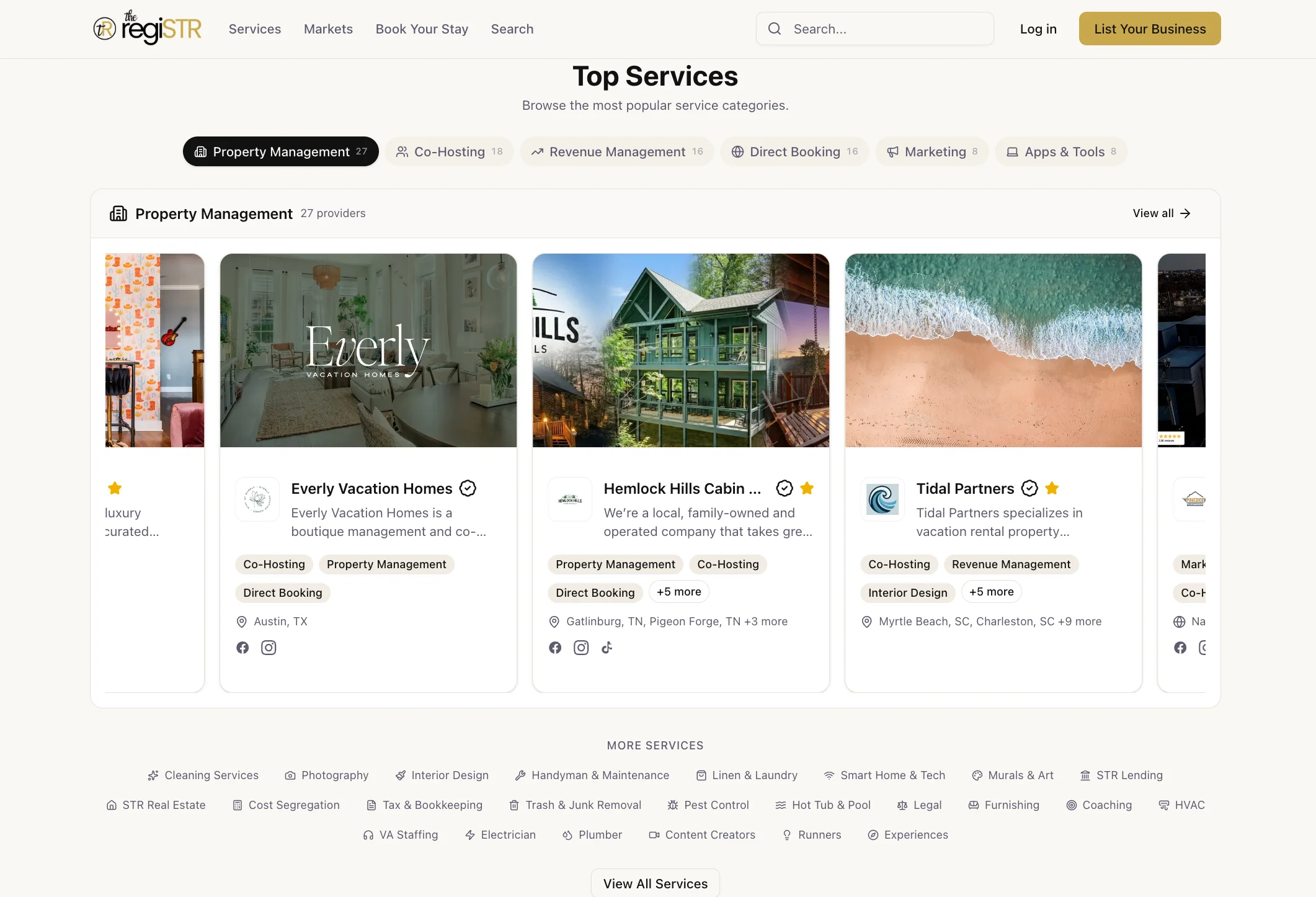
How Do I Evaluate STR Service Providers Without Getting Burned?
Evaluating STR service providers without getting burned means checking for peer endorsements from other actual operators, not just star ratings, and confirming the provider has direct short-term rental experience rather than adjacent residential or commercial background. This applies across every category: cleaning, management, photography, and maintenance.
Follow this checklist before hiring any STR vendor:
- Ask for at least one reference from another current STR client, not just a general customer.
- Confirm they explicitly service your specific market, not just the broader metro area.
- Verify their availability aligns with your typical turnover windows, especially for same-day turns.
- Get the fee structure and scope of work in writing before the first service date.
- Check whether they've listed or been vouched for on an STR-specific platform rather than only a general business directory.
The Vouch system on the regiSTR addresses this last point directly: providers are publicly endorsed by name, by real STR operators who've actually hired them, which carries more weight than an anonymous five-star rating that could apply to any type of client at all.
Data and Evidence: What the Vacation Rental Market Looks Like in 2026
The vacation rental market reached an estimated $101.37 billion globally in 2026, up from $97.85 billion in 2026, and is projected to grow to roughly $138.74 billion by 2035 at a compound annual growth rate of 3.55%, according to Precedence Research. Europe led with the largest regional share at 34% in 2026, and the homes segment (versus apartments or resorts) held the biggest share at roughly 49%.
Notably, offline booking still captured 70% of the market share in 2026 per the same research, meaning direct booking infrastructure remains underused relative to its potential. If you're relying entirely on OTA traffic, you're leaving a substantial channel on the table.
Consumer sentiment data reinforces why this business exists at all: almost 60% of respondents in a Statista survey said short-term rentals provide a valuable additional income source, and just over 50% felt positively about the impact on residents' quality of life. That's a meaningfully split sentiment, which is part of why regulatory scrutiny continues increasing in many cities.
As younger travelers, expected to make up around 75% of the traveler population per Airbnb's own projections, continue driving demand, the operators who invest in professional photography, responsive maintenance, and compliant operations are the ones positioned to capture that growth rather than lose share to regulatory friction or bad reviews.
What's the Practical Framework for Building Your STR Vendor Stack?
Building your STR vendor stack means prioritizing categories in order of operational risk, starting with cleaning and turnover, then property management or co-hosting, then photography, then revenue management and compliance. Getting the order wrong, chasing a revenue manager before you have a reliable cleaner, is a common and expensive mistake.
For first-time hosts, start here:
- Lock in a reliable cleaner who can guarantee your turnaround window before you accept your first booking.
- Decide between self-managing, co-hosting, or full-service management based on how much time you realistically have.
- Invest in professional photography before your listing goes live, not after three months of underperforming bookings.
- Confirm your local permit and licensing requirements directly with your city or county before your first guest checks in.
- Add revenue management and direct booking infrastructure once your operations are stable, not before.
For scaling investors managing multiple properties across different markets, the priority order flips: revenue management and property management come first, since inconsistent vendor quality across markets is the bigger risk at scale than any single category gap. Not every STR needs a revenue manager on day one, but every multi-property portfolio eventually does.
Common mistakes to avoid: hiring the cheapest cleaner without confirming turnaround guarantees, skipping professional photography to save money on a listing that will earn back that cost many times over, and assuming your city's regulations haven't changed since you last checked.
Frequently Asked Questions
What is the regiSTR and how does it differ from general business directories?
The regiSTR is a short-term rental service directory that connects vacation rental hosts with vetted providers across cleaning, property management, photography, maintenance, and more. Unlike general business directories, every provider is filtered specifically for STR experience and referred in by existing network members rather than self-listed with no vetting.
How do I find a vetted STR cleaner in a market I don't live in?
Browse the regiSTR's cleaning category filtered by your property's specific city, checking for guaranteed turnaround windows and supply restocking capability. Ask for a reference from another current STR client in that market before committing, since a residential cleaning background doesn't guarantee same-day turnover reliability.
What should I look for when hiring a property manager for a short-term rental?
Look for transparent fee structure, clear turnaround expectations, and confirmation of what's bundled (pricing, cleaning, maintenance) versus billed separately. Ask for references from other current clients and confirm response time commitments in writing before signing anything.
How does the regiSTR's Vouch system work?
The Vouch system lets real STR operators publicly endorse providers they've personally hired, with their name and operator context attached. This creates accountable, peer-verified proof of quality that's harder to manipulate than anonymous star ratings.
What service categories are available in the regiSTR directory?
The regiSTR covers cleaning and turnover, full-service property management, co-hosting, photography and virtual tours, interior design and staging, maintenance and repairs, revenue management and dynamic pricing, SEO and content marketing, website design, social media management, and regulatory and compliance consulting.
How can I list my STR service business on the regiSTR?
Service providers can join through an onboarding flow that includes profile auto-fill from an existing website and Google Maps integration for service area setup. Once listed, providers appear to hosts actively searching for that specific service category in that specific market, rather than competing in a general, unfiltered directory.
Is the regiSTR available in my market?
Location-dependent services like cleaning, maintenance, and property management are organized by specific metro and market pages, while services like revenue management, SEO, and website design are available nationwide regardless of where your property sits. Check the market pages directly to confirm local provider coverage in your area.
What's the difference between a co-host and a full-service property manager?
A co-host typically handles guest messaging and turnover coordination while you retain control over pricing and booking decisions, whereas a full-service property manager bundles pricing strategy, cleaning coordination, and maintenance dispatch under one comprehensive fee. Co-hosting suits hosts who want local support without giving up strategic control.
Conclusion: Building Your STR Business Solutions Stack in 2026
STR business solutions aren't a single product you buy once. They're a stack of vetted vendors, cleaning, property management, photography, maintenance, and compliance, that you build category by category based on your property's specific market and your own capacity to manage it. The vacation rental market is projected to keep growing through 2035, and the operators who invest in the right vendor stack now are the ones positioned to capture that growth rather than lose ground to a bad cleaner or an outdated permit.
The vendors exist. What's been missing is a reliable, STR-specific way to find and vet them in your exact market, rather than relying on Facebook groups or a general directory that doesn't filter for turnover experience at all. Get started with the regiSTR and browse vetted providers by city and service category before your next booking cycle starts.
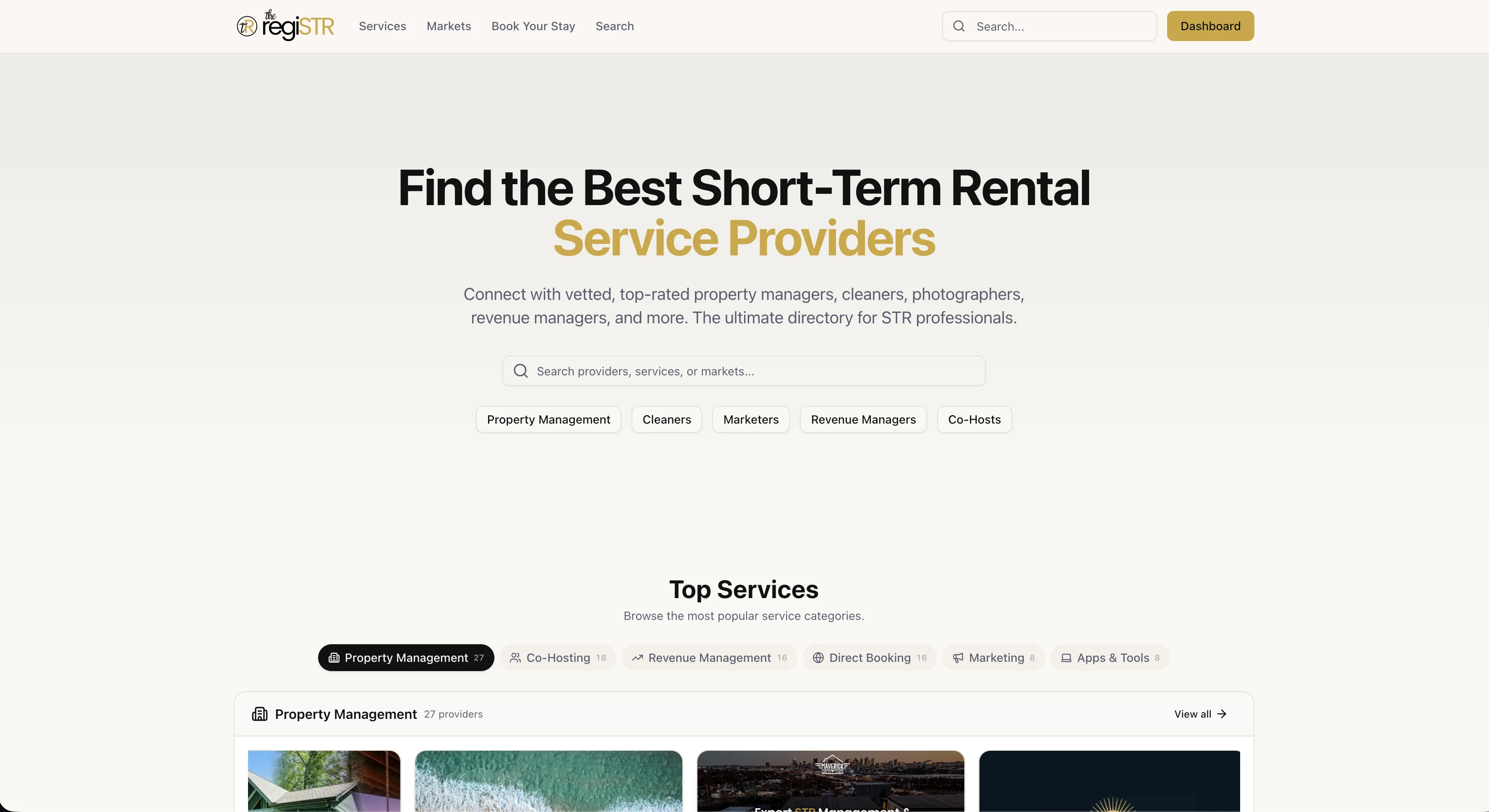
If you're piecing together your vendor stack one category at a time, browse vetted STR service providers across cleaning, property management, photography, and compliance in one place, organized by the market where your property actually sits.
Content powered by inkSTR.co