
Rent Management Company: A Host's Honest Vetting Guide

A rent management company for a short-term rental is a firm that handles the operational load of running a vacation property: guest communication, turnover coordination, pricing, maintenance dispatch, and owner reporting, typically in exchange for a percentage of revenue or a flat monthly fee. Whether it's worth the cost depends less on the sticker price and more on what your time, vacancy risk, and guest experience are actually worth to you.
Key Takeaways
- Full-service rent management companies for short-term rentals commonly charge fees that vary significantly by market and service tier, and industry research on residential property management shows monthly management fees often run in the 8% to 12% of collected rent range, a useful reference point even though STR pricing structures differ.
- Tenant-placement style fees on the long-term rental side often run 25% to 100% of one month's rent, according to industry data, which matters if your STR company also handles mid-term or long-term conversions.
- Maintenance markups reported across residential property management research typically fall between 10% and 25% on top of repair costs, a detail hosts should ask about upfront in any STR management contract.
- The distinction between a company charging on rent collected versus rent due can change your effective cost by a meaningful margin over a year, and it rarely gets explained clearly in a sales call.
- Not every host needs full-service management. Rent collection only, tenant or guest placement, partial management, and full-service are four distinct tiers, and picking the wrong one wastes money in either direction.
- The regiSTR lists vetted property management companies and co-hosts by market, with peer endorsements attached, so you can compare real options instead of relying on a single sales pitch.
Hiring a the regiSTR vetted management company is one of the biggest operational decisions an STR owner makes, and it's also one of the most opaque. Most hosts research this question after something has already gone wrong: a missed guest message, a maintenance issue that spiraled, or a burnout point where self-managing stopped being worth the money saved.
This guide breaks down what a rent management company actually does for a short-term rental, what it costs based on verifiable industry data, and how to decide whether hiring one makes sense for your specific property in 2026. We'll also cover the fee structures competitors rarely explain clearly, the ones that quietly inflate your annual cost.
Is It Worth Using a Rental Management Company?
Using a rental management company is worth it when the value of your recovered time, reduced vacancy, and professional guest handling exceeds the management fee, which typically runs in the 8% to 12% range on the residential side and often higher for full-service short-term rental management given the added workload of turnovers and guest messaging.
For a first-time host with one property and flexible time, self-managing can make financial sense in year one. You learn the operational rhythm, you keep more of the revenue, and you build the vendor relationships (cleaners, handymen, a backup key holder) that make future scaling easier.
For an out-of-state owner or someone juggling three or more properties, the math flips fast. A missed 2am guest lockout, a same-day turnover that falls through, or a maintenance emergency in a market you've never visited costs far more in stress and reputation than a management fee ever will.
The honest answer: it's not a universal yes or no. It's a function of your portfolio size, your local presence, and whether you actually enjoy the operational side of hosting. A lot of owners hire a company not because they can't do the work, but because they'd rather not.
This is exactly the vetting criteria the regiSTR applies when listing property management companies: does the provider serve STR specifically, not just long-term residential leasing, and can they show peer endorsements from operators who've actually used them. Browse Find STR Property Managers by market to compare options instead of taking one sales call at face value.
How Much Does Rent Manager Cost per Month?
Monthly rent management costs are typically structured as a percentage of collected revenue, and industry research on residential property management puts the standard range at 8% to 12% of monthly rent, though flat-fee arrangements averaging around $300 per month also show up across the market depending on property type and region.
For example, on $1,200 in monthly rent, an 8% to 12% fee translates to roughly $96 to $144 per month, according to figures reported by property management research firms. On a $2,500 monthly rental, traditional management fees have been reported in the $200 to $250 per month range.
Short-term rentals complicate this comparison because "monthly rent" isn't a fixed number, it's variable revenue driven by occupancy and seasonality. A full-service STR management company charging a percentage of gross booking revenue is effectively taking a bigger bite during peak months and a smaller one during slow ones, which is different math than a flat percentage of a fixed long-term lease.
Beyond the headline percentage, additional charges commonly show up in contracts: setup fees (reported in the $0 to $500 range depending on the provider), renewal fees ($200 to $500), inspection fees ($50 to $150), and emergency repair reserves that some contracts require upfront (reported as $250 to $1,000 per property in industry data).
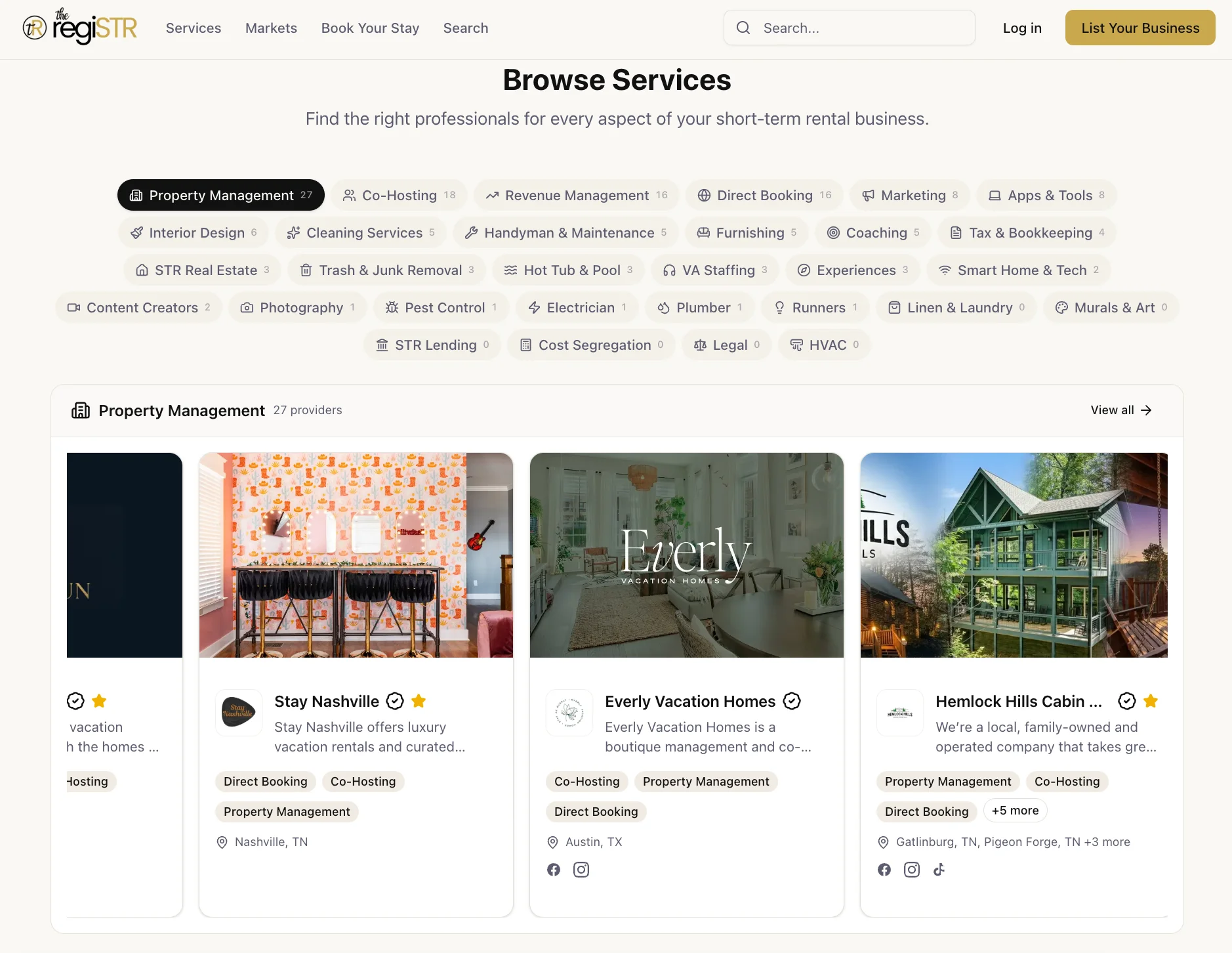
Comparing quotes side by side is exactly what a directory model enables. On the regiSTR, you can filter property management companies by market and service tier, then ask each one for a full fee schedule, not just the headline percentage, before signing anything.
What Is the 50% Rule in Rental Property?
The 50% rule in rental property investing is a rough estimating shortcut that assumes roughly half of a property's gross rental income will go toward operating expenses (excluding mortgage principal and interest), such as maintenance, property management, insurance, taxes, and vacancy reserves.
It's a back-of-envelope tool, not a precise budgeting method, and it originated in long-term rental investing rather than short-term rental operations. Applying it to a vacation rental requires adjustment, because STR operating costs typically run higher than long-term rental costs due to turnover cleaning between every guest stay, higher utility usage, furnishing depreciation, and OTA platform fees on Airbnb and Vrbo that don't exist in traditional leasing.
For an STR owner, a more useful version stacks up your actual line items: management fee (8% to 30% depending on service tier), cleaning and turnover costs per stay, maintenance markups (commonly 10% to 25% over materials, per industry data), platform commissions, insurance, and a vacancy or off-season reserve. Adding these up for your specific property gives you a real number, not a rule of thumb borrowed from a different asset class.
We consistently see hosts underestimate the maintenance markup line item specifically. If your management company charges a 15% markup on every repair and your property needs frequent small fixes (a common pattern in older cabins or heavily booked beach properties), that line adds up faster than the headline management percentage suggests. Ask for a trailing twelve-month maintenance spend from any provider you're evaluating, not just their rate card.
What Is the Best Property Management Company in Florida?
There is no single best property management company for Florida short-term rentals because the right fit depends on your specific market (coastal versus inland, condo versus single-family), your property type, and whether you need full-service management, co-hosting, or a lighter-touch service tier. Florida's STR regulatory landscape also varies significantly by county and municipality, which makes local specialization a bigger factor than brand size.
Instead of chasing a single "best" answer, evaluate Florida providers against a specific checklist: do they operate short-term rentals specifically (not just long-term residential leases), do they have documented experience with your county's short-term rental permitting requirements, and can current clients vouch for their response time during peak season, when Florida's coastal markets see the heaviest guest volume.
Florida hosts also face a compliance layer many other states don't: local tourist development taxes, condo association short-term rental restrictions, and city-specific registration rules that change periodically. A provider unfamiliar with your specific municipality's requirements is a liability, regardless of how polished their marketing looks.
The regiSTR's market pages let you filter Florida property managers and co-hosts by city, so you can see who actually serves Miami Beach, Orlando, or Saint Augustine specifically instead of a generic "Florida" listing that may not know your local rules. Browse Find STR Property Managers and check which markets each provider profile lists as served before reaching out.
What Does a Rent Management Company Actually Do?
A rent management company for a short-term rental handles the day-to-day operational functions an owner would otherwise do themselves: guest communication and screening, listing optimization across Airbnb and Vrbo, dynamic pricing adjustments, turnover cleaning coordination, maintenance dispatch, and monthly owner financial reporting.
Full-service providers typically bundle these into one fee. Lighter-touch co-hosts might handle only guest messaging and pricing while you retain your own cleaner and handyman relationships. Partial management arrangements split the difference, commonly covering guest-facing tasks while leaving maintenance oversight to the owner.
The specific mix of services matters more than the label a company uses. Two providers both calling themselves "full-service" can differ enormously: one might include revenue management with active pricing adjustments during demand spikes, while another sets a price once a month and leaves it flat regardless of local events or booking pace.
- Guest communication: pre-arrival messaging, check-in instructions, in-stay support, review requests
- Revenue management: dynamic pricing adjustments based on demand, seasonality, and comp set movement
- Turnover coordination: scheduling cleaners, verifying supply restocking, managing same-day turnaround windows
- Maintenance oversight: dispatching repairs, vetting handymen, handling emergency issues
- Owner reporting: monthly statements showing revenue, expenses, and occupancy
Not every property needs every one of these bundled together. That's exactly why we built the regiSTR's category structure around individual services (cleaning, co-hosting, revenue management, maintenance) rather than forcing hosts into a single all-or-nothing package. You can hire à la carte through Browse All STR Services or find a bundled full-service provider, whichever fits your situation.
How Should You Compare Rent Collection Only, Placement, Partial, and Full-Service Management?
Choosing between rent collection only, guest placement, partial management, and full-service management comes down to how much operational involvement you want to keep versus hand off, and each tier carries a meaningfully different cost and control tradeoff.
| Service Tier | What's Included | Best For | What You Still Handle |
|---|---|---|---|
| Rent/booking collection only | Payment processing, basic reporting | Hosts who self-manage everything else | Guest messaging, cleaning, maintenance, pricing |
| Guest placement / listing only | Listing creation, initial booking, screening | Owners who want help filling calendar but manage the stay themselves | Ongoing guest communication, turnovers, repairs |
| Partial management | Guest communication and pricing, sometimes turnover scheduling | Local owners who want relief from guest-facing tasks | Maintenance oversight, vendor relationships |
| Full-service management | Everything: guests, pricing, turnovers, maintenance, reporting | Out-of-state owners, multi-property portfolios, burned-out self-managers | Financial oversight and periodic check-ins |
The mistake we see most often: hosts pay full-service fees for a partial-management workload, or the reverse, they hire a bare-bones placement service and then get frustrated when maintenance issues fall entirely on them. Match the tier to what you actually want off your plate, not to whatever package the provider defaults to selling.
This is where comparing multiple providers matters more than picking the first one you find. On the regiSTR, provider profiles specify which service tiers they offer, so you're not guessing whether "management" means full-service or just guest messaging before you get on a call.
What Should Your Management Contract Actually Include?
A short-term rental management contract should clearly define the fee structure (percentage of collected revenue versus gross booking value), the specific services included at that fee, the notice period required to terminate, and how maintenance costs above a certain threshold get approved.
The single clause that causes the most disputes: whether the company charges its percentage on revenue collected or revenue due. A contract charging on rent or booking revenue due, rather than actually collected, means you pay the fee even on a cancelled or unpaid stay. Over a full year, this distinction can add up to a meaningful gap between what you expected to pay and what actually leaves your account.
A second clause worth scrutinizing: maintenance approval thresholds. If your contract allows the manager to authorize repairs up to a set dollar amount without contacting you first, know that number. Industry data shows maintenance markups commonly running 10% to 25% over materials cost, so a manager with a high unilateral approval limit and a markup on top of it can generate surprise charges fast.
Other clauses to check before signing: cancellation and termination notice period, whether the contract auto-renews, how security deposits or damage claims get handled, and whether the company carries its own liability insurance or expects you to carry all of it. A vague contract on any of these points is a red flag regardless of how professional the sales conversation felt.
We built the regiSTR's Vouch system specifically because contract terms are hard to evaluate from a website alone. When another operator has vouched for a provider, it's usually because the contract terms matched what was promised, not just because the service was polite on the phone.
What Fees and Charges Should You Watch For?
Beyond the headline management percentage, short-term rental management contracts commonly include secondary charges that materially affect your annual cost: setup fees, renewal fees, inspection fees, vacancy charges, and reserve fund requirements.
Industry data on residential property management shows setup fees ranging from $0 to $500, renewal fees from $200 to $500, and inspection charges from $50 to $150. Some providers also require reserve funds, cited in one industry source at approximately $200 to $500 for a single-family property, held to cover emergency repairs without needing owner approval for every small expense.
Vacancy or off-season charges show up in some contracts too, reported around $50 per month in certain residential management structures, though this concept translates differently for STRs where "vacancy" is really just unbooked nights rather than a formal lease gap.
Here's a realistic way to estimate your full annual cost instead of just the headline percentage:
- Start with your projected annual gross booking revenue.
- Apply the management fee percentage to get your base management cost.
- Add estimated setup, renewal, and inspection fees for the year.
- Add expected maintenance costs, then apply the reported 10% to 25% markup range to that figure.
- Add any reserve fund requirement the contract specifies.
- Compare that total against what you'd spend on your own time plus a backup cleaner and handyman if self-managing.
Running this calculation before signing, not after your first monthly statement arrives, is the difference between an informed decision and an expensive surprise. Comparing quotes is straightforward on the regiSTR: browse provider profiles by city and service category and request a full fee schedule from each before you commit.
How Do Rent Management Companies Handle Maintenance and Repairs?
Rent management companies for short-term rentals typically maintain a network of vetted local handymen, contractors, and specialists, dispatching them as issues arise and applying a markup to the repair cost, commonly reported in the 10% to 25% range in industry data, as their fee for coordination and oversight.
The value here is speed, not necessarily savings. A management company with an established handyman relationship in your market can often get someone on-site same-day for an HVAC failure or a plumbing issue, something a remote owner calling around cold simply can't match, particularly in a market they've never lived in.
Ask any provider you're evaluating how they source their maintenance network. A company that maintains its own vetted list of STR-experienced handymen is different from one that pulls from a general contractor marketplace each time, where the person showing up may have never worked inside an occupied vacation rental before.
This is exactly the gap the regiSTR's Maintenance and Repairs category was built to close. Instead of relying entirely on your management company's internal vendor list, you can independently browse Find STR Maintenance providers in your market as a backup or a check against what your manager is already charging.

How Should You Evaluate and Choose a Management Company?
Choosing a rent management company for a short-term rental requires evaluating four things beyond price: local market experience, communication responsiveness, contract transparency, and verifiable references from current STR clients, not just general residential landlords.
Follow this sequence when vetting a provider:
- Confirm they specifically manage short-term rentals, not just long-term leases, since the operational skill sets differ significantly.
- Request a full written fee schedule covering management percentage, setup, renewal, inspection, and maintenance markup, not just the headline rate.
- Ask whether their percentage is calculated on revenue collected or revenue due, and get that in writing.
- Ask for two or three references from current owners in your specific market, and actually call them.
- Confirm response-time expectations for guest issues and maintenance emergencies, ideally with a specific number of hours.
- Review the termination clause and notice period before you need to use it.
One pattern we consistently see: hosts vet for price first and communication second, when it should be reversed. A property manager who goes quiet after month three costs you far more in guest experience and rebooking than a slightly higher percentage would have.
Compare quotes is straightforward on the regiSTR because every property management profile lists the markets served, the services included, and peer vouches from operators who've actually worked with that provider. That's a meaningfully different starting point than a cold search or a single referral from a Facebook group.
Data and Evidence: What Reported Fee Ranges Look Like Across the Industry
Industry-reported fee ranges vary widely by market and service structure, and short-term rental hosts should treat these as reference points rather than fixed prices, since your local market, property type, and service tier will move the actual number significantly.
| Fee Type | Reported Range | Notes |
|---|---|---|
| Monthly management fee | 8% to 12% of collected rent | Residential benchmark; STR full-service often runs higher given turnover workload |
| Tenant/guest placement fee | 25% to 100% of one month's rent | Wide range reported across providers and markets |
| Setup fee | $0 to $500 | One-time onboarding charge |
| Renewal fee | $200 to $500 | Charged at lease or contract renewal |
| Inspection fee | $50 to $150 | Per property inspection visit |
| Maintenance markup | 10% to 25% over materials/labor | Applied to third-party repair costs |
| Reserve fund | $200 to $500 | Held for emergency repairs on single-family properties |
According to StayFi's reporting on Grand View Research figures, the U.S. vacation rental market was projected at $76.46 billion in 2026, up from $72.00 billion in 2026, a growth trajectory that's pulling more management companies into the STR-specific space rather than staying purely residential. That growth is part of why specialization matters more now than it did five years ago, generalist residential managers are increasingly competing with firms built specifically around turnover cycles and OTA channel management.
Frequently Asked Questions
How do I find a hotel management company for my property?
If you're looking for management specifically for a short-term rental rather than a full hotel, look for providers listed under STR-specific categories that show experience with Airbnb and Vrbo operations, not general hospitality or hotel management firms. The regiSTR's property manager directory filters by market and service type, which narrows the search to providers who actually understand vacation rental turnover cycles rather than hotel front-desk operations.
What does a rental management company do?
A rental management company for short-term rentals handles guest communication, pricing, turnover coordination, maintenance dispatch, and owner financial reporting, typically for a percentage of booking revenue. The exact scope varies by service tier, from partial management covering only guest-facing tasks to full-service management covering everything including maintenance oversight.
What does the 80/20 rule mean in property management?
There is no verified, standardized "80/20 rule" specific to property management fee structures in the data available. If you've seen this term referenced elsewhere, ask the specific provider using it to define exactly what it means in their contract rather than assuming it's an industry-wide standard, since terminology varies significantly between companies.
What is a host company?
A host company, in short-term rental terms, typically refers to a co-hosting business that manages guest communication and day-to-day operations on behalf of a property owner, often without full ownership of the listing itself. This differs from full-service property management, which usually includes maintenance oversight and revenue management on top of guest-facing tasks. Both co-hosts and full-service managers are listed separately on the regiSTR so you can identify which model fits your needs.
What services are available for vacation home management?
Vacation home management services typically include guest communication, dynamic pricing, turnover cleaning coordination, maintenance dispatch, listing optimization across Airbnb and Vrbo, and monthly owner reporting. Some providers bundle these into full-service packages, while others offer them à la carte, which is why comparing service scope, not just price, matters before you sign a contract.
Is it worth using a rental management company for a single property?
For a single property, it depends on your proximity to the property and how much time you can realistically dedicate to guest communication and turnover coordination. Out-of-state owners with even one property often find full-service management worth the cost because local presence for maintenance emergencies is difficult to replicate remotely.
How do I know if a management company's fee is on revenue collected or revenue due?
This should be explicitly stated in the contract's fee section, and if it isn't clear, ask directly before signing. A company charging on revenue due bills you even for cancelled or unpaid bookings, while revenue collected only charges you on money actually received, a difference that can add up significantly over a full booking year.
Conclusion
A rent management company earns its fee when it removes work you genuinely don't want to do or can't do well remotely, whether that's guest messaging at 11pm, coordinating a same-day turnover, or dispatching a handyman in a market you've never visited. The 8% to 12% baseline reported across the industry is a starting point, not a ceiling, and the real cost only becomes clear once you account for setup, renewal, inspection, and maintenance markup fees layered on top.
Whether you land on full-service management, a co-host, or a lighter partial arrangement, the decision should come from matching the service tier to your actual workload, not from picking whichever provider called back first. As the U.S. vacation rental market continues expanding in 2026, more specialized STR management options are entering every major market, which makes comparison shopping more valuable than it's ever been.
If you're ready to compare providers instead of guessing from a single sales call, Get started with the regiSTR and browse property management companies, co-hosts, and maintenance providers by market, each with peer vouches from operators who've actually worked with them. Sign up free at theregistr.co and filter by your city and service tier in under a minute.
Content powered by inkSTR.co