
Questions to Ask a Property Manager Before You Sign
Questions to ask a property manager before signing include how fees are calculated on collected versus scheduled revenue, what response time is guaranteed for maintenance emergencies, how often you receive owner reports, and what specific circumstances allow either party to terminate the contract. Get these answers in writing before you sign anything, not after your first bad guest experience.
Key Takeaways
- Fee structures vary widely: industry data shows residential management fees commonly run 8% to 12% of monthly rent, with tenant-placement or leasing fees, renewal fees, and maintenance markups charged separately.
- A written management agreement should specify start and end dates, renewal terms, included services, and exit conditions, according to guidance cited by property management contract resources like HomeRiver.
- Some jurisdictions set hard requirements, such as a documented emergency response window of 30 minutes for property owners in Baltimore, according to STR Profit Map.
- Property managers should be evaluated using measurable KPIs including occupancy rate, average days to lease, maintenance costs, and net operating income, a framework outlined by Buildium.
- The median number of properties managed per property manager rose from 32 in 2026 to 50 in 2026, according to the Long Island Board of Realtors, meaning your assigned manager may be juggling more accounts than you assume.
- the the regiSTR lists property managers who have been referred into the network and vouched for by other short-term rental operators, so you can compare answers to these exact questions before you ever get on a call.
If you own a short-term rental and you're about to hand the keys, calendar, and guest communication to someone else, the interview matters more than the contract. Most operators skip straight to fee percentage and skip everything that actually predicts whether the relationship will work: staffing ratios, reporting cadence, maintenance authority, and what happens the day you decide to leave.
This guide is built from what we track across the property management category on the regiSTR, where operators consistently tell us the same story: they hired based on price and got burned on communication. The questions below are organized around the full contract lifecycle, from staffing and fees to reporting and termination, so you walk into 2026 with a framework instead of a gut feeling.
We've also pulled in the exact Google-searched questions hosts ask about property managers, including the five P's, red flags, and the so-called 80/20 rule, because those searches tell us what owners are actually worried about before they sign.
What Are the Five P's of Property Management?
The five P's of property management is a framework commonly used to describe the core operational pillars a management company must handle well: People, Property, Process, Promotion, and Profit. Each pillar maps directly to a category of questions you should ask before hiring.
People covers staffing: who answers your phone at 2am, and whether one named manager or a rotating team handles your unit. Property covers maintenance standards, turnover quality, and inspection frequency. Process covers the systems behind screening, cleaning, and reporting. Promotion covers how the manager markets your listing across Airbnb, Vrbo, and direct channels. Profit covers fee structure, revenue optimization, and how net income actually lands in your account each month.
When you interview a manager, ask a specific question tied to each pillar instead of a generic "tell me about your services." For example, on People, ask what the manager-to-property ratio looks like on their team, not just the company's total portfolio size. On Promotion, ask specifically how they price your calendar during shoulder season versus peak weekends. Vague pillar-level answers are a signal the company hasn't operationalized these categories; specific, numbers-backed answers are a signal they have.
This is exactly the kind of structured vetting we apply when listing providers on the regiSTR's property manager directory: providers are asked to detail their staffing model, fee structure, and service scope before they're surfaced to hosts searching by market.
What Questions Should You Ask About Fees Before Signing?
Fee questions determine your actual take-home revenue more than any other part of the contract, and they're where vague answers cost owners the most. Industry data cited across property management resources shows residential management fees commonly range from 8% to 12% of monthly rent, but that percentage alone tells you almost nothing.
Ask specifically whether the fee is calculated on collected rent or scheduled rent. A manager charging on scheduled rent still collects their cut during a vacancy month, which changes your math significantly during slow season. Also ask about tenant-placement or guest-acquisition fees, lease-renewal or re-listing fees (commonly $150 to $500 per the fee ranges cited in industry sources), and vendor-bill markups on maintenance work, which typically run 5% to 15% on top of the actual repair cost.
Request a complete, itemized fee schedule covering management, leasing or re-letting, renewal, statement processing, technology, routine inspections, and trade coordination charges. If a manager can't produce this in writing during your first conversation, that's your answer about how transparent billing will be once you're locked into a contract.
Comparing quotes side by side only works if every provider is quoting against the same assumptions. This is exactly the kind of apples-to-apples comparison you get browsing Find STR Property Managers on the regiSTR, where fee structures are part of each provider's public profile rather than something you have to extract on a sales call.
| Fee Category | Typical Range | What to Ask |
|---|---|---|
| Management fee | 8% to 12% of monthly rent | Collected revenue or scheduled revenue? |
| Guest/tenant placement fee | 50% to 100% of first month's rent (long-term rental model) | Charged per booking or per lease term? |
| Renewal or re-listing fee | $150 to $500 | Flat fee or percentage-based? |
| Maintenance vendor markup | 5% to 15% | Applied to labor only or labor plus parts? |
| Eviction or dispute handling fee | $300 to $600 or more | Included in base fee or billed separately? |
What Are Good Questions to Ask a Property Manager About Guest Communication and Reporting?
Good questions about guest communication and reporting focus on measurable service levels, not general assurances. Ask exactly how fast guests receive a response during check-in issues, and ask exactly how often you, the owner, receive a financial and operational report.
Specifically, ask: what is the guaranteed response window for a guest locked out at midnight? Who handles that call, an in-house team or a third-party answering service? What happens if the assigned property manager is unavailable, is there a documented escalation path or does the ticket sit unanswered? In some markets, this isn't optional. Baltimore, for example, requires property owners to be able to respond to emergencies within 30 minutes, according to STR Profit Map, and a manager operating in a regulated market should already have workflows built around that kind of standard.
On reporting, ask to see a redacted sample owner report before you sign. A strong report includes exceptions and decisions made on your behalf, financial context for the month, maintenance activity, booking or leasing activity, and any open items still pending resolution. Ask how often reports are delivered: monthly is standard, but some managers only send quarterly summaries, which is too infrequent for a short-term rental where cash flow and occupancy shift week to week.
Also ask directly: does the company operate a separate trust or client-funds account for owner disbursements, and how often are those funds remitted? This single question separates operators who run a tight financial system from ones who commingle funds and hope nothing goes wrong.
What Are Red Flags When Hiring Property Managers?
Red flags when hiring a property manager include vague fee disclosures, an inability to name a specific point of contact, refusal to share a sample report, and reluctance to disclose their current portfolio size. Any one of these alone is worth a follow-up question. Two or more together should end the conversation.
Watch for these specific warning signs during your interview process:
- No written fee schedule available on request. If a manager can only describe fees verbally, or keeps redirecting to "we'll go over that in the contract," treat it as evasive.
- Can't state their manager-to-property ratio. A company managing hundreds of units with a handful of staff cannot deliver the attention a short-term rental needs during a busy weekend.
- No documented maintenance authorization limit. Ask what dollar amount they can spend on a repair without calling you first. If the answer is unclear or unlimited, your budget is exposed to decisions you never approved.
- Undisclosed vendor relationships. Ask directly whether the company owns or has a financial stake in the maintenance, cleaning, or brokerage vendors it recommends. A manager who profits twice, once on management fees and again on vendor markups, has a conflict of interest you deserve to know about upfront.
- Vague termination language. If the contract doesn't state a clear notice period and exit process, or the manager gets defensive when you ask about it, assume the exit will be harder than the sign-up.
- No references from current owners. A manager confident in their service should be able to connect you with at least one current client, not just a testimonial pulled from their website.
The referral-gated model behind the regiSTR exists specifically to filter out this kind of risk before you ever get on a call. Providers are vouched for by other STR operators who have actually worked with them, which surfaces the same red flags this section describes long before you sign anything.
What Does the 80/20 Rule Mean in Property Management?
The 80/20 rule in property management generally refers to the idea that roughly 80% of your operational issues, complaints, or maintenance costs come from a small subset, often around 20%, of your properties, tenants, or recurring problems. It's a prioritization principle, not a fixed statistic, and property managers use it to decide where to focus attention and resources.
In a short-term rental context, this often plays out as a small number of properties or booking windows generating the majority of guest complaints, damage claims, or last-minute maintenance calls. A manager who understands this concept should be able to tell you which of your specific pain points, turnover timing, HVAC reliability, guest screening, tend to drive most of the issues in your portfolio or market.
Ask your prospective manager how they identify and address the 20% of issues causing 80% of the headaches. A strong answer references specific systems: predictive maintenance scheduling, guest screening criteria, or turnover buffer times. A weak answer treats every property and every guest interaction as identical, which suggests the company isn't actually analyzing its own operational data.
Note that there is no universally agreed-upon "80/20 rule" specific to property management the way there is in general business efficiency contexts. Treat it as a useful mental model for the conversation, not a formal industry standard your manager is contractually obligated to follow.
What Should Be in a Property Management Contract Before You Sign?
A property management contract should clearly define start and end dates, whether the agreement automatically renews, the exact services included, and how either party can terminate. According to contract guidance cited by HomeRiver's checklist resources, ambiguity in any of these areas is the most common source of owner disputes after signing.
Beyond the basics, your contract should explicitly address:
- Scope of authority. What dollar threshold requires your sign-off before a repair proceeds, and what qualifies as an emergency exception?
- Fee basis. Is the management fee calculated on collected revenue or scheduled revenue, and are vacancy periods still billed?
- Insurance and liability. Does the manager carry errors-and-omissions coverage, and how is liability split between owner and manager if a guest is injured on the property?
- Handling of owner funds. Is there a separate trust account, and what is the remittance schedule?
- Dispute resolution process. What happens if you disagree with a charge or a maintenance decision, mediation, arbitration, or direct negotiation?
- Termination terms. What notice period is required, are there early-termination penalties, and who retains guest booking data and reviews after the switch?
Request the standard management agreement, a sample owner report, and a fee schedule as three separate documents before you sign anything. If a company treats these as proprietary or won't share them pre-signature, you're being asked to commit blind. Every provider listed on the regiSTR is expected to make these documents available to hosts they're actively courting, because operators shouldn't have to negotiate transparency after the fact.
How Do You Vet Property Managers Across Multiple Markets?
Vetting property managers across multiple markets means applying the same fee, staffing, and reporting standards consistently, even though local regulations and market conditions will vary by city. This matters most for portfolio operators managing properties in more than one state, where a manager who performs well in a familiar mountain market might not have the same systems built out in a coastal or urban one.
Start by asking each candidate what specific markets they actively serve, not just where they have a mailing address. Some management companies advertise broad coverage but subcontract unfamiliar markets to third parties, which dilutes accountability. Ask directly: is the team managing my property based locally, and how many other properties does that local team currently handle?
Regulatory compliance is the biggest variable across markets. Licensing requirements, occupancy limits, and registration rules differ by city and state, and a manager unfamiliar with your specific jurisdiction's rules is a liability, not a convenience. For example, some cities cap short-term rental listings at a specific guest count, and permit renewal requirements like documentation windows vary by department.
This is precisely why market-specific directories matter more than national brand recognition. Browsing Markets on the regiSTR lets you filter property managers by the exact city or metro where your property sits, so you're comparing providers who actually know the local permit office, not a call center reading from a generic script.
How Does the Regulatory and Licensing Landscape Affect Your Questions?
Regulatory questions should confirm that a prospective manager understands the specific licensing, tax, and compliance obligations tied to your property's exact location, because these rules vary significantly by city, county, and state and change often. As of 2026, this is one of the fastest-moving parts of short-term rental operations, and a manager who can't speak to current requirements in your market is a compliance risk you're paying to inherit.
Ask specifically: does the manager handle license renewal and registration filings on your behalf, or is that your responsibility? Ask whether they track quarterly reporting deadlines, since some jurisdictions charge a modest filing fee for missed or late quarterly reports. Ask whether they maintain documentation like a current Certificate of Clean Hands or equivalent clearance record if your jurisdiction requires one for licensing.
Also ask how they stay current on regulatory changes. Cities update short-term rental ordinances frequently, sometimes annually, covering guest caps, minimum stay requirements, and inspection schedules. A manager without a documented process for tracking these updates, and without a named person responsible for compliance monitoring, is operating reactively rather than proactively.
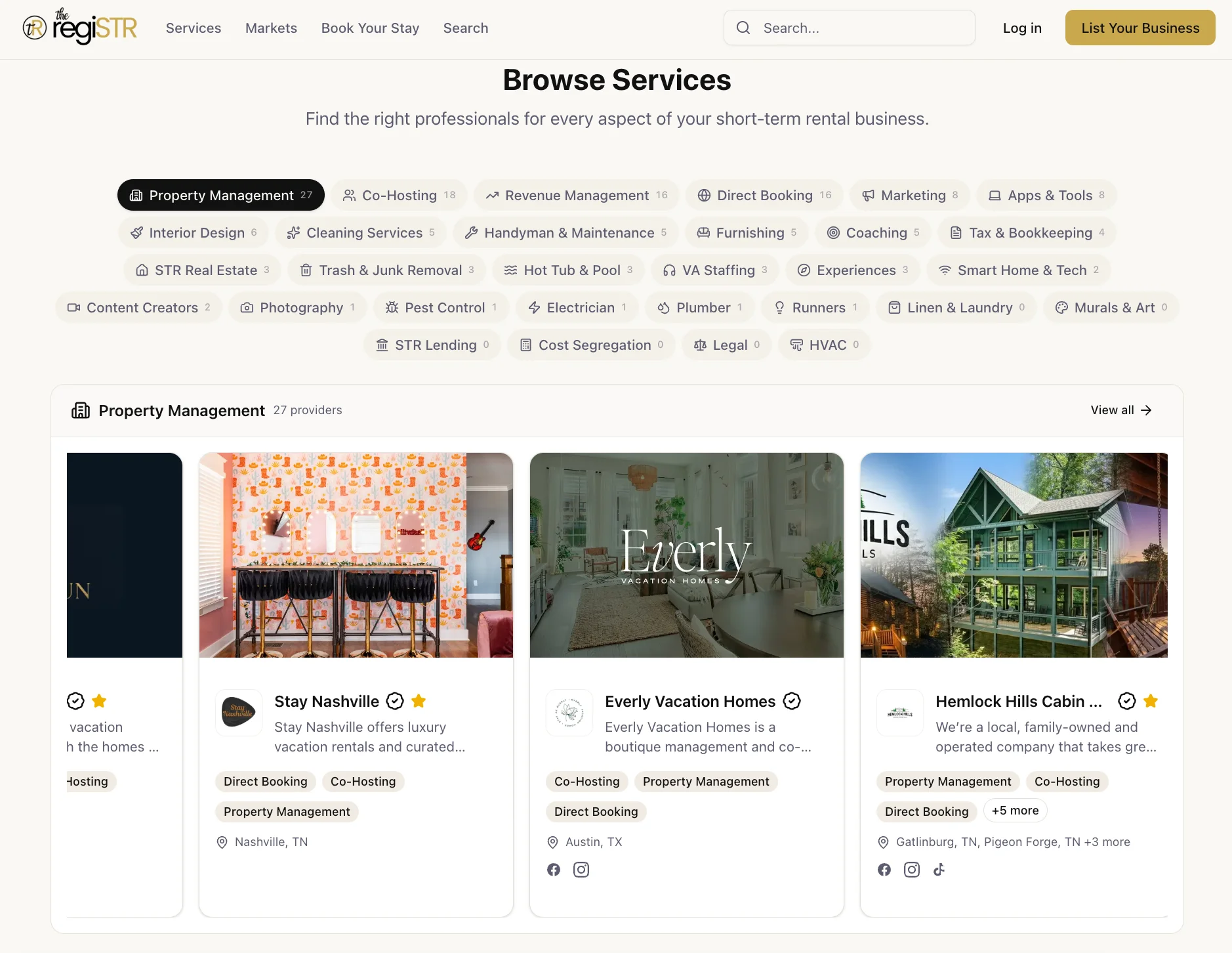
For regulatory-specific questions beyond general property management, the regiSTR's Browse All STR Services directory includes a dedicated Regulatory and Compliance category, connecting hosts with consultants who specialize in local permitting rather than general property managers stretching into unfamiliar legal territory.
How Do You Compare Property Managers Using the Same Data?
Comparing property managers fairly requires evaluating each candidate against identical performance metrics, not just their pitch. Buildium's property management KPI framework identifies occupancy or vacancy rate, rent-collection rate, average days to lease, rent-ready costs, maintenance costs, and net operating income as the core benchmarks worth requesting from any candidate.
Ask each manager to share their average occupancy rate across comparable properties in your market, their average turnaround time between guest checkout and the property being rent-ready again, and their average maintenance cost per unit annually. If a manager can't produce these numbers, or gives you a range so wide it's meaningless, that's a data-maturity problem, not just a communication gap.
Net operating income, calculated as total revenue minus operating expenses, is the number that actually matters to your bottom line. Ask how the manager reports NOI to you, and how frequently. A manager tracking this monthly and proactively flagging downward trends is operating at a different level than one who only produces year-end summaries.
This is exactly the kind of standardized comparison the regiSTR was built to make easier. Rather than collecting these numbers from five different sales calls in five different formats, hosts can browse provider profiles by market and service scope on the regiSTR's property manager directory and go into interviews already knowing which candidates are worth the deeper conversation.
Frequently Asked Questions
How do I find a hotel management company for my property?
If you're referring to short-term rental or vacation rental management rather than a traditional hotel, the process starts by searching a directory organized specifically for STR operators rather than general hospitality management firms. The regiSTR's property manager category filters by market so you can identify companies that actively work with individually owned vacation rentals in your city, rather than large hotel-brand management groups built for a different business model.
What does the 80/20 rule mean in property management?
The 80/20 rule in property management is a prioritization concept suggesting that a small share of properties, tenants, or issues, typically described as around 20%, generate the majority of operational headaches or costs, often described as around 80%. It's not a formal industry statistic but a useful framework for asking how a manager identifies and addresses recurring problems in your portfolio.
What are some good questions to ask a property manager during an interview?
Good questions include how fees are calculated (on collected versus scheduled rent), what the guaranteed emergency response time is, how often you'll receive an owner report, what the maintenance authorization limit is before they need your approval, and what the exact termination and notice terms are if you decide to leave.
What are the biggest red flags when hiring a property manager?
The biggest red flags are a refusal to provide a written fee schedule, inability to state their manager-to-property staffing ratio, no documented maintenance spending limit, undisclosed financial relationships with vendors they recommend, and vague or evasive answers about contract termination terms.
How much do property managers typically charge for short-term rentals?
Residential property management fees commonly range from 8% to 12% of monthly rent, though short-term rental fee structures vary more widely and often include additional charges for guest turnover coordination, leasing or booking fees, and maintenance vendor markups of 5% to 15%. Always request an itemized fee schedule rather than relying on a single quoted percentage.
Should I ask for references before signing a property management contract?
Yes. Request two or three current owner references, ideally including at least one client actively working with the manager right now rather than a past client. A manager confident in their service should have no hesitation connecting you directly with current clients who can speak to responsiveness, reporting quality, and fee transparency.
What's the difference between a co-host and a full-service property manager?
A co-host typically handles guest communication, listing optimization, and pricing while you retain more day-to-day involvement, often for a lower fee percentage. A full-service property manager takes on the complete operational load, including maintenance coordination, cleaning oversight, financial reporting, and often local regulatory compliance, usually for a higher fee in exchange for a more hands-off ownership experience.
Conclusion
Asking the right questions to ask a property manager before you sign protects your revenue and your sanity far more than negotiating the fee percentage down by a point or two. Fee structure, staffing ratios, reporting cadence, maintenance authority, and termination terms determine whether this relationship actually reduces your workload or just moves the stress somewhere less visible. In 2026, with more than 1.7 million short-term rental listings competing for guest attention nationwide, the operational gap between a well-run property and a poorly managed one shows up directly in your reviews and your occupancy.
Bring this list of questions to every interview, request the documents in writing before you sign, and don't settle for a manager who can't answer specifics with specifics. The right partner exists in nearly every market we track, you just need a way to find them that doesn't rely on a cold search or a lucky referral.

If you're ready to stop vetting property managers from scratch on every call, Get started with the regiSTR and browse vetted property management companies filtered by market and service scope, with peer vouches from operators who've already asked these exact questions.
Content powered by inkSTR.co