
Property Management Company in Austin: A Host's Guide

A property management company in Austin handles the day-to-day operations of a short-term rental, guest communication, turnover coordination, pricing, and maintenance, typically for 15-25% of gross rental revenue. The right one frees you from the daily grind; the wrong one costs you bookings and reputation. Here's how to tell the difference before you sign anything.
Key Takeaways
- Vacation rental management fees in competitive metro markets like Austin commonly run 15-25% of gross revenue, according to industry benchmark data, on top of separate cleaning and maintenance costs.
- Austin's short-term rental scene spans single-family homes near Zilker and South Congress, condos downtown, and larger investment portfolios stretching into Round Rock, Pflugerville, and Cedar Park.
- Full-service property management typically covers guest communication, dynamic pricing, turnover scheduling, and maintenance dispatch; not every company bundles all four at the same tier.
- Professionally managed listings now account for roughly 42% of active short-term rental listings globally as of early 2026, according to industry tracking data, a sign that self-managing is becoming the exception rather than the norm in competitive markets.
- Vetting an Austin property manager means asking about emergency response protocols, owner reporting cadence, and how they handle short-term rental permitting and tax compliance, not just their monthly fee.
- the regiSTR lists vetted property managers by market so Austin hosts can compare providers who already understand STR turnover timelines, without cold-calling a dozen companies first.
Austin's short-term rental market doesn't behave like a sleepy suburban rental pool. You've got downtown high-rises competing on walkability to Sixth Street, Zilker-adjacent bungalows trading on proximity to Barton Springs, and a growing ring of investment properties in Round Rock and Cedar Park where owners never set foot in the county. Each of those situations needs a different kind of property manager, and treating "Austin property management" as one interchangeable service is exactly how hosts end up disappointed.
This guide breaks down what a property management company in Austin actually does, what it costs, and how to vet one before you hand over your keys and your calendar. We built the regiSTR because we kept hearing the same complaint from operators across every market we track: they couldn't tell a genuinely STR-savvy manager from a long-term rental company that added "vacation rental" to their website copy. What follows draws from patterns we see across property management listings nationwide, including the Austin market specifically.
You'll get a framework for evaluating fee structures, a look at what separates full-service management from a co-hosting arrangement, and the specific questions to ask before signing a management agreement. None of this requires you to already know the difference between a channel manager and a PMS. It just requires you to know you're tired of managing your own turnovers at 11pm.
What Are the Top Property Management Companies in Austin, Texas?
Austin's property management landscape includes firms ranging from decades-old residential managers who added short-term rental services to newer companies built specifically around STR operations. The right fit depends on whether you own a single downtown condo, a Zilker-area house, or a multi-property portfolio spanning Travis, Williamson, and Hays counties.
The market splits roughly into three categories. First, established general property managers that handle long-term leases alongside a short-term rental division; these firms often have decades of Austin real estate experience but may treat STR guests with the same cadence as annual tenants, which creates friction around same-day turnovers. Second, boutique STR-specific management companies that built their entire operation around Airbnb and Vrbo workflows, dynamic pricing, and 24/7 guest support. Third, franchise-model managers with a national brand and a local office, which can mean strong systems but less flexibility on fee negotiation.
Coverage area matters as much as company size. Some Austin-area managers focus tightly on neighborhoods like Travis Heights, Barton Hills, Bouldin, Tarrytown, Zilker, Crestview, Allendale, and Rosedale, where property values and guest expectations run high. Others extend service into Pflugerville, Round Rock, Rollingwood, West Lake Hills, Bee Cave, Lakeway, Buda, Kyle, Manchaca, Leander, and Cedar Park, which matters if your investment property sits outside the urban core.
Instead of researching each firm's service radius individually, hosts can browse Find STR Property Managers on the regiSTR and filter directly by Austin market coverage. Every listing shows the specific service area, so you're not calling a company only to learn they stop managing properties at the county line.
What Is the Typical Cost of Property Management in Austin, Texas?
Property management in Austin typically costs 15-25% of gross rental revenue for full-service short-term rental management, a range consistent with vacation rental management fees nationally. That percentage usually covers guest communication, pricing strategy, and turnover coordination, but cleaning, maintenance, and supply restocking are frequently billed separately.
Where a company lands within that 15-25% range depends on service depth. A manager offering full-service operations, professional photography, dynamic pricing software, and 24/7 guest support tends to sit at the higher end. A lighter co-hosting arrangement, where you retain more responsibility for maintenance and supply decisions, often lands closer to the lower end or moves to a flat monthly fee instead of a percentage.
Beyond the management fee itself, industry benchmarks suggest owners commonly allocate 20-35% of gross rental income toward the full stack of operating costs, including property taxes, insurance, HOA dues, utilities, cleaning, maintenance, and platform commissions from Airbnb and Vrbo. That means your management fee is one line item in a larger operating budget, not the whole picture.
Flat-fee structures are worth asking about directly. Some Austin managers offer a flat monthly rate rather than a percentage of revenue, which can work in your favor during high-occupancy months but cost more during slow shoulder-season stretches. Neither structure is inherently better; it depends on your property's seasonality and your appetite for revenue variability.
Comparing quotes side by side is exactly what the regiSTR's directory is built for. Rather than getting three phone calls with three different fee explanations, you can filter Austin listings by service tier and see what's actually included at each price point.

What Does a Property Management Company Actually Do for a Short-Term Rental?
Full-service short-term rental management covers four core functions: guest communication, revenue and pricing strategy, turnover and maintenance coordination, and compliance oversight. Not every Austin manager bundles all four into a single fee, so knowing what you're actually buying matters more than the headline percentage.
Guest communication includes pre-arrival messaging, check-in instructions, mid-stay issue resolution, and review management across Airbnb and Vrbo. A manager who answers guest messages within the platform's expected response window protects your Superhost or Premier Host status, which directly affects search placement on both platforms.
Revenue management means adjusting nightly rates based on demand signals like ACL Fest weekends, SXSW, University of Texas football Saturdays, and general seasonal patterns. A manager without a dedicated pricing strategy is leaving money on the table during Austin's biggest demand spikes and pricing too aggressively during slow August weeks.
Turnover coordination means scheduling and quality-checking the cleaning between guests, restocking supplies, and dispatching maintenance for anything broken. This is where the gap between a residential property manager and an STR specialist shows up fastest: a same-day turnover with an 11am checkout and 4pm check-in leaves a tight window, and a manager unfamiliar with that pressure will eventually miss one.
Compliance oversight covers short-term rental permitting, occupancy tax collection, and staying current on any zoning or registration requirements specific to the property's location within Austin city limits versus unincorporated Travis County. This is a service category worth confirming explicitly, since not every management contract includes it. Hosts can browse Browse All STR Services to see property management listed alongside adjacent categories like maintenance and compliance consulting.
Who Are the Top 10 Property Management Companies for Austin Short-Term Rentals?
There is no single, verifiable "top 10" ranking of Austin short-term rental managers that holds up across different owner needs, because the right fit depends heavily on property type, neighborhood, and portfolio size. What matters more than a fixed ranking is understanding the categories of providers available and matching your situation to the right one.
Rather than naming specific companies, which creates a stale list the moment a firm changes ownership or service offerings, it's more useful to think in terms of provider categories:
- Downtown high-rise specialists who understand HOA restrictions common in Austin condo towers and coordinate with building management on guest access.
- Central neighborhood specialists covering Zilker, Bouldin, Travis Heights, and South Congress, where design-forward furnishing and photography matter for competing in a saturated listing pool.
- Suburban and investment-portfolio managers serving Round Rock, Pflugerville, Cedar Park, and Leander, often working with out-of-state investors who never visit the property.
- Boutique co-hosting operations that handle guest communication and pricing but leave cleaning and maintenance vendor selection to the owner.
- Full-service franchise operations with standardized systems, useful for owners who want predictable reporting over local relationship-building.
This is exactly why a static "top 10" list becomes outdated fast, and why the regiSTR's model works differently. Rather than a fixed ranking, our property manager directory updates as providers are vetted and referred into the network, with peer vouches from real Austin operators attached to each listing. You're seeing current, market-specific options rather than a list that hasn't been checked since it was published.
What Does the 80/20 Rule Mean in Property Management?
In property management, the 80/20 concept generally refers to the idea that roughly 80% of your operational headaches come from about 20% of your properties, tenants, or guest interactions. Applied to short-term rentals, it means a small share of bookings, usually the disputes, the maintenance emergencies, and the difficult guests, consume a disproportionate amount of your time.
For an Austin host managing a single property, this shows up as the handful of guest complaints or overnight maintenance calls that eat an entire weekend, while the majority of stays proceed without any host involvement at all. For portfolio operators managing multiple listings across Travis and Williamson counties, it often means one or two problem properties, maybe an older HVAC system or a location with more noise complaints, generate most of your support tickets.
The practical takeaway isn't that this ratio is a rigid law you should expect to hit exactly. It's that identifying your specific 20% and addressing the root cause, whether that's replacing aging equipment, adjusting your house rules, or handing that property to a dedicated manager, tends to free up disproportionate time relative to the effort involved.
Full-service Austin property managers absorb this exact burden. A manager fielding your 2am maintenance call means you're not the one losing sleep over the properties generating the most friction. That's the actual value proposition behind the management fee, not just calendar syncing.
How Do Austin Rental Vacancy and Turnover Costs Compare Across Providers?
Turnover costs and vacancy times in Austin's short-term rental market vary based on neighborhood demand, property type, and how tightly a manager runs the cleaning-to-booking pipeline. A downtown condo near the convention center behaves differently from a Hill Country-adjacent property in Bee Cave, and your management structure should reflect that.
Same-day turnovers, common during high-demand weekends like ACL Fest and SXSW, put pressure on a manager's cleaning vendor network. A manager without a deep bench of STR-experienced cleaners will eventually face a late checkout that pushes into the next guest's arrival window, which is one of the fastest ways to earn a negative review.
Vacancy time between bookings is influenced heavily by pricing responsiveness. A manager running dynamic pricing software that adjusts nightly rates in response to local demand signals, rather than manually updating rates once a month, tends to fill gaps in the calendar faster. Industry data shows vacation rental management software adoption accelerating specifically because of this pricing responsiveness gap.
Ask any Austin property manager directly how they measure and report vacancy time and average turnover cost per stay. A manager who can't answer with specifics, or who deflects to "it depends" without offering a range, likely isn't tracking this data closely enough to optimize it. This is precisely the kind of operational transparency the regiSTR looks for when vetting providers before they're listed in the directory.
How Should Austin Hosts Vet a Property Manager Before Signing a Contract?
Vetting an Austin property manager means going beyond their advertised fee percentage and asking specific operational questions about emergency response, reporting cadence, and vendor relationships. A manager who can't answer these clearly in a first conversation is a red flag worth taking seriously.
Start with these questions before any contract discussion:
- What is your emergency response time? Some markets have specific expectations here; for example, one Baltimore program requires owners to respond to emergencies within 30 minutes. Austin doesn't have an identical rule, but the underlying standard, a fast, defined response window, is worth confirming from any manager.
- How often do you send owner reports, and what's included? Monthly statements should break out revenue, fees, maintenance costs, and occupancy separately, not bundle everything into one number.
- Do you handle short-term rental permitting and tax filing? Some jurisdictions require quarterly filings with a nominal fee; other states have documented filing fees around $25 per quarter, for example. Confirm whether your Austin manager handles this directly or expects you to.
- What's your cleaning and maintenance vendor bench like? A single point of failure, one cleaner, one handyman, means any illness or scheduling conflict becomes your problem.
- Can I see a sample guest communication log or response time report? This shows whether they're actually monitoring platform messages promptly, not just claiming to.
This is exactly the vetting criteria we apply when listing providers on the regiSTR. Every manager in our directory has been referred in by an existing network member, and hosts can see Vouch endorsements from other Austin operators who've actually worked with them, not anonymous star ratings that can be gamed.

How Is Austin Short-Term Rental Management Different by Neighborhood and Property Type?
Property management needs in Austin shift significantly by neighborhood and property type, and a one-size-fits-all management approach tends to underperform. Downtown condos, central bungalows, and suburban investment homes each carry different guest expectations, regulatory considerations, and turnover logistics.
Downtown and Rainey Street-adjacent condos typically draw business travelers and bachelor and bachelorette groups, which means noise monitoring and HOA compliance become bigger operational concerns than in a quiet residential neighborhood. Managers here need existing relationships with building management and a clear noise-monitoring protocol.
Central neighborhoods like Zilker, Travis Heights, and South Congress draw guests looking for a design-forward, local experience close to Barton Springs and the Green Belt. Competing in this saturated segment often comes down to photography quality and interior styling, not just pricing. This is an area where an STR interior designer can matter as much as the manager you choose.
Suburban properties in Round Rock, Pflugerville, and Cedar Park often serve a different guest mix, family travel, extended work assignments, and relocations, and tend to see longer average stays. Management here leans more heavily on maintenance reliability than aggressive nightly rate optimization, since demand patterns are steadier and less event-driven than downtown's festival-fueled spikes.
Regardless of neighborhood, none of this changes the core vetting process. What changes is which capabilities matter most for your specific property, and that's worth discussing directly with any manager before signing.
How Do Austin Property Managers Handle STR Regulations and Tax Compliance?
Short-term rental regulation in Texas operates at a patchwork of city, county, and HOA levels, and Austin property managers vary widely in how much of this compliance burden they absorb versus pass back to the owner. This is one of the most underexplained parts of hiring a manager, and it's worth pressing on specifically.
Occupancy tax collection and remittance is a baseline expectation for any full-service Austin manager; confirm they're filing this on your behalf rather than leaving it to you as an owner responsibility buried in the fine print. Some jurisdictions nationally require documentation like a Certificate of Clean Hands issued within 30 days for a property owner applying for an STR license, which illustrates how document-heavy compliance can get depending on where a property sits. Austin-specific short-term rental permitting has shifted over recent years, and requirements can differ depending on whether a property sits inside city limits or unincorporated Travis County. A manager who proactively tracks these changes, rather than waiting for you to ask, is doing the job right.
Ask specifically whether your management fee includes ongoing regulatory monitoring or whether that's billed as a separate consulting service. Some Austin managers partner with dedicated STR compliance consultants for this rather than handling it in-house, which isn't a red flag by itself, as long as you know the arrangement exists before you need it.
Self-Managing vs. Hiring a Property Manager: What's the Real Tradeoff?
Self-managing a short-term rental in Austin saves the 15-25% management fee but shifts every guest communication, turnover coordination, and maintenance emergency onto your own schedule. Whether that tradeoff makes sense depends on how many properties you own, how far you live from the property, and how much your time is worth relative to the fee.
| Factor | Self-Managing | Full-Service Property Manager |
|---|---|---|
| Management cost | No fee, but higher time investment | Typically 15-25% of gross revenue |
| Guest response time | Depends on your availability | Usually 24/7 coverage |
| Pricing strategy | Manual updates, easy to fall behind | Dynamic pricing tied to demand signals |
| Emergency maintenance | You coordinate vendors directly | Manager dispatches from existing vendor bench |
| Regulatory tracking | Your responsibility to monitor | Often included or offered as add-on |
| Best for | Single local property, hands-on owners | Remote owners, multi-property portfolios |
Owners who live within a short drive of their Austin property and only manage one listing often self-manage successfully, particularly if they enjoy the guest interaction side of hosting. The math shifts fast once you own a second property, live out of state, or simply want your weekends back.
If you're leaning toward a middle ground, a co-hosting arrangement through the regiSTR's directory lets you keep some control, like choosing your own cleaner, while handing off guest communication and pricing to someone else.
Frequently Asked Questions
How do I find a hotel management company for my property?
If you're looking for management of a boutique hotel property rather than an individual short-term rental, search specifically for hospitality management firms, since most STR-focused property managers are built around single-unit or small-portfolio vacation rentals, not full hotel operations. For individual vacation rental properties in Austin, a directory like the regiSTR filters specifically for short-term rental management rather than hotel-scale hospitality companies.
What does a rental management company do?
A rental management company handles guest communication, pricing strategy, turnover coordination, and maintenance dispatch on behalf of a property owner. For short-term rentals specifically, this also includes managing listings across Airbnb and Vrbo, adjusting nightly rates for demand events, and often handling occupancy tax compliance depending on the service tier.
What is a host company?
A host company, sometimes called a co-hosting service, manages the guest-facing side of a short-term rental, messaging, check-in coordination, and review management, often without taking on full property management responsibilities like maintenance or owner-level reporting. It's typically a lighter-touch, lower-fee alternative to full-service property management.
What is the typical cost of property management in Austin, Texas?
Full-service short-term rental management in Austin typically runs 15-25% of gross rental revenue, consistent with national vacation rental management fee benchmarks. Cleaning and maintenance are usually billed separately from this percentage, and flat monthly fee structures are also available from some providers.
What are the top property management companies in Austin, Texas?
Rather than a single fixed ranking, Austin's property management landscape includes downtown high-rise specialists, central neighborhood managers focused on areas like Zilker and Travis Heights, suburban portfolio managers serving Round Rock and Cedar Park, and boutique co-hosting operations. The right fit depends on your property location and how hands-off you want to be.
What does the 80/20 rule mean in property management?
In property management, the 80/20 concept generally describes how a small share of properties or guest interactions tend to generate a disproportionate share of operational problems and time demands. It's a useful mental model for identifying where to focus improvement efforts, not a rigid statistical law.
How do I evaluate revenue management software like Wheelhouse for dynamic pricing?
Dynamic pricing software should be evaluated on how responsive it is to local demand signals, such as Austin's festival calendar and seasonal shifts, and whether it integrates cleanly with your property management company's existing systems. Ask any Austin property manager directly which pricing tool they use and how frequently rates get adjusted, since manual monthly updates leave money on the table compared to daily or weekly automated adjustments.
Conclusion
A property management company in Austin should do more than answer guest messages; it should actively manage pricing around ACL Fest and SXSW demand spikes, maintain a deep cleaning vendor bench for same-day turnovers, and stay current on Austin's short-term rental compliance requirements. The 15-25% fee range is standard, but what's included at that price varies enormously between providers.
Whether you're managing a single Zilker-area bungalow or a growing portfolio spread across Round Rock and Cedar Park, the vetting questions stay the same: emergency response time, reporting transparency, vendor bench depth, and compliance handling. Get clear answers on those four before you sign anything.
As of 2026, professionally managed listings continue gaining ground over self-managed properties across competitive metro markets, and Austin is no exception. Get started with the regiSTR to browse vetted property managers filtered specifically by Austin neighborhood and service tier, with peer vouches from real operators attached to every listing.
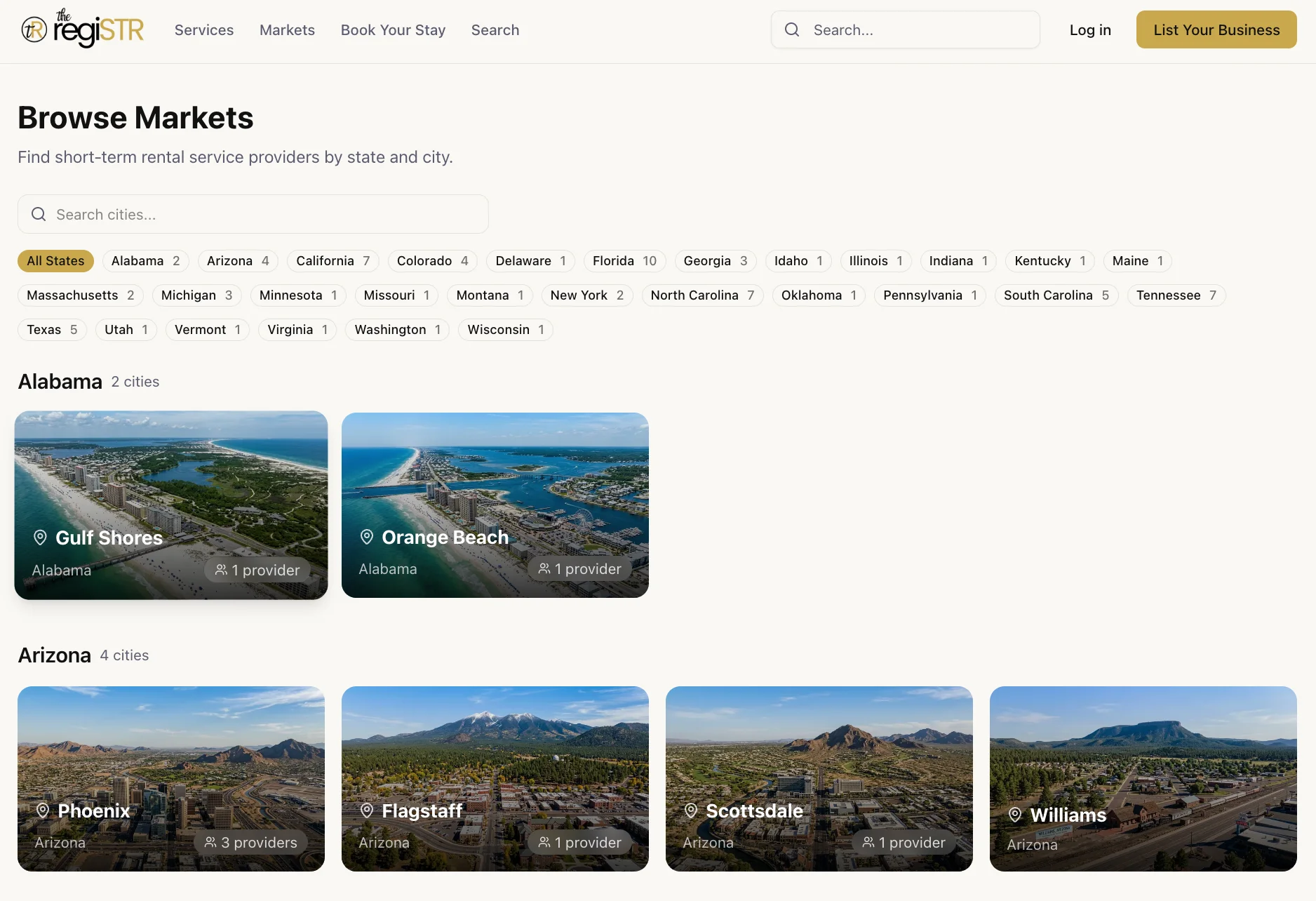
If you're comparing property management options across Austin and other Texas markets at once, the regiSTR's market directory puts every vetted provider in one filterable view instead of a dozen open browser tabs. Browse vetted property managers in Austin and see exactly what's included at each service tier before your next call.
Content powered by inkSTR.co