
Mesa Short Term Rentals: The Complete 2026 Host Guide

Running Mesa short term rentals legally in 2026 means clearing three separate hurdles before you ever list a calendar: a $250 annual city license per unit, a valid Arizona Transaction Privilege Tax (TPT) license, and Maricopa County rental registration. Skip any one of these and you're operating outside the regiSTR's definition of a compliant host, and outside the City of Mesa's, too.
Key Takeaways
- Mesa requires a short-term rental license under Mesa City Code Title 5, Chapter 15, effective since February 1, 2023, priced at $250 per unit per year.
- Combined lodging taxes in Mesa run 12.50% as of April 2026, covering state TPT plus Mesa's hotel taxes.
- Arizona Revised Statutes Section 9-500.39 prohibits Mesa from capping rental nights or zoning out short-term rentals, but it can still enforce licensing and safety rules.
- Unlicensed operation carries escalating civil penalties: $250 for month one, $500 for month two, $750 for month three, and $900 per month after that.
- Maricopa County requires a separate rental property registration on top of the city license, with its own penalty structure for noncompliance.
- The regiSTR's directory connects Mesa hosts with vetted cleaners, property managers, and compliance consultants who already understand this exact licensing stack, so you're not piecing together a vendor team from scratch.
Mesa sits in an unusual spot in the Arizona short-term rental landscape. It's inside greater Phoenix, close enough to Scottsdale and Tempe for spillover demand, but its own regulatory framework is stricter about paperwork than most of its neighbors. Since Ordinance 5734 took effect in 2023, every host operating a unit for 29 days or fewer has had to register with the city, not just the state.
What follows is a practitioner-level breakdown of what Mesa actually requires in 2026, how the tax stack works, and where the compliance gaps trip up new hosts. At the regiSTR, we've tracked this pattern across multiple Arizona markets: hosts get the Airbnb listing right and the licensing wrong, usually because nobody explains the difference between a city license and a county registration until they're already fined.
We'll also cover the vendor side. A licensed rental is only half the operation; you still need a cleaner who can turn a unit in a 90-minute window, a property manager who understands Mesa's occupancy standards, and someone who can keep your TPT filings current. That's where a lot of first-time Mesa hosts get stuck, and it's exactly the gap our directory of vetted STR service providers exists to close.
What Are Mesa's Short Term Rental Licensing Requirements in 2026?
Mesa defines a short-term rental as any residential unit, condo, or co-op offered for transient use of 29 days or fewer at a time, and it requires a city-issued license for every unit before you can legally book a single guest. This rule falls under Mesa City Code Title 5, Chapter 15, adopted by Ordinance 5734 and effective since February 1, 2023.
Each license costs $250 per unit and stays valid for one year from the issue date, with renewal at the same $250 rate. Notably, the license is issued only to the deeded property owner, not to a property management company or third-party operator acting on the owner's behalf.
Applications go through Mesa's DIMES/Accela Citizen Access online portal. Before you submit, the city requires an active Arizona TPT license tied to that specific unit's address. You'll also need to provide contact details for the owner, any statutory agent, and a designated emergency contact who can respond if something goes wrong at the property.
One detail hosts frequently miss: licenses are non-transferable and non-assignable. If you sell the property or add it to an LLC, the new owner has to apply fresh. And a separate license is required for every individual unit, so a duplex or a multi-unit property means multiple applications, not one.
Can I Get a Month-to-Month Lease in Arizona?
Yes, month-to-month leases are legal in Arizona and common across the Phoenix metro, but they operate under a different legal framework than a licensed short-term rental in Mesa. A standard month-to-month residential lease falls under Arizona's landlord-tenant statutes and typically does not trigger Mesa's short-term rental licensing requirement, since it's a longer-term tenancy rather than transient occupancy.
The distinction matters for your tax bill, too. As of January 1, 2026, Mesa stopped collecting city transaction privilege tax on residential stays of 30 days or more. That means a genuine month-to-month arrangement, where a tenant commits to a full 30-day (or longer) term, sits outside the 12.50% combined lodging tax that applies to shorter stays.
Where hosts get into trouble is trying to use a month-to-month lease as a workaround for STR licensing while actually running Airbnb-style turnover. Mesa's code looks at actual use, specifically 29 days or fewer at a time, not just what the lease document says. If your booking pattern functions like a short-term rental, the city expects the license and the TPT registration regardless of what the lease is titled.
If your business model genuinely mixes both, some Mesa units cycle between month-to-month corporate housing in slow seasons and short-term Airbnb bookings during Cactus League spring training or major Phoenix-area events, you need systems that track which mode you're in and adjust your tax collection accordingly. This is one of the areas where a co-host or property manager listed on the regiSTR's property manager directory earns their fee. They know how to flag the switch before it becomes a compliance problem.
Where Is the Best Place to Find Short Term Rentals in Mesa?
The most reliable places to find active, compliant Mesa short term rentals as a traveler or corporate housing coordinator are major booking platforms like Airbnb and Vrbo, filtered by Mesa's neighborhoods, combined with a direct check of the unit's listed license status. As of 2026, Mesa does not publish a fully searchable public license lookup the way some other cities do, so buyer diligence still matters.
For hosts asking a slightly different version of this question, "where's the best place to find guests for my Mesa rental," the answer depends on your target guest. Mesa draws a distinct mix: business travelers tied to the East Valley's tech and manufacturing employers, sports-related visitors during spring training season, families visiting Arizona State University's Polytechnic campus, and medical stays connected to nearby hospital systems.
Notably, that guest mix affects which platform performs best. Airbnb tends to convert well for leisure and short leisure stays, while corporate housing inquiries often come through direct outreach or relocation companies rather than OTA search. If you're building a rental that leans corporate or medical, a direct booking site with strong local SEO will outperform relying on Airbnb alone.
This is exactly the kind of infrastructure gap the regiSTR's directory addresses on the service-provider side. Hosts building direct booking capacity in Mesa can find STR-focused website developers and SEO specialists through the regiSTR's full services directory, rather than hiring a generalist agency that's never worked with a transient occupancy tax structure.
What Tax Obligations Apply to Mesa Short Term Rentals?
Mesa short term rentals are subject to a combined lodging tax rate of 12.50% as of April 2026, made up of the 5.5% state transient lodging TPT plus Mesa's 2% Hotels tax and 5% Additional Hotel Tax. This rate applies specifically to stays of 29 days or fewer; longer stays of 30 days or more have been exempt from Mesa's city TPT on residential lodging since January 1, 2026.
Before you can even apply for your Mesa STR license, the city requires proof of an active Arizona TPT license registered to that unit's specific address through the Arizona Department of Revenue. This isn't optional paperwork; it's a prerequisite step in the DIMES application.
Here's the trap: TPT filing frequency and remittance schedules are separate from your city license renewal. You can hold a valid Mesa STR license and still fall behind on monthly or quarterly TPT filings, which creates its own penalty exposure with the state, independent of anything the city enforces.
Most hosts underestimate how much bookkeeping this actually takes across a full year, especially once you're tracking taxable short stays separately from any tax-exempt 30-day-plus bookings in the same calendar year. A bookkeeper or STR consultant who's handled Arizona TPT filings specifically, not generic small business accounting, saves real time here. That specialization is exactly what to screen for when browsing the regiSTR's STR consulting category.
What Is the Difference Between an Airbnb and a Short Term Rental?
Airbnb is a booking platform; a short-term rental is the legal and regulatory category the property itself falls into. In Mesa, any unit rented for transient use of 29 days or fewer counts as a short-term rental under city code, regardless of whether the booking came through Airbnb, Vrbo, a direct website, or a phone call from a relocation coordinator.
This distinction trips up new hosts constantly. Listing on Airbnb does not automatically satisfy Mesa's licensing requirement. Airbnb collects and remits certain taxes on a host's behalf in many jurisdictions, but that arrangement doesn't replace the city's $250 licensing requirement or the mandatory neighbor notification step Mesa requires before you start operating.
Specifically, Mesa's code requires owners to provide written notice to neighboring properties before offering a unit as a short-term rental, a step that has nothing to do with which platform you use to book guests. Skipping it because "Airbnb handles compliance" is a common and costly misread of how the platform actually works.
The practical takeaway: think of Airbnb, Vrbo, and direct booking as distribution channels. The short-term rental license, the TPT registration, and the Maricopa County property registration are the legal foundation underneath all of them. You need the foundation regardless of which channel brings the guest.
Where Can I Live for $500 a Month in the USA, and How Does That Relate to Mesa Rentals?
Finding housing for $500 a month in the United States in 2026 generally means long-term leases in lower-cost rural areas, shared housing, or subsidized programs, not short-term or transient rentals in an active metro like Mesa. Mesa's short-term rental market operates on nightly and weekly pricing tied to tourism and business travel demand, which puts it in a completely different pricing category than budget long-term housing.
That said, this search pattern tells you something useful about guest behavior. Travelers researching ultra-low monthly housing costs are often the same demographic exploring extended-stay or corporate housing options, and some end up in Mesa's mid-term rental segment, the 30-plus day stays that now avoid the city's transient lodging tax entirely.
If you're a Mesa host weighing whether to chase nightly Airbnb bookings or pivot toward 30-day-plus stays, the tax structure actually rewards the longer play in specific cases. Since January 2026, stays of 30 days or more skip the 12.50% combined lodging tax, which changes your net revenue math even if your nightly rate is lower.
Running that comparison properly, nightly short-term rate minus 12.50% tax and higher turnover cleaning costs, versus a lower monthly rate with zero lodging tax and one cleaning cycle, is a revenue management exercise most self-managing hosts never run. It's a conversation worth having with a revenue-focused property manager rather than guessing.
Mesa STR Regulations vs. Nearby Phoenix and Scottsdale: What's Different?
Mesa's short-term rental rules are more paperwork-intensive at the city level than some neighboring East Valley markets, primarily because of the mandatory city license on top of state and county requirements. Phoenix and Scottsdale each run their own separate licensing frameworks, and none of the three cities share a unified application system, so a host operating across multiple East Valley cities needs a distinct license, and in some cases a distinct process, for every jurisdiction.
What's consistent across all of them is the statewide preemption under Arizona Revised Statutes Section 9-500.39, which blocks any Arizona city from capping the number of nights a property can be rented or zoning short-term rentals out of existence entirely. Cities can regulate through licensing, safety standards, and nuisance codes, but they can't ban the activity outright or impose an annual rental-day cap the way some states allow.
For an investor comparing where to buy, Mesa's per-unit $250 annual fee is straightforward and predictable, while the combined 12.50% lodging tax rate is comparable to typical Phoenix-metro short-term rental tax burdens as of April 2026. The bigger differentiator between markets tends to be neighborhood-level HOA restrictions rather than the city ordinance itself, so checking your specific HOA's short-term rental clause matters more than comparing city-to-city tax rates.
Investors weighing multiple Arizona submarkets can browse the regiSTR's markets directory to compare which East Valley and greater Phoenix areas have active vendor networks already built out, rather than starting vendor research from zero in each city.
New Host Compliance Checklist: What Do I Need Before I List My Mesa Rental?
A compliant Mesa short-term rental listing requires clearing four separate registration layers before your first guest checks in: city licensing, state tax registration, county property registration, and, if applicable, HOA approval. Missing any one of these creates real financial exposure, not just a warning letter.
- Confirm your property is eligible. Check zoning and, critically, your HOA's governing documents. Arizona state law prevents cities from banning short-term rentals outright, but HOAs can still restrict them contractually, and that restriction is separate from anything the city enforces.
- Register for an Arizona TPT license through the Arizona Department of Revenue, tied specifically to your rental unit's address. Mesa requires this before it will process your city license application.
- Apply for your Mesa short-term rental license through the city's DIMES/Accela Citizen Access portal. Budget $250 per unit and gather owner, statutory agent, and emergency contact information in advance.
- Register with Maricopa County. The county requires separate registration of all residential rental properties, including short-term rentals, through the Maricopa County Assessor's property registration system. Penalties for noncompliance here run independently of city penalties.
- Notify your neighbors in writing before you begin operating, as required under Mesa City Code Title 5, Chapter 15.
- Set up TPT tax collection and remittance for stays of 29 days or fewer, and confirm your booking software correctly exempts stays of 30 days or more from that same tax.
- Line up your vendor team. A turnover cleaner who can guarantee same-day windows, a maintenance contact for after-hours issues, and, if you're not local, a property manager who already knows Mesa's occupancy standards under City Code Title 6, Chapter 12.
That last step is where a lot of otherwise-compliant hosts still struggle, because none of the government portals above help you find a cleaner or a property manager. Browsing vetted STR cleaners or STR property managers already familiar with Arizona's licensing stack is a faster path than posting in a local Facebook group and hoping someone responds.
What Happens If I Operate a Mesa Short Term Rental Without a License?
Operating an unlicensed short-term rental in Mesa triggers escalating civil penalties that increase every month the violation continues, starting at $250 for the first month and rising to $900 per month by the fourth month and beyond. Each day of unlicensed operation is treated as a separate offense under Mesa City Code Title 5, Chapter 15.
Specifically, the penalty schedule runs $250 for month one, $500 for month two, $750 for month three, and $900 for every month after that. On top of city penalties, Maricopa County imposes its own fines for failing to register a rental property, ranging up to $1,000 plus $100 per additional month for newly acquired properties not yet registered, or as much as $150 per day for existing rentals that remain out of compliance.
Stack those two penalty structures together and an unlicensed host can face several thousand dollars in fines within a single quarter, well beyond the $250 it would have cost to license the property correctly from the start. As a result, the math on skipping licensing almost never works in the host's favor.
There's also a category of prohibited use worth knowing: Mesa short-term rentals cannot be used as sober-living homes, housing for registered sex offenders, adult-oriented businesses, or for the sale of liquor or illegal drugs. These restrictions apply regardless of licensing status and carry their own enforcement risk.
Mesa STR Licensing at a Glance
| Requirement | Detail |
|---|---|
| City license fee | $250 per unit, annual, non-transferable |
| Governing code | Mesa City Code Title 5, Chapter 15 (Ordinance 5734, effective Feb. 1, 2023) |
| Transient use definition | 29 days or fewer at a time |
| Combined lodging tax | 12.50% as of April 2026 (5.5% state TPT + 2% Mesa Hotels tax + 5% Additional Hotel Tax) |
| 30-day-plus stays | Exempt from Mesa city TPT since January 1, 2026 |
| State preemption | A.R.S. Section 9-500.39 bars night caps and zoning bans |
| County requirement | Separate Maricopa County property registration required |
| First-offense penalty | $250, rising to $900/month by month four |
| Application portal | DIMES/Accela Citizen Access |
| Licensing office contact | 480-644-2316, STR.licensing@mesaaz.gov |
Why Do Hosts Struggle to Build a Vendor Team for Mesa Rentals?
Hosts struggle to build a Mesa vendor team because general contractor directories don't filter for short-term rental experience, leaving owners to guess whether a cleaner or handyman actually understands turnover timelines, key-code resets, and guest-facing repair urgency. A residential cleaning company accustomed to weekly recurring visits is a very different fit than one that can turn a unit in a tight window between an 11 a.m. checkout and a 3 p.m. check-in.
We've indexed enough provider profiles across Arizona markets to see the same pattern repeat: hosts who self-manage burn out within a year, not from the guests, but from chasing down a maintenance contact at 9 p.m. on a Saturday when an AC unit fails during a Phoenix-area summer. Mesa's climate makes HVAC reliability a genuinely operational issue, not a minor inconvenience.
Interior staging matters here too. Mesa's guest mix skews toward business travelers and extended medical stays, groups that respond well to functional, comfortable furnishing rather than a heavily styled aesthetic. An interior designer who's worked exclusively on primary residences may over-decorate for a market that actually rewards practical layouts and durable materials.
The regiSTR built its maintenance and interior design categories specifically to solve this filtering problem: every provider joined through referral from an existing network member, and hosts can see which other operators have vouched for a given provider before making first contact.
Frequently Asked Questions
Do I need a license to run a short-term rental in Mesa, Arizona?
Yes. Any residential unit, condo, or co-op offered for transient use of 29 days or fewer requires a Mesa short-term rental license under City Code Title 5, Chapter 15. The license costs $250 per unit annually and must be issued to the deeded property owner directly.
How much does it cost to get a Mesa short term rental license?
A Mesa short-term rental license costs $250 per unit, valid for one year, with the same $250 fee applying at renewal. This is separate from your Arizona TPT registration and any Maricopa County registration fees.
What taxes apply to short term rentals in Mesa?
Mesa short-term rentals are subject to a combined lodging tax of 12.50% as of April 2026, covering the state's 5.5% transient lodging TPT plus Mesa's 2% Hotels tax and 5% Additional Hotel Tax. Stays of 30 days or more have been exempt from Mesa's city TPT since January 1, 2026.
Can Mesa cap the number of nights I rent my property?
No. Arizona Revised Statutes Section 9-500.39 prohibits Mesa, and every other Arizona city, from imposing annual rental-day caps or zoning-based bans on short-term rentals. Mesa can still enforce licensing, health, and safety requirements.
What's the difference between an Airbnb listing and a legal short-term rental in Mesa?
Airbnb is a booking platform; a short-term rental is the legal classification the city applies to any unit rented for 29 days or fewer. Listing on Airbnb does not replace the requirement to hold a Mesa city license, an active TPT registration, and Maricopa County property registration.
What happens if I rent out my Mesa property without a license?
Unlicensed operation triggers civil penalties starting at $250 for the first month, rising to $500, then $750, then $900 per month for every subsequent month. Each day of unlicensed operation counts as a separate offense under city code.
How do I find reliable cleaners and property managers for a Mesa rental?
The fastest approach is browsing a directory built specifically for short-term rental vendors rather than general home service listings. The regiSTR's cleaning and property management categories filter providers by market and show peer vouches from other STR operators who've actually hired them.
Conclusion
Mesa short term rentals in 2026 come down to a predictable but unforgiving compliance stack: a $250 city license per unit, active TPT registration, Maricopa County property registration, and a 12.50% combined lodging tax on stays of 29 days or fewer. Get those four pieces right, and Arizona's state preemption law protects your right to operate without facing arbitrary night caps or zoning bans.
The paperwork gets you licensed. It doesn't get you a cleaner who shows up on time, a property manager who understands Mesa's occupancy standards, or a maintenance contact who'll answer at 9 p.m. when the AC quits in July. That's the operational half of running a compliant, guest-ready property, and it's the half most Mesa hosts figure out the hard way.
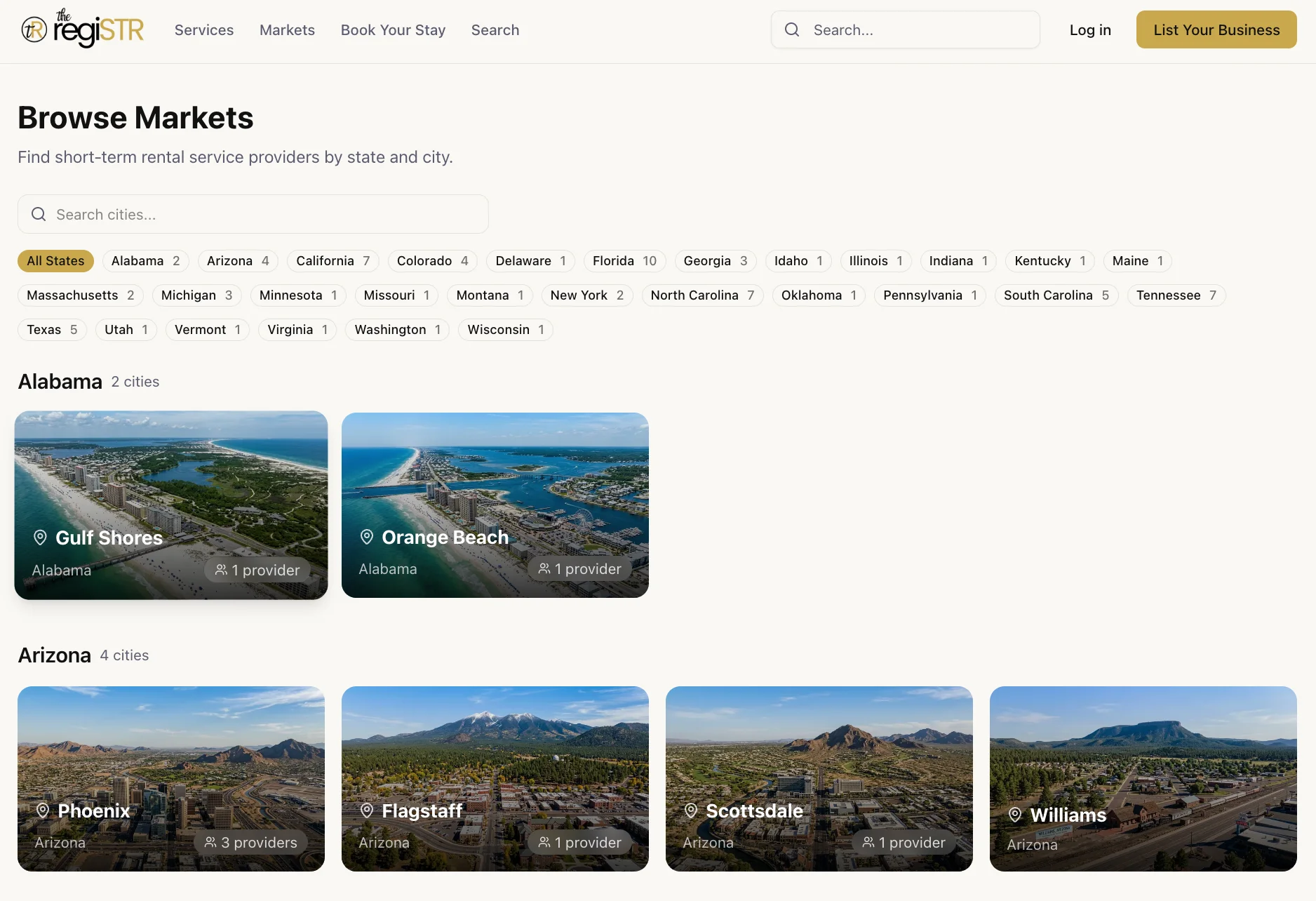
If you're building out a compliant Mesa short-term rental and need the vendor side sorted, from turnover cleaners to compliance consultants, get started with the regiSTR and browse vetted providers by market. Sign up free and search Mesa directly at theregistr.co.
Content powered by inkSTR.co