How to Improve Airbnb Listing SEO and Rank Higher in 2026
Improving your Airbnb listing SEO means optimizing your title, photos, description, amenities, and response metrics so Airbnb's search algorithm ranks you higher for guests searching your market. The listing itself, not just external marketing, is what Airbnb's search engine reads and ranks, and small changes to structure and keyword placement can move your position within days.
- Airbnb's search algorithm weighs listing completeness, photo quality, response rate, and booking conversion more heavily than most hosts realize when ranking search results.
- Title and description keyword placement in the first 40 characters directly affects both Airbnb's internal search and how your listing surfaces in Google results.
- Booked listings on Airbnb and Vrbo have remained 25 to 30 percent below pre-pandemic levels according to Statista, making listing-level differentiation more important than ever in a slower-recovery market.
- Response rate, acceptance rate, and cancellation rate feed directly into Airbnb's ranking algorithm, meaning operational habits are an SEO lever, not just a guest service metric.
- Regulatory shifts, such as the roughly 92 percent drop in NYC Airbnb listings following Local Law 18 (Airbnb Newsroom, 2026), show how quickly a market's competitive landscape can shift, changing what "ranking well" even means locally.
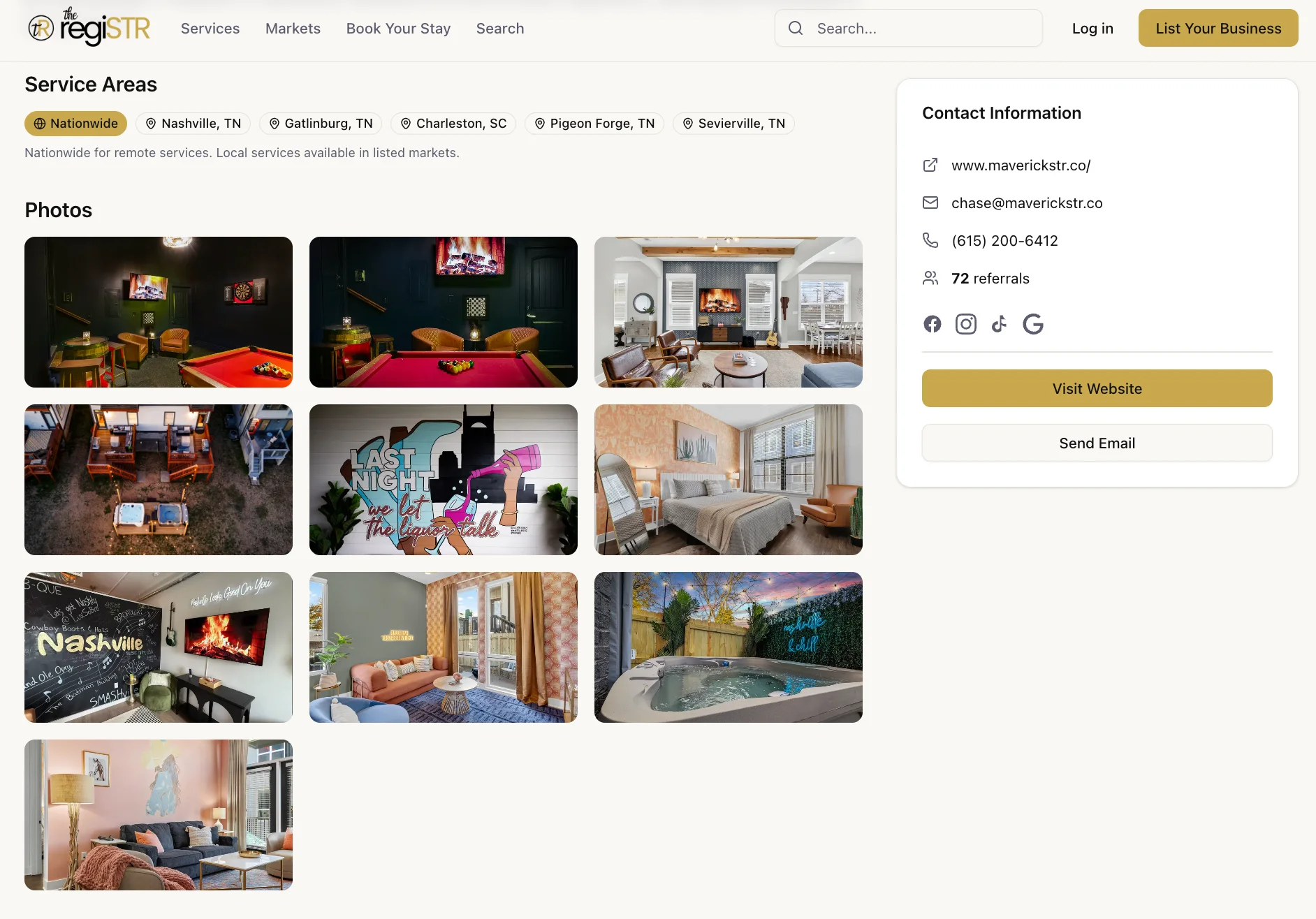
- Hosts who can't diagnose their own listing gaps can find the regiSTR's vetted photographers, copywriters, and listing optimization specialists to fix what's holding their ranking back.
If you've watched a nearly identical property in your market consistently outrank you in Airbnb search results, the difference usually isn't luck. It's listing SEO, and most hosts have never touched theirs since the day they published it.
At the regiSTR, we've reviewed listings across dozens of short-term rental markets, and the pattern is consistent: hosts obsess over pricing and amenities but ignore the structural, keyword, and behavioral signals Airbnb's search algorithm actually uses to rank a property. Learning how to improve Airbnb listing SEO is not about gaming a system. It's about giving Airbnb's algorithm, and the guests reading your page, exactly the information they need to say yes faster.
This guide walks through the specific, actionable steps that move a listing from page three of local search results toward the top: title structure, description formatting, photo sequencing, amenity tagging, and the operational metrics that quietly determine your visibility. As of 2026, with booking volume still recovering unevenly across markets, listing-level SEO is one of the few levers fully within a host's control.
What Is Airbnb Listing SEO and How Does It Work?
Airbnb listing SEO refers to the process of optimizing your property page, title, description, photos, amenities, and host performance metrics, so Airbnb's internal search algorithm ranks your listing higher for relevant guest searches in your market. Unlike Google SEO, Airbnb's algorithm operates entirely inside its own platform.
Airbnb's search engine considers several ranking inputs together: listing quality score, guest engagement history, pricing competitiveness relative to your comp set, response and acceptance rates, and how closely your listing matches a searcher's filters. Notably, Airbnb has confirmed that listings with complete profiles, accurate categorization, and strong guest satisfaction consistently surface higher in search results than incomplete or generic listings.
What makes this different from traditional web SEO is that Airbnb rewards behavior as much as content. A listing with a perfectly written description but a 60 percent response rate will still underperform a mediocre listing run by a highly responsive host. That's why the regiSTR treats listing SEO as an operational discipline, not a one-time copywriting task, when advising hosts in our network.
For hosts managing this alongside a property manager or co-host, it's worth confirming who owns listing optimization in your management agreement. Some full-service property managers include listing SEO as a standard deliverable; others treat it as an add-on. If yours doesn't, the regiSTR's STR property managers directory lets you compare providers who explicitly include listing optimization in their scope.
How Do I Write an Airbnb Title That Ranks Higher in Search?
An Airbnb title that ranks well leads with your most searchable, specific descriptor first, typically neighborhood name, property type, and standout amenity, within the first 40 to 50 characters before truncation cuts it off in search results. Generic titles like "Cozy Home Near Downtown" waste your highest-value keyword real estate.
Airbnb truncates titles aggressively on mobile search results, which is where most bookings originate. If your title reads "Beautiful 3BR Home with Amazing Views and Great Location Close to Everything," guests never see past "Beautiful 3BR Home with Amazing." Specifically, front-load the terms guests actually search: city or neighborhood, property type, and one differentiator.
For example, "Walkable Downtown Loft with Rooftop Hot Tub, Sleeps 6" tells both Airbnb's algorithm and a scanning guest exactly what they're getting, in order of search relevance. Compare that to a title stuffed with adjectives and no location or amenity keyword: it ranks worse internally and converts worse in the click-through.
Common mistakes we see across listings in the regiSTR network: titles that open with subjective language ("Stunning," "Amazing," "Perfect"), titles that omit the neighborhood entirely, and titles that don't mention capacity or bedroom count when that's a primary search filter guests apply. Fix the title first. It's the cheapest, fastest change on this entire list.
What Belongs in an Airbnb Description for Maximum Search Visibility?
An Airbnb description optimized for search visibility opens with a keyword-rich summary paragraph, followed by structured sections covering the space, guest access, neighborhood, and house rules, using natural language that mirrors how guests actually search and read. The first two sentences matter most because that's what displays before "Read more."
Airbnb's description field isn't just guest-facing copy, it's indexed content that reinforces the keywords in your title and photo captions. As a result, repeating your neighborhood name, property type, and top two amenities naturally within the first paragraph strengthens topical relevance without reading like keyword stuffing.
Structure matters as much as content. Break the description into scannable sections: a one-paragraph hook, a "The Space" section describing rooms and layout, a "Guest Access" section, and a short neighborhood callout naming specific landmarks, restaurants, or attractions guests search for independently. Notably, listings that name specific nearby points of interest, rather than vague phrases like "close to everything," perform better on guest engagement metrics that feed the ranking algorithm.
Avoid these common description mistakes: burying your best amenities in paragraph four, writing in ALL CAPS for house rules (it reads as aggressive and hurts conversion), and copying generic filler language from other listings. If your description could apply to any property in any city, rewrite it. Every sentence should be true only of your specific space.
Copywriting isn't every host's strength, and it shouldn't need to be. Providers in the regiSTR's SEO and Content Marketing category specialize specifically in Airbnb and Vrbo listing copy, not generic web content, which matters because the keyword patterns that work on a booking platform differ from what works on a blog.
How Do Photos Affect Airbnb Listing SEO and Search Ranking?
Photos affect Airbnb listing SEO by driving the engagement metrics, click-through rate, time on listing, and booking conversion, that Airbnb's algorithm uses as ranking signals, meaning photo quality is a search factor, not just a presentation choice. Airbnb's own guidance confirms that listings with professional photography consistently outperform those with phone snapshots on both views and bookings.
Your cover photo carries the most weight. It needs to be a wide-angle, well-lit hero shot of your most impressive room or exterior feature, shot ideally at golden hour or with strong natural light. A dark, cluttered, or poorly framed cover photo will suppress click-through before a guest ever reads your title or description.
Photo order matters almost as much as photo quality. Lead with your best room (usually the living space or a standout feature like a pool or view), follow with bedrooms in the order guests will actually use them, then bathrooms, kitchen, and amenity spaces. Guests and Airbnb's engagement tracking both reward listings where the photo sequence tells a coherent story of the space.
Not every "Airbnb-experienced" photographer actually understands OTA listing requirements. Wedding and portrait photographers often shoot beautiful images that are the wrong aspect ratio, poorly lit for wide rooms, or missing the detail shots (linens, amenities, outdoor space) that convert browsers into bookers. This is exactly why the regiSTR's STR photographers directory filters specifically for vacation rental portfolio experience, not general photography credentials, before a provider gets listed.
Which Amenities and Tags Should I Add to Improve My Airbnb Search Ranking?
Amenity tags improve Airbnb search ranking by matching your listing to the specific filters guests apply during search, meaning an amenity you have but haven't tagged is functionally invisible to anyone filtering for it. Airbnb's filter system is binary: if "Dedicated workspace" isn't checked on your listing, you won't appear when a guest filters for it, regardless of whether you actually offer one.
Go through Airbnb's full amenity list section by section rather than relying on memory. Hosts routinely forget to tag amenities like "Long-term stays allowed," "Self check-in," "Free parking," or specific safety features (carbon monoxide alarm, fire extinguisher, first aid kit) that both build trust and unlock additional search filter matches.
Beyond the checkbox amenities, Airbnb's categories feature, launched to help guests browse by property type and vibe (Amazing Views, Tiny Homes, Cabins, and similar groupings), also functions as a search and discovery layer. If your property genuinely fits one of these categories and you haven't opted in, you're missing a discovery channel most competitors haven't optimized either.
Common gaps we see across listings: unchecked accessibility features that would qualify a listing for accessibility-specific searches, missing "pets allowed" tags on properties that would actually accommodate pets with a small policy adjustment, and unclaimed category tags that would put a rural cabin in front of guests specifically browsing for cabins rather than generic "entire home" searches.
How Do Response Rate and Reviews Impact Airbnb Listing SEO?
Response rate, acceptance rate, cancellation rate, and review scores directly impact Airbnb listing SEO because Airbnb's ranking algorithm treats host performance as a proxy for guest experience quality, pushing high-performing hosts higher in search regardless of listing content quality. A beautifully written listing run by an unresponsive host will still rank below a plainer listing run by a highly engaged one.
Specifically, Airbnb tracks response rate (percentage of inquiries answered within 24 hours) and response time as separate metrics, and both feed the Superhost qualification, which carries its own search visibility boost. Hosts who respond within an hour consistently see stronger placement than hosts who take a full day, even with identical listing content.
Cancellations are penalized more heavily than most hosts expect. A single host-initiated cancellation can meaningfully suppress your search position for weeks, because Airbnb weights cancellations as a strong negative guest-experience signal. This is one reason overbooking across multiple channels without a reliable channel manager is a listing SEO risk, not just an operational headache.
Reviews compound this effect. Listings with a steady flow of recent five-star reviews mentioning specific positives (cleanliness, communication, accuracy) outrank listings with sparse or dated reviews, even if the underlying property is comparable. This is where turnover quality quietly becomes an SEO factor: a missed cleaning that delays check-in or leaves the property under guest expectations shows up in reviews within days, and those reviews show up in your ranking within weeks. Hosts who've been burned by unreliable cleaners can browse the regiSTR's STR cleaners directory for providers vetted specifically for same-day turnover reliability, since a missed or late turnover doesn't just cost you one guest, it costs you ranking position for the next several searches.
What Role Does Pricing Play in Airbnb Search Ranking?
Pricing plays a direct role in Airbnb search ranking because Airbnb's algorithm evaluates your nightly rate relative to comparable listings in your immediate comp set, and significantly overpriced listings are demoted in favor of options that appear more likely to convert a search into a booking. This doesn't mean the cheapest listing always wins, but wildly uncompetitive pricing without a clear differentiator will suppress visibility.
Static, flat-rate pricing throughout the year is one of the most common ranking mistakes we see. A listing priced identically on a random Tuesday in February and a holiday weekend in July is mispriced for both dates, either too expensive during slow periods (hurting conversion and therefore ranking) or too cheap during peak demand (leaving revenue on the table without any ranking benefit).
Dynamic, demand-based pricing that adjusts for seasonality, local events, and day-of-week demand tends to convert better across the calendar, and that improved conversion rate is itself a positive ranking signal. Notably, this is a separate discipline from listing content SEO, but the two reinforce each other: a well-optimized listing with poor pricing still underperforms, and a well-priced listing with weak content still underperforms.
If pricing strategy isn't something you have the bandwidth or expertise to manage manually across a shifting calendar, that's precisely the gap Revenue Management and Dynamic Pricing providers in the regiSTR network are built to close, particularly for hosts managing multiple properties or markets where local seasonality is hard to track without dedicated tools.
Data and Evidence: What Actually Moves Airbnb Listing Rankings
The table below breaks down the primary listing SEO factors by the type of signal they represent, whether Airbnb's algorithm reads them automatically or whether they depend on ongoing host behavior, and the typical timeframe to see a ranking impact after making a change.
| SEO Factor | Signal Type | Host Control Level | Typical Impact Timeframe |
|---|---|---|---|
| Title keyword placement | Content signal | Full control, one-time edit | Immediate to a few days |
| Description structure and keywords | Content signal | Full control, one-time edit | Immediate to a few days |
| Cover photo and photo sequence | Engagement signal | Full control, requires reshoot | 1 to 2 weeks (needs new engagement data) |
| Amenity tags and categories | Filter-match signal | Full control, one-time edit | Immediate for filtered searches |
| Response rate and time | Behavioral signal | Ongoing host behavior | 2 to 4 weeks of consistent behavior |
| Cancellation rate | Behavioral signal | Ongoing host behavior | Can suppress ranking for several weeks per incident |
| Review volume and recency | Trust signal | Indirect, tied to guest experience | Compounds over multiple stays |
| Pricing competitiveness | Conversion signal | Ongoing, ideally dynamic | Reflected within the current booking window |
Notice the pattern: the fastest wins (title, description, amenities) are also the ones most hosts neglect longest, often because the listing hasn't been touched since initial publication. The slower-moving factors (reviews, response behavior) require consistency over time, which is exactly why the regiSTR treats listing SEO as a full operational stack, cleaning, photography, pricing, and content, rather than a single fix.
Why Do Some Airbnb Listings Rank Well Without Superhost Status?
A listing can rank well without Superhost status because Airbnb's search algorithm weighs multiple independent signals, meaning strong content optimization, competitive pricing, and high guest engagement can outperform a Superhost badge alone if that badge isn't paired with an equally strong listing. Superhost status is a boost, not a guarantee.
What we consistently observe across the regiSTR's network is that hosts chasing Superhost status alone, while neglecting title, description, and photo quality, plateau below where they should rank given their actual guest satisfaction. The badge helps, but it doesn't compensate for a listing that fails to convert clicks into bookings.
Conversely, we've seen non-Superhost listings outrank Superhost competitors in the same market by nailing the content fundamentals: a keyword-forward title, a structured description naming specific neighborhood landmarks, professionally sequenced photography, and complete amenity tagging. This is the deep-dive insight most generic "Airbnb SEO tips" articles miss: content optimization and behavioral reputation are separate levers, and both need attention.
The takeaway for hosts in a slower-recovery booking environment, where Statista data shows booked listings on Airbnb and Vrbo still running 25 to 30 percent below pre-pandemic volume, is that you can't rely on badge status or market demand alone. Every lever, content and behavior, needs to be pulled deliberately.
What Are the Most Common Mistakes Hosts Make With Listing SEO?
The most common Airbnb listing SEO mistakes are publishing a listing once and never revisiting it, using generic adjective-heavy titles instead of keyword-forward ones, uploading unedited phone photos, and leaving amenity tags incomplete, all of which quietly suppress search visibility without the host ever realizing why bookings slowed.
- Set it and forget it. Listings written at launch and never updated miss seasonal keyword opportunities, new amenity additions, and category changes Airbnb rolls out over time.
- Front-loading adjectives instead of keywords. "Amazing," "Stunning," and "Perfect" in your title waste character count that should carry location and property type.
- Inconsistent or amateur photography. A mismatched mix of professional and phone-shot photos signals lower listing quality to both guests and Airbnb's engagement tracking.
- Incomplete amenity tagging. Every unchecked box is a search filter you're invisible to, even if you actually offer that amenity.
- Ignoring response time. Slow replies suppress ranking regardless of how well-written your listing is.
- Static year-round pricing. Flat rates hurt conversion in both directions: too high in slow months, too low during peak demand.
- Overlapping bookings across channels without a channel manager. A resulting cancellation can suppress your ranking for weeks.
Fixing these doesn't require an agency retainer. Most of this list is a weekend project if you approach it section by section, starting with title and photos since those changes take effect fastest.
Frequently Asked Questions
How long does it take to see results after improving Airbnb listing SEO?
Content changes like title and description edits can affect search visibility within a few days, since Airbnb re-indexes listing content quickly. Behavioral factors like response rate and reviews take longer, typically two to four weeks of consistent performance, to meaningfully shift your ranking position.
Does Airbnb listing SEO work the same way as Google SEO?
No. Airbnb's search algorithm operates entirely within its own platform and weighs different signals than Google, including response rate, cancellation rate, and booking conversion, alongside content factors like title and description. Google SEO principles like keyword placement still apply conceptually, but the ranking mechanics are Airbnb-specific.
Do I need professional photography to rank well on Airbnb?
Professional photography isn't strictly required, but Airbnb's own guidance and industry observation consistently show that listings with high-quality, well-lit, properly sequenced photos outperform phone-shot listings on both click-through and booking conversion, both of which feed the ranking algorithm.
How often should I update my Airbnb listing description and title?
Review your title, description, and amenity tags at least quarterly, and immediately after any property change (new amenity, renovation, or seasonal offering). Listings left untouched for a year or more often miss new category options and keyword opportunities Airbnb has since introduced.
Does Superhost status guarantee a higher search ranking?
No. Superhost status provides a ranking boost, but it's one signal among several. A listing with weak content optimization, poor photos, or uncompetitive pricing can still underperform non-Superhost competitors who have optimized those other factors thoroughly.
Can a bad cleaning or turnover experience actually hurt my Airbnb search ranking?
Yes, indirectly but significantly. A late or poor-quality turnover leads to negative reviews mentioning cleanliness or check-in delays, both of which are trust signals Airbnb's algorithm weighs. Consistent turnover reliability protects your review score, which protects your ranking over time.
Should I hire someone to optimize my Airbnb listing SEO, or can I do it myself?
Many hosts can handle title, description, and amenity tagging themselves with a few focused hours of work. Photography and ongoing dynamic pricing, however, are areas where specialized STR providers typically outperform DIY efforts, since both require tools and expertise most hosts don't maintain in-house.
What's the single fastest change I can make to improve my Airbnb listing SEO today?
Rewrite your title to lead with neighborhood, property type, and your single best amenity within the first 40 to 50 characters, since Airbnb truncates titles on mobile search and this is the highest-visibility, lowest-effort fix available to any host.
Conclusion: Turning Listing SEO Into Consistent Bookings
Improving your Airbnb listing SEO comes down to treating your listing as a living asset, not a one-time upload. Keyword-forward titles, structured descriptions, professionally sequenced photography, complete amenity tagging, and disciplined response behavior all feed the same ranking algorithm, and neglecting any one of them caps how high the others can carry you.
In a market where booked listings on Airbnb and Vrbo remain 25 to 30 percent below pre-pandemic levels according to Statista, the hosts who treat listing optimization as ongoing operational work, not a launch-day checklist, are the ones capturing disproportionate booking share. As we move further into 2026, that gap between optimized and neglected listings is only going to widen.
You don't have to execute every piece of this yourself. Whether you need a photographer who actually understands OTA listing requirements, a copywriter who knows Airbnb's search patterns, or a revenue manager to handle dynamic pricing while you focus on guest experience, Get started with the regiSTR to browse vetted STR service providers by market and category.
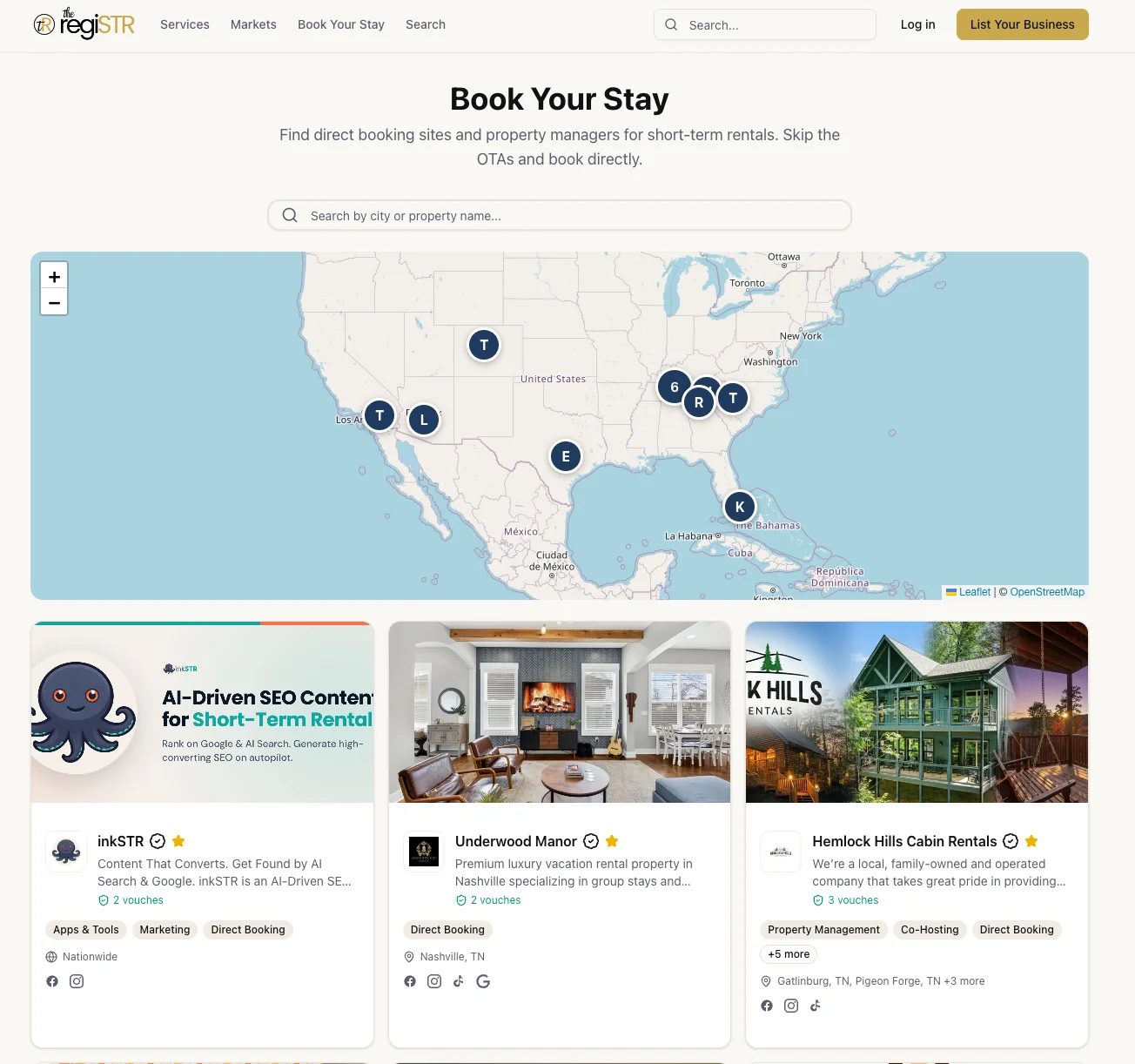
A well-staged, well-lit space like this modern living and bedroom combination is exactly the kind of cover photo that drives higher click-through in Airbnb search results. If your current listing photos don't tell this kind of story, the regiSTR's STR photographers directory is the fastest way to find someone who shoots specifically for OTA listing performance, not generic real estate marketing.
Content powered by inkSTR.co