How to Expand Your STR Portfolio Remotely in 2026
Expanding your STR portfolio remotely means acquiring and operating vacation rentals in markets where you don't live, using local vendor teams, remote-friendly technology, and standardized systems instead of your own physical presence. The operators who do this well never manage a new market alone. They build the vendor network first, then they buy.
- Remote expansion depends on vendors, not proximity: the operators who scale across markets succeed because they hire cleaners, co-hosts, and property managers who already work in that city, not because they visit often.
- The global vacation rental market is valued at roughly $109.4 billion in 2026 and is projected to reach $136.78 billion by 2031, a 4.57% CAGR, according to Mordor Intelligence, meaning the addressable market keeps expanding for new entrants and multi-market operators alike.
- Professional management companies now control about 42% of the roughly 7 million active short-term rental listings worldwide as of 2026, per DataIntelo, a sign that institutionalized, remote-managed portfolios are becoming the norm rather than the exception.
- Full-service STR management fees typically run 15 to 30% of gross revenue, with portfolios of 10 or more units often negotiating down to 15 to 20% due to economies of scale, based on industry-standard management benchmarks.
- Regulatory friction is the single biggest derailment risk in remote expansion. Local permit caps, HOA rules, and non-owner-occupancy limits can kill a deal you've already closed on.
- the regiSTR solves the core bottleneck of remote scaling: finding vetted local vendors in a market you've never lived in, organized by city and service category instead of scattered across Facebook groups and cold calls.
Scaling a short-term rental business used to mean living near your properties or hiring a full-time regional manager. That's no longer true in 2026. Between smart lock systems, cloud-based property management software, and dynamic pricing tools, the technical barriers to remote ownership have mostly disappeared.
What hasn't disappeared is the vendor problem. You can automate check-in, automate pricing, and automate guest messaging, but you still need a human being to clean the unit, fix the water heater, and show up when a smart lock battery dies at 11pm on a Friday. the regiSTR was built specifically around that gap: a directory of vetted, STR-specific service providers organized by market, so operators expanding into new cities don't have to start their vendor search from zero.
This guide walks through the actual mechanics of remote portfolio expansion: the acquisition rules experienced investors use to screen deals, the vendor-hiring workflow that keeps quality consistent across cities, the tech stack that replaces your physical presence, and the specific playbook for negotiating bulk deals and transitioning from arbitrage to ownership without losing operational control.
What Is the 7% Rule in Real Estate?
The 7% rule is a quick screening formula real estate investors use to estimate whether a rental property's annual income will cover its costs: multiply the purchase price by 7%, and if the property can generate that much in gross annual rental income, it clears the first screening threshold. It's a faster, rougher cousin of the more famous 1% rule, adjusted upward to account for the higher revenue potential of short-term rentals versus long-term leases.
For STR portfolio expansion specifically, the 7% rule matters because it lets you screen out-of-market deals fast, before you spend money on a market visit or a formal appraisal. A $400,000 cabin needs to generate roughly $28,000 a year in gross STR revenue to pass the screen. If a market's typical occupancy and nightly rate can't get you there, move on.
Notably, this rule is a filter, not a final answer. It ignores financing costs, STR-specific expenses like furnishing, photography, and turnover cleaning, and local regulatory risk. Treat it as the first of several filters, not the deciding factor. Once a property clears the 7% screen, that's when you dig into comp-set occupancy data, local permit requirements, and vendor availability in that specific city.
We see operators skip this step constantly, especially first-time out-of-market buyers who fall in love with a listing photo before running the math. Apply the 7% rule before you ever call a real estate agent in a new market. It costs nothing and saves you from wasting time on deals that were never going to pencil out.
How Do You Expand Your Real Estate Portfolio Remotely?
Expanding an STR portfolio remotely requires four sequential building blocks: market research using occupancy and regulatory data, a standardized operations system that works identically across properties, a vetted local vendor team in each target city, and a remote oversight structure that catches problems before guests do. Skipping any one of these is how out-of-state investors end up with a property they can't actually manage.
Step 1: Research the Market Before You Research the Property
Most first-time remote buyers research the property first and the market second. That's backwards. Before you look at a single listing, confirm three things about the target city: local STR permit requirements, typical seasonal occupancy patterns, and whether professional vendors (cleaners, handymen, co-hosts) actually operate there in sufficient supply.
Some U.S. cities and states cap the number of days an owner can rent per year, require mandatory registration with local tax authorities, or restrict non-owner-occupied units entirely. Hawaii and California both have jurisdictions with these constraints, and many municipalities layer HOA rules on top of municipal code. As a result, the "great deal" in a market with a two-year permit moratorium isn't a deal at all.
Step 2: Build the Vendor Team Before You Close
The single biggest mistake we see in remote expansion is investors closing on a property and then starting the vendor search. Reverse that order. Before you make an offer, confirm you can line up a turnover cleaner, a handyman, and either a co-host or property manager in that specific market.
This is exactly the gap the regiSTR's directory was built to close. Instead of cold-calling contractors who have never touched a same-day Airbnb turnover, you can browse vetted STR cleaners, property managers, and maintenance providers filtered by the exact city you're targeting, before you ever sign a purchase agreement.
Step 3: Standardize Operations Across Every Property
A remote portfolio only scales if every property runs on the same playbook: identical smart lock systems, the same property management software, the same turnover checklist, and the same guest communication templates. Operators who customize each property's workflow individually create a management burden that grows faster than their portfolio.
Industry research shows AI-powered guest messaging can now handle roughly 90% of routine guest inquiries automatically, which matters enormously once you're managing properties across multiple time zones and can't personally answer a 2am question about the Wi-Fi password.
Step 4: Set Up Remote Oversight, Not Remote Absence
Remote management isn't the same as no management. You still need visibility into what's happening at each property, ideally through a centralized dashboard that surfaces occupancy, revenue, and guest satisfaction metrics across the whole portfolio, not just a single unit.
What Is the 60/20/20 Rule for Portfolios?
The 60/20/20 rule is a portfolio allocation framework that suggests splitting your STR investment capital roughly 60% into stable, proven markets, 20% into emerging or growth markets, and 20% into higher-risk or opportunistic plays such as new construction or unproven neighborhoods. It's a risk-balancing approach borrowed from traditional investment portfolio theory and adapted for real estate.
Applied to remote STR expansion, this means the bulk of your portfolio should sit in markets with established regulatory frameworks, deep vendor availability, and predictable seasonal demand, think markets where you can already find multiple vetted cleaners and property managers rather than one guy who does everything. The 20% growth allocation goes toward markets showing rising demand signals but not yet saturated with competition.
The final 20% is where experienced portfolio operators take calculated swings: a market with regulatory uncertainty that might resolve favorably, a property type that's unproven locally, or a city just starting to attract STR-friendly zoning changes. This tier carries the most risk and the most reward, and it's where you should have the least capital exposure until you've validated the thesis.
What we consistently see is investors inverting this ratio. They put 60% of their capital into speculative markets because the numbers look exciting on paper, then discover they can't find a single reliable cleaner within 50 miles. Vendor availability should factor directly into which allocation tier a market belongs in. A market with strong fundamentals but zero professional STR vendor presence is riskier than the spreadsheet suggests.
What Is the 2% Rule for Properties?
The 2% rule states that a rental property's monthly gross rental income should equal at least 2% of its purchase price for the investment to be considered strongly cash-flow positive. A $300,000 property under the 2% rule would need to generate $6,000 a month in gross rental income, a much higher bar than the 1% rule and one that's more achievable in short-term rental operations than in traditional long-term leasing.
STRs can hit the 2% threshold more often than long-term rentals because nightly rates compound faster than monthly lease rates, particularly in markets with strong seasonal demand. Benchmark listings in high-demand STR markets typically maintain 60 to 75% annual occupancy when professionally managed and competitively priced, and that occupancy level combined with a strong average daily rate is what gets a property over the 2% line.
For remote portfolio expansion specifically, the 2% rule works best as a comparative filter across markets, not an absolute requirement. A $250,000 property in a secondary market with 55 to 70% typical occupancy might clear 2% more easily than a $600,000 property in a saturated primary market, even though the primary market has more brand recognition. Run the math per market before assuming the "obvious" city is the best expansion target.
One caveat: the 2% rule ignores management fees. If you're paying a full-service manager 20 to 25% of gross revenue, your actual net yield will be meaningfully lower than the headline number suggests. Factor management costs into every 2% rule calculation before treating a property as cleared.
How Do You Vet Remote Co-Hosts and Local Property Managers Without Losing Control?
Vetting a remote co-host or local property manager requires verifying their STR-specific experience, response time commitments, and reporting cadence before signing anything, then auditing their actual performance against those commitments during the first 90 days. Trusting a manager's word without a structured verification process is how out-of-state owners lose thousands before realizing the mistake.
Start every vetting conversation with response-time specifics, not price. Ask what happens when a guest reports a broken air conditioner at 9pm on a Saturday. A manager who can't answer that question concretely, with a named vendor they'd dispatch and an expected timeline, isn't ready to manage a property you can't physically visit.
Second, request references specifically from other out-of-state or multi-market owners, not just local clients. An owner managing a property 600 miles away has different needs than a local investor who can drop by unannounced. The reference conversation should cover communication frequency, how financial reporting works, and whether the manager proactively flags problems or waits to be asked.
Third, build in an audit mechanism from day one. This might mean requiring monthly video walkthroughs, cross-referencing cleaner check-in timestamps against the property management software's calendar, or setting up review alerts that flag any guest complaint immediately rather than in a monthly summary. Remote oversight only works if you have a system that surfaces problems automatically, since you can't catch them by walking past the property.
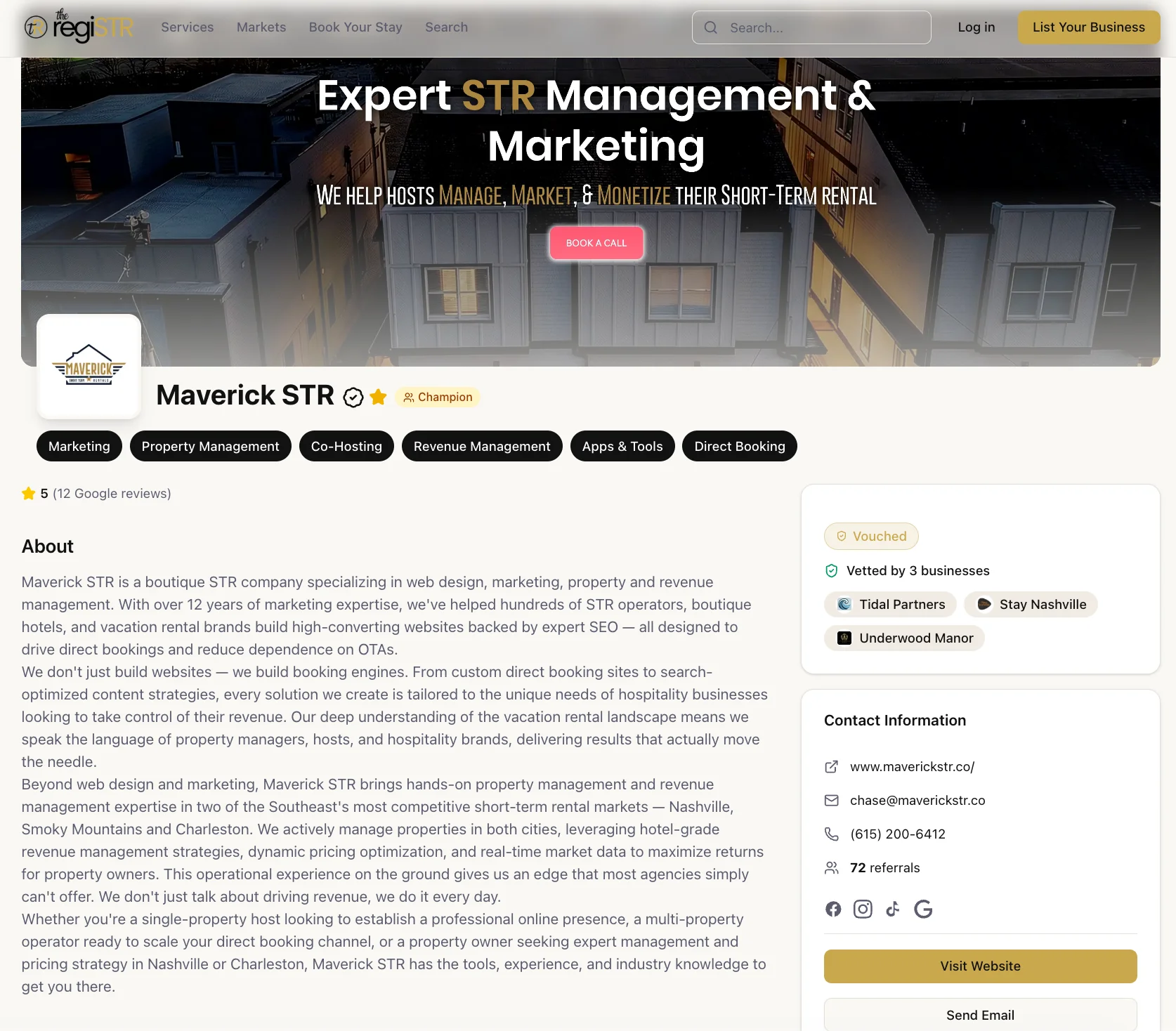
Every provider listed on the regiSTR carries a Vouch, meaning another verified STR operator has personally endorsed them by name, not an anonymous star rating that can be manipulated. That peer-verification layer is exactly what remote owners need when they can't do an in-person interview or drive by the property manager's office before signing a contract.
What Technology Stack Do You Need to Manage an STR Portfolio Remotely?
A remote STR technology stack needs, at minimum, a channel manager to sync calendars across Airbnb and Vrbo, a dynamic pricing tool, smart lock systems for keyless entry, noise or occupancy sensors for risk management, and a task management platform to coordinate cleaners and maintenance across multiple cities. Missing any one of these creates a manual bottleneck that doesn't scale past two or three properties.
Smart lock systems with dynamic key codes that change per guest eliminate the need for a physical key handoff, which is non-negotiable once you're operating in a market where you can't personally meet a guest at the door. Combine that with noise and occupancy sensors, and you get an early warning system for unauthorized parties or lease violations without needing eyes on the property.
| Tech Category | What It Solves for Remote Owners | Why It Matters at Scale |
|---|---|---|
| Property management software (PMS) | Centralizes bookings, guest messaging, and calendars across every property | One login instead of five separate Airbnb and Vrbo dashboards |
| Dynamic pricing tool | Adjusts nightly rates automatically based on demand and comp-set data | Removes manual pricing decisions across multiple markets and seasons |
| Smart locks with dynamic codes | Eliminates physical key exchange for every guest turnover | Enables true remote check-in with no local presence required |
| Noise and occupancy sensors | Flags unauthorized parties or overcrowding without cameras | Reduces liability risk across properties you can't personally monitor |
| Task management platform | Coordinates cleaner and maintenance schedules across every city | Keeps turnover timelines consistent whether it's your 1st or 20th unit |
Notably, technology replaces your physical presence, but it doesn't replace the human vendors who show up when something breaks. A perfectly configured smart lock still needs a locksmith or handyman when it malfunctions. That's the layer most remote-scaling guides gloss over: the tech stack handles information flow, but you still need real people in real cities, which is precisely why finding vetted STR maintenance providers by market matters as much as any software subscription.
How Do You Negotiate Bulk Leases for Remote STR Expansion?
Bulk leasing for STR expansion means negotiating a master lease for 5 to 10 units within a single building or complex, securing a lower per-unit rate in exchange for guaranteed occupancy across multiple units, with explicit lease language permitting short-term rental use. This approach is one of the fastest ways to scale a rental-arbitrage portfolio without buying property outright.
The negotiation leverage in a bulk deal comes from the property owner's certainty: they're filling multiple units at once instead of marketing them individually. In exchange for that certainty, push for a rate discount below the building's standard per-unit asking price, plus specific contract clauses addressing short-term rental permissions, since most standard leases assume long-term occupancy and will need STR-specific language added.
Negotiate these clauses explicitly, in writing, before signing: written permission for subletting via Airbnb and Vrbo, a defined process for handling maintenance requests across multiple units, an exit clause if local regulations change mid-lease, and clarity on who's responsible for HOA or condo association compliance if the building has one. A verbal assurance from a leasing agent that "short-term is fine" is not a legally enforceable protection if the building's board changes its policy six months in.
For owners transitioning from arbitrage to outright ownership in a market they've proven out through leasing, the vendor relationships you built during the arbitrage phase transfer directly. If you've already vetted a cleaner and handyman through a bulk lease arrangement, buying a property in that same building or neighborhood means you walk in with an operational team already in place, a considerable advantage over a cold-start acquisition in a brand-new market.
How Do You Standardize Operations Across a Multi-City Portfolio Without Losing Guest Experience Quality?
Standardizing operations across multiple cities means using identical property management software, guest communication templates, and turnover checklists at every property, while allowing local vendors to execute those standards with market-specific knowledge. The goal is consistency in guest experience, not identical properties or identical pricing.
A digital welcome guide with a QR code linking to an online guest handbook works identically whether the property is in a mountain market or a beach market, and it eliminates the need for you to personally answer the same twenty questions at every property. Standardize the guide format across your portfolio, but customize the content, local restaurant recommendations and check-in instructions still need to be market-specific.
Where operators consistently lose guest experience quality at scale is inconsistent turnover standards. A cleaner in one market might have a different definition of "guest-ready" than a cleaner in another market, unless you provide an identical, detailed checklist and audit against it. This is where a standardized cleaning protocol, distributed to every vendor regardless of city, protects your review scores as you expand.
Business intelligence tools can now track more than 55 performance metrics across a multi-property portfolio, including occupancy rates, RevPAR, and profitability per property, which gives remote operators the visibility to catch a quality slip in one market before it tanks that property's review average. Without that kind of centralized metric tracking, a struggling property can go unnoticed for months when you're not physically present to notice guest complaints trending downward.
Data Snapshot: What Remote Expansion Actually Costs in Management Fees
Full-service STR management typically runs 15 to 30% of gross revenue in the United States, with 20% commonly cited as the median rate across the industry. That fee usually includes cleaning coordination and maintenance dispatch, but the exact scope varies significantly by provider, so confirm inclusions before comparing quotes.
| Portfolio Type | Typical Management Fee Range | What's Usually Included |
|---|---|---|
| Single remote property, full-service | 20-25% of gross revenue | Pricing, guest messaging, cleaning coordination, maintenance dispatch |
| Portfolio of 10+ units, full-service | 15-20% of gross revenue | Same scope, discounted through economies of scale |
| Virtual/limited-service management | 10-15% of gross revenue | Bookings, pricing, and basic guest coordination only, no on-site services |
| Turnkey operator, 20-50 units | 15-20% net management margin | Full operational stack after third-party vendor costs |
These ranges matter because they directly affect whether a property clears the 2% rule or the 7% rule screen discussed earlier. A property that looks profitable before management fees can fall short after a 20 to 25% cut, which is exactly why we recommend running your acquisition math with fee-adjusted revenue, not gross revenue, from the start.
Practical Guidance: A Step-by-Step Checklist for Your Next Market
- Run the 7% and 2% rule screens on any target property before scheduling a market visit or hiring an agent.
- Verify local STR permit requirements and any HOA or condo restrictions before making an offer, not after closing.
- Line up a cleaner, handyman, and property manager in the target market before your close date, not after.
- Standardize your smart lock, PMS, and pricing tools across the new property to match your existing portfolio.
- Set a 90-day audit checkpoint for any new co-host or property manager, using named vendor commitments and response-time benchmarks.
- Build guest-facing materials (digital welcome guide, communication templates) from your existing portfolio's format, customized only for local details.
- Track occupancy, RevPAR, and review scores in a centralized dashboard from day one, so a quality slip in a new market surfaces immediately.
Common mistakes to avoid: closing on a property before confirming vendor availability, trusting a verbal assurance about STR permissions in a lease, and assuming a management fee percentage without confirming what services it actually covers. Each of these has ended profitable-looking deals for operators who skipped the verification step.
Frequently Asked Questions
What is the fastest way to find a reliable cleaner in a market I've never visited?
Browse a directory organized specifically for STR vendors rather than general home service platforms, since general directories don't filter for turnover-window experience. The regiSTR's Cleaning and Turnover category lists providers by city, with Vouches from real operators who've hired them, which shortcuts the cold-call phase entirely.
How many properties can one person realistically manage remotely?
There's no fixed number, since it depends heavily on how standardized your systems are and how much you delegate to local vendors versus handling personally. Operators who rely on automated guest messaging, a consolidated PMS, and dedicated local property managers can scale well beyond what a manual, single-tool operator could handle.
Should I hire a co-host or a full-service property manager for a remote property?
A co-host typically handles guest communication and calendar management at a lower fee, while a full-service property manager coordinates cleaning, maintenance, and sometimes pricing in addition to guest communication. Choose a co-host if you want to retain more control over vendor relationships, and a full-service manager if you want a single point of accountability.
What is rental arbitrage and how does it fit into remote expansion?
Rental arbitrage means leasing a property from an owner and subletting it as a short-term rental, rather than buying the property outright. It's a lower-capital entry point into a new market, and bulk lease negotiations for 5 to 10 units in a single building can accelerate this strategy significantly.
How do I know if a market has enough vendor supply to support remote ownership?
Search a market-specific STR service directory before making an offer, and if you can't find at least a few vetted cleaners, handymen, and property managers listed for that city, treat that as a red flag on vendor supply. Thin vendor availability in a market is a risk factor the 7% and 2% rules don't capture.
What happens if local STR regulations change after I've already expanded into a market?
This is why bulk lease agreements and management contracts should include an explicit exit clause tied to regulatory changes. Regulatory uncertainty has led some jurisdictions to temporarily restrict or ban STRs in residential areas, so building contract flexibility upfront protects you from being locked into an unenforceable arrangement.
Do I need different technology for each market, or can I use one stack across my whole portfolio?
Use one consistent technology stack, PMS, smart locks, and pricing tool, across every property regardless of market. Standardization is what makes remote oversight manageable; only your guest-facing local content and vendor relationships should vary city by city.
How do I audit a property manager's performance if I can't visit the property?
Request monthly video walkthroughs, cross-reference cleaner check-in timestamps against your PMS calendar, and set up automated alerts for any guest complaint rather than waiting for a monthly summary. A manager who resists this level of transparency in the first 90 days is signaling a problem before it costs you revenue.
Conclusion: Building an STR Portfolio Without Living Near a Single Property
Expanding your STR portfolio remotely in 2026 comes down to sequence: research the market and its regulations, line up vendors before you close, standardize your tech stack, and build an audit system that replaces your physical presence. The global vacation rental market's continued growth toward $136.78 billion by 2031 means the opportunity is real, but the operators who capture it are the ones who solve the vendor problem before they solve the property problem.
The 7% rule, the 2% rule, and the 60/20/20 allocation framework give you the financial screens. What they don't give you is a cleaner in Gatlinburg or a property manager in Scottsdale who already knows how STR turnover works. That's the gap the regiSTR closes, one vetted, market-specific provider at a time.

If your next acquisition is in a market you've never set foot in, don't start with a Facebook group post asking for cleaner recommendations. Get started with the regiSTR and browse vetted property managers, cleaners, and maintenance providers by city, so your vendor team is already in place before you even sign the purchase agreement.
Content powered by inkSTR.co