
What Is a Cohost Company? How to Hire One in 2026

A cohost company is a business that handles the day-to-day operations of your short-term rental, guest messaging, turnover coordination, pricing adjustments, and issue resolution, typically for a percentage of booking revenue rather than a flat fee. It sits between full self-management and hiring a full-service property manager, giving you a hands-off operation while keeping the listing and guest relationship under your name.
Key Takeaways
- A cohost company typically charges a percentage of revenue (commonly in the 10-20% range across the industry, though exact rates vary by market and scope of work) rather than the higher full-service management fees.
- Unlike full-service property management, cohosting usually leaves the Airbnb or Vrbo listing, pricing strategy control, and guest relationship in the owner's name.
- The global vacation-rental management software market is projected to reach $238.05 million in 2026, according to Market Reports World, a sign of how much operational infrastructure now supports cohosting workflows.
- Cohosting works best for owners who want relief from the daily grind (guest texts, cleaner coordination, midnight maintenance calls) but still want visibility into pricing and reviews.
- Contracts should spell out response-time guarantees, turnover windows, revenue-split terms, and termination notice; vague agreements are the most common source of owner-cohost disputes.
- The regiSTR lists vetted co-hosting and co-management providers by market, so you can compare real options instead of relying on a single Facebook group recommendation.
If you're searching for a cohost company in 2026, you're probably at one of two points: you're burned out from answering guest messages at 11pm, or you're an out-of-state owner who has never met the person cleaning your property. Both situations point to the same solution category, and both come with the same risk: hiring someone who calls themselves a cohost but has never actually run a same-day turnover.
At the regiSTR, we built our Co-Hosting and Co-Management directory category specifically because this hiring decision is harder than it looks. General contractor sites and freelance marketplaces don't filter for STR-specific experience, and a cohost who's never dealt with a 2pm checkout followed by a 4pm check-in is going to cost you reviews before you realize the mismatch.
This guide covers what a cohost company actually does, how pricing typically works, what belongs in a co-hosting agreement, and how to tell a legitimate operator from someone who's just reselling a checklist. We'll also flag where cohosting stops making sense and full-service management becomes the better call.
What Does a Cohost Company Actually Do?
A cohost company handles the operational tasks of running a short-term rental on behalf of the owner: guest messaging, booking calendar management, turnover coordination with cleaners, pricing adjustments, and issue triage when something breaks mid-stay. The owner typically retains ownership of the listing account and final say on major decisions.
In practice, this breaks down into a handful of recurring responsibilities. First, guest communication: answering inquiry messages, sending check-in instructions, and responding to questions during the stay, often within a guaranteed response window. Second, turnover logistics: scheduling the cleaner, confirming the property is guest-ready, and handling last-minute cleaner cancellations. Third, calendar and pricing oversight: adjusting nightly rates for demand shifts, blocking dates for maintenance, and syncing calendars across Airbnb and Vrbo if you list on both.
Notably, a cohost company is not the same as a channel manager or a software tool. Platforms like Hospitable, Hostaway, and Lodgify automate the calendar-sync piece, but they don't answer the phone when your HVAC dies at 11pm in a market you've never visited. A cohost fills that human gap. Some cohosts also handle light maintenance dispatch, calling a local handyman when something needs attention, though major repairs and vendor sourcing usually fall outside standard cohost scope.
What separates a strong cohost from a weak one is response-time consistency. If your cohost is juggling twenty properties and takes six hours to answer a guest's "the wifi is down" message, you'll feel it in your review scores within a month. That's exactly the criteria we apply when vetting providers listed on the regiSTR's Find STR Property Managers and co-hosting category pages.

How Much Does a Cohost Company Typically Charge?
Cohost companies typically charge a percentage of gross booking revenue rather than a flat monthly fee, and that percentage is generally lower than full-service property management rates because the scope of work is narrower. Exact figures vary significantly by market, property complexity, and what's included, so always get the fee structure in writing before you sign anything.
Full-service property management, by comparison, tends to run higher because it typically bundles marketing, revenue strategy, owner reporting dashboards, and sometimes furnishing or design services on top of the operational tasks a cohost handles. A cohost is essentially the operational layer without the strategic layer. If you already handle your own pricing strategy and marketing but hate answering 2am guest texts, cohosting is the cheaper, narrower fit.
Watch for hidden add-ons. Some cohosts quote a base percentage but then charge separately for supply restocking, emergency after-hours calls, or calendar management across a second platform. Ask for a complete fee sheet, not just the headline percentage, before you compare two quotes side by side.
Comparing quotes is exactly what the regiSTR's directory structure is built for: you can browse multiple co-hosting providers in your market and compare what's actually included in each fee before committing to one.
Should I Hire a Cohost Company or a Full-Service Property Manager?
The choice between a cohost company and full-service property management comes down to how much strategic control you want to keep versus how much operational relief you need. Cohosting keeps you in the driver's seat on pricing and marketing while removing the daily grind; full-service management hands over both the operations and the strategy.
| Factor | Cohost Company | Full-Service Property Manager |
|---|---|---|
| Listing ownership | Stays in owner's name | Often moved to manager's master account or co-managed |
| Pricing control | Owner typically retains final say | Manager usually sets and adjusts pricing independently |
| Fee structure | Percentage of revenue, generally lower | Percentage of revenue, generally higher, often bundles more services |
| Marketing and photography | Usually not included; owner sources separately | Often bundled or coordinated by the manager |
| Best fit | Hands-on owners who want relief from daily tasks | Owners who want to be fully hands-off |
Not every owner needs full-service management on day one. If you're a first-time host who enjoys picking your own photos and setting your own weekend rates but dreads the 7am "where's the parking" text, cohosting solves your actual problem without paying for services you don't want. Scaling investors with three or more properties across different markets, on the other hand, often outgrow the cohost model because the coordination overhead across markets starts to demand full management infrastructure.
If you're leaning toward full management instead, browse vetted STR property managers on the regiSTR to compare that tier directly against co-hosting quotes.
What Should Be in a Cohost Company Contract?
A co-hosting contract should specify the exact scope of services, the revenue-split percentage, response-time commitments, turnover coordination responsibilities, and termination terms in writing before you hand over calendar access. A verbal agreement or a one-paragraph email is not sufficient for a relationship involving guest communication and revenue.
First, the scope section needs specifics: does the cohost handle guest messaging only, or also cleaner scheduling and calendar pricing? Second, response-time guarantees matter more than almost anything else in the agreement. A cohost who won't commit to a maximum response window, say, replying to guest messages within a set number of hours, is telling you something about how many properties they're juggling. Third, the revenue-split terms should state whether the percentage applies to gross booking revenue or net revenue after platform fees, since that distinction changes the real cost meaningfully.
Additionally, the contract should address who owns the guest relationship data and reviews if the arrangement ends. Termination notice periods, typically 30 to 60 days in service agreements of this type, protect you from a sudden operational gap. And clarify who's liable if a cohost's delayed response causes a guest complaint that results in a refund or a negative review.
This is exactly the kind of vetting criteria we apply before listing a provider on the regiSTR. Every cohost in our co-hosting directory has been referred in by a network member, and operators can see peer vouches before signing anything.
What Should I Look for When Vetting a Cohost Company?
Vetting a cohost company means checking for STR-specific experience, verifiable response-time practices, and references from other short-term rental owners, not just generic customer service reviews. A cohost with a background in hotel front-desk work isn't automatically qualified for the pace of Airbnb turnover cycles.
Start by asking how many properties the cohost currently manages and in what markets. A cohost juggling forty properties solo is going to have slower response times than one managing a portfolio of eight to twelve, regardless of how the sales pitch sounds. Second, ask what happens during a same-day emergency, a broken lockbox, an early guest arrival, a cleaner no-show, and get a specific answer, not a vague reassurance.
Third, request references from current clients who own properties similar to yours in guest capacity and market. A cohost who's only ever managed studio condos may not translate well to a six-bedroom lake house with a hot tub and complex check-in instructions. Fourth, check whether the cohost has direct experience with your specific platforms; Airbnb, Vrbo, and direct booking each have different messaging and review mechanics.
Notably, general directories like broad home-services listing sites don't filter for any of this. They surface cleaners, handymen, and property managers side by side without distinguishing who actually understands a three-hour turnover window. That's the gap the regiSTR was built to close: every provider joined the network by referral, and the Vouch system lets other STR operators publicly endorse a cohost by name, not an anonymous star rating.
How Do I Find a Cohost Company in a Market I Don't Live In?
Finding a cohost company in a market you don't live in requires searching a directory organized by geographic location rather than relying on general web searches, since local reputation and word-of-mouth referrals don't reach owners managing properties remotely. Out-of-state owners face this problem constantly with cabins in the Smoky Mountains or beachfront units on the Gulf Coast.
The typical failure mode looks like this: an owner in Colorado buys a cabin near Gatlinburg, posts in a regional Facebook group asking for cohost recommendations, and gets three replies from people who may or may not still be taking clients. There's no way to verify experience, current capacity, or actual client satisfaction from a comment thread.
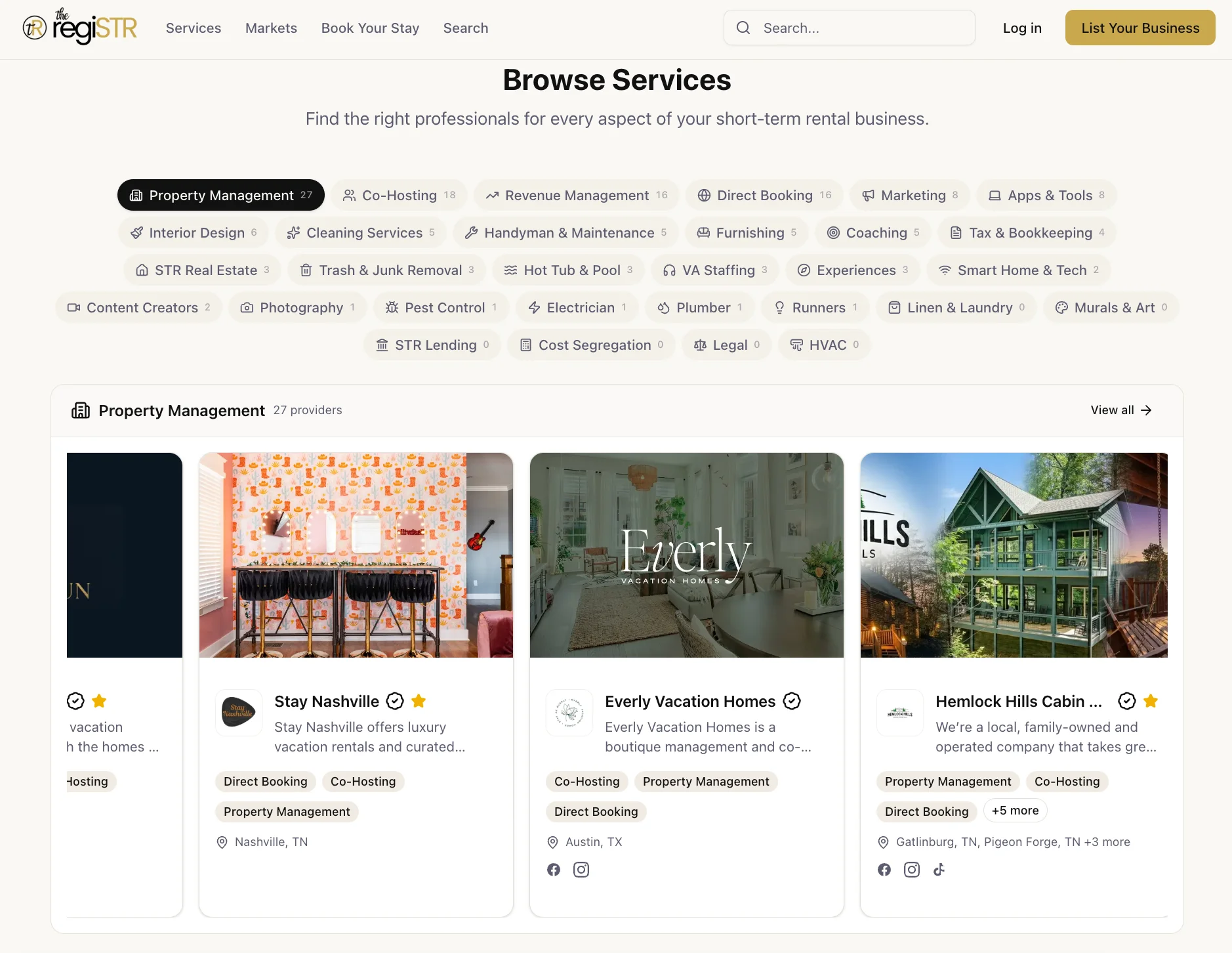
The regiSTR's market pages solve this by organizing co-hosting providers by city and metro, so an owner can filter directly to their property's location and see who's actively serving that market, alongside cleaning, maintenance, and photography providers for the same area. This matters because a cohost who's genuinely embedded in a market usually already has relationships with local cleaners and handymen, which speeds up onboarding.
Building a reliable local team in a market you've never visited doesn't have to take months of trial and error. Browse vetted co-hosting providers by market on the regiSTR and sign up free to access the full directory in under a minute.
What Are the Biggest Mistakes Owners Make When Hiring a Cohost Company?
The most common mistake owners make is vetting a cohost company on price alone instead of response-time reliability, which leads to slower guest replies, missed turnovers, and declining review scores within the first few months. A cheaper cohost quote that can't back up response commitments usually costs more in lost bookings than it saves in fees.
Second, owners frequently skip the reference-check step entirely, trusting a polished website or social media presence over an actual conversation with a current client. Third, many owners fail to clarify who owns the listing account and guest review history if the relationship ends, which creates a messy transition later. Fourth, some owners assume cohosting includes marketing and photography by default, only to discover those are separate add-ons after signing.
Fifth, and this one is subtle: owners sometimes hire a cohost without checking whether that cohost has actual experience with same-day or back-to-back turnovers. A cohost who's only worked with week-long stays may not have the operational muscle memory for a market with frequent short bookings. As of 2026, with over 1,000 top Airbnb markets tracked according to Awning, the operational demands vary enormously by location and guest profile, so market-specific experience is not optional.
Data Point: Why the Cohosting Model Is Growing in 2026
The vacation-rental management software market, which includes the tools cohost companies rely on for messaging automation and calendar syncing, is projected to reach $238.05 million globally in 2026 and grow to $356.82 million by 2035, a 4.6% compound annual growth rate, according to Market Reports World. That growth reflects increasing professionalization across the STR operations layer, not just the property management tier.
Separately, the broader property-management software market is projected at $3.81 billion in 2026, climbing to $5.89 billion by 2033 at a 6.4% CAGR, according to Grand View Research figures. Cohost companies increasingly rely on this software infrastructure, unified inboxes, automated pricing rules, and turnover scheduling tools, to manage more properties without sacrificing response time.
For owners, this matters practically: a cohost using modern tooling can typically manage a larger portfolio without the response-time degradation that plagued cohosts running everything manually through separate apps five years ago. When vetting a cohost, it's fair to ask what software stack they use and whether guest messages route through a unified system or get manually checked across four different apps.
How the regiSTR Handles Co-Hosting Vetting
The regiSTR treats co-hosting the same way it treats every other STR service category: invite-only onboarding, market-based filtering, and a peer Vouch system instead of anonymous star ratings. A cohost joins the network because an existing STR operator referred them in, not because they paid for a listing on a generic directory.
What we consistently see is that cohosts who thrive in our network are the ones with narrow, defined service areas and honest capacity limits. A cohost managing eight properties in Charleston with a stated two-hour response guarantee is a stronger listing than one claiming to serve "the entire Southeast" with no specifics. Our provider profiles show markets served, service scope, and Vouches from real operators who've hired that cohost before.
For hosts comparing options, the directory experience looks like this: filter by your market, browse co-hosting and co-management providers alongside cleaners, photographers, and maintenance vendors for the same area, and read what other owners have publicly said about working with each one. It removes the guesswork of cold outreach and replaces it with actual accountability.
Frequently Asked Questions
What is a host company?
A host company, in the short-term rental context, typically refers to a business that manages guest-facing operations for a property owner, similar to a cohost company. It handles messaging, booking coordination, and turnover logistics, usually for a percentage of revenue rather than a flat fee.
What does a rental management company do?
A rental management company handles the broader operational and strategic tasks of running a short-term rental, including pricing strategy, marketing, guest communication, cleaning coordination, and maintenance oversight. Compared to a cohost, a full rental management company typically takes on more strategic control, often including listing ownership and independent pricing authority.
How do I find a hotel management company for my property?
If you're searching for hotel-style management for a short-term rental rather than a traditional hotel property, the closest equivalent in the STR space is a full-service property manager or a cohost company, depending on how much operational control you want to retain. The regiSTR's directory lets you filter by market and compare property management and co-hosting providers side by side.
What's the difference between a cohost and a full-service property manager?
A cohost typically handles operational tasks, guest messaging, turnover coordination, and calendar management, while the owner retains listing ownership and pricing control. A full-service property manager usually takes on both the operations and the strategy, including pricing, marketing, and often listing account control, for a correspondingly higher fee.
How much does a cohost company typically charge?
Cohost companies typically charge a percentage of gross booking revenue, and rates vary by market, property type, and scope of services included. Always request a full fee breakdown in writing, since some cohosts charge separately for supply restocking or after-hours emergency response on top of the base percentage.
How do I know if a cohost company has actually worked with short-term rentals before?
Ask for references from current clients with properties similar in size and market to yours, and ask specific questions about how the cohost handles same-day turnovers and guest emergencies. A cohost with only long-term rental or hotel front-desk experience may not have the operational reflexes needed for fast STR turnover cycles.
Is a revenue management tool like Wheelhouse worth evaluating alongside a cohost company?
Dynamic pricing tools handle rate optimization based on demand signals, while a cohost company handles the human side of guest communication and turnover coordination, so the two typically serve different functions rather than competing directly. Many cohosts already incorporate pricing software into their workflow, so it's worth asking during vetting whether pricing tools are included or billed separately.
Can a cohost company help me get more direct bookings?
Most cohost companies focus on operational tasks rather than direct booking strategy, though some coordinate with website design, SEO, or social media specialists as an add-on. If reducing your dependence on Airbnb and Vrbo platform fees is a priority, look for a cohost or STR consultant with specific direct booking experience, or browse the regiSTR's marketing and website categories separately.
Conclusion: Finding the Right Cohost Company for Your Property
A cohost company gives you the operational relief of professional guest management and turnover coordination without handing over full pricing and marketing control, typically at a lower fee than full-service property management. The right fit depends on how much you want to stay involved and how much of your day you're currently losing to guest texts and cleaner check-ins.
Vetting matters more than price. A cohost who won't commit to a specific response-time window, can't name their current property count, or has no references from similar STR owners is a risk you don't need to take in 2026, when so many verified options exist. Get the contract terms in writing, ask about software tools, and check references before you hand over calendar access.
If you're ready to stop cold-calling cohosts off a Facebook group thread, Get started with the regiSTR and browse co-hosting providers filtered by your exact market, complete with peer Vouches from operators who've already hired them. Sign up free at theregistr.co and compare your options before your next guest checks in.
Content powered by inkSTR.co