
Airbnb Sample Reviews: What Actually Earns a 5-Star Rating

Airbnb sample reviews work best when they name a specific detail the next guest or host can actually use, like a spotless kitchen, a fast response time, or a smooth checkout, rather than a generic compliment. A review that says "great host, would stay again" tells a future guest almost nothing. A review that says "the host answered our late check-in question in under ten minutes and left a full welcome book with Wi-Fi and parking instructions" tells them everything.
Key Takeaways
- Airbnb gives both guests and hosts a 14-day window after checkout to submit a review, and reviews only publish once both sides submit or that window closes.
- The average Airbnb review runs about 58 words, and most fall between 4 and 77 words, according to a published study of over 181,000 Airbnb review comments.
- Airbnb reported more than 460 million guest reviews left on the platform over its first 16 years, with more than 80% of reviews landing at five stars.
- Listings with 10 or more reviews average notably higher occupancy than listings with no reviews at all, based on Airbtics data covering nearly 300,000 active U.S. listings.
- Specific, evidence-based reviews (naming a cleanliness detail, a communication moment, or a house rule followed) consistently read as more credible than vague praise, on both sides of the transaction.
- the regiSTR helps hosts build the kind of operation that earns strong reviews in the first place, by connecting you with vetted cleaners, photographers, and property managers who understand exactly what Airbnb guests are grading you on.
If you run a short-term rental, reviews are not a courtesy. They are a ranking signal, a trust signal, and often the deciding factor between a guest booking your place or scrolling to the next listing. Airbnb's own data backs this up: listings with ten or more reviews consistently outperform unreviewed listings on occupancy, according to Airbtics research covering close to 300,000 active U.S. properties.
This guide breaks down what actually belongs in a strong Airbnb review, whether you're a host writing about a guest or a guest writing about a stay. We'll cover positive, negative, and mixed-review scenarios, plus the situations most guides skip entirely: how to flag a real issue without sounding retaliatory, and what belongs in a private message instead of a public review. At the regiSTR, we work with hosts across dozens of markets who are trying to build five-star operations from the ground up, and reviews are usually where the gap between "good enough" and "guest favorite" becomes obvious fast.
As of 2026, Airbnb's Guest Favorite listings, a designation built partly on review quality, have collectively logged more than 250 million booked nights at an average rating of 4.92. That's the bar. Here's how to write reviews that actually move you toward it.
Can You Provide Some Examples of 5-Star Airbnb Reviews?
A five-star Airbnb review names at least one concrete, verifiable detail instead of relying on adjectives alone. The strongest examples reference cleanliness, communication speed, or specific amenities the guest actually used, giving future readers something real to evaluate.
Here are five sample reviews, each built around a different guest scenario:
Family stay: "The house was spotless when we arrived and the kids' room already had a cot and a small basket of toys we hadn't even asked for. The welcome book covered Wi-Fi, parking, and the nearest grocery store, which saved us a lot of guessing on night one."
Couple's getaway: "Everything about this stay was easy. The host answered a question about early check-in within minutes, the apartment matched the photos exactly, and we left feeling like the space had been genuinely cared for, not just staged for the listing."
Group of six: "Six of us stayed comfortably thanks to the large living room and terrace setup. We had a quick question about the grill and the host responded in under five minutes with clear instructions. Would book again for our next group trip."
Solo business traveler: "Quiet, clean, and exactly as described. Fast Wi-Fi, a proper desk, and self-check-in that took less than two minutes. Ideal for anyone working remotely for a few nights."
First-time guest: "This was our first Airbnb stay and it set the bar high. The host checked in once by message, not intrusively, and the apartment was immaculate at checkout. We'd recommend this place without hesitation."
Notice none of these lean on "amazing" or "perfect" alone. Each one anchors the praise to something the next reader can picture. That specificity is exactly what separates a review that gets read from one that gets skimmed and forgotten.

What Should I Include in an Airbnb Review?
A complete Airbnb review should cover three to four categories: cleanliness, communication, adherence to house rules, and overall property condition. Airbnb itself structures its star-rating system around these categories, so mirroring them in written feedback makes your review more useful and more aligned with how the platform actually scores stays.
Specifically, aim to include:
- Cleanliness at arrival or checkout. Note the actual condition, not just "it was clean." Was the kitchen stocked and wiped down? Were linens fresh?
- Communication timing. How fast did the host or guest respond to messages? Did they confirm check-in details in advance?
- House rule compliance. For hosts reviewing guests, this matters most: did they respect occupancy limits, quiet hours, and checkout time?
- One specific, memorable detail. A welcome basket, a broken appliance that got fixed fast, a neighbor who was disturbed. This is the detail that makes a review feel real instead of templated.
Avoid stuffing a review with every possible compliment. A study of over 181,000 Airbnb review comments found the average length runs about 58 words, with nearly 76% landing between 4 and 77 words. Long reviews aren't more credible; specific ones are. As a host, if you're building a track record that will eventually support a Superhost application (Airbnb reported more than 1.3 million Superhosts globally in 2026), consistency and specificity in what you write about guests also signals to Airbnb's systems that you're an engaged, professional operator.
This is the same logic we apply when vetting service providers for the regiSTR network. A generic "great cleaner, would hire again" tells us nothing. We look for hosts who can point to a specific turnover window met, a specific communication response time, or a specific detail a cleaning crew caught that a lesser provider would have missed.
What Are Examples of Short 5-Star Reviews?
Short five-star reviews still work when they trade length for precision, packing one concrete detail into a sentence or two instead of stretching praise across a paragraph. A tight, specific review often reads as more trustworthy than a long, vague one because it feels less rehearsed.
Sample short reviews for different guest types:
- Couple: "Clean, quiet, exactly as pictured. Would book again."
- Solo traveler: "Fast self-check-in, strong Wi-Fi, no issues at all. Great for a work trip."
- Family: "Kid-friendly setup and a spotless kitchen. Made a hectic trip easy."
- Group: "Plenty of space for six, host responded fast when we had a question about parking."
- Business traveler: "In and out in under two minutes at check-in. Desk setup was better than most hotels."
Each of these is under 25 words but still names something specific: self-check-in speed, a kitchen condition, a parking response. That's the pattern that makes a short review useful rather than filler. Compare that to something like "amazing stay, 10/10," which contains zero transferable information for the next guest weighing a booking decision.
For hosts, this same principle applies when you're writing quick reviews of guests after a busy turnover season. A one-line note like "left the unit exactly as they found it, checked out five minutes early" takes fifteen seconds to type and gives future hosts real signal. It's also the kind of specificity we look for on the regiSTR when hosts leave feedback on the STR cleaners and vendors in our network. A short, factual note beats a long, generic one every time.
How to Write a Good Review on Airbnb as a Guest
Writing a good Airbnb review as a guest means submitting honest, specific feedback within Airbnb's 14-day post-checkout window, focused on what you actually experienced rather than what you assume the host wants to hear. Airbnb publishes reviews simultaneously once both parties submit, or automatically once the window closes, so there's no benefit to waiting strategically.
A step-by-step approach for guests:
- Review your notes or photos from the stay within a day or two of checkout, while details are fresh.
- Start with the overall impression in one sentence, positive, negative, or mixed.
- Add one specific detail about cleanliness or property condition.
- Add one specific detail about communication, response time, check-in process, or how questions were handled.
- If relevant, note whether the listing matched the photos and description accurately.
- Close with whether you'd stay again or recommend the property to others.
- Submit within the 14-day window; both host and guest reviews publish together once both sides submit.
One thing most guides skip: the difference between a private message and a public review. If something needs fixing, like a stuck window or a confusing parking situation, that belongs in a direct message to the host during your stay, not buried in a public review after the fact. Public reviews should focus on your overall experience and outcome, not serve as a maintenance ticket. And never disclose sensitive personal information, exact addresses, or details that could compromise the host's safety or the property's security in a public review; that's what Airbnb's messaging system exists for. Notably, a study of Airbnb reviews across five major U.S. cities found that only about 44.6% of trips in the sample received any guest feedback at all. If you had a good stay, leaving a review is genuinely one of the highest-impact things a guest can do, since it directly influences future booking decisions for that host.

How Do You Handle a Mixed or Negative Airbnb Review Fairly?
A fair mixed or negative Airbnb review states the specific issue factually, without emotional language or personal attacks, and separates what went wrong from an overall assessment of the stay. This protects both the reviewer from a defamation risk and the reviewed party from an unfair, vague accusation they can't respond to.
Here's a sample neutral-to-mixed review: "The apartment itself was in good condition and the location matched the description. Communication was a bit slower than expected; we didn't hear back about a late check-in request until close to arrival time, which made planning our evening harder than it needed to be."
That review does three things right. First, it names a specific, factual issue (response delay on a specific request). Second, it avoids inflammatory language like "rude" or "unprofessional" without evidence to back it up. Third, it still credits what worked (the apartment itself, the location). Compare that to a version that fails the fairness test: "Terrible host, would never stay here again, avoid at all costs." This tells a reader nothing actionable and reads as retaliatory rather than informative, the kind of review Airbnb's own moderation systems are more likely to scrutinize. If you're a host on the receiving end of a fair but critical review, resist the urge to argue in your public response. Instead, briefly acknowledge the specific point and note any change made since. Airbnb reported an approximately 15% year-over-year decrease in quality-related customer service issues after tightening enforcement on listings that failed its standards, which tells you the platform is actively watching how hosts respond to and act on legitimate feedback. This is also where a lot of self-managing hosts start to feel the strain. If a pattern of mixed reviews keeps citing the same issue, whether it's cleanliness, response time, or maintenance, that's usually a signal to bring in specialized help rather than absorb the same complaint stay after stay. Comparing quotes from vetted STR property managers is exactly the kind of vetting we built the regiSTR to simplify.
How Should Review Templates Differ by Guest Type?
Review templates should shift in tone and focus depending on who stayed, because a family's priorities (space, safety, cleanliness for kids) differ meaningfully from a solo business traveler's (Wi-Fi speed, desk setup, quiet). Using the same generic template for every guest type produces reviews that feel copy-pasted rather than genuine.
| Guest Type | Primary Focus | Sample Phrase |
|---|---|---|
| Family with children | Space, kid-friendly setup, safety | "Cot and toys were ready without us asking, and the layout gave the kids room to move." |
| Couple | Atmosphere, accuracy of listing photos | "Matched the photos exactly and felt genuinely cared for, not just staged." |
| Solo traveler | Efficiency, security, self-check-in speed | "Self-check-in took under two minutes and the neighborhood felt safe walking in after dark." |
| Group of 4 to 8 | Shared space capacity, host responsiveness | "Living room and terrace comfortably fit six of us, and questions got answered within minutes." |
| Business traveler | Wi-Fi reliability, desk setup, quiet | "Reliable Wi-Fi and a real desk made this better than most hotel rooms for a work trip." |
| Long-stay guest | Durability of experience over multiple weeks, kitchen completeness | "After two weeks here, the kitchen had everything we needed and nothing broke down on us." |
Notice each sample phrase names a specific expectation for that guest type and confirms whether it was met. That's the difference between a review that reads as authentic and one that reads as a filled-in blank. If you're a host writing feedback on guests instead, the same logic applies in reverse: note whether a family respected quiet hours, whether a group stayed within occupancy limits, or whether a business traveler left the space undisturbed for the next check-in.
What Data Actually Backs Up the Importance of Airbnb Reviews?
Airbnb reviews carry measurable weight in both booking conversion and platform trust systems, backed by data the company and independent researchers have published. As of 2026, understanding these numbers helps explain why a well-written review isn't just etiquette, it's a functional part of how the marketplace ranks and filters listings.
| Metric | Figure | Source |
|---|---|---|
| Total guest reviews on Airbnb (first 16 years) | 460+ million | Airbnb Global Quality Report |
| Average Airbnb listing rating | Above 4.75 | Airbnb Global Quality Report |
| Share of reviews that are five-star | Over 80% | Airbnb Global Quality Report |
| Share of reviews that are one-star | Under 1% | Airbnb Global Quality Report |
| Occupancy for listings with 10+ reviews | 62% average | Airbtics (nearly 300,000 U.S. listings) |
| Occupancy for listings with zero reviews | 56% average | Airbtics |
| Superhosts globally (2026) | 1.3+ million | Airbnb Global Quality Report |
| Guest Favorite listings' average rating | 4.92 | Airbnb Global Quality Report |
The occupancy gap between reviewed and unreviewed listings, roughly six percentage points based on the Airbtics dataset, is the single most concrete argument for prioritizing reviews early in a listing's life. A study analyzing Airbnb activity across 193 countries examined 2.3 million listings, 1.3 million hosts, and 19.4 million reviews, confirming that review volume and quality correlate strongly with sustained booking performance globally, not just in isolated markets.
For hosts trying to close that gap fast, the fastest lever isn't waiting for organic reviews to accumulate. It's tightening the operational details, cleanliness consistency, response speed, accurate listing photos, that generate five-star reviews in the first place. That's the exact gap the regiSTR's directory of vetted STR photographers and cleaning providers is built to close.
What Mistakes Should You Avoid When Writing Airbnb Reviews?
The most common Airbnb review mistakes involve vague language, delayed submission, and confusing a private complaint with public feedback. Avoiding these mistakes takes minimal extra effort but significantly improves how useful and credible your review reads to others.
- Don't rely on adjectives alone. "Great, clean, would recommend" gives future readers nothing to evaluate. Name what was actually clean or great.
- Don't wait until the last day of the 14-day window. Details fade fast; write your review within 48 hours of checkout while it's still fresh.
- Don't use a public review to report a maintenance issue that needs fixing now. Message the host directly during the stay; save the review for your overall assessment afterward.
- Don't include identifying personal information about other guests, exact security details, or anything that could compromise safety in a public review.
- Don't write in anger immediately after a bad experience. A cooling-off period of even a few hours produces a fairer, more factual review.
- Don't copy-paste the same template for every stay. Reviews that read as templated lose credibility fast, both with future guests and with Airbnb's own quality systems.
Airbnb's own screening and quality enforcement has gotten more aggressive in recent years. The platform reported removing more than 400,000 listings that failed quality standards, and its screening technology has blocked or redirected more than 1.4 million booking attempts worldwide. Reviews are part of that ecosystem: specific, honest feedback helps the platform's systems (and future guests) make better decisions, while vague or retaliatory reviews add noise without adding value.
How Can Hosts Build an Operation That Naturally Earns 5-Star Reviews?
Building an operation that earns five-star reviews consistently starts with the same categories Airbnb grades on: cleanliness, communication, and accuracy. Rather than writing a better review after the fact, the highest-leverage move is fixing the operational gaps that generate mediocre reviews in the first place.
Specifically, look at three areas:
- Turnover cleaning consistency. A cleaner who can't guarantee the same standard every single turnover is the most common source of inconsistent reviews. Browsing vetted STR cleaning providers by market removes the guesswork of hiring blind.
- Listing accuracy through professional photography. "Matched the photos exactly" is one of the most common five-star phrases for a reason; guests reward accuracy. STR-specialized photographers understand this in a way generalist photographers often don't.
- Response time and communication systems. If you can't respond within minutes consistently, a property manager or co-host who can may be worth the fee, especially if slow responses keep showing up as the recurring complaint in your reviews.
In our experience working with operators across the regiSTR network, the hosts who consistently earn Guest Favorite status treat reviews as an operational feedback loop, not a scoreboard. They read every review for patterns, not just star counts, and fix the actual gap a review is pointing to. If cleanliness comes up twice in three reviews, that's not bad luck. That's a vendor problem worth solving before it compounds into a ranking problem.
Frequently Asked Questions
How to improve Airbnb ranking through reviews?
Improving Airbnb ranking through reviews means consistently earning five-star ratings across cleanliness, communication, and accuracy categories, since these directly feed Airbnb's search and Guest Favorite algorithms. Listings with ten or more reviews average meaningfully higher occupancy than unreviewed listings, based on Airbtics data, so prioritizing early review volume and quality matters more than almost any other single lever.
Can you provide some examples of 5-star Airbnb reviews?
Yes. A strong five-star example reads: "The house was spotless when we arrived, the welcome book covered everything we needed, and the host answered our one question within minutes." The key pattern is a specific, verifiable detail rather than a generic compliment like "amazing stay."
What should I include in an Airbnb review?
Include a note on cleanliness, a note on communication speed or quality, whether house rules or listing accuracy held up, and one specific memorable detail. Airbnb's own star-rating categories center on cleanliness, communication, and adherence to house rules, so mirroring those categories makes your written review more useful.
What are examples of short 5-star reviews?
Short examples include "Fast self-check-in, strong Wi-Fi, no issues. Great for a work trip" or "Clean, quiet, exactly as pictured. Would book again." Both are under 25 words but still name a specific, checkable detail, which keeps them credible despite their brevity.
How to write a good review on Airbnb as a guest?
Write your review within a day or two of checkout while details are fresh, cover cleanliness and communication specifically, and submit before Airbnb's 14-day window closes. Reviews publish once both host and guest submit, or automatically at the 14-day mark, so there's no strategic advantage to delaying.
Is it okay to mention a problem in a public Airbnb review?
You can mention a genuine, factual problem, but frame it neutrally and separate it from anything that needed urgent fixing during your stay, which should go to the host directly by message instead. A fair mixed review states the issue factually without inflammatory language and still credits what worked well.
Do Airbnb reviews actually affect booking rates?
Yes. Airbtics data covering nearly 300,000 active U.S. listings found properties with ten or more reviews average about 62% occupancy, compared to 56% for listings with zero reviews. That gap makes early, quality reviews one of the most measurable levers a new host has for improving bookings.
Conclusion
Airbnb sample reviews that actually work share one pattern: they trade vague praise for a specific, verifiable detail a future guest or host can act on. Whether you're writing a five-star review after a great stay or handling a mixed one fairly, specificity around cleanliness, communication, and accuracy is what makes feedback useful rather than noise. With more than 460 million reviews already on the platform and a Guest Favorite tier averaging a 4.92 rating, the bar for a strong review, and a strong stay, keeps rising every year.
If you're a host who keeps seeing the same complaint show up in review after review, that's not bad luck, it's a signal to fix the underlying vendor relationship before it costs you more bookings.
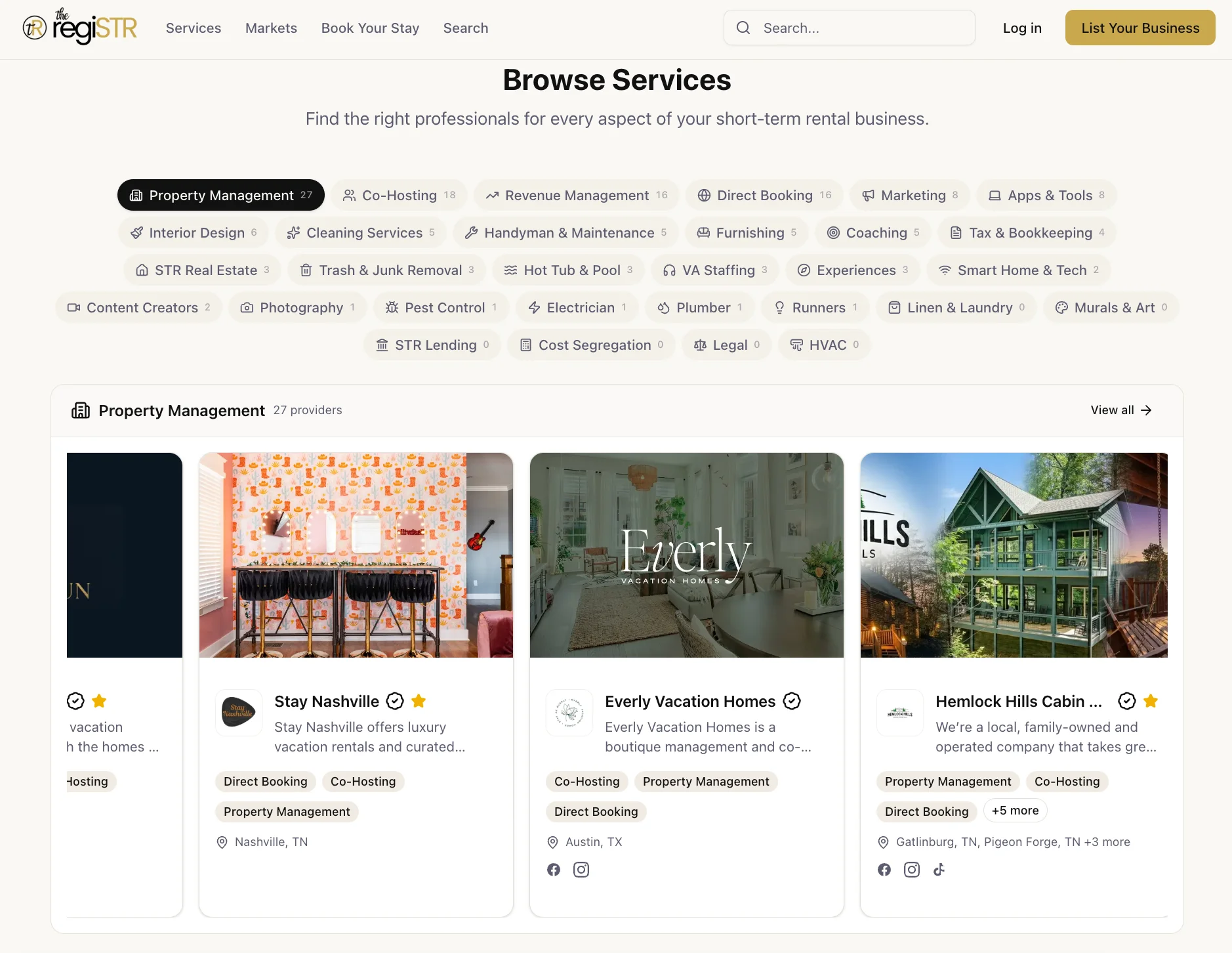
Browse vetted STR cleaners, photographers, and property managers by market so the details guests write about, spotless turnovers, accurate photos, fast responses, are already handled before the next booking. Get started with the regiSTR and sign up free to see the providers already earning five-star mentions in their own markets.
Content powered by inkSTR.co