
Airbnb Co Host Companies: How to Vet and Hire the Right One
Airbnb co host companies are third-party businesses that manage day-to-day guest communication, pricing, and turnover coordination for a short-term rental owner, typically in exchange for a percentage of booking revenue rather than a flat fee. They differ from full-service property managers because the owner still holds the listing and often handles a piece of the operational load, while the co-host takes on the parts that eat the most time: messaging, scheduling cleaners, and reacting to problems in real time.
- Co-hosting sits between self-management and full-service property management, with the owner retaining listing control while the co-host handles messaging, pricing, and vendor coordination.
- Commission structures vary widely by market and service scope, and the biggest content gap we see across the industry is a lack of clear breakdown on what those percentages actually cover.
- Professionally managed listings now represent roughly 42% of active short-term rental listings globally as of early 2026, according to Data Intello's vacation rental management software research, a sign that more owners are choosing structured help over pure DIY hosting.
- Regulatory compliance is now a core co-hosting function, not an afterthought, as cities increasingly require registration IDs, occupancy taxes, and local-law certification tied directly to the listing.
- Airbnb's own Co-Host Network exists, but it only surfaces individuals meeting platform thresholds like host ratings and cancellation rates, not vetted companies with references you can check.
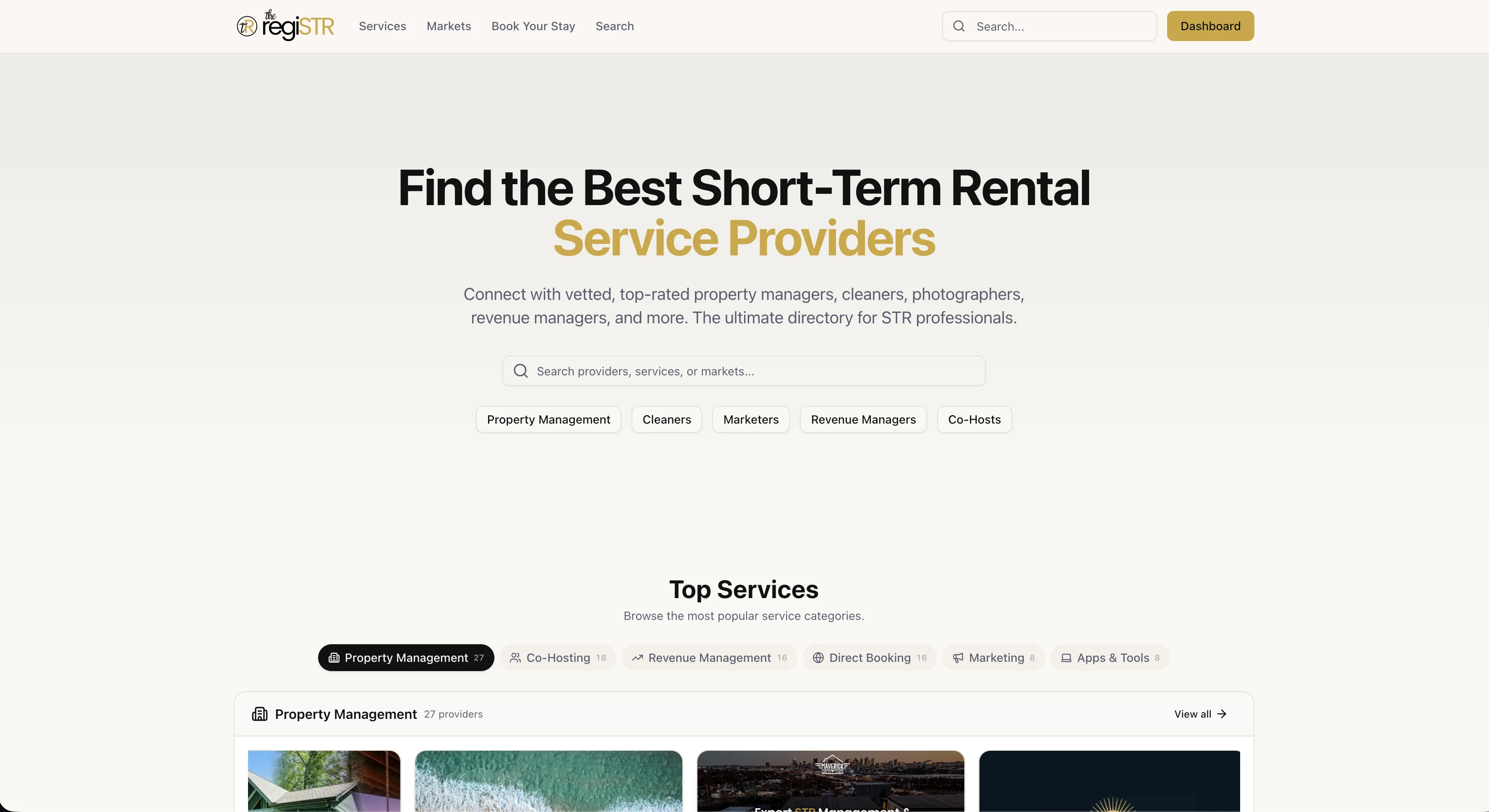
- the regiSTR solves the discovery gap by listing co-hosting and co-management providers who were referred in by other operators, so you can compare options by market instead of gambling on a cold inquiry.
If you're reading this, you're probably somewhere between "I can't keep answering guest messages at 11pm" and "I don't want to give up 25% of my revenue to a full-service manager I've never met." That's exactly the gap co-hosting fills, and it's exactly why the category has grown messy. Anyone can call themselves a co-host. Not everyone running a co-hosting business actually understands STR operations at the level your property needs.
At the regiSTR, we track co-hosting and co-management providers across every major short-term rental market we cover, and the pattern we consistently see is this: hosts get burned not because co-hosting doesn't work, but because they hired the first company that showed up in a Google search without checking whether that company actually specializes in short-term rentals. This guide breaks down what Airbnb co host companies actually do, what separates a legitimate operator from a reseller, what questions to ask before signing anything, and where the industry's coverage gaps leave hosts exposed. As of 2026, with regulatory scrutiny tightening in cities nationwide, choosing the wrong co-host is a compliance risk as much as an operational one.

What Do Airbnb Co Host Companies Actually Do?
Airbnb co host companies provide operational support services for STR owners, typically covering guest messaging, calendar and pricing management, cleaner scheduling, and issue resolution, while the property remains listed under the owner's account. Specifically, most co-hosts operate through Airbnb's co-host permission system, which grants them access without transferring ownership of the listing itself.
The core service breakdown usually includes: 24/7 or business-hours guest messaging, calendar syncing across Airbnb and Vrbo, coordinating with your existing cleaner or sourcing a new one, handling maintenance requests, and adjusting nightly rates in response to demand shifts. Some co-hosts also manage review responses and guest screening.
Where co-hosting differs most from full-service property management: the owner typically keeps more control over pricing strategy, vendor selection, and financial reporting cadence. A co-host is a partner in operations, not a replacement for ownership decisions. For example, a co-host might flag that your Nashville listing is underpriced for a CMA weekend, but you decide whether to accept the suggested rate change.
Not every co-host offers the same scope. Some are single-property specialists who work with a handful of local owners. Others run co-hosting as a scaled business model across dozens of listings in one metro. Browsing Find STR Property Managers alongside dedicated co-hosting listings on the regiSTR helps you see where the line between the two service types actually falls in your market.
What Requirements Does Airbnb Set for Its Co-Host Network?
Airbnb's official Co-Host Network is a platform feature that connects hosts with individual co-hosts who meet specific performance thresholds, including a track record of completed stays, a minimum guest rating, and a low cancellation rate. This network is built for finding individuals, not vetting companies.
Typical eligibility markers referenced across the industry include something like 10 or more completed stays, 100-plus hosted nights, a 4.8-star average rating or higher, and a cancellation rate under roughly 3%. These thresholds exist to filter for experienced hosts turned co-hosts, not to guarantee business legitimacy, insurance coverage, or company-level accountability.
Here's the gap: Airbnb's network tells you whether an individual has hosted well. It does not tell you whether a co-hosting company has processes, backup staff, or a defensible track record with owners in your specific market. If your co-host gets sick or takes a vacation, does someone else pick up the messaging thread? Airbnb's network doesn't answer that question.
This is precisely why the regiSTR structures its directory differently. Providers join through referral from existing network members, and the Vouch system lets other operators publicly endorse a co-host by name, not through an anonymous star rating that can be manipulated. If you're comparing an individual you found through Airbnb's network against a company listed on the regiSTR, ask both the same operational questions before deciding.
How Do Co-Hosting Commissions and Pricing Actually Work?
Co-hosting commission structures are typically calculated as a percentage of gross booking revenue, though the exact scope of what that percentage covers varies significantly between providers, and this is one of the least transparent parts of the entire category. Some co-hosts bundle messaging, pricing, and vendor coordination into one flat percentage. Others charge separately for cleaning coordination or maintenance dispatch.
Full-service property management, by comparison, commonly runs in the 20 to 35% range of gross revenue, according to industry software analysts tracking the space in 2026. Co-hosting arrangements often position themselves below that range because the owner retains more of the workload, but "often below" isn't a guarantee, and you should never assume a lower headline percentage means lower total cost.
Before agreeing to a commission structure, ask exactly what's included: Does the percentage cover guest messaging only, or does it also include pricing strategy, cleaner sourcing, and maintenance coordination? Is there a separate fee for onboarding a new listing? Does the commission apply to gross booking value or net revenue after platform fees?
Notably, few published resources break down commission ranges by market tier or listing type, which leaves hosts negotiating blind. Comparing multiple providers side by side, rather than accepting the first quote, is exactly the kind of research the regiSTR's directory structure is built to support. You can browse Browse All STR Services to see how co-hosting positioning varies by provider and market before committing to a contract.
What Should You Ask Before Hiring a Co-Host Company?
Vetting a co-hosting company requires asking operational questions that go beyond price, specifically around response time guarantees, backup coverage, and how the company handles guest issues outside business hours. A co-host who can't answer these clearly is not ready for STR-specific work.
- What's your guaranteed guest message response time? Anything slower than 15 to 30 minutes during active booking windows risks review damage.
- Who covers messaging when your primary contact is unavailable? A one-person co-hosting operation with no backup is a liability during peak season.
- How do you handle same-day cancellations or maintenance emergencies? Ask for a specific example, not a general policy statement.
- What's your process for adjusting pricing around local events? A co-host unfamiliar with your market's demand calendar will underprice you consistently.
- Can you provide references from current owners in a comparable market? A legitimate operator should have two or three you can actually call.
- Do you carry liability insurance, and does it cover guest incidents at the property? This question alone eliminates a surprising share of unqualified operators.
Watch for red flags: vague answers about response times, reluctance to share references, or a commission structure that isn't written down anywhere. This is exactly the vetting criteria the regiSTR applies when listing service providers, which is why every co-hosting profile in our directory reflects a referral from an existing network member rather than a cold application.

What Do the Best Airbnb Co Host Companies Have in Common Across Markets?
The strongest co-hosting companies share a specific set of operational traits regardless of what market they serve: documented response-time guarantees, a named backup contact for after-hours issues, and a demonstrated understanding of local regulatory requirements tied to the listing. These traits separate companies built for STR work from generalists offering co-hosting as a side service.
Local regulatory fluency deserves more attention than it typically gets. Many jurisdictions now require hosts to register short-term rentals and display a unique registration ID on the listing itself, with lodging or transient occupancy taxes commonly ranging from 5% to 15% of the nightly rate. A co-host who doesn't proactively manage this exposes the owner to fines, not just poor reviews.
Multi-unit owners and portfolio investors face a coverage gap most co-hosting content ignores entirely: nearly all published guidance assumes a single-property owner, not someone managing five or ten units across different cities. If you're scaling, ask any prospective co-host directly whether they've handled multi-property coordination, staggered turnover schedules, and consolidated financial reporting across a portfolio. Many companies built for solo hosts simply haven't built the systems for that.
In our experience working with operators across markets from the Smoky Mountains to the Gulf Coast, the co-hosts who perform best treat regulatory compliance, backup staffing, and multi-property reporting as core service features, not optional add-ons. That's the standard we look for when a provider joins the regiSTR network.
Data Snapshot: Co-Hosting vs. Full-Service Management vs. Self-Managing
| Factor | Self-Managing | Co-Hosting | Full-Service Management |
|---|---|---|---|
| Owner controls listing and pricing decisions | Full control | Shared, owner retains final say | Largely delegated to manager |
| Typical cost structure | No fee, owner's time only | Percentage of revenue, scope varies | Commonly 20 to 35% of gross revenue |
| Guest messaging coverage | Owner handles all | Co-host handles, business hours or 24/7 depending on plan | Full coverage included |
| Regulatory and tax compliance support | Owner's responsibility | Varies by provider, ask directly | Typically included |
| Best fit for | Highly hands-on single-property owners | Owners who want relief from daily tasks but keep strategic control | Remote or scaling owners who want hands-off operations |
This comparison matters because the line between co-hosting and full-service management has blurred as the market matures. According to Grand View Research's vacation rental market analysis, the global vacation rental market is projected to reach roughly USD 106.5 billion in 2026, and a growing share of that revenue is flowing through professionally managed or co-hosted listings rather than pure self-management. The regiSTR's directory reflects that shift by listing both categories separately, with clear service scope on each provider profile, so you're not guessing which model you're actually buying.
How Do Co-Hosts Handle Regulation and Local Compliance?
Regulatory and tax compliance handling by co-hosting companies means actively managing registration IDs, occupancy limits, and lodging tax remittance on behalf of the owner, rather than leaving those obligations to the host by default. This is one of the most underreported functions in the entire co-hosting category.
Some jurisdictions cap the number of short-term rental nights allowed per year, often somewhere between 90 and 180 days, while others limit the number of licenses a single host can hold. Baltimore, for example, permits a maximum of two STR licenses per host, according to STR Profit Map data. A co-host managing multiple properties for one owner in a market like that needs to understand license caps before onboarding a new listing, not after.
Airbnb itself requires local-law compliance steps as part of listing activation, including tax registration and, in some cities, safety inspection certification. A co-hosting company that treats this as the owner's problem rather than a service it actively manages is passing risk back to you without lowering its fee to reflect that.
Ask any prospective co-host directly how they track changing local ordinances and whether tax remittance is included in their service scope or billed separately. This is the kind of specificity the regiSTR expects from every provider before they're listed under a Regulatory and Compliance or Co-Hosting category, and it's the single question we recommend hosts never skip.
Practical Guidance: How to Choose the Right Co-Host for Your Property
Choosing the right co-hosting company starts with matching scope of service to your actual pain points, not picking based on the lowest commission percentage. If your biggest problem is guest messaging at odd hours, prioritize response-time guarantees over pricing optimization features you may not need yet.
- Start with your specific pain point. Messaging fatigue, pricing blind spots, and maintenance coordination each call for different co-host strengths.
- Get the commission structure in writing before you sign anything. Verbal quotes change once you're a client.
- Check for a named backup contact, not just a primary point of contact who disappears during vacation weeks.
- Confirm regulatory handling explicitly. Don't assume tax remittance and registration ID display are included.
- Ask for references from owners in a comparable market, not just testimonials pulled from a website.
- Avoid companies unwilling to specify response-time commitments. Vague promises around "quick responses" are a red flag, not a service standard.
Common mistakes we see repeatedly: hosts hiring based on the friendliest sales call rather than operational fit, skipping reference checks entirely, and assuming a lower commission automatically means lower total cost once hidden fees are factored in. Comparing quotes side by side is straightforward on the regiSTR: browse by city and service category, and you'll see scope differences that a single cold-call inquiry would never surface.
Frequently Asked Questions
What is the difference between a co-host and a full-service property manager?
A co-host typically operates under your existing listing with shared control over pricing and vendor decisions, handling guest messaging and day-to-day coordination. A full-service property manager usually takes over listing management entirely, including pricing strategy, vendor relationships, and financial reporting, commonly for a fee in the 20 to 35% range of gross revenue.
How much do Airbnb co host companies typically charge?
Co-hosting commissions are calculated as a percentage of revenue, but the scope covered by that percentage varies significantly by provider. Some bundle messaging, pricing, and vendor coordination into one rate, while others charge separately for cleaning coordination. Always get the exact scope in writing before comparing percentages across companies.
Is Airbnb's Co-Host Network the same as hiring a co-hosting company?
No. Airbnb's Co-Host Network connects hosts with individuals who meet platform thresholds like ratings and completed stays, but it doesn't vet business-level factors like backup staffing, insurance, or regulatory handling. A co-hosting company is a business you vet independently for those operational specifics.
Do co-hosts handle short-term rental tax and registration requirements?
Some do, some don't, and this is exactly why you need to ask directly before signing. Many jurisdictions require registration IDs displayed on the listing and lodging tax remittance ranging from 5 to 15% of the nightly rate. A qualified co-host should manage this proactively rather than leaving it to the owner.
Can co-hosting companies manage multiple properties across different cities?
Some can, but this is an underserved niche in the industry, and many co-hosts are built primarily for single-property owners. If you're scaling a portfolio, ask specifically about multi-property coordination, staggered turnover scheduling, and consolidated financial reporting before assuming any company can handle it.
How do I find a vetted Airbnb co-hosting company in my market?
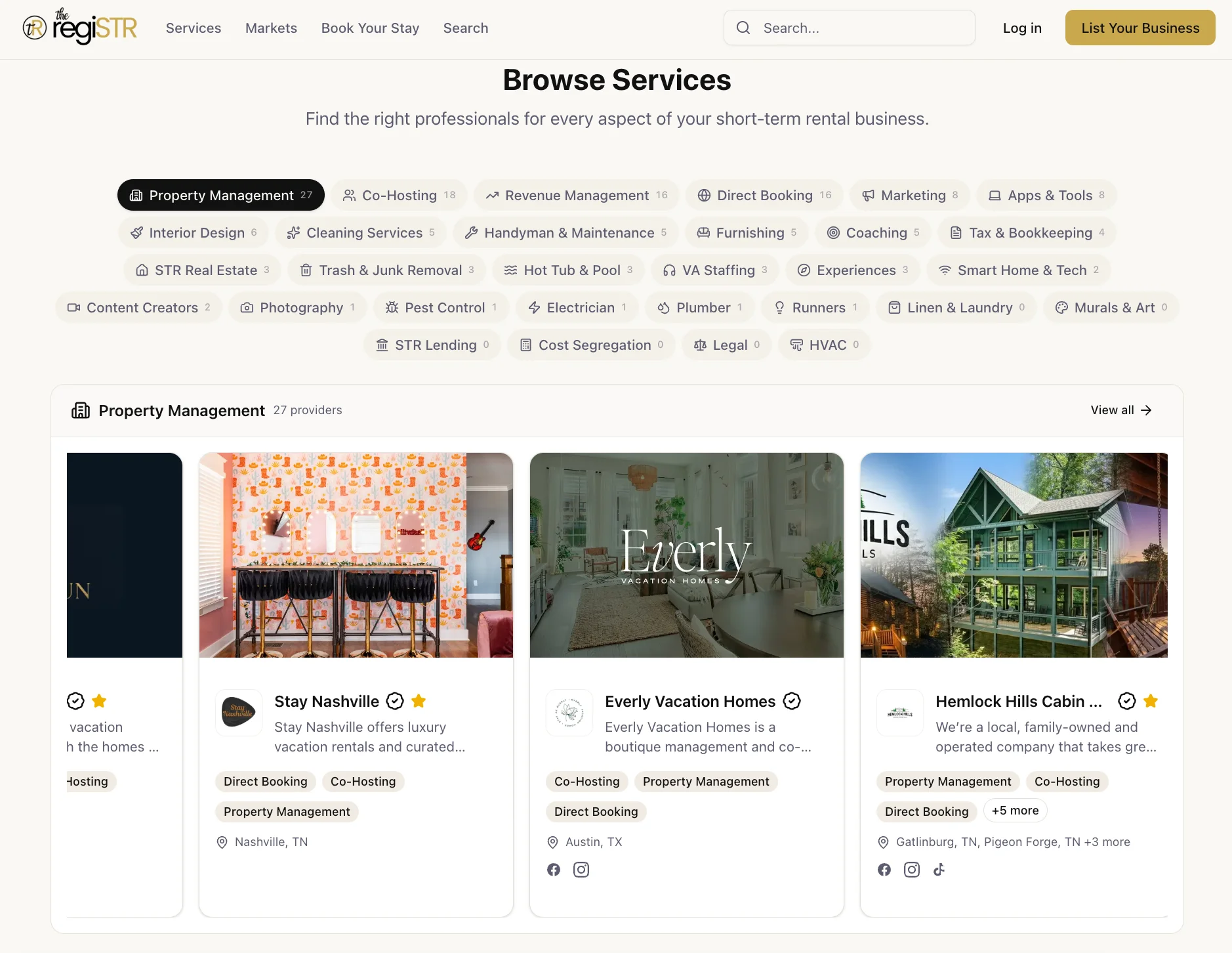
Rather than relying on a cold search or a Facebook group recommendation, browse a directory that filters providers by market and requires referral from existing network members. The regiSTR organizes co-hosting and property management listings by city, with a Vouch system that lets other operators publicly endorse providers they've actually hired.
What questions should I ask before hiring an Airbnb co-host?
Ask about guaranteed response times, who covers messaging when the primary contact is unavailable, how emergencies are handled, whether pricing adjusts for local events, and whether references from comparable-market owners are available. A company that can't answer these directly isn't ready for STR-specific work.
Conclusion: Finding a Co-Host Who Actually Fits Your Operation
Airbnb co host companies solve a real problem: the daily grind of messaging, scheduling, and issue resolution that burns out even experienced hosts. But the category is inconsistent, commission structures are murky, and Airbnb's own Co-Host Network only screens individuals, not businesses. The hosts who succeed with co-hosting are the ones who vet for response times, backup coverage, and regulatory handling before they look at price.
As of 2026, with roughly 42% of active listings globally now under some form of professional management, the shift toward structured co-hosting and management relationships is only accelerating. Vetting is no longer optional. It's the difference between relief and a second job managing your co-host.
Instead of gambling on a cold outreach or a name pulled from a Facebook group, browse co-hosting and property management providers organized by city and referral-vetted by real operators. Get started with the regiSTR and sign up free to compare vetted co-hosts in your market before your next guest message goes unanswered.
Content powered by inkSTR.co